Best CPQ Software for Manufacturing Top Choices
For manufacturers, the right Configure, Price, Quote (CPQ) software isn't just another sales tool—it's a specialized platform built to manage complex product rules, shifting prices, and deep ERP integration. When you're dealing with intricate products, generic quoting just doesn't cut it. That's why solutions like Salesforce CPQ, Oracle CPQ, and modern alternatives like TimberCloud are leading the pack. They turn a slow, mistake-ridden manual process into an efficient engine for revenue.
Why Manufacturers Need Specialized CPQ Solutions
Relying on spreadsheets and institutional knowledge to quote complex products is more than just slow—it’s a direct hit to your bottom line. Sales teams get stuck in a constant battle against bad data, outdated pricing, and configuration mistakes. Each error risks sending out a quote that either scares off a potential customer with an inflated price or eats into your profit margins with an accidental discount. This sluggish, manual process creates a massive bottleneck, dragging out the sales cycle and letting nimbler competitors get ahead.
The global CPQ software market is currently valued at around USD 3 billion and is expected to hit USD 7.3 billion by 2030, growing at a CAGR of 16.2%. The manufacturing sector is a huge part of that growth, with adoption rates almost double those in the services industry. This trend isn't surprising, given the intense need for pricing agility and the ability to configure highly complex products. You can dig deeper into these CPQ market trends and their impact on manufacturing to see where the industry is headed.
Generic sales tools just can't keep up with the sheer complexity of manufacturing. They don't have the sophisticated rule engines required to handle complicated product dependencies, multi-level bills of materials (BOMs), or engineer-to-order (ETO) workflows.
Moving Beyond Generic Quoting Tools
This is where a CPQ built specifically for manufacturing becomes essential. It’s designed to handle all that complexity, creating a single, reliable system that connects your sales, engineering, and production teams. It becomes the single source of truth for every piece of product and pricing information.
So, what really sets a manufacturing CPQ apart?
- Advanced Configuration Rules: It enforces complex product constraints, making sure every configuration is actually valid and buildable. This alone prevents incredibly expensive errors down the line.
- Dynamic Pricing Engine: The system can automatically account for fluctuating material costs, tiered discounts for channel partners, and regional price adjustments.
- Seamless System Integration: It plugs directly into your ERP and CRM systems. This ensures data flows smoothly from the moment a quote is created all the way to the final production order.
A specialized CPQ moves the sales process from a reactive, error-prone chore into a strategic advantage. It gives your sales team the power to create accurate, professional quotes in minutes—not days—which directly accelerates revenue and keeps customers happy.
In the end, choosing the right CPQ software is about more than just speeding up the quoting process. It’s about gaining a real competitive edge in a market where speed, accuracy, and customization are everything. This guide will help you compare your options so you can pick the platform that will help you work smarter and win more business.
What to Look for in a Manufacturing CPQ
Picking the right CPQ software for a manufacturing business isn't like choosing one for a SaaS company. Off-the-shelf platforms just don't get the nuance of multi-level product assemblies, volatile material costs, or that all-important connection between what sales promises and what production can actually deliver. To make the right call, you need to evaluate potential solutions through a specific manufacturing lens.
I always tell people to focus on four foundational pillars. Each one tackles a make-or-break challenge that manufacturers deal with every single day. If you use these criteria as your scorecard, you can quickly cut through the marketing fluff and find a tool that genuinely fits how you operate.
Can It Handle Your Product Complexity?
The real test of any manufacturing CPQ is how it manages complex product rules. You aren't just selling simple SKUs; you’re selling highly specific combinations of components, materials, and custom options. The software’s main job is to enforce all the dependencies between those parts to prevent incredibly expensive mistakes down the line.
A solid configurator guarantees that every quote is for a product that can actually be built. It needs to walk sales reps—and maybe even your distributors—through a logical sequence of choices, stopping them from picking incompatible options. This is absolutely critical when you're dealing with deep bills of materials (BOMs) for things like industrial machinery, where one wrong component can bring an entire production run to a screeching halt.
Here’s what to look for:
- Constraint-Based Rules: The system has to be smart enough to automatically block impossible combinations. Think of it as a digital guardrail that prevents someone from pairing a motor that's way too powerful for the chassis it's going into.
- Guided Selling: Does it ask the user questions to steer them toward the right options? This is key to making sure the final configuration solves the customer's actual problem.
- Visualization Tools: For a lot of manufacturers, especially in woodworking or custom metal fabrication, being able to show the customer a 2D or 3D model of what they’re ordering is a complete game-changer for getting quick approvals.
Does It Have a Truly Dynamic Pricing Engine?
Pricing in manufacturing is never static. It's a living, breathing calculation that shifts with raw material costs, supplier discounts, labor rates, and customer-specific contracts. A basic pricing tool that just applies simple discounts won't cut it.
Your CPQ has to pull in real-time data to make sure every single quote is both competitive and profitable. It needs to handle things like tiered pricing for distributors, apply volume discounts on the fly, and even adjust for a sudden spike in steel or lumber prices. If it can't do that, you're either quoting at a loss or pricing yourself right out of the deal.
The right pricing engine is your margin's best defense. It ensures that even the most complicated quotes—the ones with thousands of parts and layers of pricing rules—are calculated accurately in seconds. It plugs the revenue leaks that always happen with manual, spreadsheet-based quoting.
How Well Does It Integrate with Your ERP and CRM?
A CPQ system that doesn’t talk to your other core systems is practically useless. Its real value comes from plugging seamlessly into your Enterprise Resource Planning (ERP) and Customer Relationship Management (CRM) platforms. This creates a single, unbroken chain of information, from the first sales call to the final work order on the factory floor.
When a customer approves a quote, the CPQ should automatically feed the detailed BOM and production specs straight into your ERP. This completely gets rid of manual data entry, which is where so many devastating errors originate. At the same time, pulling customer details from your CRM ensures every quote has the right contact info, negotiated terms, and purchase history. For any kind of real operational efficiency, this unified data flow is non-negotiable.
Is It Actually Easy to Use?
Let's be honest: even the most powerful software in the world is worthless if your team hates using it. The user experience (UX) is a massively important evaluation point, especially if you need to get sales teams, external partners, and distributors on board. A clunky, confusing interface just means people will go back to their old, inefficient spreadsheets.
You can get a better sense of how a well-designed system should feel by exploring the core TimberCloud platform features, which were built specifically for ease of use. The whole point of a CPQ is to make quoting faster and simpler, not to add another frustrating layer of complexity to everyone's job.
Comparing the Top CPQ Software for Manufacturing
Choosing the right CPQ software for a manufacturing business isn't about ticking off features on a generic checklist. It's about finding a system that can handle the very real, often messy, complexities of your industry. A CPQ that works wonders for a SaaS company could easily buckle under the pressure of a multi-level bill of materials (BOM) or fail to adjust for volatile raw material costs. This comparison gets straight to what matters for manufacturers.
We’re putting four key players under the microscope: the established giants Salesforce CPQ, Oracle CPQ, and SAP CPQ, alongside a modern, industry-focused platform, TimberCloud. My goal here is to cut through the marketing jargon and show you the nuanced differences that will actually impact your operations, from the sales desk to the shop floor.
This infographic breaks down the four pillars every manufacturer should use when evaluating a CPQ solution.
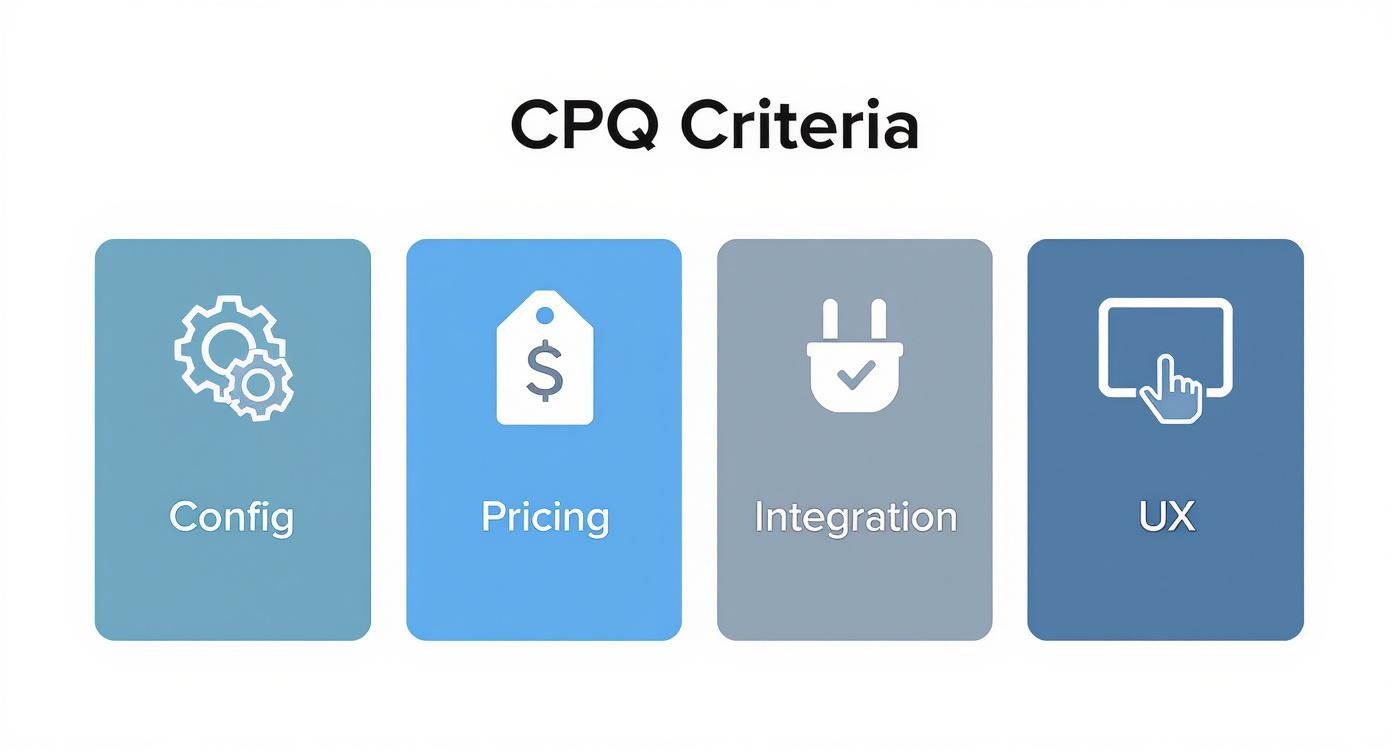
Think of these—Configuration, Pricing, Integration, and User Experience—as the core functions where a CPQ will either become your biggest asset or your most frustrating bottleneck.
Salesforce CPQ: The Ecosystem Powerhouse
Let's be honest, Salesforce CPQ (now officially Sales Cloud CPQ) is often the first stop for any company already living inside the Salesforce ecosystem. Its biggest selling point is its flawless, native integration with Salesforce CRM. This creates a unified world where sales teams never have to leave a familiar interface to manage everything from a new lead to a finalized quote.
For a manufacturer, this means customer history, special pricing tiers, and contract terms are all right there, inside the quoting tool. This context is gold for personalizing quotes and making sure you’re honoring existing agreements. The platform’s rule engine is also powerful enough to handle complex product dependencies and guide reps through tricky configurations.
The trade-off? It can sometimes feel like a sales tool that was adapted for manufacturing, rather than built for it from the ground up. While it can handle BOMs, getting it to manage highly detailed, multi-level engineer-to-order (ETO) products often requires some serious customization or a trip to the AppExchange for add-ons.
Key Differentiator: You just can't beat Salesforce CPQ's deep, native bond with the world's most popular CRM. If your sales process is already built around Salesforce, the seamless data flow and user experience are incredibly compelling.
It’s an excellent fit for manufacturers who want to arm their sales teams with a single source of truth, especially if their product complexity is manageable without heavy custom coding.
Oracle CPQ: The Enterprise-Grade Configurator
Oracle CPQ, which many old-timers still know as BigMachines, has earned its stripes in the manufacturing world. It’s known for one thing above all else: a monstrously powerful and flexible configuration engine. This is the platform you turn to when you’re a global enterprise juggling thousands of SKUs, byzantine product rules, and endless customization options.
Where Oracle really flexes its muscles is in complex, constraint-based logic. It’s right at home in engineer-to-order (ETO) and configure-to-order (CTO) environments where every single quote could result in a one-of-a-kind product. Its engine can chew through thousands of rules in an instant, ensuring every choice a salesperson makes is actually buildable from an engineering standpoint. That alone can prevent a world of pain down the line.
Of course, all that power comes with its own complexity. Implementation isn’t a weekend project, and managing the system requires specialized expertise and a significant investment. It’s built to scale for huge sales teams and partner networks, and its integration story extends beyond Oracle's own suite to other major enterprise platforms.
Key Differentiator: At its core, Oracle CPQ is an industrial-strength configuration machine. It was designed to solve the gnarliest product modeling puzzles, making it the clear choice for manufacturers whose catalogs would overwhelm less robust systems.
This is the solution for large-scale manufacturers with deeply complex product lines and the IT muscle to tame a true enterprise system.
SAP CPQ: The ERP-Integrated Solution
For the thousands of manufacturers whose entire operation runs on SAP ERP, SAP CPQ presents a very logical argument. Much like Salesforce, its greatest strength is the native integration with its home ecosystem. When your business already uses SAP for inventory, production planning, and finance, SAP CPQ creates an end-to-end data pipeline that’s tough to replicate.
This direct line to the ERP means your quotes are built with real-time data on material costs, inventory levels, and even production capacity. Once a quote is approved, it can automatically create a sales order in SAP S/4HANA without anyone lifting a finger. That’s a true quote-to-cash process, and it’s brilliant for cutting down errors and speeding up fulfillment.
On the other hand, it can feel a bit jarring for users who aren't already steeped in the SAP universe. While the user interface is getting better, it has a reputation for being less intuitive than some of its more modern rivals. Customizing it can also be a complex affair, often demanding developers who speak fluent SAP.
Key Differentiator: SAP CPQ's superpower is its seamless, out-of-the-box integration with SAP ERP. It bridges the gap between the sales team and the factory floor, ensuring every quote is grounded in operational reality.
It’s the no-brainer choice for any manufacturer already committed to the SAP ecosystem, especially if quote accuracy depends on live production and financial data.
TimberCloud: The Visual and Agile Contender
TimberCloud represents a different approach—a CPQ built from the ground up for the specific needs of custom manufacturing, like millwork and cabinetry. Its most striking feature is an incredibly intuitive visual product configurator. This is a huge deal for businesses where showing the customer exactly what they're getting is just as critical as pricing it.
Instead of clicking through text menus, users can drag, drop, and modify products in 2D or 3D, while the system updates the rules and price in real-time. This flattens the learning curve for salespeople and even makes it possible for distributors or customers to configure products themselves through a web portal. This self-service model can take a massive load off your internal sales team.
TimberCloud also bakes in functions you’d normally find in an ERP, like inventory and production tracking, creating a more all-in-one platform for small to mid-sized manufacturers. It’s designed to be more nimble and accessible than the enterprise giants. While it might not have the sheer feature depth of an Oracle or SAP, it provides a laser-focused toolset that solves the biggest pain points for custom shops without the enterprise-level price tag and complexity.
Key Differentiator: TimberCloud's magic lies in its visual configurator and all-in-one design. It makes complex product configuration accessible to non-technical users, empowering both sales teams and customers to build accurate quotes with ease.
This makes it an ideal fit for custom manufacturers who value ease of use, visual engagement, and a streamlined system that ties sales directly to operations.
Manufacturing CPQ Feature Comparison
To see how these platforms stack up head-to-head, it helps to compare them across a few key areas that are absolutely critical for any manufacturing operation. The table below breaks down how each one approaches these challenges.
| Feature | Salesforce CPQ | Oracle CPQ | SAP CPQ | TimberCloud |
|---|---|---|---|---|
| Product Configuration | Strong rule-based engine, best for guided selling and moderate complexity. | Industrial-grade, handles extreme complexity, ETO/CTO, and constraint-based logic. | Robust and tied to ERP data, excels with variant configuration. | Highly visual (2D/3D), intuitive for custom products, simplifies complex choices. |
| Pricing Engine | Flexible with volume, contract, and channel pricing. Relies on CRM data. | Handles complex, multi-layered pricing logic and global price books at scale. | Directly pulls real-time costs from SAP ERP for high-accuracy margin calculation. | Real-time pricing updates as visual configuration changes, includes material costs. |
| Core Integration Strength | Native to Salesforce CRM, creating a unified sales and quoting environment. | Strong with Oracle's enterprise suite (NetSuite, Fusion) and other major systems. | Seamless, out-of-the-box integration with SAP ERP (S/4HANA). | All-in-one platform design with built-in ERP-like features for SMBs. |
| User Experience (UX) | Familiar Salesforce interface, high adoption among sales teams. | Powerful but can have a steeper learning curve; requires specialized admin skills. | Can be complex for non-SAP users but is cohesive within the SAP ecosystem. | Exceptionally easy to use, visual-first approach reduces training time. |
| Best-Fit Scenario | Manufacturers prioritizing sales team efficiency within the Salesforce ecosystem. | Large enterprises with highly complex, customizable products and global operations. | Businesses deeply invested in SAP ERP needing a quote-to-cash process. | Custom manufacturers prioritizing ease of use, visual quoting, and self-service. |
Ultimately, the "best" CPQ depends entirely on your specific context. A system that’s perfect for a massive automotive supplier running SAP will be overkill for a custom cabinet shop that needs visual flair and agility. Use this breakdown to focus on the platform that aligns not just with your products, but with your people, processes, and existing tech stack.
Putting CPQ to the Test: Real-World Manufacturing Scenarios
Feature lists are great, but the real test of any software is how it performs on the factory floor and in the sales office. Let's move past the theory and look at how a top-tier CPQ system solves the messy, high-stakes problems manufacturers wrestle with every single day.
These aren't just hypotheticals. They're common situations where the right CPQ turns operational chaos into a serious competitive advantage, showcasing a different core strength in each case—from taming complex product rules to navigating byzantine pricing structures.
Custom Machinery and Intricate Configurations
Picture a manufacturer of bespoke industrial machinery. Their products come with thousands of potential variations—motors, hydraulic systems, control panels, safety features, you name it. The catch? Countless compatibility rules govern what works with what. A specific motor, for instance, might demand a heavy-duty frame and a beefed-up cooling system.
-
The Problem: The sales team, armed with nothing but spreadsheets and hazy institutional knowledge, constantly quotes configurations that are physically impossible to build. This kicks off a painful back-and-forth with engineering, dragging out the quoting process for days, sometimes weeks. In one all-too-common example, a salesperson quoted a machine with an incompatible motor. The error wasn't caught until after the parts were ordered, costing the company a cool $15,000 in restocking fees and wasted labor.
-
The CPQ Solution: They bring in a powerful CPQ with a constraint-based rule engine. Now, the system walks the salesperson through a logical sequence of choices. When they select that high-powered motor, the software instantly grays out incompatible frames and automatically adds the mandatory cooling system. It simply won't allow an invalid combination to be quoted.
-
The Business Outcome: The time it takes to generate a complex quote plummets from three days to less than 15 minutes. Costly configuration errors are completely stamped out, saving a small fortune and, just as importantly, rebuilding trust between the sales and engineering teams.
Building Materials and Labyrinthine Distributor Pricing
Now, let's shift gears to a large supplier of building materials selling through a sprawling, multi-tiered distributor network. Every distributor has a unique pricing agreement based on sales volume, region, and their partnership level—Gold, Silver, or Bronze. Trying to manage this by hand is a recipe for disaster.
The Problem: Sales ops are burning hours manually crunching discounts for every single quote, cross-referencing massive, static price books on spreadsheets. It's not just slow; it's riddled with errors. A single misplaced decimal on a large lumber order could easily erase the entire profit margin on the deal. Worse, there’s no consistency. Two distributors in the same tier often end up with different prices for the exact same products.
This lack of pricing governance is toxic. It creates channel conflict and systematically erodes the trust of your distributors. When partners suspect they aren't getting a fair shake, their motivation to push your products over a competitor’s evaporates.
A robust CPQ system cuts right through this pricing chaos. It becomes the single source of truth for all pricing logic, making sure every quote follows the rules. When a sales rep selects a distributor, the CPQ automatically pulls in the correct pricing tier, volume discounts, and any special promos tied to that partner's account.
This shift to automation makes pricing both accurate and consistent across the entire channel. The administrative load on the sales team shrinks dramatically, and pricing discrepancies vanish. Distributors can finally trust that the quotes they get are correct, every single time, which goes a long way in strengthening those crucial channel relationships. If you're looking to dive deeper into operational wins like this, you can find more insights on the TimberCloud blog.
High-Tech Electronics and Constant Component Churn
Finally, consider a manufacturer in the high-tech electronics space, where the pace of change is relentless. A go-to processor is suddenly replaced by a newer model, or a key supplier discontinues a memory chip, forcing an immediate pivot to an alternative.
-
The Problem: Keeping product catalogs and price lists current across the entire sales organization is a constant battle. Sales reps frequently quote products with obsolete components, leading to fulfillment nightmares and angry customers when they find out the item they ordered is no longer available as specced. Production lines grind to a halt to sort out orders containing outdated parts.
-
The CPQ Solution: The manufacturer integrates its CPQ directly with its Product Lifecycle Management (PLM) and ERP systems. This creates a live connection. When an engineer updates a component in the PLM system, that change is pushed to the CPQ's product catalog in real-time. If a part is marked as obsolete, the system automatically blocks it from being selected in any new quotes.
-
The Business Outcome: The entire quote-to-production workflow is now perfectly in sync. Sales reps are always working from the most current product data, guaranteeing that every quote is buildable with parts that are actually in stock. This newfound agility allows the company to absorb supply chain shocks without disrupting the sales cycle or breaking promises to customers.
How to Choose the Right CPQ for Your Business
Picking the best CPQ software for your manufacturing operation is about more than just a feature checklist. It's a serious business decision that needs to align with how you actually work, where you want to go, and the tech you already have in place. The right choice will feel like a natural extension of your team; the wrong one will just create new headaches.
To get to the right answer, you have to look past the sales pitch and weigh the real-world factors: implementation time, the quality of vendor support, scalability, and the total cost of ownership (TCO). A platform can look amazing in a demo, but if it takes a year to get running or the support is terrible, your ROI is dead on arrival.
It’s surprising, but adoption is still a major hurdle. Despite the obvious upside, only 22% of U.S. manufacturers are using CPQ software. Even more telling, a massive 86% admit they lose deals because their quoting process is too slow and manual. That's a huge opportunity for any company that gets it right. You can find more data on how manufacturers are leveraging CPQ on Aleran.com.
Matching Your Needs to the Right Solution
Your final choice has to be based on your specific situation. There's no single "best" CPQ—only the one that fits your manufacturing environment and priorities like a glove. The best way to start is by asking some honest questions about what you truly need.
Here are a few scenarios to get you thinking:
-
If your business lives and breathes Salesforce... then Salesforce CPQ is a no-brainer. The native integration makes everything feel seamless. Your sales team gets one place to manage everything from customer data to quotes, which cuts down on training and keeps your data clean.
-
If your product catalog is wildly complex... I'm talking thousands of parts, intricate rules, and engineer-to-order specs. In that case, the heavy-duty configuration engine in Oracle CPQ was built for that kind of scale. It’s a workhorse for large enterprises where getting the configuration perfect is non-negotiable.
-
If your entire operation runs on SAP ERP... the case for SAP CPQ becomes incredibly compelling. Its direct integration means quotes are always tied to real-time production costs and inventory levels. It connects the dots from the first quote to the final cash payment.
Prioritizing User Experience and Visuals
For a lot of custom manufacturers, the biggest challenge isn't just managing complex rules. It's about giving a non-technical sales team—or even the customers themselves—a simple, visual way to build a quote. This is where newer, specialized platforms really shine compared to the enterprise giants.
If your main goal is to let distributors or customers configure products on their own using a visual interface, a solution like TimberCloud might be a much better fit. Its focus on 2D/3D visualization and an all-in-one design makes quoting feel intuitive for everyone, taking the pressure off your internal engineering and sales teams.
At the end of the day, the total cost of ownership is a huge piece of the puzzle. It isn't just the subscription fee; you have to account for implementation, customization, and ongoing maintenance. For a transparent look at what a modern platform costs, you can explore TimberCloud's pricing structure. The goal is to find a partner that solves your technical problems and also fits your financial and operational plans for the long haul.
Frequently Asked Questions
When you're digging into CPQ software, a lot of practical questions pop up. Here are some straightforward answers to the questions we hear most often from manufacturers.
How Long Does It Take to Get a CPQ System Running?
The timeline for a CPQ implementation really depends on the complexity of your business. If you have a fairly simple product line, you could be looking at a 3 to 6-month rollout. But for a large-scale project involving complicated product rules, tiered pricing, and multiple integrations, it’s not uncommon for it to take over a year.
The biggest factors are the state of your current product data and how many custom rules you need to build. A smart way to tackle this is with a phased rollout. You can go live with one product family first, see a quick win, and then expand from there.
Will a CPQ Connect with Our ERP and CAD Software?
Absolutely. Solid integration is a non-negotiable feature for the best CPQ software for manufacturing. The leading platforms are designed to talk to the other critical systems you rely on every day.
- ERP & CRM: Most top-tier CPQs have pre-built connectors or powerful APIs for major systems like SAP, Oracle, and popular CRMs. This is the key to creating a single, reliable flow of information from the initial sales quote all the way to the production order.
- CAD Systems: For manufacturers doing any kind of engineer-to-order work, CAD integration is a massive advantage. It lets your sales team generate technical drawings or even 3D models right from the quote, which frees up a ton of your engineering team's time.
A word of advice: always double-check the specific integration capabilities and any extra costs before you sign on with a CPQ vendor. The real magic happens when your sales and production systems are perfectly in sync.
What’s the Real ROI for a Manufacturing CPQ?
While every company's numbers will be a little different, the financial impact is almost always significant and positive. Manufacturers who adopt a CPQ built for their industry consistently see impressive results.
We're talking about a 10-20% shorter sales cycle on average and a 5-10% increase in overall revenue. That boost comes from getting quotes out the door faster—which helps you win more deals—and using guided selling to surface smart upsell and cross-sell options.
But the most stunning improvement is often the near-total elimination of quoting errors, with many companies reporting a reduction of 95% or more. This stops you from losing money on bad pricing and prevents expensive production headaches from incorrect configurations. The right platform quickly pays for itself by plugging those hidden leaks and speeding up your entire quote-to-cash cycle.
Ready to transform your quoting process with a visually intuitive, all-in-one platform built for custom manufacturing? See how TimberCloud can eliminate errors, accelerate sales, and connect your shop floor to your storefront. Explore TimberCloud's features and request a demo today!
Topics
TimberCloud Team
Content Team
The TimberCloud team is dedicated to helping manufacturers streamline their operations with intelligent software solutions.