Build: a product configurator for custom wood shops
A product configurator lets your customer build custom products themselves and watch the price update as they go. For the shops that live on custom work.
Ready to scale beyond solo work?
TimberCloud Build gives you the operations backbone for a growing shop. Manage your team, track materials, ship orders efficiently, and see where your business stands with real reporting.
This is the tier for shops moving from one-person operations to structured businesses. You get shipping management that handles everything from small packages to LTL freight. Purchase orders that track materials from order to delivery. Reports that show job profitability and cash flow.
Seven team members can access the system with role-based permissions. Your project manager sees different data than your shop floor lead.
What is a product configurator?
It's the part of your site where a customer builds the exact thing they want and gets a real price for it — not a "starting at," not a "contact us," but the price for the product they just spec'd.
For a stocked-goods store, a configurator swaps a color or a size. For a custom shop, it has to do more: hold every option you actually offer, price each combination correctly, and hand you an order you can build from without re-drawing it. That's what an online product configurator built for custom manufacturing looks like — and it's the front door to the rest of the job.
How does formula pricing work?
You price custom work with rules, not a fixed catalog — per linear foot, per box, a multiplier for the material, an add-on for soft-close hardware, a bump for an oversized panel. You set those rules once. The configurator runs the math live, on every option the customer touches.
So a solid-maple door with a glass insert and a custom width prices itself correctly the moment the customer builds it. No pricing spreadsheet open on the side. No "let me get back to you." The number the customer sees is the number you'd have worked out by hand — without you working it out by hand.
Can customers order without the back-and-forth?
Yes — that's the whole point.
The old loop: the customer emails specs, you build a quote, they change the width, you rebuild the quote, they ask about a finish, you rebuild it again. Days go by on a job you haven't started. With the configurator, the customer builds the spec and places the order themselves. What lands in your queue is already complete, already priced, already buildable.
Porta Door — a custom door manufacturer in Seymour, CT — put its catalog behind a TimberCloud configurator and cut about 15 hours a week of quote rework, with a six-week cutover. That's a person's day-and-a-half, every week, back on the floor instead of in the inbox.
Shipping that scales with your orders
Ship cabinets, millwork, and furniture without the logistics headache. Build tier connects your shop to major carriers and freight services.
Generate shipping labels directly from job orders. Compare carrier rates for each shipment. Track packages and LTL freight from your dashboard.
Freight shipping gets complex fast with custom woodwork. Our LTL support handles the paperwork and scheduling so you focus on building, not shipping coordination.

Operations tools that work how you work
Build sheets turn your designs into clear production instructions. Generate cut lists, hardware schedules, and assembly notes from your project data.
Purchasing connects to your suppliers and tracks material costs against jobs. See which orders are profitable and which ones ate into margins.
Receiving updates inventory levels when materials arrive. No more guessing what lumber you have in stock or when that hardware order ships.
Team management built for shops
Seven user accounts let your whole team access what they need. Set permissions by role - estimators see different data than installers.
Track who worked on what project and for how long. See bottlenecks in your production flow. Know which team members are overloaded and which have capacity.
Role-based access keeps sensitive financial data private while giving everyone the project information they need to do their job.
Visual Configurator included
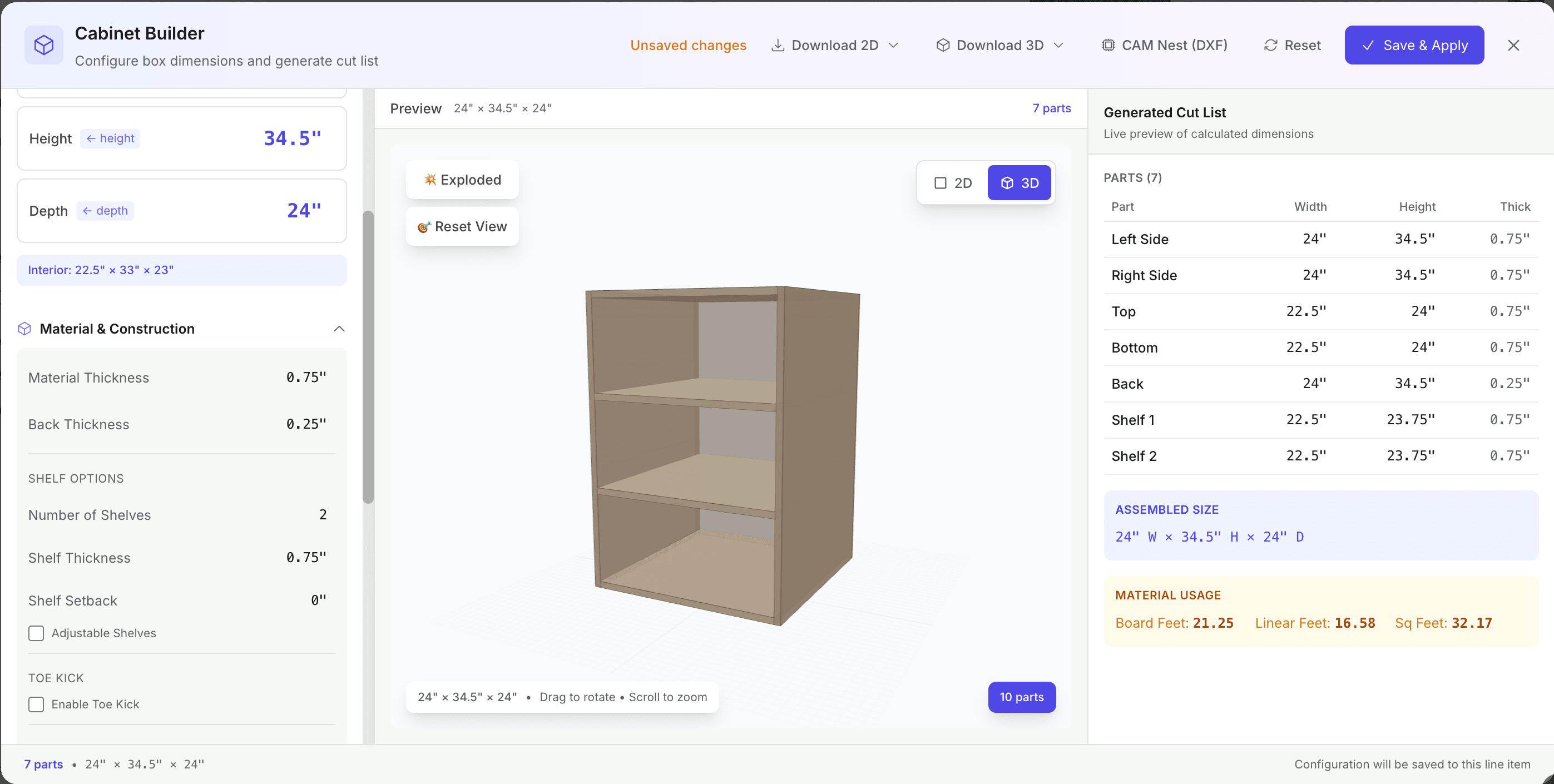
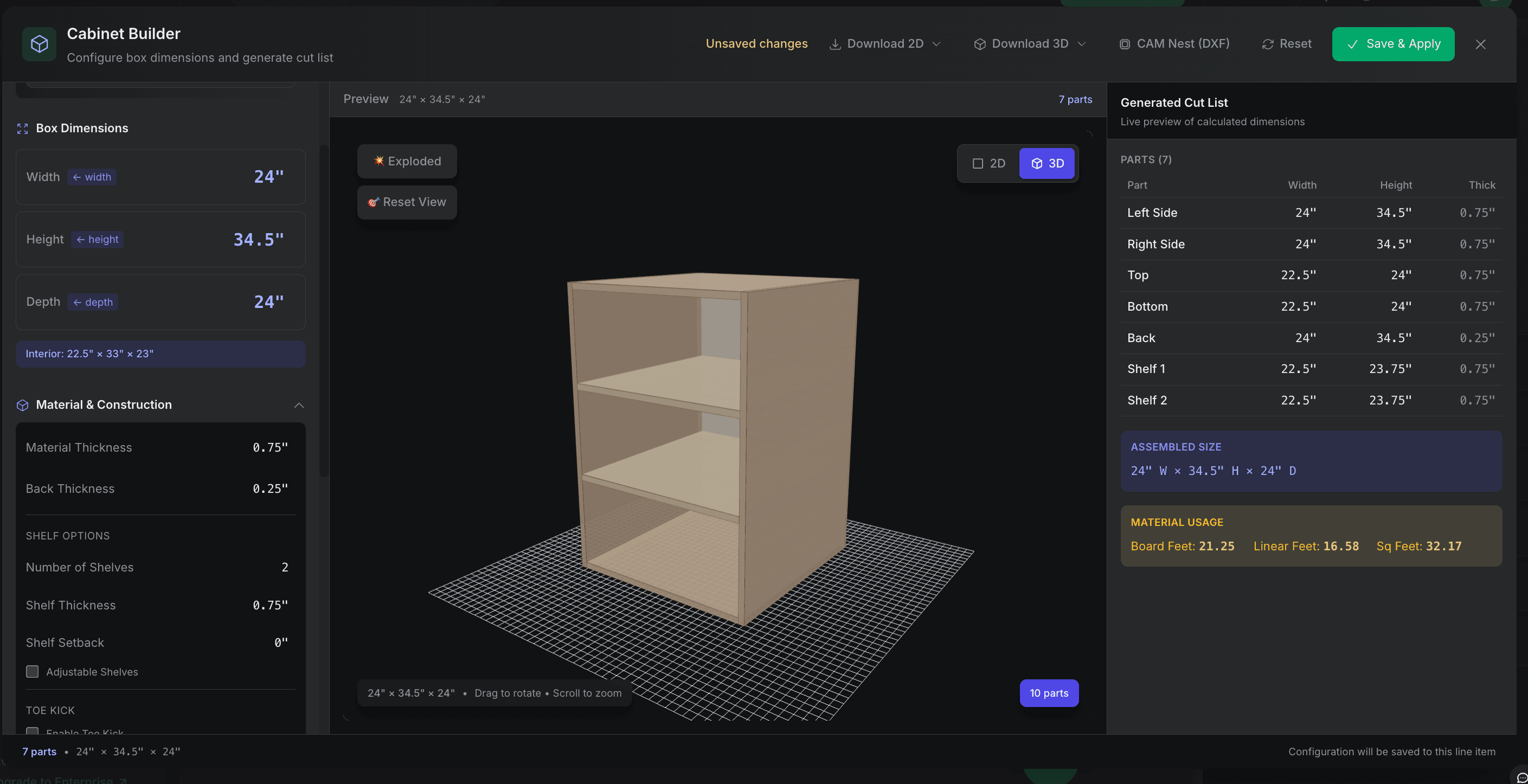
Show customers exactly what they're buying before you build it. The Visual Configurator renders 3D models of cabinets, built-ins, and furniture from your specifications.
Customers can adjust finishes, hardware, and dimensions in real-time. Changes update pricing automatically. Fewer revisions, clearer expectations, faster approvals.
Generate accurate quotes from the visual models. What the customer sees matches what you build.
Does it work for doors, cabinets, millwork, and furniture?
One configuration engine, four product types. You define your options and pricing rules for what you actually build:
- Cabinet shops — box construction, door styles, finishes, hardware, dimensions. See cabinet shops →
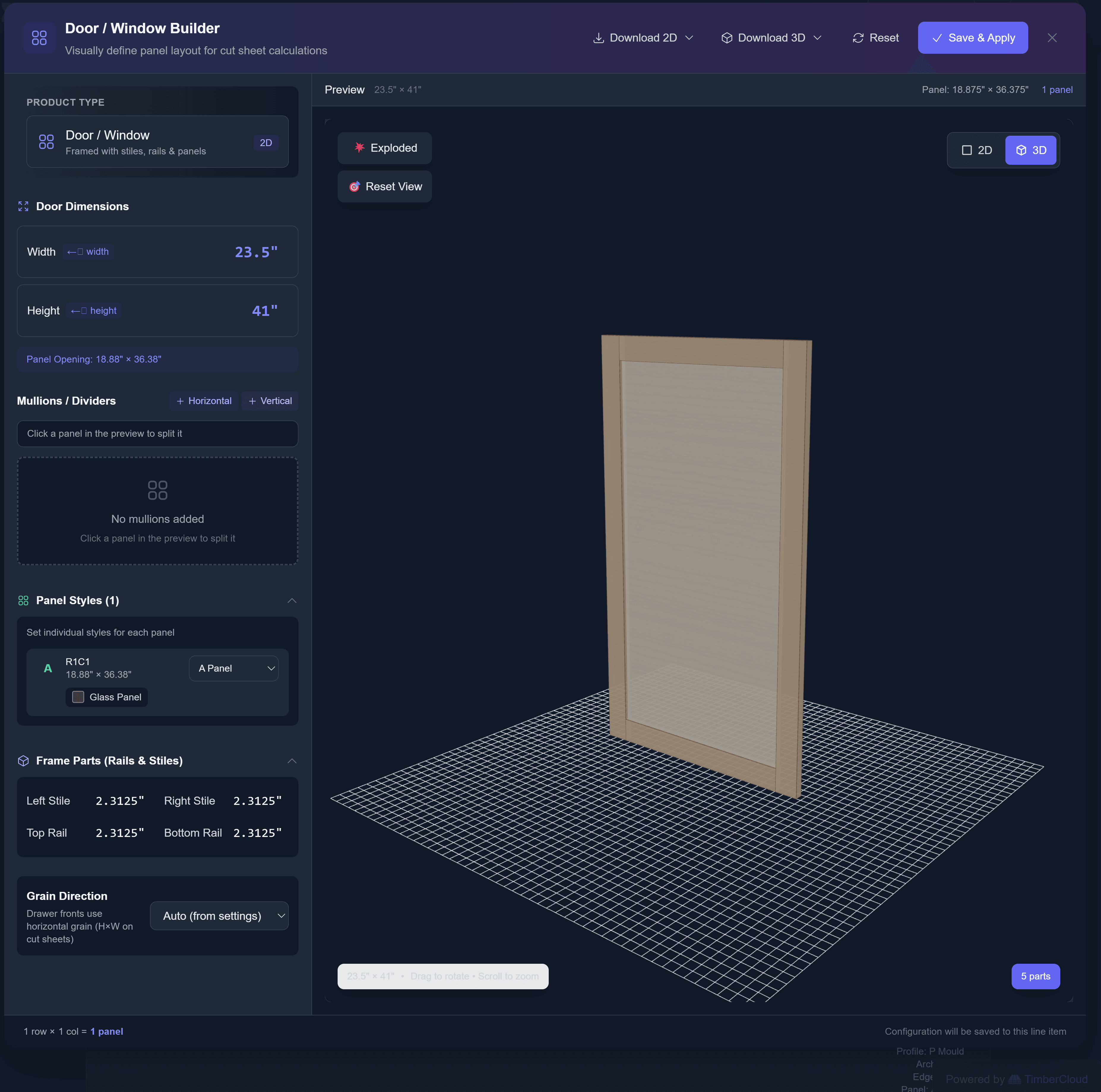
- Door manufacturers — a door configurator that handles species, glass, panel layout, sizing, and jamb details. See door manufacturers →
- Millwork operations — profiles, materials, run lengths, custom specs. See millwork →
- Furniture makers — a custom product builder for dimensions, materials, joinery, and finish. See furniture makers →
Same engine underneath, tuned to how your product is actually spec'd and priced.
What happens after the customer hits order?
The configurator isn't a standalone widget — it's the start of one connected job. The order the customer builds becomes the order you build from:
Configure → Price → Order → Build → Stock → Ship, in one place.
The spec flows into build sheets and cut lists, so the floor gets clear production instructions from the same data the customer entered. Purchasing tracks material against the job, so you can see which orders made money and which ate the margin. Receiving updates what's on hand when it arrives. And shipping pulls labels and freight straight off the order — small parcels through LTL for the big custom pieces — without re-keying an address.
No re-entry between "the customer ordered it" and "the truck left." That's the part a website configurator bolted onto a spreadsheet stack can't do.
How is this different from Shopify plus a spreadsheet?
A generic store configurator is built for stocked products — it changes a variant and charges a set price. Custom shops end up patching around it: Shopify for the storefront, a separate tool for production, a shipping app, and a pricing spreadsheet holding it all together. Every handoff is a place to re-type the order and introduce an error.
TimberCloud puts the custom configurator, the pricing, the order, the build, and the shipment on one record. Build custom, sell it online, and watch it move — without the stack.
FAQ
t's an online tool that lets a customer build a custom product — choosing size, material, hardware, and finish — and see an accurate price for that exact configuration. For custom manufacturers, it also produces a buildable spec that flows into production, so the order the customer places is the order the shop builds.
Yes. TimberCloud uses formula pricing: you set your rules once — per linear foot, per box, material multipliers, hardware add-ons — and the configurator calculates the price live as the customer changes options. Every combination is priced correctly without a manual step.
es. Because the configurator prices each option live, the customer configures and orders in one pass. What reaches your shop is already complete and priced, which removes the email-a-spec, wait-for-a-price loop. Porta Door cut roughly 15 hours a week of that rework after switching.
Cabinets, doors, millwork, and custom furniture. It's one configuration engine you tune to your own options and pricing rules for each product type.
Yes. The spec flows into build sheets, cut lists, purchasing, inventory, and shipping — Configure, Price, Order, Build, Stock, Ship — on one record, with no re-entry between the order and the shipment.