Cloud ERP for Manufacturers A Practical Guide
Think of a modern cloud ERP for manufacturers as the digital command center for your entire operation. It’s the single platform that ties every department together, from the front office to the shop floor, creating one intelligent, unified system.
The Modern Factory Runs on Cloud ERP
In today's market, where deadlines are tight and margins are even tighter, manufacturers simply can't afford to run on disconnected systems. Old-school, on-premise software inevitably creates data silos. The sales team sees one thing, the production floor another, and supply chain managers are working from a completely different set of numbers. This kind of fragmentation is a recipe for disaster, leading to expensive production mistakes, poorly managed inventory, and a crippling inability to react when the market shifts.
A cloud ERP for manufacturers is designed to tear down those walls. It's less like a piece of software and more like the operational backbone of your business, connecting every critical function. It establishes a single source of truth, making sure every decision—whether it’s buying raw materials or scheduling a production run—is based on the most up-to-date, accurate data you have. For any manufacturing business looking to grow, this isn't just a nice-to-have; it's fundamental.
Moving Beyond Data Management
But the real magic of a cloud ERP isn't just about storing data; it’s about putting that data to work to actively improve your processes and fuel growth. Instead of just being a record of what already happened, it helps you get ahead of what’s going to happen. This switch from reactive to proactive is what gives you a serious competitive edge.
For example, a cloud ERP can:
- Automate Workflows: Automatically trigger a purchase order the moment inventory for a critical part dips below a specific threshold.
- Provide Real-Time Visibility: Let a sales rep check the live status of a customer's custom order right from their tablet, without ever having to call the shop floor.
- Sharpen Decision-Making: Use live data from the factory floor to pinpoint a bottleneck, allowing a manager to shift resources on the fly to keep things moving.
By bringing all your data and processes under one roof, a cloud ERP gives manufacturers the agility to navigate supply chain disruptions, meet ever-changing customer demands, and innovate faster than competitors who are still stuck in the past.
At the end of the day, moving to a cloud-based system is more than a technical upgrade—it's a strategic business move. It gives your entire organization the tools to streamline production, cut down on operational headaches, and build a smarter, more resilient factory ready for whatever comes next.
Understanding Cloud ERP in Manufacturing
So, what exactly is a cloud ERP when we're talking about manufacturing? Let's cut through the jargon.
Think of it this way: if your current operation feels like it’s running on scattered spreadsheets and disconnected software, that’s the old on-premise world. Now, imagine bringing everything—from the front office to the shop floor—into a single, secure digital command center. That's a cloud ERP.
This system centralizes all the data that keeps your facility running: bills of materials, production schedules, inventory levels, and quality control reports. Everything is instantly accessible from anywhere you have an internet connection. The "cloud" part simply means you're off the hook for buying and maintaining expensive servers. Instead, you get a powerful system on a subscription basis that can grow right alongside your business. No more IT headaches, just focus on what you do best: making things.
This isn't just a fleeting trend; it’s a seismic shift in how modern manufacturing gets done. The global cloud ERP market was valued at $57.17 billion in 2024 and is expected to rocket to $181.04 billion by 2032. As of 2024, cloud solutions already account for 70.4% of all ERP implementations, showing a clear industry-wide migration away from clunky, outdated systems. If you're curious, you can explore more ERP statistics to get the full picture.
On-Premise ERP vs Cloud ERP for Manufacturers
To truly appreciate the difference, it helps to see a side-by-side comparison. For manufacturers, the choice between sticking with an old on-premise system and moving to the cloud impacts everything from cash flow to daily operations.
Here’s a breakdown of how they stack up in the areas that matter most.
| Feature | On-Premise ERP | Cloud ERP |
|---|---|---|
| Initial Cost | High upfront investment in hardware, licenses, and IT staff. | Low upfront cost with a predictable subscription-based fee (SaaS). |
| Accessibility | Limited to on-site access, making remote work and multi-location management difficult. | Accessible from any device with an internet connection, enabling real-time collaboration. |
| Maintenance | Requires a dedicated internal IT team to manage servers, security, and updates. | The vendor handles all maintenance, security, and automatic software updates. |
| Scalability | Scaling is complex and expensive, requiring new hardware and software licenses. | Easily scalable by adding users or modules as your business grows. |
| Implementation | Long and often disruptive implementation timelines, sometimes lasting over a year. | Faster and more streamlined implementation process, often completed in months. |
As the table shows, the game has changed. While having servers on-site gives you a sense of direct control, that "benefit" often comes handcuffed to massive costs, inflexibility, and a constant maintenance burden. Cloud ERPs free you from that, letting you focus on your business instead of your IT infrastructure.
Core Benefits Visualized
This infographic gives a great high-level view of how a cloud ERP touches every corner of a manufacturing operation—from production and supply chain to finance and sales.
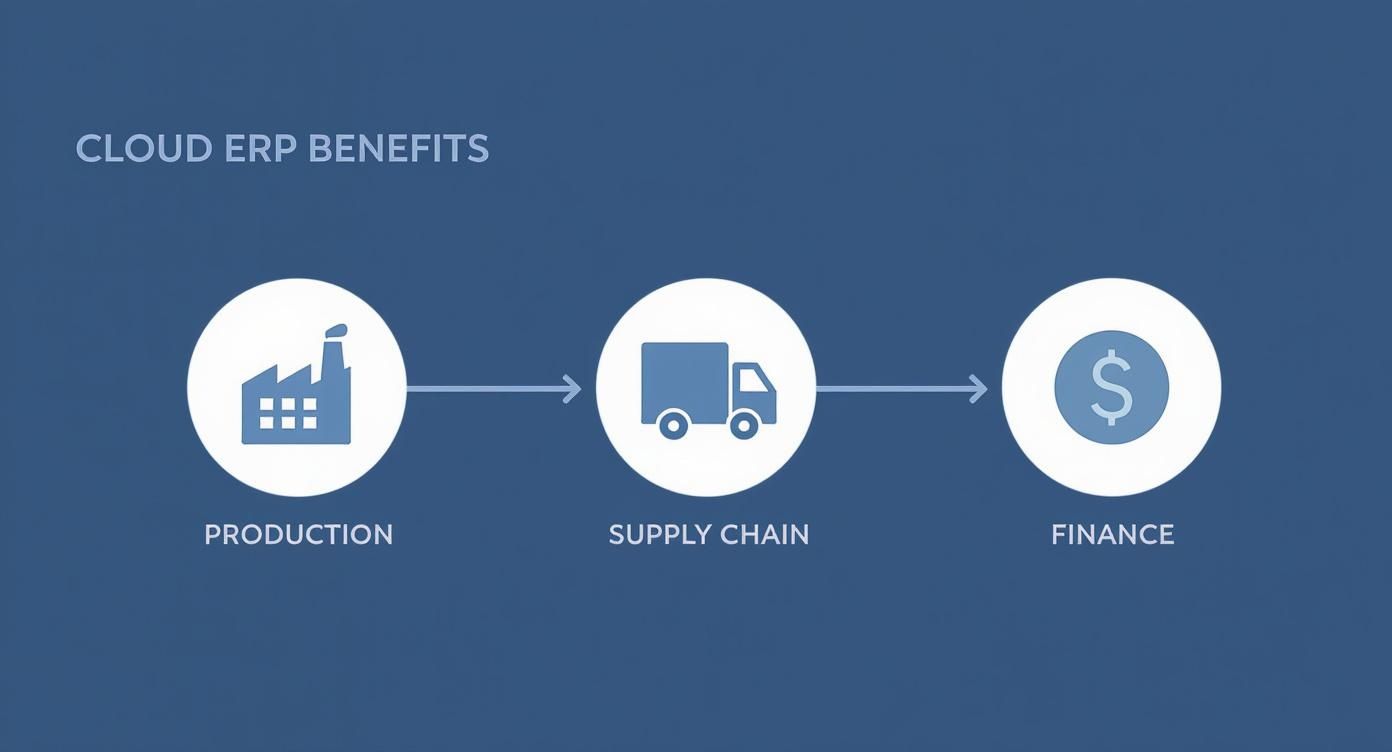
It’s all about creating a connected ecosystem. When you gain better visibility in one department, the positive effects ripple through the entire organization, leading to smarter decisions and a much more efficient operation from top to bottom.
The Must-Have Features in a Cloud ERP for Manufacturers
https://www.youtube.com/embed/9x6yOwR7lSk
When you're shopping for a cloud ERP for manufacturers, it's easy to get lost in endless feature lists. But more isn't always better. The goal is to find a system with the right tools—the ones built from the ground up to solve the real-world problems you face on the shop floor every single day. A generic ERP designed for a retailer or a service business just won’t have what it takes.
A true manufacturing ERP is built around the core pillars of your business. It's not just a digital filing cabinet; it's an active partner that helps you make things better, faster, and more profitably.
Taming the Shop Floor with Production Management
Everything starts on the production floor. This is where your raw materials are transformed, and it's where a powerful cloud ERP really proves its worth. These are the tools that separate a dedicated manufacturing solution from a simple accounting package.
You should be looking for capabilities like:
- Real-Time Shop Floor Control: Imagine a live dashboard for your entire production line. This lets you see job progress, check machine status, and track labor in real-time. It means you can spot a bottleneck the moment it happens, not hours later when the damage is done.
- Dynamic Production Scheduling: Static spreadsheets can't keep up with the chaos of a real manufacturing environment. A dynamic scheduler lets you instantly adjust priorities when a rush order comes in, a machine goes down, or a material shipment is late. It’s all about staying agile.
Together, these features give you a command center for your entire operation, making production more predictable and efficient.
Gaining Control with End-to-End Supply Chain Visibility
Your factory is just one piece of a much larger puzzle. A top-tier cloud ERP for manufacturers connects the dots, giving you a crystal-clear view of your entire supply chain, from the supplier's warehouse to your customer's loading dock.
Without this visibility, you’re flying blind. You risk shutting down the line because of an unexpected stockout, or you end up with cash tied up in way too much inventory that's just collecting dust.
Here are the supply chain features that matter most:
- Granular Inventory Tracking: This is about more than just counting boxes. It means tracking materials by lot, serial number, and exact location in your warehouse. This gives you complete traceability and helps you manage expiration dates for any perishable goods.
- Streamlined Procurement: The system should take the manual work out of buying. It can automatically generate purchase orders when you're running low, help you manage supplier performance, and track every inbound shipment so you know exactly when it will arrive.
Making Smarter Decisions with Financials and Analytics
Finally, a great ERP has to connect what’s happening on the floor directly to your bottom line. This integration is what lets you truly understand your costs and make decisions that actually drive growth. It requires much more than a standard accounting module.
Look for these critical financial tools:
- Integrated Cost Accounting: This feature automatically calculates the true cost of every single product you make. It rolls up all the material, labor, and overhead costs from the shop floor, giving you an accurate, real-time look at your profit margins on every job.
- Predictive Forecasting: The system should use your past sales data and current trends to help you see what’s coming next. This allows you to plan production and order materials proactively instead of constantly reacting to surprises.
These capabilities turn your ERP from a simple system of record into a powerful engine for business intelligence. To see a detailed breakdown of how these functionalities work together, you can explore the complete list of TimberCloud features and see how they support modern woodworking and manufacturing shops.
How AI and IoT Are Creating the Smart Factory
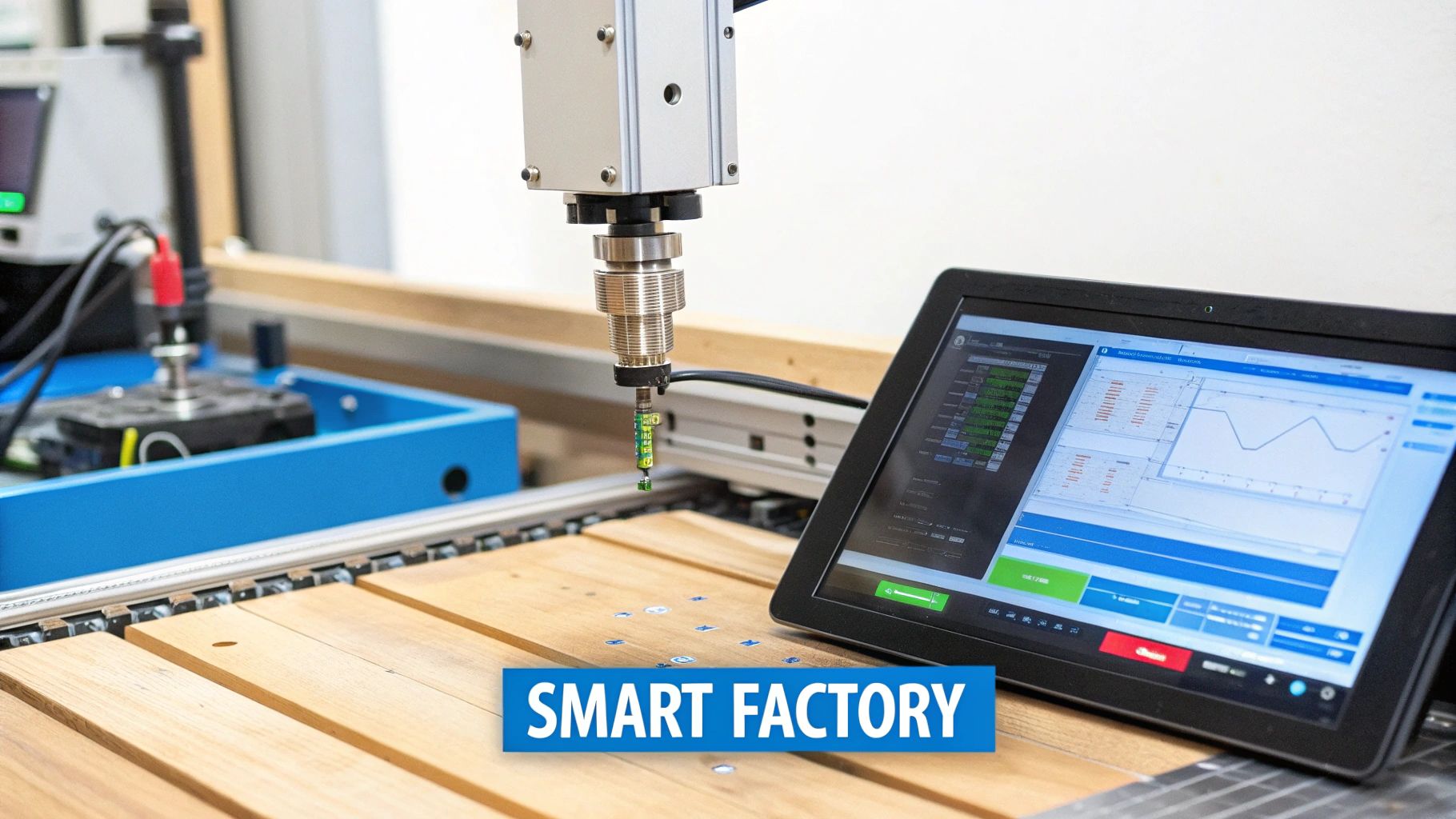
A modern cloud ERP for manufacturers does a lot more than just track orders and inventory. It acts as the central brain for a connected, intelligent operation—what many now call a "smart factory." This isn't just a buzzword; it's a real shift made possible by weaving together two key technologies: Artificial Intelligence (AI) and the Internet of Things (IoT).
Think of IoT as the factory's nervous system. We're talking about small, affordable sensors attached to just about everything: machinery, workstations, even pallets of finished goods. These sensors are constantly collecting real-time data—machine temperature, vibration patterns, output rates, and GPS location—and feeding that information straight into the cloud ERP.
This firehose of data gives you an incredibly detailed, live picture of your entire production environment. Instead of waiting for someone to key in data or relying on end-of-shift reports, you can see exactly what’s happening on the floor, right now.
From Raw Data to Actionable Intelligence
All that data is great, but it's just noise until you can make sense of it. That’s where AI steps in.
AI algorithms built into the cloud ERP sift through the incoming IoT data, hunting for patterns and anomalies. They turn a mountain of raw numbers into clear, actionable insights. It's this partnership between IoT's data collection and AI's analytical power that creates a proactive, self-improving factory.
This isn’t science fiction; it’s rapidly becoming the industry standard. Some platforms now use in-memory databases to run analytics in real-time, while IoT devices provide the live data needed for predictive maintenance. You'll also see edge computing, which processes data right at the source to cut down on lag for time-critical tasks. You can learn more about how these technologies are shaping manufacturing's future and what to expect.
By connecting the physical world of your shop floor to the digital intelligence of the cloud, you move from simply recording what happened to actively predicting and shaping what will happen next.
This opens the door to capabilities that were simply out of reach just a few years ago.
Practical Applications in the Smart Factory
So, what does this actually look like on a typical Tuesday afternoon? Here are a few real-world examples of how a cloud ERP for manufacturers, supercharged with AI and IoT, changes the game:
- Predictive Maintenance: An AI algorithm notices a machine’s vibrations are just slightly off—a subtle tell that it's heading for a breakdown. The ERP automatically creates a maintenance ticket for a technician and intelligently reshuffles the production schedule to work around it. The result? You avoid an expensive, unexpected shutdown.
- Automated Quality Control: Imagine IoT-powered cameras on an assembly line that use AI to spot tiny, microscopic defects in parts as they move past. Any faulty items are instantly flagged and pulled from the line, pushing quality standards way up without slowing anything down.
- Dynamic Resource Allocation: The ERP analyzes live production data and sees a bottleneck starting to form at one workstation. Before it snarls up the whole line, the system might suggest reassigning an idle employee or machine to clear the jam.
These examples highlight a massive shift from putting out fires to preventing them in the first place. For more ideas on fine-tuning your factory workflows, check out the insights on the TimberCloud blog. The smart factory isn’t some far-off concept—it’s the natural outcome of pairing intelligent tech with a robust cloud ERP.
Your Roadmap to a Successful ERP Implementation
Bringing a new cloud ERP for manufacturers into your operations is a huge undertaking. There's no sugarcoating it. But with a clear roadmap, you can break this massive project down into a manageable, and ultimately rewarding, process. A structured plan is what separates a smooth transition from a chaotic one, keeping you on track, on budget, and protecting your day-to-day operations from unnecessary disruptions.
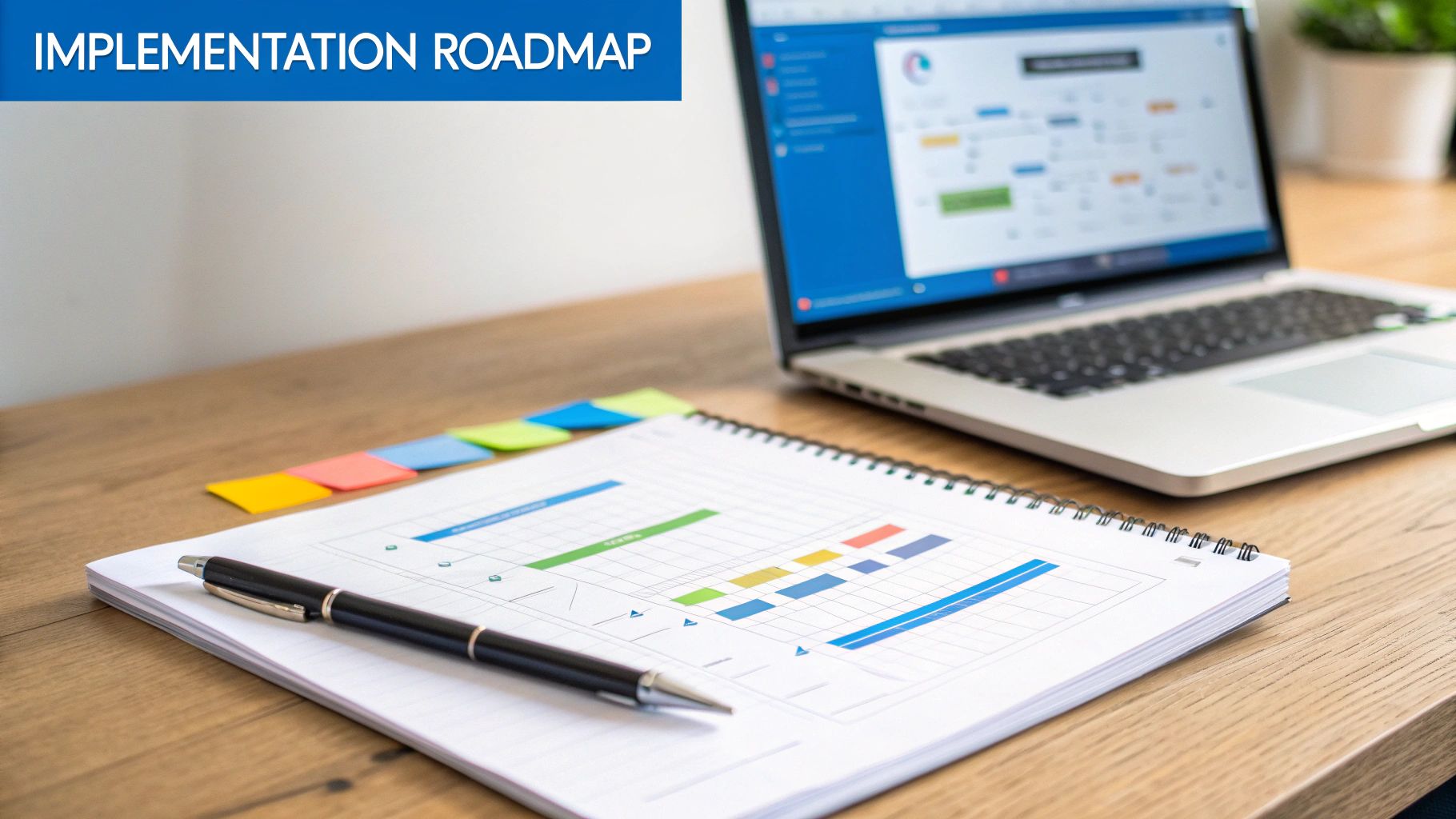
Think of it like building a new facility—you wouldn't just start pouring concrete without a detailed blueprint. This journey to a fully integrated system is best tackled in four distinct phases, with each stage building on the one before it.
Phase 1: Strategic Planning and Vendor Selection
This is where you do the real thinking, and it’s arguably the most important phase of all. Before you even look at a single piece of software, you have to define what success actually looks like for your business. What specific pain points are you trying to fix? Are you looking to slash lead times, get a real-time handle on inventory, or finally understand your true job costs? Get these goals down on paper.
Next, you need to assemble your team. This can't be just an IT project. You absolutely must have key people from the shop floor, finance, sales, and management in the room. Their insights are invaluable for choosing a system that works for everyone, not just the back office. With your requirements in hand, you can finally start vetting vendors and seeing demos. Understanding the numbers is key, and it helps to learn more about how Cloud ERP pricing models are structured before you get too deep into those conversations.
Phase 2: Data Migration and System Configuration
Once you’ve selected your ERP partner, the hands-on work begins. The single most crucial task here is data cleansing. I can't stress this enough: moving messy, outdated, or duplicate data into a brand-new system is a guaranteed recipe for disaster. You have to take the time to audit, clean, and standardize your existing information, from customer records to complex bills of materials.
At the same time, your implementation partner will start configuring the software to mirror your unique workflows. The goal isn't to force your processes to fit the software; it's to mold the software to support the way you already work best. This stage requires constant communication with your project team to make sure the setup is perfectly aligned with the goals you defined back in phase one.
Phase 3: Team Training and Go-Live
A state-of-the-art ERP is nothing more than expensive shelfware if your team doesn't know how to use it. A lack of proper training is one of the top reasons implementations fail. Don't treat it like a box to be checked at the last minute. You need a solid training plan that's customized for different roles—what your machine operators need to know is completely different from what your accounting team needs.
A successful go-live isn't a flip of a switch. It's the result of meticulous planning, rigorous testing, and a well-prepared team ready to embrace a new way of working.
Before you make the official switch, run everything in a "sandbox" or test environment. This is your chance to find and iron out any wrinkles. Many manufacturers also opt for a phased rollout, bringing one department or process online at a time to minimize risk and make the transition smoother for everyone.
Phase 4: Continuous Improvement and Optimization
Getting the system live isn't the finish line; it’s the starting line. Now, the real work begins: optimization. Make it a habit to gather feedback from your users to spot opportunities for improvement or areas where more training might be needed. Use the system's own analytics to keep a close eye on your key performance indicators (KPIs) and see how you’re tracking against the goals you set from the very beginning.
Your business isn't static, and your ERP shouldn't be either. The real power of a modern cloud ERP for manufacturers is its flexibility. As you grow, you can easily add new users, bolt on new modules, and enable new features, ensuring the system remains a strategic asset for years to come.
Common Questions About Manufacturing Cloud ERP
Making a big technology shift always stirs up some important questions. When you're looking at a cloud ERP for your manufacturing business, you need straight answers to feel confident. Let’s tackle the most common questions we hear from people in your shoes.
Is My Manufacturing Data Secure in the Cloud?
This is usually the first question people ask, and it’s a big one. The short answer is yes, absolutely. Top-tier cloud ERP providers pour massive resources into multi-layered security protocols—far more than what most individual manufacturers could ever manage in-house. Security is their business.
Think of it this way:
- Physical Security: Their data centers are like fortresses with tightly controlled access.
- Data Encryption: Your information is scrambled and protected, whether it's being sent across the internet or just sitting on a server.
- Constant Audits: Independent security experts are regularly brought in to test and verify their defenses.
- Threat Monitoring: They have teams watching for suspicious activity 24/7, ready to shut down threats instantly.
Reputable vendors also comply with strict international standards like ISO 27001 and SOC 2. This isn't just a promise; it's a verified commitment to protecting your operational data and intellectual property.
Storing your data with a major cloud provider is like moving your company’s cash from a safe in the back office to a vault at a major national bank. They simply have more expertise and resources dedicated to keeping it secure.
How Does Cloud ERP Handle My Specific Industry Needs?
Modern cloud ERP systems aren’t generic, one-size-fits-all platforms anymore. The best ones are built as flexible foundations that can be tailored with industry-specific modules for different types of manufacturing, whether you're in discrete, process, or job shop environments.
For instance, a cloud ERP for manufacturers in a regulated field like medical devices will have built-in tools for rigorous quality control, deep lot traceability, and compliance reporting for standards like FDA or ISO. This means you can manage those highly specialized workflows right inside the system, instead of relying on clunky spreadsheets or separate, disconnected software.
What Does the Cost Structure Look Like?
Cloud ERPs run on a subscription model, which you'll often hear called Software-as-a-Service (SaaS). This completely flips the script on how you pay for your core business software.
Instead of a massive upfront investment in servers, hardware, and expensive licenses, you pay a predictable monthly or annual fee. This fee is usually based on the number of users and covers everything: the software itself, hosting, maintenance, security, and all future updates. It effectively shifts the cost from a huge, unpredictable capital expense (CapEx) to a manageable, forecastable operating expense (OpEx).
Can It Integrate With the Equipment I Already Have?
Yes, and this is one of the biggest strengths of a modern cloud ERP. These systems are designed with open APIs (Application Programming Interfaces), which essentially act as universal translators. They allow the ERP to talk to all the other systems and equipment on your shop floor.
This connectivity makes some pretty powerful things possible:
- Pulling real-time production data directly from IoT sensors on your machines.
- Syncing with CAD/PLM software to automatically update your bills of materials.
- Connecting to your CRM and shipping platforms for a complete, end-to-end view of every order.
This is how you finally break down the data silos between departments. Information flows freely from one part of the business to another, giving you a single, accurate picture of your entire operation.
Ready to see how a unified platform can transform your manufacturing operations? TimberCloud, Inc. combines e-commerce, ERP, and AI into a single workflow designed for custom manufacturers. Discover how TimberCloud can streamline your business today.
Topics
TimberCloud Team
Content Team
The TimberCloud team is dedicated to helping manufacturers streamline their operations with intelligent software solutions.