Woodworking Business Plan: A Template for Cabinet and Millwork Shops
A woodworking business plan is a short document that explains what your shop makes, who buys it, how you price it, how much you can produce, and how the numbers work. For a custom cabinet, door or millwork shop, the most important sections are pricing and capacity, because those decide whether the shop makes money.
Below is what each section should cover, followed by a template you can copy and fill in.
Do you need a woodworking business plan?
Yes, if you are borrowing money, leasing a building, buying major equipment or bringing on a partner. Banks and landlords will ask for one. If you are not doing any of those, a one-page version is still worth writing, because it makes you put numbers on your pricing and capacity.
What to include in a woodworking business plan
1. Summary
The summary covers the whole plan in a few paragraphs: what you make, who you sell to, how much revenue you expect, and what you need (a loan amount, a building, equipment). Write it last.
2. Products and services
List what you make and what you don't. "Frameless kitchen cabinets and vanities for residential remodelers" is more useful than "custom woodworking." Note whether you install, finish in-house, or sell components (doors, drawer boxes, face frames) to other shops.
3. Customers and market
Name the types of customers who will pay you. For most custom shops that is some mix of homeowners, general contractors, remodelers, designers, builders and other cabinet shops. Estimate how many of them are in your area and how they buy today. Contractors and designers usually bring repeat work; homeowners usually bring higher margins and more hand-holding.
4. Competition
List the shops and big-box lines you compete with and how you are different. Price, lead time, quality, styles offered and how easy you are to order from are the usual points of difference.
5. Pricing
Pricing is the section lenders read most closely, so show your method, not just your prices. Say whether you price by linear foot, by box, by opening or from a full cost build-up, and show a worked example with material, labor, overhead and margin. Our guide on how to price custom cabinets walks through the formula.
6. Operations and capacity
Capacity is how much work your shop can finish in a week. Estimate it in the unit you sell (boxes, doors or linear feet per week) from your staff, equipment and hours. Then check it against your revenue goal: if you need 40 boxes a week to hit your number and the shop can build 25, the plan has a gap.
7. Equipment and facility
List the equipment you have and what you need to buy, with costs. For a cabinet shop that usually means a panel saw or CNC, edgebander, line boring, assembly space and finishing. Include rent, power and dust collection.
8. Marketing and sales
Explain how customers will find you and how you will turn leads into orders: showroom, website, contractor relationships, referrals, trade shows. Include how fast you can get a quote out, because slow quotes lose jobs.
9. Team
List who does what now and who you will need to hire. Include owner roles such as sales, estimating, design and production management, since in small shops one person often covers several.
10. Financials
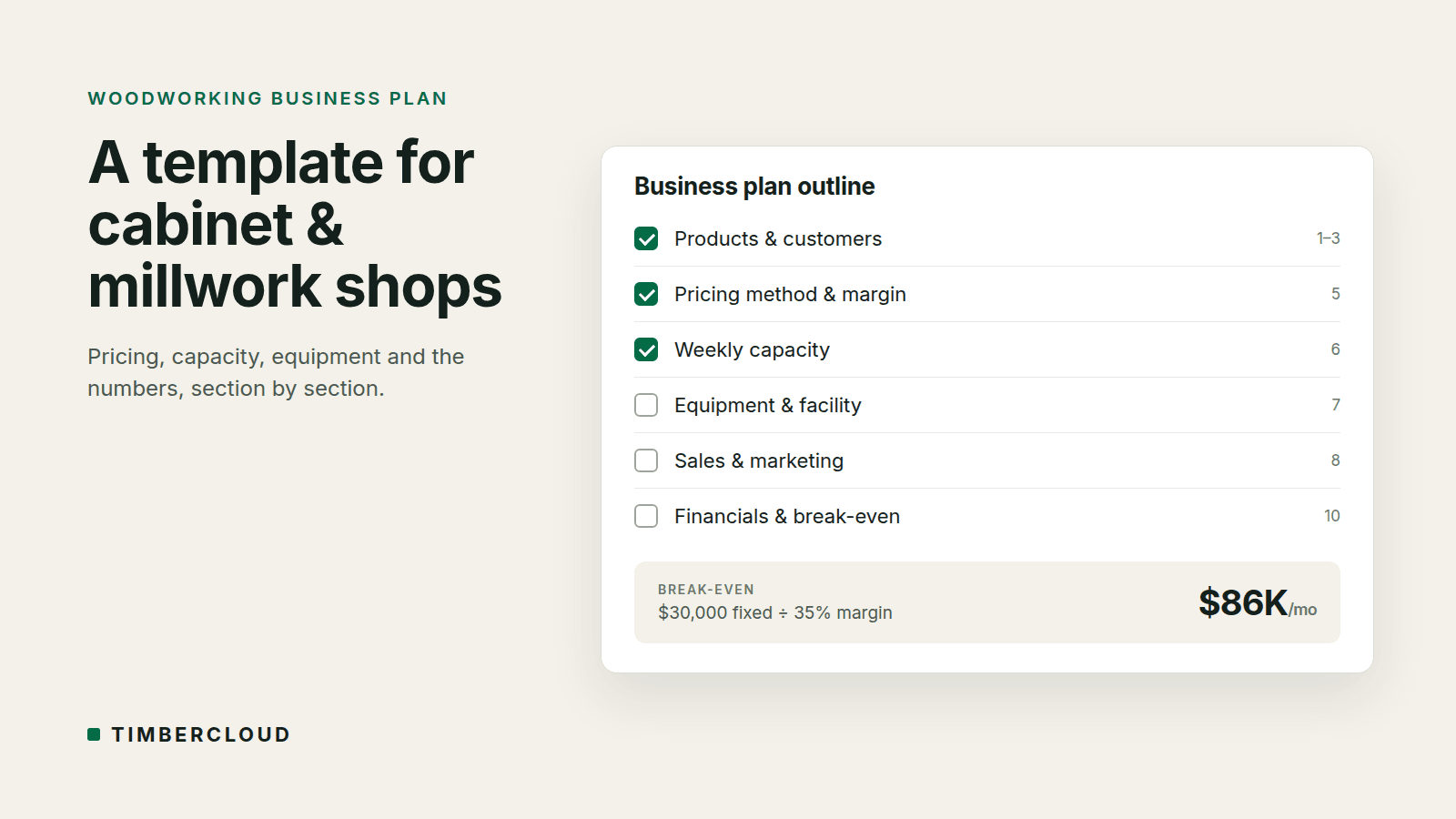
The financial section needs three things: startup or expansion costs, a 12-month revenue and expense forecast, and your break-even point. Break-even is fixed monthly costs divided by your average gross margin percentage. For example, $30,000 of fixed costs at a 35% gross margin means you need about $86,000 in monthly sales to break even.
Woodworking business plan template
Copy this outline into a document and fill in each line. Most shops can finish a first draft in an afternoon.
- Business name, location, legal structure, owner(s)
- Summary: what we make, for whom, year-one revenue goal, what we are asking for
- Products: product lines, what we don't make, installation yes/no, finishing in-house yes/no
- Customers: top 3 customer types, % of revenue from each, how each one buys
- Competitors: top 3–5, their price level, their lead time, how we are different
- Pricing: pricing method, worked example for one standard job, target gross margin %
- Capacity: units per week today, units per week needed to hit goal, how we close the gap
- Equipment: owned, needed, cost, timing
- Facility: size, rent, lease term, utilities
- Sales and marketing: lead sources, quote turnaround target, close rate target
- Team: current roles, planned hires, cost per hire
- Financials: startup costs, 12-month forecast, fixed monthly costs, break-even sales
- Risks: top 3 risks (e.g., one large customer, material prices, key employee) and how we handle each
Keeping the plan current
A plan is only useful if the numbers in it are close to the numbers in your shop. Review pricing, capacity and margins every quarter against what actually happened on real jobs.
TimberCloud tracks quotes, orders and job costs in one place, so the pricing and capacity numbers in your plan come from real jobs instead of estimates. See how it works for custom shops, how it compares, or see pricing.
Frequently asked questions
How long should a woodworking business plan be?
For a bank loan, 10–20 pages with financials is typical. For your own use, one or two pages that cover pricing, capacity and break-even is enough.
Is a woodworking business profitable?
It can be. Custom cabinet and millwork shops that price from real costs and keep the shop full commonly run healthy gross margins. Shops that underprice or quote from guesses often don't. Your pricing and capacity sections show which one your shop is.
What is the biggest mistake in a woodworking business plan?
Setting a revenue goal the shop can't physically produce. Check your revenue goal against your weekly capacity before anything else.
Topics
TimberCloud Team
Content Team
The TimberCloud team is dedicated to helping manufacturers streamline their operations with intelligent software solutions.