A Guide to Process Planning in Manufacturing
Process planning in manufacturing is the work of deciding exactly how a product will be made before production starts: the sequence of operations, the machines and tools for each step, the materials, and the time and cost of every stage.
It happens in six steps — analyze the part specifications, select raw materials, determine the sequence of operations, choose tools and machinery, calculate production times and costs, and compile the final documentation. In a custom woodworking shop, that plan is what turns a one-off order into a repeatable job instead of a scramble on the floor.
Process Planning by the Numbers
- 92% of manufacturers say smart manufacturing — digital planning included — will be the primary driver of competitiveness over the next three years. (Deloitte 2025 Smart Manufacturing Survey, 600 executives)
- Unplanned downtime costs large industrial companies roughly 11% of annual revenue, up from 8% in 2019. (Siemens, The True Cost of Downtime, 2024)
- 83% of industrial decision-makers put the cost of unplanned downtime at $10,000 per hour or more. (ABB / Sapio Research, October 2025)
Planning is what keeps those hours from happening by accident. A documented process plan is also how a shop keeps hard-won know-how from walking out the door when an experienced machinist retires.
The Blueprint for Production Success
Before a single machine hums to life on the factory floor, a detailed plan has to be in place. Process planning is that essential bridge connecting a design concept to a physical product. It's a systematic way for manufacturing engineers to figure out the most logical and efficient path to create a component.
This isn't just some simple to-do list. It's a deeply technical document that governs the entire production lifecycle.
Imagine trying to build a complex piece of furniture without the instructions. You'd probably end up with a wobbly table, a pile of wasted wood, and a whole lot of frustration. A process plan is those instructions, but for industrial-scale manufacturing. It makes sure every operator, machine, and quality check works in perfect harmony.
From Design to Detailed Instruction
At its core, process planning translates an engineer's design—usually a CAD model or technical drawing—into a concrete set of work instructions. This means answering a series of critical questions that become the foundation of the production run.
A well-thought-out plan addresses everything needed for a successful outcome. Key elements decided during this phase include:
- Material Selection: Pinpointing the exact raw materials and their required specs.
- Operational Sequence: Defining the step-by-step order of manufacturing operations, from cutting and drilling to finishing and assembly.
- Machine and Tool Allocation: Assigning the right machinery, tools, and fixtures for each specific task.
- Quality Control Points: Setting up checkpoints to inspect the part and make sure it meets all tolerance and quality requirements.
This visual shows that fundamental flow, from picking materials to sequencing operations and locking in quality.
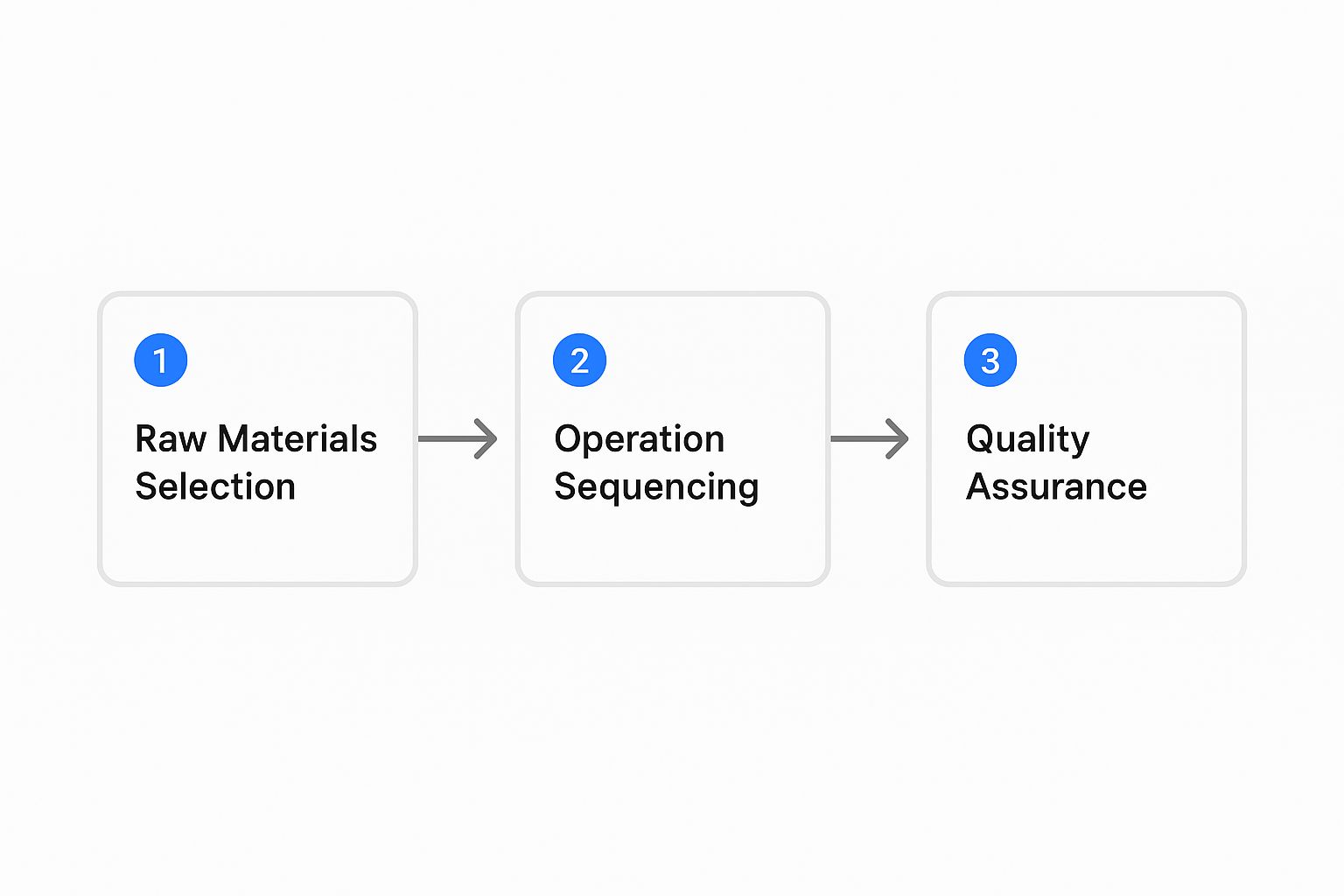
As the diagram shows, process planning is a logical progression. Each step builds directly on the one before it.
Why It Is So Important
Without solid process planning, a manufacturing facility would be pure chaos. Lead times would become a guessing game, costs would spiral, and product quality would be inconsistent at best. By creating a standardized, optimized roadmap, companies can get predictable and profitable results.
A robust process plan is the single source of truth for the shop floor. It eliminates ambiguity, minimizes operator error, and creates a repeatable framework for excellence, turning a complex design into a tangible, high-quality product.
Ultimately, this foundational work is what separates haphazard production from world-class manufacturing. It lays the groundwork for efficiency, consistency, and growth, making it a non-negotiable discipline for any modern manufacturer trying to stay competitive.
The 6 Steps of Process Planning in Manufacturing
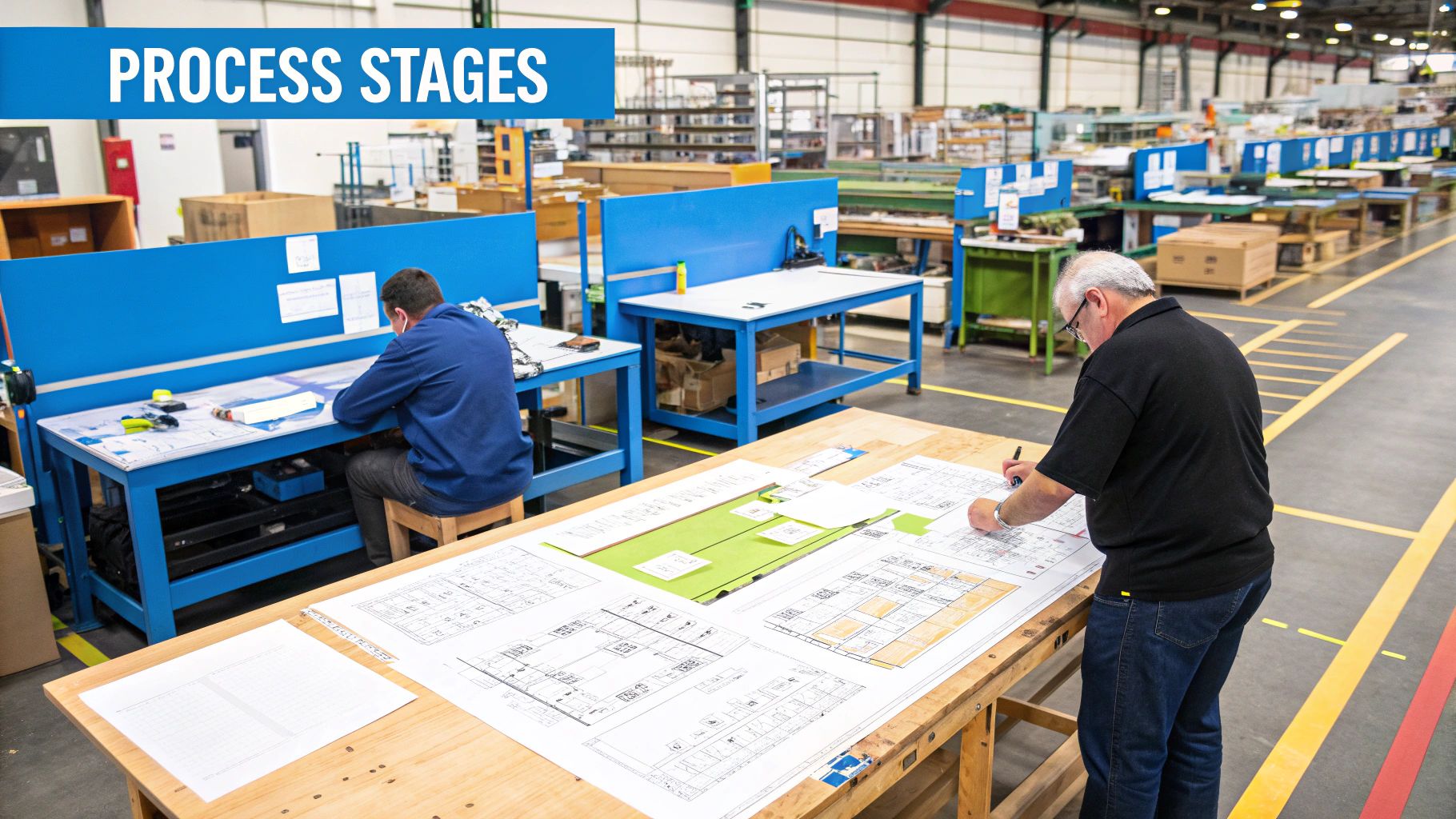
Turning a detailed design into a physical product isn't magic. It's a carefully mapped-out journey. Process planning in manufacturing is that map—a series of connected stages, where each step builds logically on the one before it to create a complete production blueprint.
Think of it like building a house. You can't put up the roof before the walls are framed, and you can't frame the walls until the foundation is poured. Each stage answers a critical question about how the product gets made, leaving nothing to chance. This methodical approach is the secret to turning a great design into a repeatable, high-quality product.
Let's walk through the key stages.
Stage 1: Analyzing Part Specifications
It all starts with the design. This first step is a deep dive into the technical drawings, CAD models, and spec sheets to understand every single detail of the part. This isn't just a quick look; it's a forensic examination of what needs to be made.
During this stage, the team focuses on the non-negotiables:
- Geometric Dimensions and Tolerances: How big is it? What's the shape? What are the acceptable variations? Precision here is everything.
- Surface Finish Requirements: How smooth or rough does the surface need to be? This directly influences the manufacturing methods we'll choose later.
- Material Properties: Does it need to be strong? Hard? Flexible? We need to confirm the physical characteristics of the final part.
Get this part wrong, and you're setting yourself up for costly mistakes and rework down the line. This analysis is the bedrock for all other decisions.
Stage 2: Selecting Raw Materials
Once you know exactly what you’re making, you can figure out what to make it from. Choosing the right raw material is a balancing act that directly impacts the product's performance, cost, and how easy it is to manufacture.
The decision is far more specific than just "steel" or "wood." You have to specify the exact grade, form, and condition. Will you be machining the part from a solid block of aluminum? Casting it from molten metal? Stamping it from a sheet? Each choice demands a completely different set of machines and operations.
Stage 3: Determining the Sequence of Operations
This is where the manufacturing "recipe" really comes to life. Known as routing, this stage is all about defining the exact step-by-step sequence needed to turn raw stock into a finished part. The planner has to think like a strategist, figuring out the most logical and efficient path.
Should you drill the holes before or after milling the face? Does heat treatment come before or after the final polish? The order matters. A poorly planned sequence can waste time, introduce flaws, or even make the part impossible to manufacture correctly.
The goal of routing is to establish a flawless operational flow that minimizes material handling, reduces setup times, and ensures each step prepares the part perfectly for the next. It’s the core choreography of the factory floor.
Stage 4: Choosing Tools and Machinery
With the sequence mapped out, it's time to assign the right tools for the job. Each step in the process needs a specific machine and the correct tooling, connecting the theoretical plan to the real-world capabilities of the factory.
The planner has to consider machine availability, capacity, and precision. A high-tolerance operation might demand a specific CNC machine, while a simple cut could be handled by a more standard saw. Tooling is just as important—from selecting the right drill bits and cutting inserts to designing custom jigs and fixtures that hold the part securely.
Platforms that connect all aspects of production, like the features available on TimberCloud, help shops ensure the right machines, tools, and materials are ready to go when the job hits the floor.
Stage 5: Calculating Production Times and Costs
We’ve figured out the "what" and "how." Now it’s time for the "how long" and "how much." Planners estimate the time needed for every operation, including machine setup, run time, and teardown. These numbers are essential for scheduling, quoting delivery times, and understanding the factory's true capacity.
From there, it's a straight line to calculating production cost. This includes labor, machine time, materials, and overhead. Accurate cost estimates are the foundation of a profitable business—they determine pricing, guide business decisions, and ultimately decide if a job is worth taking on.
Stage 6: Compiling Final Documentation
The last step is to pull everything together into one comprehensive process plan. This document becomes the single source of truth for the shop floor, giving an operator everything they need to produce the part correctly, every single time.
This final package usually includes:
- Detailed work instructions for each step.
- Setup sheets with diagrams and parameters.
- Tool lists and equipment specifications.
- Quality control checkpoints and inspection criteria.
This documentation is what makes manufacturing scalable and repeatable. It ensures that every part is made the same way, no matter who is on shift, turning tribal knowledge into a reliable system for quality production.
To wrap it up, these stages aren't just a checklist; they're an interconnected system for translating an idea into reality. Here's a quick summary of how they fit together:
Key Stages of Process Planning
| Stage | Objective | Key Activities |
|---|---|---|
| 1. Specification Analysis | To fully understand all technical and functional requirements of the part. | Review CAD models, technical drawings, tolerances, and material callouts. |
| 2. Material Selection | To choose the most appropriate and cost-effective raw material. | Evaluate material properties, form (bar, sheet, casting), and supplier options. |
| 3. Operation Sequencing | To define the most logical and efficient order of manufacturing steps. | Create the routing plan, determining the flow from raw material to finished good. |
| 4. Tool & Machine Selection | To assign the correct equipment and tooling for each operation. | Identify specific machines, fixtures, cutting tools, and gauges required. |
| 5. Time & Cost Calculation | To estimate the resources required and determine the production cost. | Calculate setup times, cycle times, labor costs, and material expenses. |
| 6. Documentation | To create a comprehensive guide for the shop floor to ensure consistency. | Compile work instructions, setup sheets, tool lists, and quality plans. |
Each stage lays the groundwork for the next, ensuring that by the time a job hits the factory floor, the path to a perfect part is already clearly defined.
Exploring Different Process Planning Methods

When it comes to creating a blueprint for manufacturing, there's no single "right" way to do it. The methods range from old-school, hands-on expertise to fully intelligent systems that do the heavy lifting for you. Picking the right approach is crucial because each one has its own set of advantages and trade-offs that can seriously impact your production floor.
The most traditional method is, of course, Manual Process Planning. This is where a seasoned manufacturing engineer or planner builds the entire plan from their own experience. Think of it like a master craftsman building a custom piece of furniture without a single written instruction—it's all based on years of honed skill and intuition.
The planner looks at the engineering drawings and, using their deep knowledge of the shop's machines, tools, and materials, maps out the entire production sequence in their head or on paper. This can work beautifully for small batches or highly custom, one-off jobs. But it has some obvious weak spots: it's incredibly time-consuming, doesn't scale well, and the quality of the final plan rests entirely on one person's shoulders. For many shops, this reliance on manual know-how is a key reason they struggle to react quickly to changes.
The Rise of Computer-Aided Process Planning
To get past the bottlenecks of manual planning, most modern manufacturers have embraced Computer-Aided Process Planning (CAPP). As the name suggests, this involves using software to help create, manage, and even automate the creation of process plans. It takes the guesswork out of the equation and replaces it with consistency, speed, and data-backed logic.
This shift is part of a much bigger trend. The move toward smart factories has completely reshaped how we think about production, pushing for more connectivity and automation everywhere. Many facilities are already running sophisticated smart manufacturing systems, making CAPP a logical and necessary next step. You can dive deeper into these manufacturing trends and see how they’re changing the game.
Within the world of CAPP, there are two main flavors, each offering a different degree of automation.
Variant CAPP: The Smart Template Approach
Variant CAPP is often the first step companies take into automated planning. It’s built on a simple but powerful idea called "group technology." The core concept is that many parts, even if they look different, are similar enough to be made using almost the same process.
Let's say you're a custom cabinet shop. You might offer hundreds of different door sizes, but they all share the same fundamental construction. With Variant CAPP, you’d create a single master plan for that core door design. When a new order with unique dimensions comes in, the system pulls up that master plan and just tweaks the parameters—like length, width, and hinge placement—to match the new part.
Variant CAPP works like a sophisticated template. It doesn't invent a new process from scratch. Instead, it finds a proven plan for a similar part and intelligently adapts it, saving a ton of time and ensuring consistency across a whole family of products.
This approach is a lifesaver for businesses that produce a high mix of similar components. It standardizes your best practices and dramatically cuts down the time it takes to get a new part into production.
Generative CAPP: The AI-Powered Innovator
If Variant CAPP is about adapting templates, Generative CAPP is about creating brand-new plans from the ground up, automatically. This is the most advanced form of process planning out there. It acts like an AI expert, using complex logic and manufacturing rules to analyze a part's design and generate the absolute best production sequence.
The system looks at everything—the part's geometry, the material it's made from, required tolerances, and the machines you have available—to build the most efficient and cost-effective plan possible, all without a human stepping in. It’s like giving an AI architect a set of building codes and a client's wish list and having it spit out a complete, optimized blueprint.
This method is perfect for making truly novel parts or for any situation where wringing out every last drop of efficiency is the goal. While it’s more complex to set up, Generative CAPP offers a huge leap forward in the world of process planning in manufacturing.
How AI Is Revolutionizing Process Planning
Think of a traditional process plan as a printed roadmap. It gives you a fixed set of instructions to get from Point A to Point B. But what happens if there’s an unexpected road closure, a traffic jam, or a last-minute detour? That carefully printed map is suddenly useless, and you're left scrambling.
This is exactly what happens on the factory floor. A machine breaks down, a supplier is late, or a rush order lands on your desk. The old, static plan falls apart, causing costly delays and frantic rescheduling.
AI completely flips this script. It transforms process planning from a one-and-done document into a living, breathing system that constantly optimizes itself. It’s the difference between that old paper map and a real-time GPS that reroutes you around problems before you even know they exist.
From Static Plans to Dynamic Intelligence
AI-powered systems don't just look at a snapshot in time; they connect directly to the pulse of your entire operation. They pull in live data from machine sensors, check inventory levels in the warehouse, get updates from the supply chain, and sync with the company's Enterprise Resource Planning (ERP) system. This creates a complete, up-to-the-second view of everything happening on the floor.
Armed with this real-time awareness, AI algorithms can make smart adjustments on the fly. Let's say a critical CNC machine goes down for maintenance. The system doesn't wait for a manager to notice and react. It instantly reroutes jobs to other available machines, re-optimizes the entire schedule to minimize disruption, and notifies the right people.
This creates a self-correcting loop. The system isn't just following orders; it's constantly monitoring reality, learning from it, and adapting to keep production flowing as efficiently as possible, no matter what surprises the day brings.
The Power of Digital Twins and Predictive Analytics
One of the cornerstone technologies making this possible is the digital twin. A digital twin is a virtual, real-time replica of a physical asset, a process, or even the entire factory. It’s essentially a safe sandbox where AI can run experiments without affecting actual production.
Before making a change, the AI can simulate its impact on the digital twin. It can ask questions like, "What happens if we boost this production line's speed by 10%?" or "How will a delay in raw material 'X' affect our delivery schedule next week?" The AI can run thousands of these simulations in seconds to find the absolute best path forward.
This screenshot shows how digital technologies are now a central trend in modern manufacturing, enabling this kind of dynamic planning.
This move towards integrated digital systems allows for proactive, data-driven decisions. It's about spotting and solving problems before they even have a chance to disrupt the workflow.
Real-World AI Applications in Process Planning
The impact of AI isn't some far-off theory; it's delivering real, measurable results today. According to recent industry analysis, the process planning in manufacturing for 2025 is being shaped by AI-driven systems that optimize scheduling by analyzing real-time data on everything from material availability to machine status and demand shifts. This allows manufacturers to pivot instantly, slashing waste and boosting throughput. You can learn more about these manufacturing industry trends on rministreet.com.
Here’s a look at how AI is making a tangible difference:
- Predictive Maintenance: Instead of waiting for a machine to fail, AI algorithms analyze sensor data to predict when it's likely to fail. This allows maintenance to be scheduled proactively, preventing the kind of unplanned downtime that can cripple a production schedule.
- Automated Quality Control: AI-powered vision systems can inspect parts on the assembly line with incredible speed and accuracy. They spot defects in real-time and feed that data back to the system to adjust process parameters and prevent more faulty parts from being made.
- Optimized Resource Allocation: AI can look at the current mix of jobs and determine the most efficient way to use every machine, tool, and person on the floor. This ensures that no resource is left sitting idle while another is overloaded.
This technology isn't just for massive corporations, either. As the platforms become more user-friendly and affordable, smaller custom shops are also starting to adopt these smart planning methods. If you're interested in learning more about how tech is empowering modern woodworkers and manufacturers, you can find some great reads over on the TimberCloud blog.
In the end, AI is shifting process planning away from rigid, fragile instructions and toward intelligent, real-time decision-making that brings a whole new level of agility and efficiency to the factory floor.
The Strategic Benefits of Smart Process Planning

Good process planning in manufacturing is much more than just a set of instructions for the shop floor; it's the engine that drives business growth. When you get it right, a solid plan delivers real, measurable results that hit the bottom line. It’s the difference between a production line running on guesswork and one operating as a fine-tuned, strategic machine.
Think of it this way: you can have a group of talented musicians, but without a conductor and a musical score, you just have noise. A process plan is that score. It brings harmony, precision, and a predictable rhythm to every step, creating a final product that’s far greater than the sum of its parts.
Driving Down Production Costs
One of the first places you'll see the impact of smart process planning is in your production costs. By figuring out the best sequence of operations and matching them with the right tools and machinery, you start to systematically eliminate wasted time, energy, and materials.
This isn't just one big fix; it's a series of small, smart adjustments that add up:
- Reduced Material Waste: Plans that specify exact cuts and material usage mean less scrap heading for the recycling bin.
- Lower Labor Costs: With clear steps, operators can work confidently and efficiently, cutting down on rework and confusion.
- Optimized Machine Usage: A good plan keeps machines running. It slashes idle time and speeds up setups, making sure you get the most out of your expensive equipment.
Each of these gains contributes to a leaner, more profitable operation. It’s really about doing more with less and turning that shop-floor efficiency into a serious financial advantage.
Enhancing Product Quality and Consistency
Nothing erodes customer trust faster than inconsistent quality. Smart process planning is your best defense against it, creating a standardized playbook for every part of the manufacturing journey. When you have a proven, optimized plan, you can expect the same high-quality result every single time, no matter who is running the line.
This consistency comes from building quality checks, precise tool requirements, and clear work instructions directly into the plan itself. You're removing the variables—the ambiguity—that so often lead to defects.
By making excellence repeatable, process planning transforms quality from an unpredictable variable into a reliable business asset. This foundation of trust is crucial for retaining customers and building a strong brand reputation.
Accelerating Lead Times and Delivery
In a world where everyone wants everything yesterday, speed is a huge competitive edge. A well-designed process plan is your key to shrinking the time between a customer's order and their delivery. By creating an efficient workflow and accurately estimating how long each step will take, you can set lead times you can actually meet.
This approach smooths out the entire production flow, preventing the bottlenecks that bring work to a grinding halt. When a customer asks, "When will it be ready?" you can give them a confident answer backed by a data-driven plan. This reliability doesn't just make customers happy; it boosts your factory's overall throughput, freeing you up to take on more orders.
For example, a tactic called SKU rationalization has become a critical part of process planning, especially with all the recent supply chain chaos. Companies are analyzing performance data to cut their low-selling products, which lets them focus production on the items that truly drive growth. You can read more about these kinds of strategic manufacturing industry trends on bdo.com. This kind of focused approach makes sure your resources are always pointed at your most profitable work.
Ready to bridge the gap between planning and production? TimberCloud offers an all-in-one platform that integrates AI-powered planning with real-time shop floor execution, giving you the tools to create efficient, accurate, and adaptable manufacturing processes. Visit https://timbercloud.com to learn how we can help you turn complex designs into profitable products.
Frequently asked questions
Process planning is determining the exact method of manufacturing a product — operations, sequence, machines, tooling, materials, times, and costs — before work begins. It converts a design or customer order into instructions the shop floor can execute.
Six: analyze part specifications, select raw materials, determine the sequence of operations, choose tools and machinery, calculate production times and costs, and compile final documentation. Custom shops repeat this cycle for every new job, which is why software that stores and reuses plans pays off quickly.
Process planning defines how a product is made — the methods, machines, and sequence for a single part. Production planning defines when and in what quantity, scheduling those plans across the whole shop against capacity and deadlines. Process planning writes the recipe; production planning decides how many to bake today and in which oven.
CAPP is software that generates or retrieves process plans from part data instead of a planner building each one by hand. The accessible entry point for a small shop is variant CAPP: group parts into families by how they are made, document a master plan for the most common family, store it in your existing ERP or CAD/CAM system, then adapt that template for each similar job.
Three recur. Managing change, since machine availability, tool wear, material quality, and operator skill all shift and can invalidate a plan overnight. The skills gap, as veteran planners retire and take undocumented judgment with them. And system integration — a plan that cannot talk to inventory, the shop floor, and quality feedback becomes another digital island requiring manual re-entry.
It makes job costs predictable, quotes accurate, and quality repeatable, and it captures know-how that otherwise lives in one person’s head. Shops with documented processes also onboard new hires considerably faster.
Topics
TimberCloud Team
Content Team
The TimberCloud team is dedicated to helping manufacturers streamline their operations with intelligent software solutions.