Automation of Manufacturing Processes: A Practical Guide
When we talk about manufacturing automation, we're talking about using technology to handle production tasks that people used to do. Think of it as creating a smart, connected factory—from robotic arms on the assembly line to AI that predicts when a machine needs a tune-up—all working together to make production more efficient, consistent, and flexible.
The Real Meaning of Manufacturing Automation Today
Picture a massive commercial kitchen. Now, what if that kitchen could not only follow every recipe to perfection but also knew when the lunch rush was coming and prepped ingredients ahead of time? What if it could automatically reorder flour when supplies got low and flag an oven for maintenance before it breaks down mid-shift? That’s what modern manufacturing automation looks like. It's so much more than the simple, repetitive robotic arms that first showed up on factory floors decades ago.
Today, the automation of manufacturing processes is about building a fully connected, intelligent system—the heart of what many call Industry 4.0. This isn't just about swapping out human labor for machines on tedious tasks. It's about creating a production environment that can think for itself, adapt on the fly, and even learn from its own performance. Essentially, modern automation acts like a digital nervous system for the entire factory.
More Than Just Robots
While robots are still a huge part of the picture, the real magic happens when you weave multiple technologies together. It’s like a symphony where every instrument plays its part perfectly to create something incredible. This interconnected system results in a production line that's smarter, faster, and far more resilient.
Some of the key pieces of this modern approach include:
- Data-Driven Decisions: Tiny sensors on equipment constantly gather real-time data on performance, temperature, and output, which allows for instant, precise adjustments.
- Predictive Capabilities: Artificial intelligence analyzes all that data to forecast when a machine might fail, helping prevent expensive, unplanned downtime.
- Elevated Human Roles: Automation takes over the dangerous, dirty, and dull jobs, freeing up human workers to focus on what they do best: complex problem-solving, creative innovation, and overseeing the whole system.
- Incredible Agility: A truly automated factory can switch from making one product to a completely different one with minimal downtime or manual setup.
The goal of modern automation isn't to create a "lights-out" factory with no people. It's about building a factory where people and machines work together, achieving a level of speed, precision, and quality that neither could manage on their own.
This guide will walk you through everything you need to know. We’ll start by breaking down the core technologies that make it all possible, from the Internet of Things (IoT) to AI. Then, we'll get into the real-world benefits, navigate the common challenges you might face, and look at some companies that are getting it right. Finally, we'll give you a practical game plan to start your own automation journey, turning these big ideas into real strategies for your business.
Understanding the Core Technologies Driving Automation
To really get a feel for manufacturing automation, you have to look under the hood at the technologies that make it all happen. These aren't just separate gadgets; they're all part of an interconnected system that creates a smart, responsive production environment. Think of it like building a championship team—every player has a specific, vital role, and they all have to work together.
At its heart, this tech is what turns a traditional plant into a “smart factory.” It’s an entire ecosystem that’s connected, intelligent, and built to last.
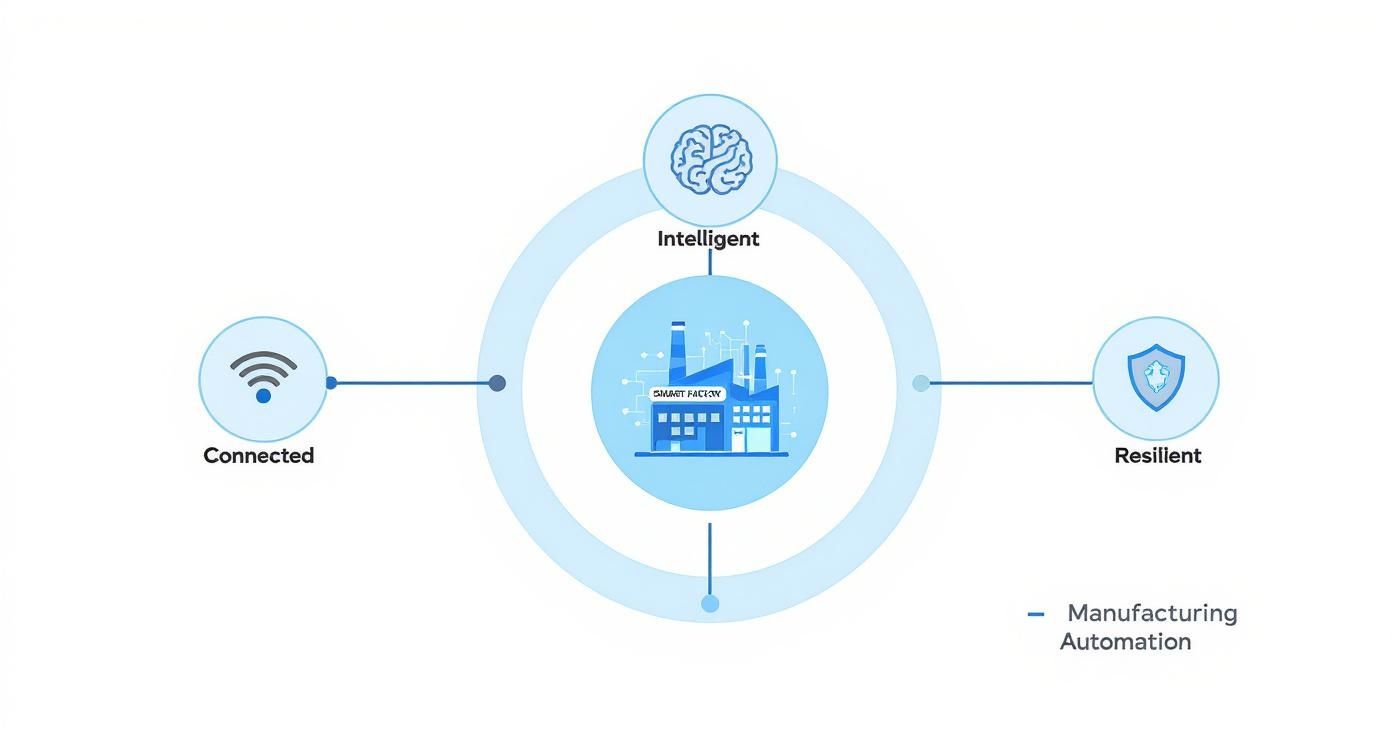
As you can see, a smart factory isn't just about one piece of tech. Success comes from weaving together connectivity (the nervous system), intelligence (the brain), and resilience (the protective shield) into a single, cohesive strategy.
The Nervous System: Industrial Internet of Things (IIoT)
The Industrial Internet of Things (IIoT) is the foundation that modern automation is built on. Picture thousands of tiny sensors embedded in every machine, conveyor belt, and inventory bin on your factory floor. These sensors are like the nerve endings of your entire operation, constantly gathering and sending data.
They track everything from a motor’s temperature and vibration to the precise location of raw materials. This non-stop flow of information gives you an amazingly detailed, real-time picture of what’s happening everywhere in your process. Without IIoT, all the other advanced technologies would be flying blind.
The Brain: Artificial Intelligence and Machine Learning
If IIoT is the nervous system, then Artificial Intelligence (AI) and its partner, Machine Learning (ML), are the brain. AI is what takes the massive flood of data from all those IIoT sensors and actually makes sense of it. It’s the powerhouse that spots hidden patterns, predicts what’s coming next, and helps make smart decisions.
For instance, an AI algorithm could analyze vibration data from a CNC machine and predict a potential breakdown weeks in advance. That means you can schedule maintenance on your own terms instead of dealing with a costly, unexpected shutdown. In quality control, AI-powered cameras can inspect thousands of parts a minute, catching tiny defects the human eye would never see.
AI doesn’t just tell you what happened; it anticipates what will happen. This predictive power is a game-changer, moving manufacturing from a reactive "firefighting" mode to a proactive, strategic one.
The Muscle: Advanced Robotics and Cobots
Finally, you have robotics—the muscle of the automated factory. These are the systems that physically get the work done. While most people picture giant industrial robots working alone in cages, a new generation is changing that dynamic entirely.
Collaborative robots, or “cobots,” are designed to work safely right next to human employees. They might handle delicate assembly tasks, pack finished products, or help a worker with heavy lifting. This teamwork boosts human abilities instead of just replacing them, creating a more flexible and efficient workforce.
Let's break down these core technologies to see how they fit into the bigger picture.
Key Automation Technologies Explained
| Technology | Primary Function | Manufacturing Application Example |
|---|---|---|
| Industrial Internet of Things (IIoT) | Connects machines and sensors to collect real-time data from the factory floor. | A sensor on a motor tracks its temperature and sends an alert if it overheats, preventing a costly breakdown. |
| Artificial Intelligence (AI) / Machine Learning (ML) | Analyzes vast amounts of data to identify patterns, predict outcomes, and make decisions. | An AI system reviews images from a production line to spot defective products far more accurately than human inspection. |
| Robotics & Cobots | Performs physical tasks, from heavy lifting and welding to delicate assembly and packaging. | A cobot works alongside a human operator, holding a heavy part steady while the person performs a complex assembly task. |
Each of these technologies is powerful on its own, but their true value is unlocked when they work together.
This isn't just theory; these tools are already being put to work. Recent research shows 57% of manufacturers are using cloud computing and data analytics, with 46% having already rolled out IIoT solutions. And they’re not stopping there—future investments are heavily pointed toward AI and analytics.
When you connect smart equipment with intelligent platforms and physical automation, you create a system that can practically run itself. For businesses in specialized fields like custom woodworking, this opens up a whole new world of possibilities. You can get a clearer picture of how this works by exploring how a platform that combines e-commerce, ERP, and AI into one system. This connected approach is what manufacturing automation is all about today.
Here's the rewritten section, designed to sound natural and human-written, as if from an experienced expert.
The Strategic Benefits of Automating Production
Let's look beyond the obvious efficiency boosts. The real game-changer with manufacturing automation is the strategic muscle it adds to your entire business. This isn't just about making things faster; it's about making them better, safer, and far more adaptable than your competitors. We've moved past seeing automation as just a cost-cutting tool—it's now the weapon of choice for manufacturing leaders.
When you bring automation into your facility, you're essentially buying predictability and quality on a massive scale. The benefits don't just stay on the shop floor; they ripple out to affect your bottom line, building a more robust and profitable company.
Elevating Product Quality and Consistency
Even the most skilled person has an off day. A master welder might produce a perfect seam nine times in a row, but fatigue or a simple distraction can introduce a tiny flaw on the tenth. Robots don't get tired, and they don't get distracted. They execute the same precise motion, with the same force and at the same angle, millions of times without variation.
This level of consistency is a massive competitive advantage. Think about aerospace, where automated vision systems can spot a microscopic crack in a turbine blade that the human eye would almost certainly miss. Or consider a food company that uses automation to ensure every single package has the exact same weight and mix of ingredients. That’s how you build rock-solid trust with your customers.
Automation flips quality control on its head. Instead of reacting to mistakes after they happen, you're proactively engineering a system that prevents them in the first place. That means less scrap, fewer recalls, and a brand reputation built on excellence.
Creating a Safer Work Environment
Let's be honest: many manufacturing jobs are just plain dangerous. We're talking about heavy lifting, working with harsh chemicals, or being near dangerously hot equipment. Handing these high-risk tasks over to robots is one of the most powerful and responsible things you can do with automation. It’s about protecting your most important asset: your people.
By automating the most hazardous processes, companies see a dramatic drop in accidents and injuries. This has a cascade of positive effects:
- Lower Insurance Premiums: A better safety record almost always means paying less for workers' compensation.
- Improved Employee Morale: People feel safer and more valued when they see the company investing in their well-being.
- Reduced Downtime: An accident doesn't just hurt a person; it stops the production line for investigations and creates staff shortages.
This shift frees up your human team for safer, more engaging work—jobs that rely on their brains, not their brawn, like programming, system management, and creative problem-solving.
Achieving Unmatched Production Agility
Today's market can turn on a dime. The company that can quickly ramp up production to meet a sudden spike in demand—or pivot to a new product line—is the one that wins. Automation gives you that exact agility, letting you adapt without the enormous headache and cost of hiring and training a temporary workforce.
Picture a furniture company that lands a massive, unexpected order from a hotel chain. An automated factory can run 24/7 with just a skeleton crew to hit that tight deadline. Trying to do that with manual labor alone would be a logistical and financial nightmare. This flexibility cuts both ways, too, allowing you to scale back production cost-effectively when things get quiet.
This is why we're seeing such a huge rush to adopt these technologies. The global industrial automation market is currently sitting at around $190 billion USD and is on track to hit $378.57 billion by 2030. These numbers tell a clear story: businesses all over the world are turning to automation to get a decisive edge. You can dive deeper into these industrial automation market projections for more details.
Navigating Common Implementation Challenges
While the benefits are obvious, the path to automating your manufacturing processes is rarely a straight shot. It’s a major business shift, and like any big change, it comes with its own set of very real hurdles. Knowing what these challenges are ahead of time lets you build a smarter, more resilient plan and avoid the common traps that can stall a project before it even gets going.
Making automation work is about more than just buying the latest tech. It requires a clear-eyed look at the money, the machinery, and the people involved. Let's break down the most common roadblocks and talk about practical ways to get around them.
Managing the Upfront Capital Investment
Let’s get the big one out of the way first: the cost. High-performance robots, sophisticated software, and the work needed to tie it all together can demand a serious initial investment. For small and medium-sized businesses, that price tag can be more than a little intimidating.
But that cost shouldn't be a deal-breaker. Instead of trying to do a massive, all-at-once overhaul, think in phases. Pinpoint one or two key processes where automation will give you the biggest and fastest return on investment (ROI). That first "quick win" can then help fund the next stage of your automation plan, creating a self-sustaining cycle of improvement.
Overcoming Technical Integration Headaches
Take a look at your factory floor. It's probably a mix of equipment from different brands and different decades. Getting a brand-new robotic arm to talk to a ten-year-old CNC machine is a serious technical puzzle. This lack of interoperability—the ability for different systems to communicate—can create huge bottlenecks.
The key here is not to go it alone. Working with a specialized systems integrator is often the smartest move you can make. These experts do this for a living, and they have the experience to build the digital bridges between your old and new equipment. They’ll make sure data flows smoothly, preventing the frustrating scenario where your powerful new tools end up operating in their own little silos.
The goal isn't just to add new machines; it's to create a cohesive, interconnected system. Without proper integration, you're just collecting expensive, isolated islands of technology on your shop floor.
Reskilling Your Workforce for New Roles
One of the biggest myths about automation is that it’s all about replacing people. The reality is that it changes the kind of work people do. As machines take over repetitive manual tasks, the need for skilled technicians who can operate, program, and maintain these complex systems goes through the roof.
This skills gap is a major challenge for many manufacturers. To get ahead of it, you have to invest in your current team with dedicated reskilling and upskilling programs.
- Create Clear Development Paths: Offer training to help current employees become robot technicians, data analysts, or automation specialists.
- Build a Culture of Learning: Frame automation as a tool that makes human jobs safer, more interesting, and more valuable.
- Partner with Local Schools: Connect with community colleges and technical schools to help build a pipeline of future talent that already has the right skills.
When you proactively develop your workforce, you turn the fear of job loss into an opportunity for career growth. You end up with a team that isn’t just ready for automation but is actively helping it succeed. That kind of forward thinking is critical for any modern manufacturing operation.
Manufacturing Automation in the Real World
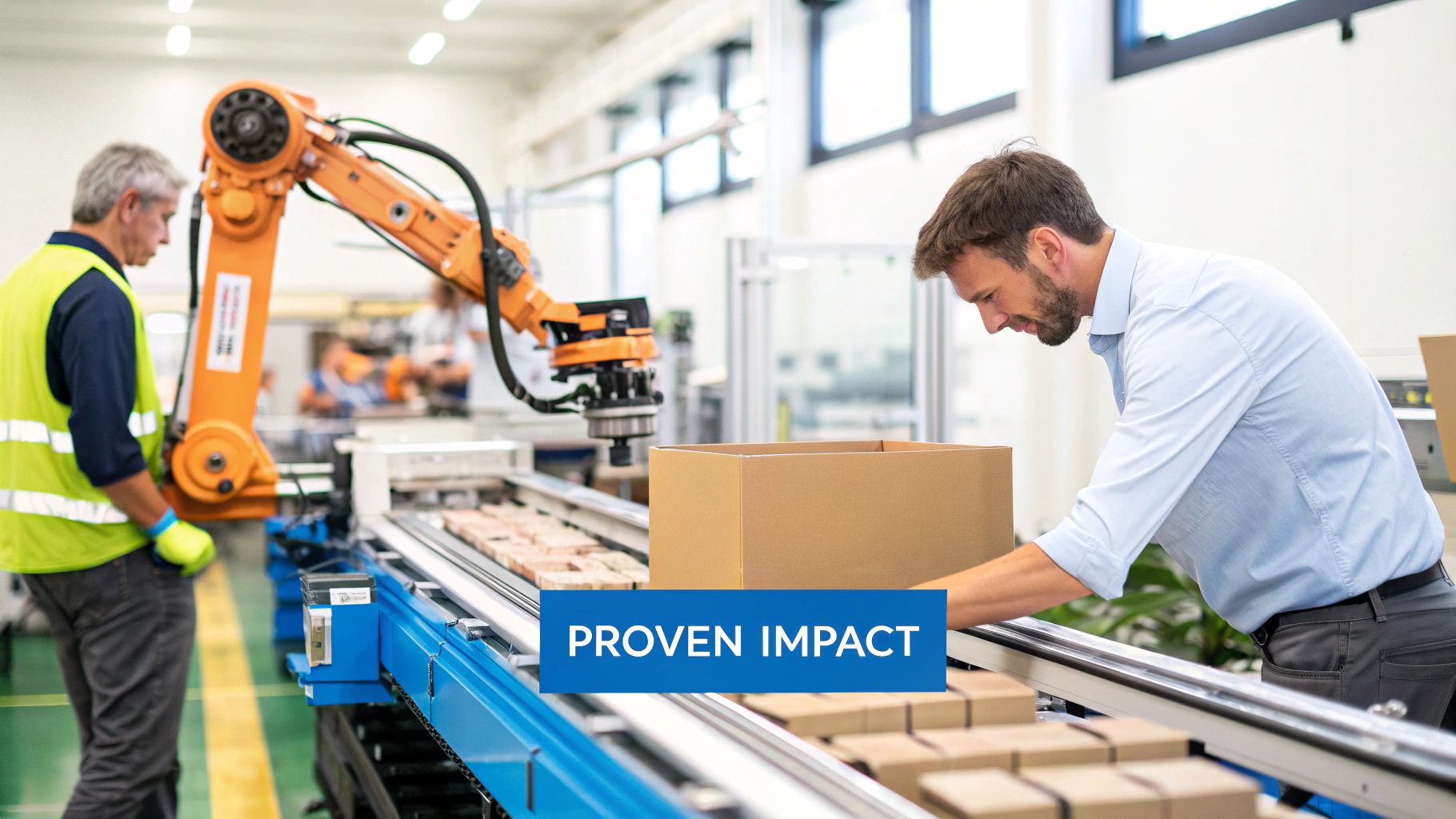
It’s one thing to talk about the benefits and technologies behind automation, but seeing it in action on a real factory floor is where it all clicks. The true test is whether these systems deliver real, measurable results day in and day out. Across countless industries, companies aren't just using automation of manufacturing processes to make small improvements; they're using it to completely rethink what’s possible.
From the high-stakes precision of pharmaceuticals to the breakneck pace of consumer goods, the stories are powerful. These aren’t just theories. They are real-world case studies proving that smart automation builds a stronger, more competitive business. Each example shows a specific problem, the technology that solved it, and the impressive results that followed.
Automotive Assembly Lines Transformed by Cobots
The auto industry has always been a trailblazer in automation, but today's factories are a world away from the old-school, caged-off robot cells. Modern plants now feature collaborative robots (cobots) that work safely right alongside human technicians on some of the most complex assembly jobs.
Picture this: a final assembly station where a worker needs to install a heavy, awkward dashboard console. Instead of struggling to hold the unit steady while fumbling with wires and bolts, a cobot now lifts and positions the dashboard with perfect stability. This frees up the human expert to focus entirely on the high-skill connections, which drastically cuts down on physical strain and boosts accuracy.
The results of this human-robot partnership speak for themselves:
- A 30% increase in output at specific workstations because the workflow is faster and more ergonomic.
- A huge drop in repetitive strain injuries, leading to a safer, more engaged team.
- Better first-pass quality, since errors caused by fatigue and physical strain are almost completely gone.
This shift reveals a deeper understanding of automation’s role. It’s not about replacing people but amplifying their skills, creating a production floor where humans and machines achieve more together than either could on their own.
High-Precision Automation in Pharmaceuticals
In the pharmaceutical world, there is absolutely zero room for error. Making life-saving medicines demands perfect precision, sterility, and traceability. This is where high-speed, high-precision automation is not just helpful—it’s essential for tasks far beyond human capability.
Automated systems in sterile labs can fill thousands of vials an hour with the exact dose, seal them perfectly, and label each one for complete tracking. AI-powered vision systems inspect every single vial for microscopic cracks or impurities, giving you a level of quality control that a person simply can’t match. This ensures every product is not only effective but, more importantly, safe.
The impact is staggering, with companies reporting a 99.9% reduction in product defects and maintaining full compliance with the strictest regulatory standards.
Automated Logistics in Consumer Goods
For the giants in consumer goods, the game is all about speed. Getting products from a massive warehouse to a customer's door faster than the competition requires a perfectly synchronized logistics operation. This is where automated guided vehicles (AGVs) and robotic sorters have become the stars of the show.
AGVs navigate sprawling warehouse floors on their own, picking up pallets and delivering them to the right shipping lane without a human touching them. At the same time, robotic arms sort thousands of individual packages per hour, directing them onto the correct conveyor belts for shipping. It’s a non-stop, 24/7 flow of goods. This kind of hands-off efficiency is a cornerstone of modern supply chain strategy, a topic we dive into on our manufacturing and e-commerce blog.
This global push is obvious in the market trends. The number of industrial robot installations doubled between 2014 and today. China is leading the pack, responsible for a massive 54% of global robot deployments. In a single recent year, the country installed 295,000 robots—a record high for any nation. You can get the full picture by reading more about the worldwide growth in factory robot demand.
Building Your Automation Implementation Roadmap

The key is to avoid the temptation of trying to overhaul everything at once. This is about making smart, strategic moves that build momentum and deliver real results you can see and measure. Think of the automation of manufacturing processes as a journey, not a destination. It starts with finding the right opportunities and setting clear, achievable goals.
Identify Your Low-Hanging Fruit
Before you even think about new technology, take a hard look at your current workflow. Where are the biggest bottlenecks? What tasks are painfully repetitive, prone to mistakes, or just plain physically draining for your team?
These are your "low-hanging fruit." They represent the areas where a little bit of automation will deliver the biggest and fastest return on your investment. Look for the processes that are always causing delays or creating quality headaches.
Common starting points include:
- Manual Data Entry: Automating simple order processing or inventory updates can wipe out costly human errors almost overnight.
- Repetitive Assembly Tasks: A basic cobot can take over a monotonous job, freeing up a skilled worker to focus on more complex problem-solving.
- Material Handling: Automated Guided Vehicles (AGVs) can get parts and raw materials where they need to go, cutting down on wasted time and keeping the line moving.
By nailing these quick wins first, you prove the value of automation immediately. This makes it much easier to get buy-in for bigger, more ambitious projects down the road.
A successful automation journey begins by solving a single, painful problem exceptionally well. This initial success creates the confidence and financial justification needed to tackle bigger challenges.
Set Clear and Measurable Goals
Once you’ve picked your target, you need to define what success actually looks like. A vague goal like "improve efficiency" isn't going to cut it. You need specific, measurable Key Performance Indicators (KPIs) that let you track your progress and see if your investment is paying off.
For instance, your goals could be much more concrete:
- Reduce manual data entry errors by 95% within six months.
- Increase output on the finishing line by 20% in the first quarter after implementation.
- Cut machine changeover time from 45 minutes down to 15 minutes.
Targets like these leave no room for guesswork. Everyone on the team knows exactly what you're trying to achieve. Understanding the financial side is also critical, which is why exploring different software pricing models and their expected ROI is a fundamental part of this planning phase.
Plan a Phased and People-First Implementation
Trying to do everything at once—a "big bang" approach—is almost always a mistake. A phased rollout is smarter. It keeps operational disruptions to a minimum, gives your team time to adjust, and allows you to learn as you go. Start with that low-hanging fruit and build from there.
Most importantly, you have to bring your people into the loop early and often. Automation only truly succeeds when employees see it as a tool that makes their jobs better, not as something that threatens them.
- Communicate the 'Why': Be upfront about how automation will get rid of tedious work, make the shop floor safer, and create new opportunities for people to learn valuable skills.
- Invest in Training: Don’t skimp here. Create solid training programs that give your team the confidence to operate, manage, and maintain the new systems.
- Create Automation Advocates: Find the champions on your team—the people who are excited about the change—and empower them to lead the way and help their colleagues.
When you put your people at the heart of your plan, you turn potential resistance into enthusiastic support. That’s how you ensure your automation investment pays off for years to come.
Your Top Questions About Manufacturing Automation, Answered
Jumping into manufacturing automation brings up a lot of questions. It's a big topic, and it's smart to get the practical details sorted out before you dive in. Whether you're just starting to think about it or you're ready to expand, here are some straight answers to the most common questions we hear.
We'll cut through the noise to tackle the real-world impact of automation on costs, jobs, and how a business of any size can get started.
How Much Does It Cost to Get Started?
This is usually the first question on everyone's mind, but there's no single price tag. The cost of automation is all about scale and complexity. A simple robotic arm for one specific task might be a surprisingly affordable investment, while a full, factory-wide system is obviously a much larger capital project.
The good news is that you don't have to do it all at once. The smartest way to start is small. Find one specific, high-impact area in your process that’s causing a bottleneck. Automating that single point delivers a faster return on your investment, which you can then roll into your next automation project.
Will Automation Replace All Human Jobs?
This is probably the biggest myth out there. The goal isn't to get rid of your people; it's to change the kind of work they do. While some repetitive, manual tasks will be handed over to machines, automation actually creates new, more valuable roles.
As robots take over the dull, dirty, and dangerous jobs, you'll need people who can:
- Program and maintain the new robotic systems.
- Analyze the data pouring in from smart equipment.
- Oversee and fine-tune the entire automated workflow.
The best automation setups don't replace people—they supercharge them. It frees up your team to focus on creative problem-solving, quality control, and strategic thinking that machines just can't do.
Can Small Businesses Benefit from Automation?
Absolutely. Automation isn't just for the big players anymore. Thanks to more affordable and flexible technology—like collaborative robots (cobots) and cloud-based software—it's well within reach for small and medium-sized businesses.
A smaller shop can see huge wins by automating just one or two key processes, like quality inspection or moving materials. This kind of targeted approach can boost your output, improve product consistency, and make your workplace safer, all without needing a massive factory overhaul. It's one of the best ways to level the playing field.
Ready to see how a connected platform can kickstart your automation journey? TimberCloud, Inc. combines e-commerce, ERP, and AI to streamline operations for custom manufacturers. Explore our all-in-one solution at https://timbercloud.com.
Topics
TimberCloud Team
Content Team
The TimberCloud team is dedicated to helping manufacturers streamline their operations with intelligent software solutions.