How to Calculate Manufacturing Cost Accurately

Calculating your total manufacturing cost isn't just an accounting chore; it's the bedrock of a profitable business. It all boils down to adding up three key components: direct materials, direct labor, and manufacturing overhead. Get these right, and you’ll know the true cost to create your product before it ever goes out the door.
The Three Pillars of Manufacturing Cost
Before you can run the numbers, you have to know what you’re counting. Understanding these costs is crucial for setting smart prices, protecting your profit margins, and growing your business sustainably. Every successful maker, whether you're a one-person woodworking shop or a bustling factory, lives and dies by how well they track these core expenses.
The whole process is about sorting every dollar you spend into one of three buckets. To make this crystal clear, let's imagine we're building a custom oak desk.
Direct Materials
This is all the raw material that physically ends up in the finished product. These are the costs you can trace directly to a specific item you’ve made. For our custom oak desk, this would include:
- The oak lumber itself, priced per board foot.
- The hardware, like the drawer pulls and metal slides.
- Finishing supplies, such as the specific wood stain and protective oil.
Simply put, if you can point to it on the final desk, it’s a direct material.
Direct Labor
Direct labor is what you pay the people who are physically building the product. This is the cost of the "hands-on" work. For our desk, this is the hourly wage of the woodworker who is cutting, joining, sanding, and finishing the piece. It doesn't include the salary of a supervisor or the person answering phones in the office—we'll get to them next.
Manufacturing Overhead
This is the big "catch-all" category. Overhead includes all the other costs you have in your workshop or factory that are essential for production but aren't tied to a single, specific desk. Think of these as the background costs that keep the lights on and the tools running.
Key Takeaway: Overhead is indirect, but it is absolutely essential. Forgetting to account for it is one of the fastest ways to kill your profit margin. If your pricing doesn't cover the rent, electricity, and tool maintenance, you're not charging enough.
For our custom woodworking shop, overhead would include things like:
- Workshop rent and utilities (electricity, water, heat).
- Consumables like sandpaper, glue, and saw blades.
- Depreciation on your big tools, like the table saw and planer.
- The salary for a shop manager or quality control inspector.
To help you visualize how these pieces fit together, here's a quick breakdown.
Quick Guide to Manufacturing Cost Components
| Cost Component | What It Is | Example (For a Custom Oak Desk) |
|---|---|---|
| Direct Materials | The raw materials that become part of the final product. | The oak lumber, drawer hardware, and wood finish. |
| Direct Labor | Wages for employees who physically build the product. | The hourly pay for the carpenter assembling the desk. |
| Manufacturing Overhead | All other indirect factory costs needed for production. | Workshop rent, electricity, sandpaper, and saw blade depreciation. |
Each of these costs is a critical piece of the puzzle. Once you've tallied them up, you have your total manufacturing cost.
So, the time-tested formula is simple: add the three pillars together. For example, if your shop spent $150,000 on materials, $80,000 on labor, and $50,000 on overhead in a month, your total manufacturing cost for that period would be $280,000. While this concept is universal, you can learn more about the nuances of manufacturing cost estimating in different industries.
Getting a Handle on Your Direct Material Costs
Your direct material costs are the bedrock of your entire manufacturing cost calculation. This isn't just an accounting exercise; it's about every physical piece that you transform into a finished product. Nailing this number is absolutely critical for smart pricing and protecting your profit margins.
When we think about our custom oak desk example, the big-ticket items come to mind first—the oak lumber, the drawer hardware. But it doesn't stop there. You have to account for the finishing oils, the wood glue, and every single screw used to hold it together. My rule of thumb is simple: if you can see it or touch it on the final product, it belongs in your cost breakdown.
For tracking materials over a whole quarter or year, the classic formula works well:
Direct Materials = Starting Inventory + Purchases – Ending Inventory
This gives you a big-picture view of the total value of materials used up. To get a rough per-unit cost from this, you'd just divide that total by the number of items you built.
Break It Down: The Bill of Materials
For pricing a specific job, you need to get much more granular. The best way I’ve found to do this is with a Bill of Materials, or BOM. Think of it as the complete recipe for one product, listing every single ingredient and its cost.
Let's build a simple BOM for our oak desk:
- Oak Lumber: 30 board feet at $9 per board foot = $270
- Drawer Slides: 2 pairs at $18 per pair = $36
- Drawer Pulls: 2 units at $7 per unit = $14
- Finishing Oil: 0.25 quarts at $40 per quart = $10
Tallying that up, our starting material cost is $330. Having a BOM for every product you make takes the guesswork out of quoting and ensures you never forget a component.
One of the most common mistakes I see is makers only tracking the major materials. Those "little things"—fasteners, dowels, sandpaper, or that special bit of hardware—can add up to a significant number over a year. They'll silently chew away at your profits if you don't account for them.
The Reality of Waste and Scrap
In a perfect world, every inch of material you buy ends up in the final product. But in the real world, especially in woodworking, that never happens. You have to account for cut-offs, knots you have to work around, and the occasional mistake. This is your scrap factor, and it's a very real cost.
Let's say you've tracked your projects and know you typically have a 15% waste factor on lumber. You can't just base your price on the 30 board feet that are in the finished desk; you have to factor in the material you actually consumed to produce it.
Here’s how that changes the math:
- Lumber in Desk: 30 board feet
- Waste Factor: 15% (or 1.15 multiplier)
- Total Lumber to Account For: 30 board feet * 1.15 = 34.5 board feet
- Adjusted Lumber Cost: 34.5 board feet * $9/bf = $310.50
That simple adjustment just added $40.50 to the desk's true material cost. If you ignore waste, you're essentially paying for that extra material out of your own pocket on every single piece you build.
Pinpointing Your Direct Labor Costs
Time is money. In manufacturing, your direct labor cost is the clearest proof of that old saying.
This isn't just about the hourly wage you pay your craftspeople. It's about capturing the total, all-in cost of their time spent physically bringing a product to life. Getting this wrong is one of the quickest ways to lose money on a project without even realizing it.
Direct labor refers only to the wages of employees who are hands-on in the production process. For our custom oak desk, this is the woodworker cutting, joining, and sanding the wood. It’s not the shop manager's salary or the person answering sales calls—those are different cost buckets we'll get to later.
Calculating Your Fully-Burdened Labor Rate
Using an employee's base hourly wage in your cost calculations is a common and incredibly costly mistake. The true cost to employ someone is always higher. To get an accurate picture, you need to calculate a fully-burdened labor rate.
This all-in number goes beyond the paycheck to include all the extra expenses that come with having that employee on your team.
Think of it this way: for every dollar you pay in wages, you're also paying for:
- Payroll Taxes: Things like Social Security, Medicare, and unemployment taxes.
- Workers' Compensation Insurance: An essential cost to protect your team and your business.
- Employee Benefits: The real cost of health insurance, retirement contributions (like a 401k match), and paid time off.
To find this rate, you'll add up the employee's gross annual wage and all these extra annual costs. Then, divide that total by the number of hours they actually work in a year (which is typically around 2,080 hours, minus any vacation, sick, and holiday time).
A carpenter earning $25/hour might seem straightforward. But once you add payroll taxes, insurance, and benefits, their true cost—their fully-burdened rate—might be closer to $32/hour. If you use the lower number in your costings, you're underpricing your work by nearly 30% on labor alone.
Applying the Rate to Your Projects
Once you have a realistic, fully-burdened hourly rate, the next move is to track the time spent on each specific product with precision. This used to be a pain, but modern tools make it much easier. You can use anything from simple digital time-tracking apps to more advanced project management software that assigns labor hours directly to a job number.
Let's bring this back to our custom oak desk. The woodworker logs their time carefully throughout the build.
- Milling & Cutting Lumber: 4.5 hours
- Assembly & Joinery: 8 hours
- Sanding & Finishing: 3.5 hours
The total time directly spent making this desk comes out to 16 hours. Now we can finally calculate the true direct labor cost for this single piece of furniture.
The formula is simple:
Direct Labor Cost = Total Labor Hours × Fully-Burdened Hourly Rate
Plugging in our example numbers:
Direct Labor Cost = 16 hours × $32/hour = $512
That $512 is a much more accurate and defensible number than the $400 you would have calculated using just the base wage (16 hours × $25/hour).
This kind of precision isn't just about good accounting; it's fundamental to building a profitable, sustainable business. It ensures every minute of your team's valuable time is properly accounted for in your final price.
Untangling Your Manufacturing Overhead Costs
Overhead is, without a doubt, the trickiest part of nailing down your true manufacturing cost. It's the "catch-all" bucket for every single expense that keeps your shop running but isn't directly bolted onto a specific finished product.
Think about it like this: the beautiful slab of oak for a custom desk is a clear direct material. The time your master carpenter spends shaping it is direct labor. But what about the electricity spinning the saw blade? Or the rent you pay for the workshop itself?
Those are your manufacturing overhead costs. If you ignore them, your pricing is built on a shaky foundation. Sooner or later, it'll collapse because it's not actually supporting the full, real cost of doing business.
Pinpointing Your Indirect Costs
First things first, you need to get a handle on all the indirect costs that keep your production floor humming. I recommend grabbing a notepad or opening a spreadsheet and listing out every single expense for a set period, like a month or a quarter. We're talking about everything that's essential for production but can't be practically traced back to a single table or chair.
Here’s a good starting list of what to look for in a typical workshop:
- Factory Rent or Mortgage: The cost of the roof over your machines.
- Utilities: The power bill for your saws and sanders, plus water, heat, and A/C for the shop.
- Indirect Labor: This is a big one. It's the salaries for crucial team members who aren't directly building products—think shop supervisors, maintenance staff, or your quality control expert.
- Equipment Depreciation: Your heavy hitters—the table saw, CNC router, planer—lose value over time. That loss is a real cost.
- Consumable Supplies: All the stuff that gets used up but isn't part of the final product. Sandpaper, saw blades, glue, finishing rags, and cleaning supplies all fall in this category.
- Shop Insurance: The policies that protect your equipment and your business.
- Property Taxes: If you own the building, this is a key part of your overhead.
Once you’ve hunted down all these figures, add them up. That final number is your Total Manufacturing Overhead for the period. Let's say you tally up a month's worth of rent, utilities, supervisor pay, and supplies, and it comes to $10,000. That's your monthly overhead.
How to Calculate Your Manufacturing Overhead Rate
Okay, so you have a big overhead number—$10,000 for the month. How do you fairly slice up that cost and apply a small piece of it to every single item you produce? The answer is the manufacturing overhead rate. This rate lets you systematically spread those indirect costs across your production activity.
To figure out your rate, you need to pick an allocation base. This is just a yardstick for your shop's activity level, something that logically connects to your overhead costs.
Common choices are:
- Direct Labor Hours
- Machine Hours
- Direct Labor Cost
Let's stick with a popular one: direct labor hours. Imagine your team worked a total of 800 direct labor hours during that same month you had $10,000 in overhead. Now you have what you need to calculate your rate.
The formula is straightforward:
Overhead Rate = Total Manufacturing Overhead / Total Allocation Base
Here's how it plays out:
$10,000 (Total Overhead) / 800 (Direct Labor Hours) = $12.50 per direct labor hour
That $12.50 is your magic number—your manufacturing overhead rate. It means for every single hour a craftsman spends hands-on with a project, you need to tack on an additional $12.50 to cover that project's fair share of running the workshop.
By applying this rate, you ensure every piece that goes out the door carries its portion of the factory's hidden costs. This is how you move from guesswork to a truly accurate and sustainable cost picture.
Putting It All Together: The Final Manufacturing Cost
Alright, you've done the hard work of tracking down your material costs, calculating your true labor rate, and figuring out your shop's overhead. Now it's time for the payoff—bringing all those numbers together to find the true cost of building your product.
This is the moment of clarity. We're about to calculate the single most important number for any maker: what it actually costs you to produce one unit.
The formula itself is straightforward, combining the three pillars we've just broken down:
Total Manufacturing Cost = Direct Materials + Direct Labor + Manufacturing Overhead
Let's walk through this using the numbers from our custom oak desk project. We've already got all the pieces, so now we just need to assemble them.
Nailing Down the Cost for a Single Desk
Using the figures we worked out earlier, here’s how the calculation looks for one desk.
- Direct Material Cost: $310.50. This covers the oak, our 15% waste factor, and all the hardware and finishing supplies.
- Direct Labor Cost: $512.00. This is for the 16 hours of skilled work at our fully-burdened rate of $32/hour.
- Manufacturing Overhead Cost: $200.00. We got this by multiplying the 16 direct labor hours by our shop's overhead rate of $12.50 per hour.
Let's add it all up:
$310.50 (Materials) + $512.00 (Labor) + $200.00 (Overhead) = $1,022.50
So there it is. The total manufacturing cost for one custom oak desk is $1,022.50. This isn't a ballpark figure; it's a real, data-driven number you can build your business on.
This final number is your cost foundation. Any price you set below this figure means you are actively losing money on every single sale, no matter how busy your workshop feels.
This process ensures that every hidden cost—from the light bill to the blade sharpener—is fairly accounted for in each product you build.
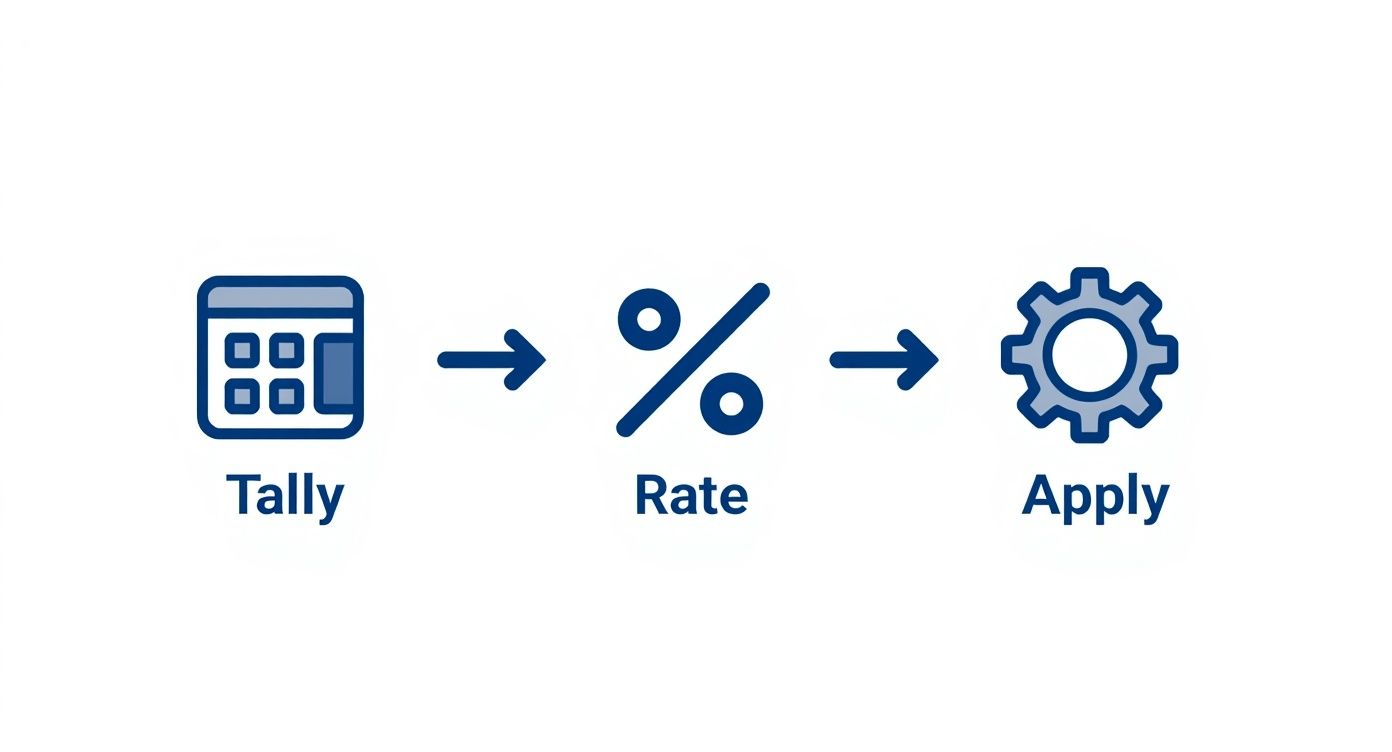
Let's break down the final calculation for our desk in a clear table format.
Cost Calculation for a Custom Oak Desk
This table shows exactly how each cost component contributes to the final manufacturing cost for our single desk example.
| Cost Item | Calculation Details | Total Cost |
|---|---|---|
| Direct Materials | Oak lumber, hardware, and finishing supplies (including 15% waste) | $310.50 |
| Direct Labor | 16 hours of hands-on work at a burdened rate of $32/hour | $512.00 |
| Manufacturing Overhead | 16 direct labor hours multiplied by a $12.50/hour overhead rate | $200.00 |
| Total Manufacturing Cost | Sum of Materials + Labor + Overhead | $1,022.50 |
Seeing the numbers laid out like this really highlights how each part of your operation impacts the final cost.
From One Desk to Your Entire Production
The power of this calculation really shines when you scale it up. Knowing your per-unit cost lets you accurately value your entire production run.
If you built ten of these desks in a month, you could confidently say your Cost of Goods Manufactured (COGM) for that product line was $10,225.00.
This COGM figure is a critical part of your business's financial health, feeding directly into your income statement. Keeping these numbers straight is a lot easier with the right tools. Platforms that link inventory management with production tracking can do a lot of this heavy lifting for you, giving you real-time cost data. You can explore some of these integrated TimberCloud features to see how they pull sales, inventory, and production into a single, cohesive workflow.
Ultimately, mastering this calculation is what separates a hobby from a business. It gives you the financial clarity you need to price for profit and grow with confidence.
Using Cost Data to Drive Smarter Decisions
Knowing how to calculate your manufacturing cost isn't just an accounting chore. It's the key to making strategic decisions that actually grow your business. Once you've nailed down that core number, you can stop guessing and start steering your shop with real data. This is where the magic happens.
With a precise cost per unit, you can finally set prices that guarantee a healthy profit margin on every single thing you sell. It also acts like a spotlight, illuminating your biggest expenses and showing you exactly where you can trim the fat. Is lumber waste killing your material budget? Is one specific assembly step eating up way too many labor hours? The numbers don't lie.
Pinpoint Inefficiencies and Boost Profits
This whole process gives you a crystal-clear look at your production efficiency. When you start comparing the calculated costs of different product lines, you'll quickly see which items are your cash cows and which ones might need a process tweak or a price hike.
Modern data-driven models can get even more granular. For example, some advanced statistical methods use clustering algorithms to group products with similar cost behaviors, leading to much more accurate estimates. This is a game-changer when you're juggling a wide range of products with all sorts of cost factors, as highlighted in recent research on manufacturing cost estimation.
The ultimate goal is to turn numbers on a spreadsheet into actionable business intelligence. Your manufacturing cost is the metric that tells you what to build, how to price it, and where to invest in your workshop for the future.
Getting this level of financial insight is absolutely critical if you want to scale your operations without running into cash flow problems. To see how specialized software can help you wrangle all these variables, it’s worth checking out the different pricing plans for manufacturing platforms that automate these calculations for you.
Got Questions About Manufacturing Costs? We’ve Got Answers
Even with the formula laid out, a few things tend to trip people up when they first start digging into their numbers. Let's tackle some of the most common questions that pop up when you're calculating the real cost to make your products.
What’s the Deal with Prime Cost and Conversion Cost?
You'll definitely hear these terms in the manufacturing world, and they’re really just different ways of slicing the same pie.
-
Prime Cost is simply your direct materials plus your direct labor. Think of it as the most direct, "prime" expenses needed to physically create one of your products.
-
Conversion Cost is your direct labor plus your manufacturing overhead. This is the cost incurred to convert those raw materials into a finished good ready for sale.
Knowing both gives you different perspectives on where your money is going, which is super helpful for spotting inefficiencies.
How Often Should I Be Recalculating My Overhead Rate?
This is a big one. Your overhead rate is not a "set it and forget it" number. You should absolutely plan to recalculate it at least once a year.
Even better, get in the habit of revisiting it anytime a major business cost changes. Did your shop's rent go up? Did you hire a new salaried manager? Both are perfect triggers to update your overhead calculation. Staying on top of this is the only way to keep your product costing accurate.
Forgetting to update your overhead rate is a classic way to slowly bleed profit without realizing it. An old rate means you're under-costing every single job, a silent killer for any custom woodworking business.
For more deep dives into business best practices, you can find a wealth of information on the TimberCloud blog. Hopefully, these quick answers help you tackle your own cost calculations with a lot more confidence.
Ready to stop juggling spreadsheets and start making data-driven decisions? TimberCloud integrates your e-commerce, production, and inventory into one powerful platform built for custom manufacturing. Get started with TimberCloud today!
Topics
TimberCloud Team
Content Team
The TimberCloud team is dedicated to helping manufacturers streamline their operations with intelligent software solutions.