How to Calculate Production Costs for Profit

Total production cost = direct materials + direct labor + manufacturing overhead. To get your cost per unit, divide that total by the number of units built in the same period.
For a custom shop, that means the lumber and hardware that go into the piece, the shop-floor hours spent building it, and a fair slice of rent, power, insurance, and machine depreciation. Get those three numbers right and every quote you send is priced on real margin instead of gut feel.
The Production Cost Formula (Materials + Labor + Overhead)
Total production cost = direct materials + direct labor + manufacturing overhead Cost per unit = total production cost ÷ units produced in the same period
Everything below unpacks those three inputs — what belongs in each, how to allocate overhead honestly, and where custom shops most often get it wrong.
Production Costs by the Numbers
- 83.1% of manufacturers name rising raw material and input costs as their top business challenge, up sharply from 57.5% one quarter earlier. (NAM Manufacturers' Outlook Survey, Q2 2026)
- Manufacturers expect input costs to rise another 5.8% over the next 12 months, up from a 4.1% forecast the prior quarter. (NAM Manufacturers' Outlook Survey, Q2 2026)
- Manufacturing unit labor costs rose 2.2% in the fourth quarter of 2025, revised down from a preliminary 2.4%. (U.S. Bureau of Labor Statistics, Productivity and Costs)
With input costs climbing at that pace, a cost model built a year ago is almost certainly underquoting today's work.
Decoding Your Core Production Costs
Before you can punch numbers into a calculator, you need to know exactly what you’re adding up. I like to think of production costs as having three main pillars. If you misclassify an expense, your entire cost structure becomes unreliable, which can lead to underpricing and shrinking margins. Nailing these categories from the start is non-negotiable.
To help you get this right every time, here’s a quick-reference table breaking down the three pillars of production costs.
The Three Pillars of Production Costs
| Cost Category | Definition | Common Examples |
|---|---|---|
| Direct Materials | The raw materials that are an integral part of the final product and can be easily traced to it. | Wood for a table, fabric for a shirt, steel for a machine part. |
| Direct Labor | The wages and benefits paid to employees who physically work on manufacturing the product. | A welder's hourly pay, a seamstress's salary, a cabinet maker's wages. |
| Manufacturing Overhead | All other indirect costs incurred during the production process that aren't direct materials or labor. | Factory rent, utilities, equipment depreciation, supervisor salaries. |
Think of this table as your cheat sheet for sorting expenses. If you can't decide where a cost goes, refer back to these definitions.
Direct vs. Indirect Costs
The first major split you'll make is between direct and indirect costs. It's a simple concept but one where mistakes often happen.
Direct costs are the expenses you can point to and say, "That cost belongs to that specific product." If you're building custom furniture, the oak used for a particular dining table and the hours the woodworker spent on it are classic direct costs.
On the flip side, indirect costs are essential for production but don't belong to any single item. The salary of the shop foreman, the electricity bill for the entire workshop, or the annual maintenance contract for your table saw—these all fall into the indirect bucket, which we call manufacturing overhead.
Fixed vs. Variable Costs
Another way to look at your costs is based on how they react when your production levels change. This distinction is incredibly useful for forecasting and budgeting.
-
Fixed Costs: These are the bills you have to pay no matter what. Your monthly rent for the workshop, property taxes, and insurance premiums are perfect examples. You owe the same amount whether you produce 50 units or 500.
-
Variable Costs: These costs move in lockstep with your production volume. The more you make, the more you spend. Think raw materials, packaging supplies, and piece-rate labor wages.
When you take the time to separate your costs this way, you get a crystal-clear picture of your operation's financial health. It shows you exactly where every dollar is going, which makes it much easier to spot inefficiencies, find savings, and make smart calls on pricing your work.
The Production Cost Formula in Action
Theory is one thing, but seeing the numbers in action is where it all clicks. The core formula for calculating production costs is pretty simple on the surface: Direct Materials + Direct Labor + Manufacturing Overhead = Total Production Cost. So, how does this actually play out? Let's get practical and run through an example with a custom furniture business.
Picture this: your workshop is building a batch of 50 handcrafted oak dining tables. To figure out what this job truly costs, we need to break down each part of that formula for this specific production run.
Tallying the Direct Costs
First up are the direct costs. These are the straightforward expenses you can point to and say, "That went directly into making these tables."
Think about your direct materials—all the wood, screws, glue, and finishing oils. If you know each table needs $300 worth of oak plus another $25 in hardware and finish, your direct material cost is a clean $325 per table.
Then comes direct labor. This is all about tracking the time your team spends only on this batch of tables. If it takes a craftsperson 10 hours to build one table and you pay them a loaded rate of $40 per hour (that includes wages, taxes, and benefits), your direct labor cost lands at $400 per table.
Use the Fully Burdened Rate, Not the Wage
The fastest way to underprice a job is costing labor at the wage you pay. A $25/hour bench worker actually costs closer to $35/hour once payroll taxes, workers' comp, health benefits, and paid time off are loaded in — roughly a 30% premium. Run every labor calculation at that burdened rate, and be strict about who counts as direct labor: the finisher spraying doors is direct; your shop foreman doing scheduling belongs in overhead.
Let Your BOM Do the Heavy Lifting on Materials
A bill of materials turns material costing from guesswork into a checklist — down to screws, glue, and finish. Two adjustments make it honest: add a scrap factor (5–10% is typical for solid wood, since knots, checks, and grain matching generate waste), and cost materials at landed price — what the lumber actually cost delivered to your dock, freight included — not the supplier's list price.
Applying Manufacturing Overhead
Now for the part that trips most people up: manufacturing overhead. These are all the essential but indirect costs—the workshop rent, the electricity bill, the salary of the supervisor who oversees everything. You can't just assign the entire electricity bill to a single table, so you have to allocate it logically.
Let’s say your shop's total overhead for the month is $10,000. During that same month, your team logged a total of 500 direct labor hours across all projects. This gives you an overhead rate of $20 per direct labor hour ($10,000 ÷ 500 hours).
Since we know each table takes 10 labor hours to build, we can now allocate $200 in overhead to each one ($20 rate x 10 hours).
This visual really helps illustrate how all these different costs come together.
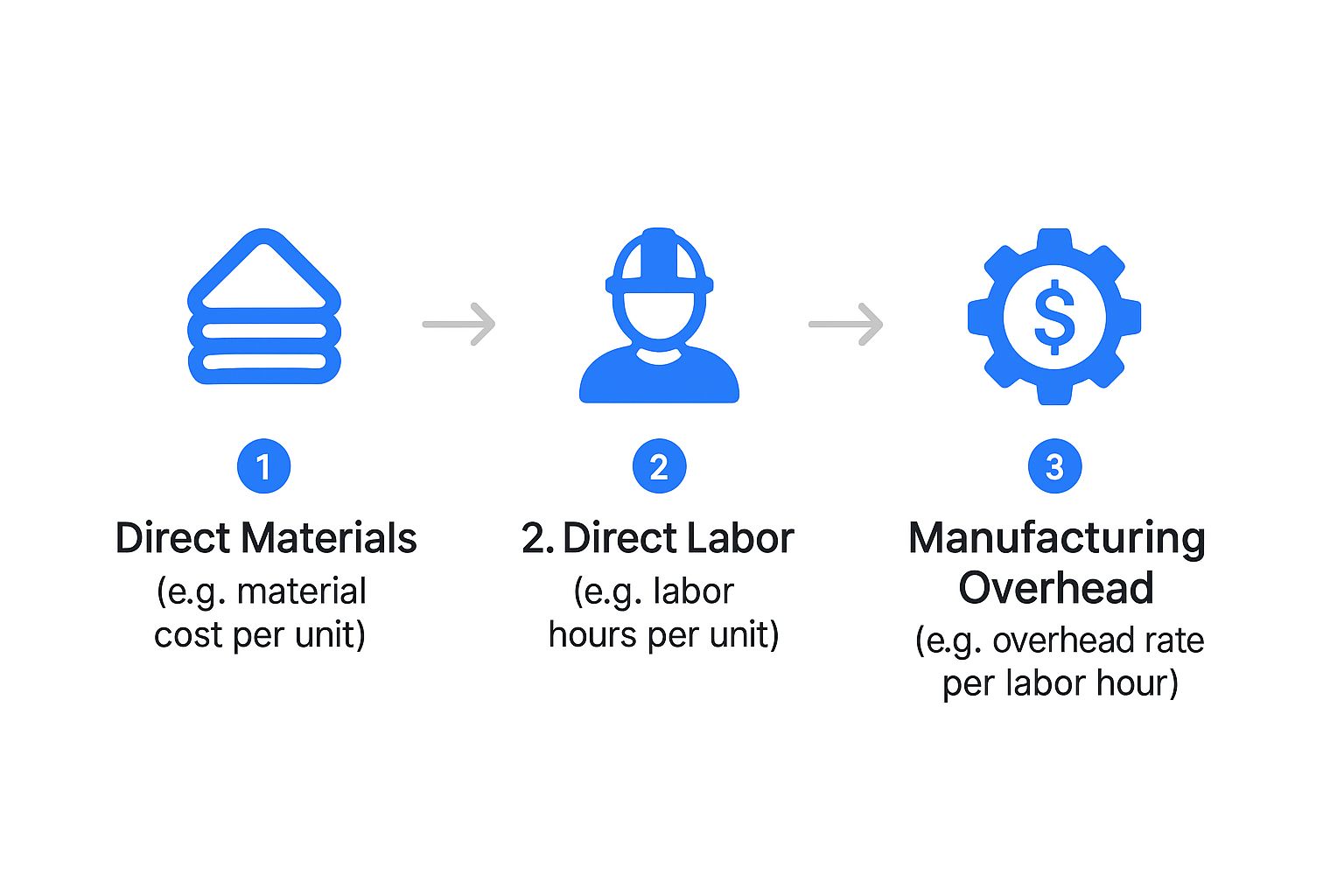
As you can see, the direct costs are added up first, but the final, accurate cost only comes after you've applied that calculated overhead.
Putting It All Together: The Final Calculation
With all the pieces in place, you just have to add them up for a single table:
- Direct Materials: $325
- Direct Labor: $400
- Manufacturing Overhead: $200
Total Production Cost Per Table = $925
That $925 is your magic number. It’s the true cost to produce one of those oak dining tables, giving you the solid foundation you need to price it for a healthy profit.
Getting Manufacturing Overhead Right

This is where the math gets fuzzy for a lot of shops, and honestly, it's the number one reason I see businesses underpricing their work. Direct costs are easy—you know what the lumber and hardware cost. But what about the indirect costs? Things like the factory's electric bill, the wear-and-tear on your saws, or the salary of your shop foreman are all shared across every single thing you build.
The only way to get an accurate cost is to assign those indirect expenses fairly using an overhead allocation rate.
Think of it this way: how much of your workshop’s rent is a single custom cabinet responsible for? You can't just pull a number out of thin air. You need a consistent, logical way to spread those costs across everything that goes out the door.
Finding the Right Allocation Base
To figure out your overhead rate, you first need to pick an allocation base. This is just a measurable activity that directly influences your overhead costs. You're looking for a clear cause-and-effect relationship here.
What you choose really depends on how your shop runs:
- Direct Labor Hours: This is the old standby for a reason. It's perfect for shops where most of the work is hands-on. The more hours your team is on the floor, the more electricity is used, the more supervision is needed, and so on.
- Machine Hours: If you've invested heavily in automation, like CNC machines that run for hours on end, this is a much better fit. In this case, the machinery itself is what’s really driving costs like maintenance, depreciation, and power consumption.
- Direct Labor Cost: This can be a useful alternative if you have a mix of skill levels and pay scales on your team. It sometimes provides a more balanced allocation than just using hours alone.
Whatever you choose, the most important thing is to be consistent. Pick one allocation base and stick with it. If you start changing your method every other month, your data becomes unreliable, and you'll have no idea if you're actually making money over time.
How to Calculate and Apply Your Rate
Once you've settled on a base, the math is actually pretty simple. You just divide your total estimated manufacturing overhead for a period (let's say for one month) by your total estimated allocation base for that same period.
Let's walk through a quick example. Say your shop’s total monthly overhead comes out to $10,000. You look at your schedule and estimate your team will put in about 500 direct labor hours.
Your overhead rate would be $20 per direct labor hour ($10,000 ÷ 500 hours).
Now you have a powerful tool. When you quote a new project, like a set of custom cabinets that you figure will take 15 hours of labor, you can confidently allocate $300 of overhead to that job ($20 rate × 15 hours). This single step ensures every product carries its fair share of what it truly costs to keep the lights on.
Using Modern Tech for Smarter Cost Tracking

Relying on old-school spreadsheets to track production costs is like navigating a complex factory floor blindfolded. You might get where you're going, but you're missing the real-time details that prevent costly mistakes. Modern technology, thankfully, lifts that blindfold.
Imagine having IoT sensors on your machinery that tell you the exact energy consumed per part produced. Or picture an AI that predicts when a critical tool needs maintenance before it causes an expensive shutdown. This isn't just about collecting more data; it's about replacing guesswork with hard, actionable numbers that directly boost your bottom line.
When you integrate smart manufacturing systems, you suddenly see the hidden inefficiencies you’ve been missing. This lets you make on-the-fly adjustments, leading to sharper cost calculations, more competitive pricing, and ultimately, healthier profit margins.
Embrace Data-Driven Production
This move toward smarter manufacturing isn't just a fleeting trend. It’s a complete overhaul of how modern businesses need to think, shifting the focus from reactive problem-solving to proactive, constant improvement.
It all comes down to using real-time information to answer critical questions:
- Which machine is burning the most energy after hours?
- Is that new batch of raw material causing our tools to wear out faster?
- How is the humidity in the shop today affecting the cure time for our finishes?
Answering these questions with dead-on accuracy helps you fine-tune every part of your process, trimming waste and boosting output. The numbers back this up, too. Projections show that by 2025, 70% of manufacturers will rely on IoT for real-time monitoring. This shift is expected to slash downtime by 50% and cut maintenance costs by as much as 40%.
This data-first mindset changes cost calculation from a backward-looking report into a live dashboard. You stop asking what a job cost last quarter and start seeing what it's costing you right now.
Why Integrated Platforms Are a Game-Changer
The true power of this technology is unlocked when everything is connected on a single platform. Forget about juggling separate, disconnected systems for sales, inventory, and production. An integrated solution brings it all together.
For example, when a customer places a custom order online, a truly connected system can instantly generate a bill of materials, check and allocate inventory, and schedule time on the right machines—all without manual input.
This smooth, automated flow of information is the key to accurate, up-to-the-minute costing. You can see how these moving parts work in concert by exploring the various features of a modern manufacturing platform. Tying your operations together like this breaks down data silos and gives everyone a single, reliable source of truth to work from.
How Global Trends Are Reshaping Your Costs
For a long time, figuring out your production costs was an inside job. You looked at what was happening within your own four walls—materials, labor, overhead—and that was pretty much it. But that's not the world we live in anymore.
Now, things happening on the other side of the globe can throw your numbers into a tailspin overnight. International tariffs, shifting currency values, and supply chain snags can inflate your expenses without warning. Suddenly, that specialty hardware you import costs 20% more, and your profit margins are taking a direct hit. These aren't just abstract economic headlines; they are real-world variables you have to plug into your cost formula.
The New Cost Calculus
This adds a whole new layer of complexity to manufacturing. According to a recent survey from the BCG Henderson Institute, executives are now forced to weigh traditional costs against less tangible risks, like geopolitical instability. Your cost calculations can't be static anymore; they have to be living, breathing models. You can read more about what BCG calls the new cost calculus for manufacturers.
If you're not tracking these global trends, you're essentially flying blind. It's like heading into a storm without a weather forecast—you're gambling with your company's profitability. Staying informed is the only way to make smart sourcing decisions and build a pricing strategy that can actually hold up.
Building a More Resilient Strategy
So, what does this mean for you on a practical level? You need a system that can roll with the punches. A flexible cost model is your best defense against supply chain volatility.
This means getting into the habit of:
- Reviewing supplier costs regularly, especially for anything you import.
- Building a buffer into your pricing to absorb sudden cost hikes.
- Finding and vetting alternative or domestic suppliers so you're not over-reliant on one source.
By keeping a close watch on these external factors, you shift from simply reacting to problems to proactively managing them. This is where having clear visibility into your expenses becomes critical. Tools that give you this kind of real-time data, like the ones detailed in TimberCloud's pricing and feature sets, empower you to make agile decisions and protect your business from whatever the global economy throws your way.
Ready to move beyond spreadsheets and get real-time, accurate production costs? The all-in-one platform from TimberCloud integrates sales, inventory, and production to give you a crystal-clear view of your true costs. Learn more at https://timbercloud.com.
Article created using Outrank
Frequently asked questions
Add direct materials, direct labor, and manufacturing overhead for a period, then divide by the units produced in that same period. If you spent $9,000 on materials, $6,000 on labor, and $3,000 on overhead to build 20 tables, your cost per unit is $900.
Total production cost = direct materials + direct labor + manufacturing overhead. Direct costs are traceable to a specific job; overhead covers everything that keeps the shop running — rent, utilities, insurance, depreciation, and indirect labor.
Production cost is what you spend to make units in a period, whether or not they sell, and it sits on the balance sheet as inventory value. Cost of goods sold is the production cost of only the units actually sold in that period, and it hits the income statement as an expense. A finished piece in your showroom counts toward production cost but not COGS until someone buys it.
Total your indirect costs for a period, pick an allocation base — machine hours or direct labor hours both work well for wood shops — and divide to get an overhead rate. Then apply that rate to each job based on the hours it consumed. For example, $20,000 of monthly overhead across 1,000 machine hours is $20 per machine hour.
Quarterly at minimum, and monthly if material prices are moving. With manufacturers reporting input costs as their top challenge and expecting another 5.8% rise over the coming year, a rate set twelve months ago is almost certainly underquoting today’s jobs.
Product costs — materials, shop labor, overhead — attach to the pieces you build and sit in inventory until sold. Period costs such as sales salaries, office rent, and marketing are expensed as incurred and should never be baked into your per-unit production cost.
Usually one of three causes: a material price increase you have not repriced in your bill of materials, lower production volume spreading fixed overhead across fewer units, or a stale overhead rate. Refresh material prices and recalculate your overhead rate before concluding the shop got less efficient.
Three recur constantly. Underestimating overhead by forgetting supervisor wages, quality inspection, plant electricity, and machine depreciation. Using material prices from six months ago instead of current landed cost. And spreading overhead evenly across every product, which over-costs simple pieces and under-costs complex ones.
Topics
TimberCloud Team
Content Team
The TimberCloud team is dedicated to helping manufacturers streamline their operations with intelligent software solutions.