Top Procurement Cost Reduction Strategies to Save More
In the relentless pursuit of profitability, companies often prioritize sales growth while neglecting a powerful, internal financial lever: procurement. Effective purchasing is far more than an administrative task; it's a strategic function that directly impacts your bottom line. Moving beyond basic price haggling to implement sophisticated procurement cost reduction strategies can unlock substantial, sustainable savings that flow directly to profit. This transformation turns your procurement department from a simple cost center into a dynamic, value-generating engine for the entire organization.
This guide provides a clear roadmap with eight actionable strategies designed to overhaul your purchasing approach. We will explore practical methods, from leveraging technology for automation and deep data analysis to fostering strategic supplier relationships that yield long-term benefits. You'll learn how to implement proven techniques like Total Cost of Ownership (TCO) analysis, supplier consolidation, and strategic sourcing to gain a competitive edge. Whether you're a custom woodworking shop, a manufacturer, or an e-commerce furniture maker, these insights will equip you to optimize spending, eliminate waste, and significantly boost your financial performance. Forget theory; this is your practical playbook for impactful cost savings.
1. Strategic Sourcing
Strategic sourcing elevates procurement from a simple purchasing function to a proactive, analytical business discipline. It’s a systematic approach to supply chain management that involves a deep dive into an organization's spending patterns. By analyzing this data, businesses can leverage their collective buying power to negotiate better terms, foster stronger supplier relationships, and optimize the total cost of ownership (TCO) rather than just focusing on the initial purchase price.
This methodology, pioneered by consulting firms like A.T. Kearney and thought leaders such as Peter Kraljic, moves beyond reactive buying. Instead, it involves a cyclical process of data collection, market research, supplier evaluation, and structured negotiations. For custom woodworking shops, this means looking beyond the cost per board foot of lumber and considering factors like supplier reliability, waste reduction, delivery logistics, and material quality consistency.
How Strategic Sourcing Drives Savings
The core principle is to manage procurement categories holistically. Instead of sourcing materials for each individual job, a furniture maker might analyze their total annual spend on hardwoods, finishes, and hardware. This analysis reveals high-impact categories where consolidating suppliers or negotiating volume-based contracts can yield significant savings.
For example, global giants like Procter & Gamble and Coca-Cola have used strategic sourcing to achieve savings in the billions and double-digit percentages respectively, while simultaneously improving quality and supplier performance.
Implementing Strategic Sourcing
To apply this powerful procurement cost reduction strategy, follow a structured approach:
- Conduct a Thorough Spend Analysis: Begin by gathering and classifying all purchasing data. Identify who is buying what, from which suppliers, and at what price. This foundational step highlights the biggest opportunities for savings.
- Engage Stakeholders Early: Involve production managers, shop floor teams, and designers in the process. Their insights into material performance and operational needs are critical to ensure that cost savings don't compromise product quality.
- Develop Category Strategies: Tailor your sourcing approach to each specific spend area. The strategy for sourcing unique, exotic veneers will be vastly different from the strategy for commodity hardware like screws and hinges.
- Focus on Total Cost of Ownership (TCO): Calculate the full cost associated with a purchase. This includes the unit price plus shipping, inventory holding costs, potential waste, and the cost of poor quality.
This infographic provides a quick reference for the typical outcomes and focus of a strategic sourcing initiative.
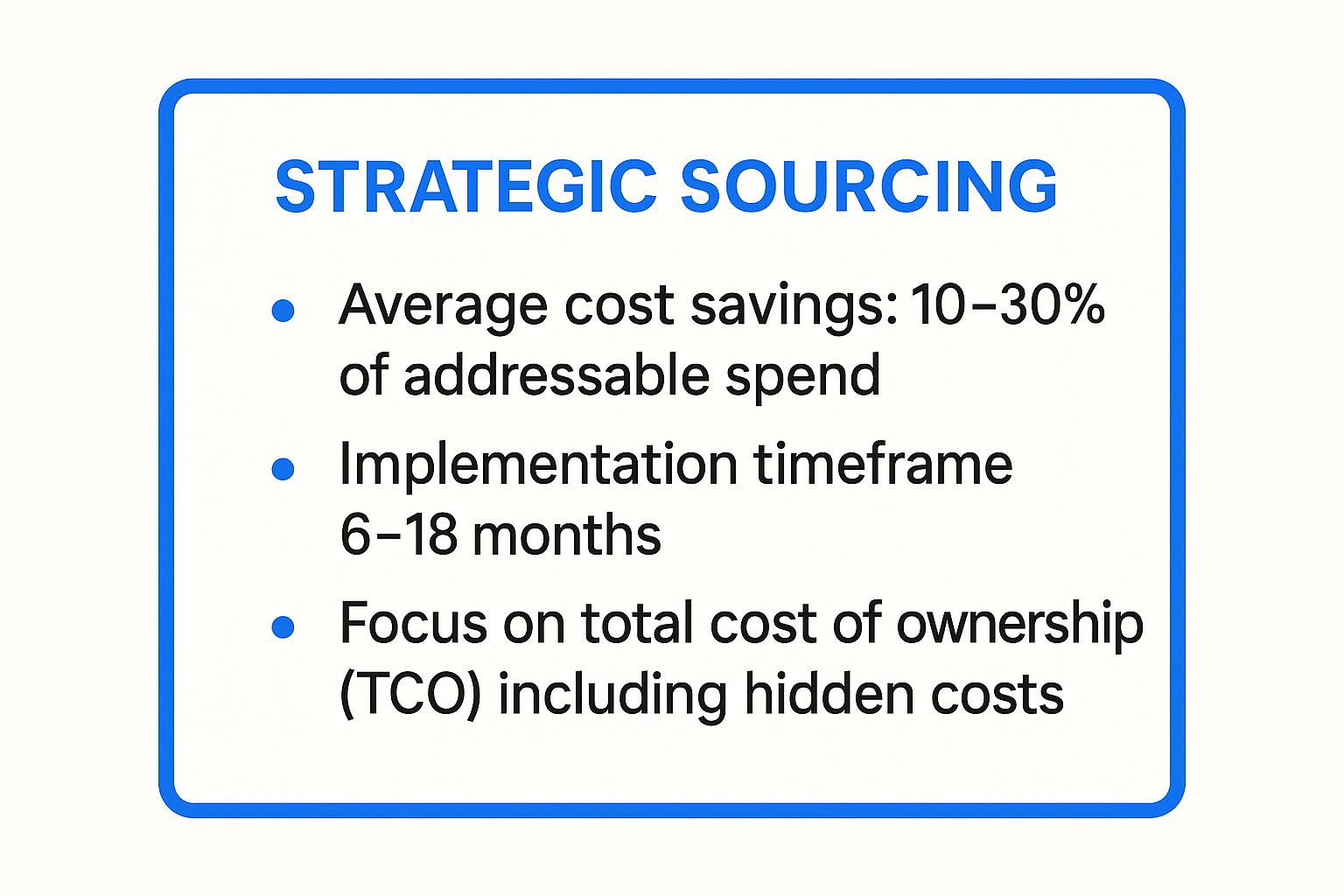
As the data highlights, the emphasis on TCO over several months of implementation can lead to substantial savings, making it a cornerstone of effective procurement management. By shifting from a purely transactional mindset to a strategic one, you create a sustainable competitive advantage.
2. Supplier Consolidation
Supplier consolidation is a powerful procurement cost reduction strategy that involves strategically reducing the number of suppliers an organization works with. By channeling a larger volume of business to a smaller group of preferred partners, companies can gain significant leverage to negotiate better pricing and more favorable contract terms. This approach transforms transactional supplier interactions into deeper, more collaborative partnerships.
Inspired by principles from lean manufacturing and the Japanese keiretsu system, this strategy moves beyond merely cutting suppliers. It focuses on identifying and nurturing high-performing partners who can offer greater value. For a cabinetry maker, this could mean moving from five different hardware suppliers to just two, concentrating their spend to secure volume discounts and better service levels, ultimately reducing administrative overhead and complexity.

How Supplier Consolidation Drives Savings
The primary benefit comes from economies of scale. Consolidating your spend gives you more negotiating power, leading to lower unit costs. It also streamlines procurement processes, reducing the time and resources spent managing numerous relationships, invoices, and deliveries. This frees up your procurement team to focus on more strategic activities.
For example, Ford Motor Company famously saved billions annually by reducing its supplier base from over 3,300 to around 1,000. This allowed them to build stronger, more integrated relationships, improving both cost efficiency and innovation.
Implementing Supplier Consolidation
To successfully reduce your supplier base without increasing risk, a methodical approach is essential:
- Analyze Your Supplier Spend: Use spend analysis to identify categories where you have a fragmented supplier base. Pinpoint which suppliers receive the most business and evaluate their performance metrics on quality, delivery, and cost.
- Segment Your Suppliers: Classify suppliers into tiers: strategic, preferred, and transactional. Focus your consolidation efforts on the transactional group, where switching costs are low and the potential for savings is high.
- Develop Core Partnerships: Engage your chosen strategic partners in discussions about long-term volume commitments. Work collaboratively to identify opportunities for cost savings and process improvements that benefit both parties.
- Manage Transition and Risk: Create a phased transition plan to move business away from non-preferred suppliers. It's crucial to maintain backup sources for critical materials to mitigate supply chain disruption risks.
By concentrating purchasing power, businesses can achieve more than just price reductions; they can build resilient supply chains with partners invested in their success.
3. E-Procurement and Automation
E-procurement transforms purchasing from a manual, paper-based task into a streamlined, digital operation. It is the use of automated systems and digital technology to manage the entire purchasing lifecycle, from requisition and ordering to invoice and payment. This ecosystem includes e-sourcing platforms, electronic catalogs, automated approval workflows, and advanced analytics, all working together to eliminate manual errors and provide real-time visibility.
Pioneered by platforms like SAP Ariba and Coupa, this approach moves procurement beyond simple order placing. It automates repetitive tasks, freeing up procurement professionals to focus on strategic activities like negotiation and supplier relationship management. For a custom cabinetry maker, this means replacing manual purchase orders with an automated system that routes requisitions for approval, tracks orders in real-time, and simplifies invoice matching, significantly speeding up the entire process.
How E-Procurement and Automation Drive Savings
The primary benefit is a dramatic reduction in process-related costs. By automating the purchase-to-pay (P2P) cycle, organizations can minimize labor, reduce errors, and accelerate transaction times. This efficiency allows businesses to capture early payment discounts and avoid late fees, creating direct bottom-line impact.
For instance, industrial giant Siemens leveraged SAP Ariba to process over 100,000 purchase orders annually, achieving a 70% reduction in processing costs. Similarly, Nestlé deployed a global e-procurement system that now manages $46 billion in spend and delivered a 15% savings in processing costs alone. These examples highlight how automation is a key procurement cost reduction strategy.
Implementing E-Procurement and Automation
To successfully deploy this powerful strategy, a methodical approach is essential:
- Analyze High-Transaction Categories: Start by identifying areas with high volumes of routine purchases, like fasteners, hardware, or finishing supplies. These are ideal candidates for automation and punch-out catalogs.
- Prioritize User Experience (UX): Choose a cloud-based solution with an intuitive interface. If the system is difficult for your shop floor team or project managers to use, adoption will fail, and the potential savings will never materialize.
- Integrate with Key Systems: Ensure your e-procurement platform can seamlessly integrate with your existing ERP or accounting software and connect directly with key suppliers’ systems for real-time data exchange.
- Establish Strong Data Governance: Implement clear standards for data entry and management from the beginning. Clean, accurate data is the foundation for meaningful spend analytics and future strategic decisions.
This video provides a concise overview of the benefits and components of an e-procurement system.
By embracing digital transformation, you move procurement from a cost center to a value-generating function. Automating routine tasks provides the control, visibility, and efficiency needed to manage costs effectively and support strategic growth.
4. Total Cost of Ownership (TCO) Analysis
Total Cost of Ownership (TCO) analysis is a financial estimate intended to help buyers determine the direct and indirect costs of a product or system. This procurement cost reduction strategy shifts the focus from the initial purchase price to the entire lifecycle cost, providing a more accurate picture of a purchase's long-term financial impact. It encompasses acquisition, operation, maintenance, training, and disposal costs.
This comprehensive approach, popularized in the IT sector by Gartner Group, prevents the common pitfall of selecting a seemingly cheaper option that ultimately costs more over its lifetime. For a cabinetry maker, this means evaluating a new CNC machine not just on its sticker price, but also on its energy consumption, tooling costs, maintenance requirements, and potential downtime, which all impact the bottom line.
How TCO Analysis Drives Savings
The primary value of TCO is revealing hidden costs that are often overlooked in traditional purchasing decisions. By quantifying the full cost stream associated with an asset, businesses can make more informed, value-driven choices that optimize long-term expenses rather than short-term cash outlay.
For instance, Caterpillar equipment buyers have long used TCO, finding that higher upfront costs are often offset by superior fuel efficiency, lower maintenance needs, and higher resale value. Similarly, Walmart's switch to LED lighting, despite higher initial prices, was driven by TCO analysis that revealed a 40% savings over five years due to lower energy and replacement costs.
Implementing TCO Analysis
To effectively leverage this powerful procurement cost reduction strategy, implement a systematic process:
- Create TCO Templates: Develop standardized templates for frequently purchased categories, like machinery or software. This ensures all relevant cost factors are consistently considered for every evaluation.
- Involve Cross-Functional Teams: Engage operators, maintenance staff, and production managers. Their firsthand experience provides crucial data on operational costs like energy usage, consumable parts, and repair frequency.
- Identify All Cost Categories: Be exhaustive. Include the acquisition price, shipping, installation, training, operation (energy, labor), maintenance, consumables, and end-of-life disposal or resale value.
- Request TCO Data from Suppliers: During the RFP or quoting process, ask potential suppliers to provide detailed lifecycle cost information. This not only gives you valuable data but also signals that you are a sophisticated buyer focused on long-term value.
5. Demand Management and Specification Optimization
Demand management and specification optimization is one of the most powerful, yet often overlooked, procurement cost reduction strategies. It shifts the focus from negotiating better prices for existing items to fundamentally questioning what is being bought and why. This approach recognizes that the most significant savings often come from avoiding unnecessary purchases or eliminating overly complex, high-cost specifications before the procurement process even begins.
This strategy was pioneered by figures like Lawrence Miles, the inventor of Value Analysis/Value Engineering at General Electric, and is a core component of lean systems like the Toyota Production System. For a custom millwork company, this means challenging a request for a rare, expensive wood species when a more common, equally effective alternative exists, or standardizing hardware across different cabinet lines to increase buying power and reduce inventory complexity.
How Demand Management Drives Savings
The core principle is to control consumption and standardize requirements across the organization. By challenging internal demand and optimizing product or service specifications, businesses can eliminate waste, reduce stock-keeping unit (SKU) proliferation, and prevent "gold-plating," where components are specified with higher quality or features than necessary. This proactive intervention prevents unnecessary costs from ever entering the supply chain.
For example, consumer goods giant Unilever famously consolidated its portfolio from over 15,000 SKUs to just 4,000, which resulted in a 25% reduction in complexity-related costs. Similarly, 3M achieved over $200 million in annual savings by trimming its product portfolio by 30%, eliminating low-volume, high-complexity items.
Implementing Demand Management and Specification Optimization
To effectively apply this strategy, procurement must be involved early in the design and planning stages:
- Establish a Formal Specification Review: Create a cross-functional team, including procurement, engineering, and production, to review and approve all new material or component specifications before sourcing activities begin.
- Challenge Every Requirement: Use techniques like the "5 Whys" to understand the true need behind a specification. Ask if a feature is a "must-have" or a "nice-to-have" and what value it truly adds for the end customer.
- Standardize and Consolidate: Use Pareto analysis (the 80/20 rule) to identify high-volume components. Focus on standardizing these items to create a preferred parts library, maximizing volume leverage with suppliers.
- Involve Procurement in Product Development: Integrate the procurement team into the new product introduction (NPI) process. Their early input on material costs, supplier capabilities, and market availability can prevent costly design choices downstream.
6. Global Sourcing and Low-Cost Country Sourcing (LCCS)
Global sourcing expands the procurement landscape beyond domestic borders, tapping into international markets to find optimal value. This strategy, particularly Low-Cost Country Sourcing (LCCS), involves identifying suppliers in emerging economies to capitalize on lower labor costs, access specialized manufacturing capabilities, and gain competitive price advantages while maintaining quality standards.
This approach was heavily popularized by China’s rise as a manufacturing powerhouse and further enabled by global trade liberalization. For a custom woodworking shop, this could mean sourcing hardware or specific components from Vietnam or Eastern Europe, or even unique veneers from South America, transforming the global market into a viable extension of their supply chain.
How Global Sourcing Drives Savings
The primary driver is the significant reduction in direct costs, often stemming from lower labor expenses in countries like Mexico, India, or Vietnam. By strategically moving the production of certain components or finished goods to these regions, companies can drastically lower their cost of goods sold (COGS). This is a core component of many procurement cost reduction strategies for multinational corporations.
For instance, furniture giant IKEA sources from over 50 countries, leveraging LCCS in China and Eastern Europe to achieve substantial cost reductions. Similarly, Nike’s manufacturing presence in Vietnam and Indonesia allows it to reduce production costs by as much as 40% compared to domestic alternatives.
Implementing Global Sourcing
Successfully navigating international procurement requires careful planning and risk management. To implement this strategy effectively, follow a structured process:
- Calculate Total Landed Cost: Look beyond the initial unit price. Your calculation must include shipping, tariffs, insurance, currency conversion fees, and inventory holding costs to understand the true financial impact.
- Verify Suppliers in Person: Before committing to a large contract, visit potential supplier facilities. An on-site visit is invaluable for assessing their capabilities, quality control processes, and working conditions.
- Start with Pilot Programs: Mitigate risk by starting with non-critical components or smaller orders. This allows you to test the supplier’s reliability, communication, and product quality before scaling the relationship.
- Establish Rigorous Quality Protocols: Create detailed product specifications and clear inspection criteria. Use third-party quality inspection services on the ground to verify shipments before they leave the port, ensuring standards are met.
- Consider Nearshoring as an Alternative: Explore sourcing from nearby low-cost countries, like Mexico for North American companies or Eastern Europe for EU businesses. Nearshoring often provides a better balance of cost savings, shorter lead times, and reduced geopolitical risk.
7. Supplier Relationship Management (SRM) and Performance-Based Contracting
Supplier Relationship Management (SRM) transforms the traditional, often adversarial buyer-supplier dynamic into a collaborative partnership. It is a systematic approach to managing interactions with strategic suppliers to maximize the value of those relationships. Instead of focusing solely on transactional negotiations, SRM fosters alignment between buyer and supplier goals through transparent communication, joint problem-solving, and shared success.
This strategy, famously exemplified by Toyota's keiretsu model, views key suppliers as extensions of the business. For a custom millwork manufacturer, this means moving beyond simply demanding lower prices for exotic hardwoods. Instead, it involves working collaboratively with a key lumber supplier to improve forecasting, reduce lead times, and jointly develop solutions for minimizing waste, ultimately creating value for both parties.
How SRM Drives Savings
The fundamental principle of SRM is that a mutually beneficial partnership drives more value than a zero-sum negotiation. By sharing information, risk, and rewards, companies can unlock cost savings through process improvements, innovation, and improved performance. These savings extend far beyond the initial purchase price to impact the total cost of ownership.
For instance, Honda's legendary supplier partnerships have led to significant annual cost reductions through collaborative kaizen (continuous improvement) events. Similarly, John Deere's supplier partnership program reportedly achieved over $1 billion in cost savings over five years by focusing on joint value creation.
Implementing SRM and Performance-Based Contracting
To effectively leverage this powerful procurement cost reduction strategy, you need a structured and selective approach:
- Segment Your Suppliers: Apply intensive SRM practices only to your most strategic partners, those critical to your product quality and business success. Use a different, more transactional approach for suppliers of commodity items like standard fasteners.
- Establish Clear Performance Metrics: Work with your strategic suppliers to develop a balanced scorecard. Track key performance indicators (KPIs) like on-time delivery, quality acceptance rates, and responsiveness, ensuring they are tied directly to your business objectives.
- Create Joint Cost Reduction Targets: Move beyond demanding price cuts. Establish shared goals for efficiency gains or waste reduction and implement gain-sharing contracts where both your company and the supplier benefit financially from the savings achieved.
- Involve Suppliers in Development: Bring your key partners into the new product development process early. Their expertise on materials and manufacturing capabilities can prevent costly design changes and accelerate time-to-market.
By treating key suppliers as strategic allies rather than mere vendors, you can unlock a deeper level of collaboration that drives sustainable cost reduction and competitive advantage.
8. Category Management and Spend Analysis
Category management is a strategic approach that organizes procurement activities around specific spending areas, or "categories," like raw materials, IT services, or logistics. Instead of a generalized purchasing team handling all buys, dedicated category managers become subject matter experts, developing deep market knowledge and tailored sourcing strategies for their specific area. This method combines sophisticated spend analysis with market intelligence to unlock savings and value that a one-size-fits-all approach cannot achieve.
This discipline, advanced by thinkers like Peter Kraljic and consulting firms such as A.T. Kearney, treats procurement as a collection of specialized business units. For a custom cabinetry shop, this means having one expert manage all hardwood and panel sourcing, while another focuses on hardware and finishing supplies. Each manager understands the unique supplier landscape, price drivers, and innovations within their category, enabling more effective negotiations and supply chain management.

How Category Management Drives Savings
The primary benefit comes from deep expertise and strategic focus. By understanding the entire supply market for a category, managers can identify opportunities for supplier consolidation, leverage volume for better pricing, and mitigate category-specific risks. This specialized knowledge turns procurement into a powerful engine for value creation.
For instance, consumer goods giant Unilever used category management to treat procurement as a core strategic function, reportedly saving over €1 billion. Similarly, global shipping leader Maersk achieved a 12% cost reduction across multiple categories by implementing a global category management structure.
Implementing Category Management
Adopting this procurement cost reduction strategy requires a structured, data-driven methodology:
- Conduct a Comprehensive Spend Analysis: The first step is to cleanse, classify, and analyze all purchasing data. Understand what you are buying, from whom, and for how much to identify high-value categories.
- Define Logical Categories: Group similar products or services into categories based on their supply markets, not just internal departments. For example, all fasteners (screws, nails, staples) could be one category.
- Develop Category Experts: Assign managers to specific categories and empower them to become true subject matter experts. Invest in their training on market analysis and supplier relationship management.
- Use the Kraljic Matrix: Segment your categories based on risk and profit impact (e.g., strategic, leverage, bottleneck, non-critical) to tailor the sourcing strategy for each one, ensuring resources are focused where they matter most.
By segmenting spend and developing specialized expertise, you transform procurement from a reactive service into a proactive, strategic function that delivers sustainable cost savings and competitive advantage.
Procurement Cost Reduction Strategies Comparison
| Strategy / Method | Implementation Complexity 🔄 | Resource Requirements 💡 | Expected Outcomes 📊 | Ideal Use Cases 💡 | Key Advantages ⭐⚡ |
|---|---|---|---|---|---|
| Strategic Sourcing | High 🔄🔄🔄 | High (data analytics, cross-functional teams) | 10-30% cost savings, better supplier quality 📊⭐ | Complex, high-spend categories needing TCO focus | Long-term supplier relationships, spend visibility ⭐ |
| Supplier Consolidation | Medium 🔄🔄 | Medium (change management, supplier rationalization) | 5-20% savings via volume discounts 📊 | Organizations with large supplier bases | Increased buying power, reduced admin costs, quality⭐ |
| E-Procurement and Automation | Medium-High 🔄🔄🔄 | High (tech investment, integration, training) | 10-25% savings via efficiency, faster cycles ⚡📊 | High-transaction volume, digitization goals | Drastic process cost reduction, real-time spend visibility⚡ |
| Total Cost of Ownership (TCO) Analysis | High 🔄🔄🔄 | Medium-High (detailed data, lifecycle costing) | 15-40% savings by revealing hidden lifecycle costs 📊 | Capital equipment, IT, fleet, long-term procurement | True cost focus improves decision quality, reduces overruns⭐ |
| Demand Management & Specification Optimization | Medium 🔄🔄 | Medium (stakeholder coordination, technical expertise) | 15-35% savings by reducing unnecessary specs 📊 | SKU-heavy categories, complex product specs | Addresses root cost causes, enhances standardization ⭐ |
| Global Sourcing & Low-Cost Country Sourcing (LCCS) | High 🔄🔄🔄 | High (supplier management, compliance, risk mgmt) | 20-50% savings on labor-intensive products 📊 | Cost-sensitive, labor-intensive, volume manufacturing | Access to global capabilities, significant cost savings⭐ |
| Supplier Relationship Management (SRM) & Performance-Based Contracting | High 🔄🔄🔄 | High (ongoing collaboration, governance) | 5-15% annual savings, better innovation 📊 | Strategic suppliers requiring collaboration | Drives continuous improvement, supplier innovation ⭐ |
| Category Management and Spend Analysis | Medium-High 🔄🔄🔄 | High (data analytics, category expertise) | 10-25% savings over 2-3 years 📊 | Organizations with diverse, sizable spend categories | Deep expertise, tailored strategies, improved control ⭐ |
From Strategy to Action: Implementing Your Cost Reduction Plan
The journey through these eight procurement cost reduction strategies reveals a fundamental truth: effective cost management is not a one-time project, but a continuous, strategic discipline. From the forensic detail of Total Cost of Ownership (TCO) analysis to the broad-stroke efficiencies of supplier consolidation, each tactic offers a distinct lever to pull. The real power, however, emerges when these strategies are integrated into a cohesive, organization-wide approach.
Viewing procurement as a strategic partner rather than a transactional function is the foundational shift. It’s about moving beyond simply haggling for lower prices and instead building a resilient, efficient, and value-driven supply chain. The strategies we've explored, such as robust Supplier Relationship Management (SRM) and data-driven Category Management, are the building blocks for this transformation. They empower your team to make smarter decisions, mitigate risks, and uncover hidden value.
Your Blueprint for Implementation
Knowledge without action is merely potential. To translate these concepts into tangible savings and operational improvements, a structured implementation plan is essential. Don't attempt to overhaul everything at once; instead, build momentum through a phased approach.
- Step 1: Start with Data. The first, non-negotiable step is a comprehensive spend analysis. You cannot manage what you do not measure. This initial deep dive will illuminate your spending patterns, identify maverick spend, and pinpoint the categories with the most significant savings potential.
- Step 2: Prioritize and Pilot. Based on your analysis, select one or two high-impact strategies that align with your business goals and capabilities. For a custom woodworking shop, this might mean consolidating hardware suppliers to leverage volume discounts. For a growing furniture manufacturer, piloting an e-procurement system for standard materials could be the perfect starting point.
- Step 3: Foster Collaboration. Procurement cost reduction is a team sport. Success requires buy-in and active participation from finance, operations, engineering, and even sales. Create cross-functional teams to tackle specific categories or initiatives, ensuring that specification optimization and demand management efforts reflect real-world operational needs.
- Step 4: Measure and Iterate. Define clear key performance indicators (KPIs) for your chosen initiatives. Track your progress against these benchmarks, celebrate wins, and learn from setbacks. This continuous feedback loop is critical for refining your approach and demonstrating the value of your procurement efforts to senior leadership.
By methodically applying these procurement cost reduction strategies, you do more than just trim expenses. You build a more agile, resilient, and competitive organization capable of navigating market volatility and seizing new opportunities. The commitment to strategic procurement is an investment in your company’s long-term financial health and operational excellence.
Ready to supercharge your procurement process with cutting-edge automation? TimberCloud, Inc. provides a powerful platform designed for the wood products industry, helping you streamline purchasing, track materials, and implement many of the cost-saving strategies discussed in this article. Explore how you can reduce waste and improve efficiency by visiting TimberCloud, Inc. today.
Topics
TimberCloud Team
Content Team
The TimberCloud team is dedicated to helping manufacturers streamline their operations with intelligent software solutions.