Industrial Manufacturing Software for Modern Woodworking Shops
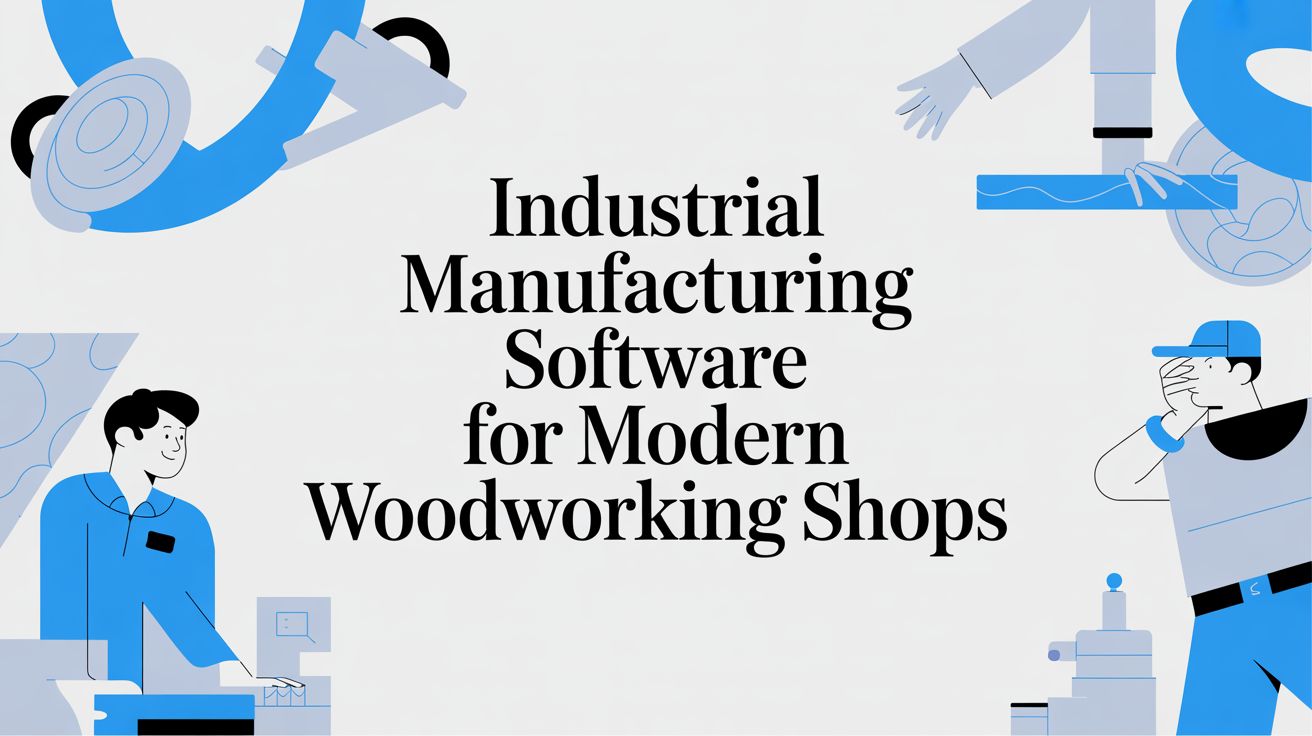
Think of industrial manufacturing software as the central nervous system for a modern shop. It’s a set of digital tools designed to connect every single part of your operation—from the initial sales call and design phase all the way through production and shipping. The goal is to finally replace the frustrating chaos of scattered spreadsheets, sticky notes, and manual data entry with one intelligent, seamless workflow.
The Digital Heartbeat of a Modern Shop
Picture your shop floor right now. If it feels like every department is working on its own little island, you're not alone. The sales team might land a complex custom job, but critical details get lost in translation by the time they hit the production floor. Your design team could create flawless blueprints, but the machinists are stuck working from outdated paper orders.
Sound familiar? This kind of disconnect is what causes crippling bottlenecks, costly mistakes, and disappearing profits.
This is exactly the problem that industrial manufacturing software is built to solve. It isn't just another piece of tech; it's the digital heartbeat that pumps the right information to the right people at precisely the right time. You go from having fragmented, disjointed processes to a unified, data-driven operation where everyone is on the same page.
Your business is custom; your software should be too. Forcing generic tools to manage unique workflows is like trying to build a custom cabinet with only a hammer—it’s frustrating, inefficient, and the results are never quite right.
From Disconnected Stations to a Unified Workflow
Making this shift is more than a simple upgrade. It's a fundamental change in how your entire business operates. To truly get this digital heartbeat pumping, many modern shops rely on specialized manufacturing IT services to seamlessly connect their shop floor equipment (OT) with their office-based systems (IT). This integration is what's fueling massive growth in the market.
In fact, the global industrial software market hit $20.35 billion in 2023 and is on track to reach a staggering $60.91 billion by 2030. North America is leading the charge, accounting for 33.96% of that revenue. This boom shows just how quickly shops are adopting these tools in innovation hubs across the U.S., including right here in Tucson, Arizona, where TimberCloud is headquartered. You can dig deeper into this market expansion in a recent industry report.
Key Types Of Manufacturing Software At A Glance
The world of manufacturing software is filled with acronyms, which can be confusing at first. This table breaks down the most common types and explains what they actually do in plain English.
| Software Type | Primary Focus | Example Use Case |
|---|---|---|
| ERP | Business & Financial Resources | Managing company-wide accounting, human resources, and high-level inventory. |
| MES | Shop Floor Execution | Tracking real-time production status, machine output, and labor on the floor. |
| PLM | Product Lifecycle Management | Managing a product from initial concept and design through to end-of-life. |
| APS | Advanced Planning & Scheduling | Optimizing production schedules based on material availability and capacity. |
| WMS | Warehouse Management | Controlling inventory movement, storage, picking, and packing within a warehouse. |
Each of these systems plays a unique role, but they work best when they can communicate with each other. Understanding their core functions is the first step toward building a tech stack that truly works for your shop.
2. The Five Key Types of Industrial Manufacturing Software
Stepping into the world of industrial manufacturing software can feel a bit like walking into a massive hardware store for the first time. You're surrounded by powerful tools, and each one promises to solve a different problem. So, let's skip the dry, textbook definitions and instead open up the toolbox to see what each major tool actually does for a shop like yours.
Think of it like this: you wouldn't use a finishing sander to rip a sheet of plywood, right? Each tool has a specific, vital role. The same goes for software.

The diagram above shows how a central software system acts as the nerve center of the entire operation. It connects every part of your business—from the first sales call to the final product shipment—and makes sure everyone is working from the same playbook.
ERP and MES: The Brains and The Brawn
You can think of your software stack as having two main players: the business brain and the shop floor general.
At the very top, you have Enterprise Resource Planning (ERP) software. An ERP is the "business brain." It’s focused on the big picture: company-wide financials, high-level inventory, human resources, and sales data. It’s all about making sure the business as a whole is running profitably.
But an ERP isn't built for the minute-by-minute reality of the shop floor. That’s where a Manufacturing Execution System (MES) comes in. If the ERP is the brain, the MES is your best shop floor general—that seasoned foreman who knows exactly what’s happening, what needs to be done next, and who needs to do it. It’s all about real-time production, tracking jobs as they move through stations, and getting the right plans and materials to your team at the perfect moment.
For a deeper dive into how this works on the ground, check out our guide on shop floor management software.
PLM, APS, and WMS: The Specialists
Beyond that core duo, a few other specialized systems handle very specific, but critical, tasks. Think of these as the precision tools in your workshop, like a dovetail jig or a custom routing template.
-
Product Lifecycle Management (PLM): This is the ultimate "single source of truth" for a product's entire journey. A PLM tracks everything from the first napkin sketch and design revisions all the way to engineering changes and final specifications.
-
Advanced Planning & Scheduling (APS): An APS system is your master strategist. It analyzes all your active jobs, material availability, labor, and machine capacity to build the most efficient production schedule possible. It’s a game-changer for spotting bottlenecks before they grind your shop to a halt.
-
Warehouse Management System (WMS): This software is laser-focused on optimizing your warehouse operations. A WMS manages every aspect of your inventory, from receiving and put-away to picking, packing, and shipping. It ensures you know exactly what you have and where to find it.
For many shops, keeping track of certifications, safety protocols, and project documents is a major headache. A dedicated document management system software can replace scattered server folders with a central, organized library, making compliance and audits much simpler.
While each of these systems is powerful on its own, their real magic is unleashed when they work together. An integrated platform allows an order from the ERP to automatically create a schedule in the APS and a work order in the MES. It’s a seamless flow of information from the office to the shop floor, connecting every click to the final creation.
Why Generic Software Fails Custom Woodworking
If you've ever tried to run a custom woodworking shop with generic project management tools or a tangled web of spreadsheets, you know the pain. That system you thought would solve everything? It starts to creak and groan under the pressure. Suddenly, deadlines are slipping, materials aren't showing up on time, and the shop floor feels like organized chaos. It’s because the software was never designed for how you actually work.

It’s the classic square-peg-in-a-round-hole scenario. Your spreadsheet can’t dynamically track lumber as it's cut and used, and that off-the-shelf project tool has no clue what a multi-level Bill of Materials (BOM) for a custom kitchen island even is. You end up spending more time fighting the software than you do managing the actual work.
The Limits of Off-the-Shelf Tools
Generic software simply can't grasp the unique, often non-linear, flow of a custom shop. It’s built for simple, repeatable tasks, not the fluid, ever-changing reality of custom fabrication. This fundamental mismatch creates huge operational blind spots.
For instance, a spreadsheet can't give you the real-time status of a job on the floor. It can't warn you that a specific CNC machine is becoming a bottleneck that will derail three other projects. You're left chasing people down for updates and relying on guesswork—the very things technology is supposed to fix. The hidden danger of spreadsheet-driven planning is that it introduces instability just when you need predictability the most.
These tools just don't have the DNA for manufacturing:
- No Product Configuration: They can't manage the endless variations, optional features, or thousands of combinations that are the bread and butter of custom work.
- No Material-Specific Logic: They don’t understand board feet, how to calculate for waste, or the best way to generate an optimized cut list from a design.
- No Shop-Floor Integration: They can't talk to your machinery, track actual labor time at each station, or push machine-ready files like G-code directly to the floor.
Purpose-Built for Customization
This is where industrial manufacturing software completely changes the game. It’s built from the ground up to handle the exact complexities that break generic tools. This kind of software understands that a "product" might be a one-off masterpiece with unique materials, dimensions, and finishing steps.
Instead of fighting your software, you get a system that speaks the language of your shop. It ties quoting, design, and production together into one seamless flow.
Your business is custom; your software should be too. Forcing generic tools to manage unique workflows is like trying to build a custom cabinet with only a hammer—it’s frustrating, inefficient, and the results are never quite right.
This specialized approach lets you automate the tedious tasks that used to be manual burdens. It gives you the visibility and control you need to grow your operations profitably, all without compromising the craftsmanship that makes your work special.
Unlocking Your Future with AI and Automation
The future of manufacturing isn't some far-off dream—it's happening right now in workshops that are embracing artificial intelligence and smart automation. When you hear terms like "AI" and "automation," it's easy to picture robots taking over. But that's not the reality. The goal is to supercharge your skilled craftspeople, transforming them from laborers into supervisors of a highly efficient, intelligent production system.
Think about it this way: what if you had a system that could instantly read a client's complex architectural blueprints or detailed specifications? Modern industrial manufacturing software, powered by an AI engine, can do just that. It automatically pulls out the critical details, identifies every piece of material, and generates a production-ready work order in minutes. This directly solves some of the most frustrating bottlenecks in any shop: manual data entry mistakes and the long back-and-forth of engineering reviews.
This isn't just a nice-to-have anymore; it's rapidly becoming the key difference between shops that are just getting by and those that are truly thriving. It’s how you take on more complex, high-margin projects without burning out your team or needing to double your staff. Adopting this kind of technology strategically is what makes a company "Future-fit."
From Manual Effort to Automated Execution
The move toward automation is far more than a passing trend. It's a fundamental shift in how the best manufacturers operate. The number of industrial manufacturers expecting to heavily automate their core processes is set to more than double by 2030, jumping from just 18% to a full 50%. And the "Future-fit" companies—the top 20% most agile businesses—are already miles ahead. They expect their use of heavy tech in production to skyrocket from 29% to 76%.
Why the big push? Because leaders see AI as the number one driver for both growth (47%) and productivity (46%). You can see the full data on this shift in this detailed PwC outlook.
This isn't something reserved for giant corporations, either. For custom woodworking and millwork shops, the benefits are immediate and hit right where it counts. The right software platform can completely change your workflow from the initial plan to the final product.
- Intelligent Data Extraction: The software acts like an expert estimator, reading your plans and automatically identifying every dimension, material, and piece of hardware. This eliminates hours of tedious manual takeoff work.
- Automated Work Order Generation: As soon as the data is captured, the system instantly creates a detailed work order, complete with precise cut lists and routing instructions for the shop floor.
- Reduced Engineering Bottlenecks: By automating the painstaking process of translating a design into production steps, your most skilled people are freed up. They can finally focus on genuine problem-solving and innovation instead of mind-numbing data entry.
AI and automation aren't about removing the human element. They’re about removing human error and tedious administrative work, allowing your team to focus on what they do best—building exceptional products.
This kind of smart automation is the missing link between custom, high-touch craftsmanship and profitable, scalable production. It gives you the power to maintain impeccable quality while dramatically boosting your shop's throughput and bottom line. If you're curious to see how you can bring this efficiency to your own shop, our guide on the automation of manufacturing processes is a great next step.
Choosing and Implementing Your Next Platform
Picking a new software platform for your shop feels like a huge commitment, and honestly, it is. But it doesn't have to be a nightmare. The secret isn't finding some mythical "perfect" system. It's about finding the right system for your specific business and having a solid game plan to get it up and running. When you approach it this way, what seems like a monster project becomes a series of manageable steps that deliver a serious return.

Before you even start watching demos, you need to get your priorities straight. Nail down these three criteria first. They'll help you cut through the marketing fluff and find a real partner, not just another software vendor.
- Scalability: Can this software grow with you? A system that’s great for a five-person crew should have a clear, painless path to supporting a fifty-person operation. You don't want to be forced into another massive software hunt in a few years.
- Integration: Your new software can't be a silo. It absolutely must talk to the tools you already rely on, especially your accounting package. A seamless flow of data between systems is non-negotiable.
- Total Cost of Ownership (TCO): Don't get fixated on the sticker price. You need the full picture: implementation fees, training costs, ongoing support, and any per-user licensing. This is the only way to understand the true long-term investment.
Your Five-Step Implementation Checklist
Okay, you've picked your platform. Now comes the critical part: the rollout. A structured plan is your best friend here. Trying to do everything at once is a recipe for disaster. A phased approach prevents your team from getting overwhelmed and lets them build confidence one step at a time. Many shops are pleasantly surprised to find that adopting new cloud-based manufacturing software is much more straightforward than they feared.
Use this checklist to keep your project on the rails.
- Define Clear Goals: What is the single biggest headache you need to fix? Start right there. Maybe it's getting quotes out the door faster or cutting down on costly shop floor mistakes. Focus your initial launch on nailing one or two high-impact wins first.
- Involve Your Team Early: The people on your shop floor live and breathe your workflows every day. Bring them into the conversation from the beginning. Their input is invaluable for setting the system up to match reality, and it builds the buy-in you'll need for a smooth transition.
- Plan Your Data Migration: Think carefully about what historical data you actually need. Is it every job from the last ten years, or just your customer list, product specs, and material libraries? A good software partner will guide you through cleaning up and importing what’s truly essential.
- Execute a Phased Rollout: Seriously, don't try to flip the switch on everything at once. Start with one core module, like quoting or generating work orders. Let the team get comfortable and see the benefits. Then, and only then, move on to the next piece.
- Measure and Adjust: How will you know if it's working? Track your key numbers before and after. Are quotes getting approved faster? Has material waste gone down? Use this hard data to prove the ROI to yourself and your team, and to decide where to focus your efforts next.
A successful software implementation isn’t a one-and-done event; it’s the beginning of a process of continuous improvement. By starting with clear, achievable goals and making your team part of the solution, you lay the foundation for real operational excellence and a healthier bottom line.
Answering Your Key Software Questions
Thinking about bringing in new software can feel overwhelming, especially when you're busy just keeping the shop running. It's only natural to have a few big questions swirling in your head. Is my shop the right size for this? Will it completely disrupt everything we do? Can my team even figure it out?
Let's cut through the noise and tackle these questions directly.
Is My Shop Too Small for This Software?
Absolutely not. That’s a myth left over from the old days when only giant corporations could afford powerful industrial manufacturing software.
Today's cloud-based systems are built to scale. You can start small and affordably, focusing on the features that will make the biggest impact right now—like getting quotes out faster or tracking jobs on the floor. As your business grows, the software grows with you. The whole point is to get you a win, right out of the gate, no matter your size.
How Long Does It Take to Get Started?
Probably a lot faster than you’re imagining. We’re talking weeks, not months. The horror stories of year-long implementations are a thing of the past, especially with all-in-one cloud platforms.
The trick is to find a partner with a clear, step-by-step onboarding plan. A smart rollout will focus on your biggest headaches first. This gets you a quick, tangible return and builds momentum for everything that comes next.
The best modern software is designed for real people, not computer scientists. It uses intuitive interfaces that often mirror the workflows your team already knows. The focus is on practical, real-world application, not a bunch of technical jargon.
Will My Team Struggle to Learn New Software?
This is a huge, and perfectly valid, concern. But the right platform is designed to be easy to pick up. Look for a vendor that provides solid training and is there for you with ongoing support after you go live.
Here’s a pro tip: involve your key team members in the decision-making process from the start. When they have a say in choosing the tool, they take ownership of it. That makes the transition to using it every day a whole lot smoother.
Ready to see how a platform built specifically for your world can make a difference? TimberCloud, Inc. brings e-commerce, shop management, and AI together in one system designed for the custom woodworking industry. Explore the platform and book your personalized demo today.
Topics
TimberCloud Team
Content Team
The TimberCloud team is dedicated to helping manufacturers streamline their operations with intelligent software solutions.