Cloud Based Manufacturing Software Explained
Think about trying to coordinate a global logistics operation using nothing but landline phones and paper maps. Sounds crazy, right? Yet, for a long time, that’s essentially how many manufacturers operated with their traditional, on-premise software—powerful, but completely locked down to a single physical location.
Cloud-based manufacturing software is the modern answer. It untethers your entire operation from the server room, giving you a flexible, internet-based command center to manage everything from anywhere with a connection.
Why Modern Manufacturing Is Moving to the Cloud
For decades, the standard was to have your manufacturing software live on a dedicated server humming away in a back office. This on-premise model worked, but it came with some serious baggage. Updates were a manual, often disruptive, process. Accessing data remotely was a pipe dream. And scaling up? That meant buying expensive new hardware and bracing for significant downtime. Your system was a fortress, but it was also a cage.
This old way of doing things is a lot like that landline phone—it does one job reliably in one spot, but it's completely out of its depth in today's fast-paced, interconnected world. Cloud-based manufacturing software, on the other hand, works more like a smartphone. It links every part of your business—from sales and engineering to the shop floor and your supply chain partners—into one secure and incredibly accessible online hub.

Breaking Down Data Silos
In a typical on-premise setup, information gets stuck in departmental cul-de-sacs. The sales team's forecast doesn't talk to the production schedule, and the inventory numbers you're looking at might be hours, or even days, out of date. These "data silos" mean different teams are working from different realities, which inevitably leads to costly mistakes, missed deadlines, and wasted resources.
Cloud software knocks down those walls. By pulling all your operational data into a single, central location, it ensures everyone is reading from the same sheet of music.
The real game-changer is creating a single source of truth. When your sales, engineering, and production teams all see the exact same live data, you eliminate guesswork and empower smarter, faster decisions across the board.
Enabling Agility and Scalability
At its core, the move to the cloud is all about becoming more agile. Manufacturers today need to react to market shifts in real time, not in weeks or months. With the cloud, adding a new production line, opening another facility, or bringing a remote team into the fold no longer requires a massive IT project.
This new way of working delivers some pretty powerful, practical advantages:
- Real-Time Accessibility: A floor manager can check a machine's status from a tablet, while an executive can review production dashboards from a laptop halfway around the world.
- Reduced IT Burden: You get to offload all the headaches of server maintenance, security patches, and software updates to your provider. This frees up your team to focus on what they do best: making things.
- Effortless Collaboration: Designers in one country can work on the same CAD files in real-time with production engineers in another, slashing development cycles.
When it's all said and done, shifting to the cloud is more than just a technical upgrade. It's a fundamental business decision to build a more resilient, connected, and competitive manufacturing operation that’s ready for whatever comes next.
How Does Cloud Manufacturing Software Actually Work?
Let’s start with an analogy you’re probably familiar with: streaming services. Think about how you watch movies today. Instead of keeping a huge collection of DVDs that take up shelf space and can get lost or scratched, you just log into a service like Netflix. The movies aren't on your device; they live on powerful remote servers—the cloud—and you can stream them anytime, anywhere, with an internet connection.
Cloud manufacturing software applies that exact same idea to your factory floor. Rather than installing clunky, expensive software on a dedicated server tucked away in a closet, your entire manufacturing operation is hosted online by a specialized provider. This is what's known as Software as a Service (SaaS). You simply pay a subscription fee, and the provider takes care of all the heavy lifting in the background—security, updates, backups, and maintenance.
This simple shift completely changes the game. Your data is no longer siloed on one machine or stuck within your local network. It’s centralized, secure, and available in real-time to anyone on your team who needs it, whether they’re on the shop floor with a tablet or meeting a client on the other side of the country.
The Core Components of Your Digital Factory
Think of a cloud platform as the digital nervous system for your manufacturing business. It connects every department and process, making sure information flows smoothly from one area to the next. This system is typically built around a few key modules, but the two most critical are the ERP and the MES.
-
Enterprise Resource Planning (ERP): This is the business brain of your company. Your ERP system handles the big-picture functions like finance, accounting, sales orders, customer relationship management (CRM), and managing the broader supply chain. It’s focused on the "what" and "when"—what needs to be made and by what deadline.
-
Manufacturing Execution System (MES): If the ERP is the brain, the MES is the shop floor supervisor. An MES is all about the "how." It manages and monitors work-in-progress on the factory floor as it happens, tracking everything from machine uptime and operator performance to quality control checks.
In the past, these two systems were often completely separate, creating frustrating data silos and communication breakdowns. One of the biggest wins with modern cloud based manufacturing software is its ability to merge these two worlds onto a single, connected platform.
By bringing ERP and MES functions together in the cloud, you establish a "single source of truth." When a new sales order is created in the ERP, it can instantly and automatically generate a production schedule in the MES. This gives you end-to-end visibility, from the initial quote all the way to final shipment, without anyone having to manually copy-paste data between spreadsheets.
A Unified Platform for Smarter Decisions
This deep integration is where the magic really happens. Picture this: your sales team lands a massive, rush order. With a unified cloud system, that order immediately checks your live raw material inventory, reserves capacity on the production schedule, and updates your financial forecasts—all at once. Everyone from the CEO looking at profit margins to the machine operator checking their next job sees the same up-to-the-minute information, tailored to what they need to know.
This level of connectivity is fueling massive growth in the industry. The global market for cloud manufacturing software is ballooning, projected to grow from $2.93 billion in 2021 to an estimated $8.60 billion by 2033. Why the surge? Manufacturers are hungry for the real-time analytics and deep operational insights that only a connected cloud platform can deliver. You can explore more about these market trends and what's driving them.
At its core, cloud-based manufacturing software works by tearing down the walls that have traditionally separated your business offices from your production floor. It creates a responsive, data-driven environment where information flows freely, empowering your team to make smarter, faster decisions that cut waste, boost efficiency, and drive real growth.
The Core Features Driving Production Efficiency
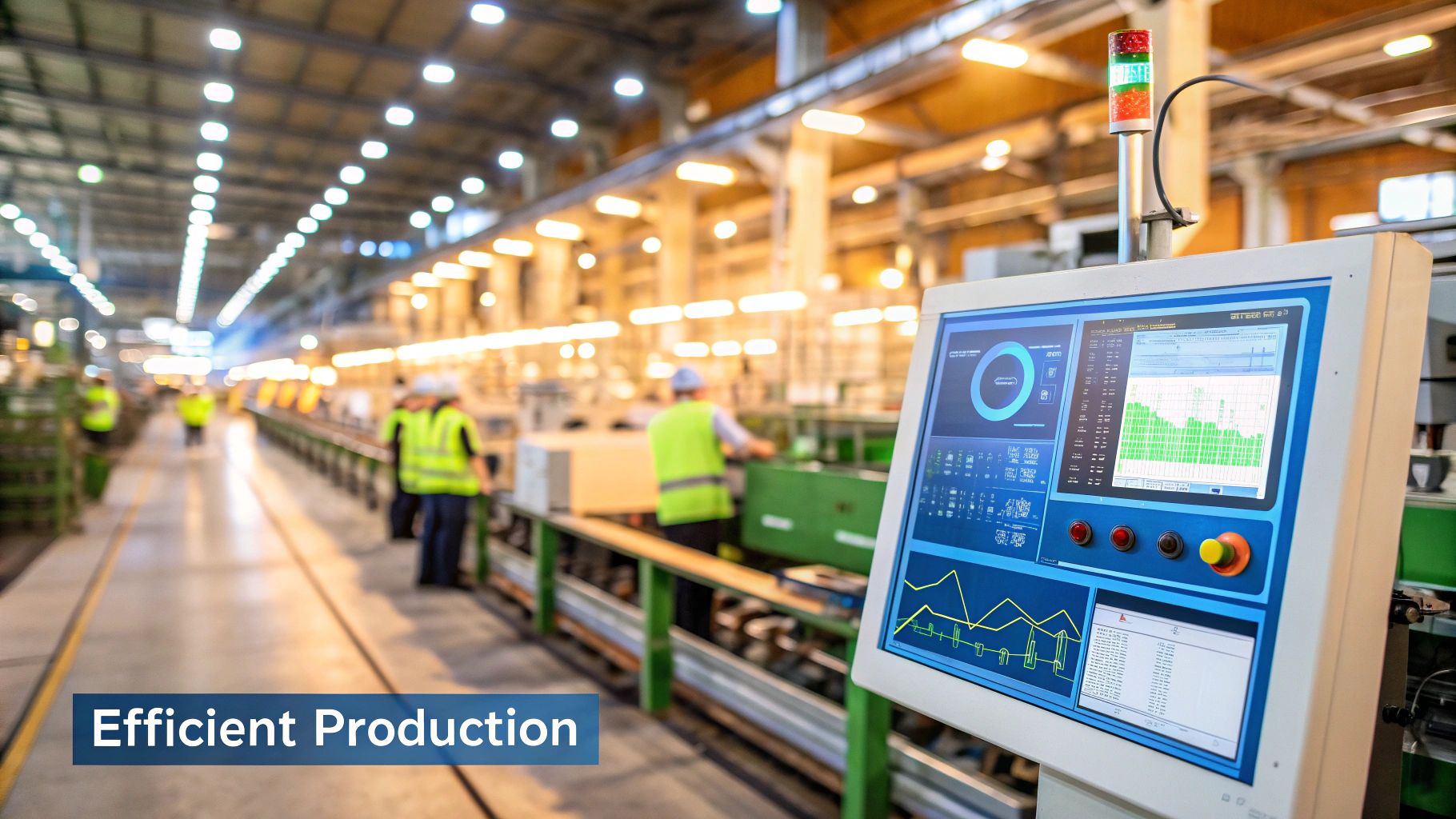
To really get what makes cloud-based manufacturing software tick, you have to look under the hood at the specific tools that change how you work every day. These aren't just minor tweaks; they represent a complete shift in how you see, manage, and fine-tune your entire production flow.
When you connect each feature to a real-world business outcome, its value becomes crystal clear. These tools don't operate in silos—they work together to build a transparent, connected, and incredibly efficient manufacturing operation.
Real-Time Dashboards and Analytics
Could you imagine flying a plane if the instruments only updated every few hours? That's what it feels like to run a modern factory using last week's spreadsheets. Cloud software swaps that guesswork for real-time dashboards, giving you a live control center for your entire shop floor.
These aren't just pretty charts. They pull live data from every machine, workstation, and inventory shelf, then display it in a way that makes immediate sense. You can see production rates, machine downtime, and quality control metrics as they happen. This constant feedback loop empowers managers to spot a bottleneck and fix it in minutes, not days.
A key benefit of cloud based manufacturing software is turning raw data into actionable intelligence. When you can see a production line's efficiency drop by 7% in real-time, you can intervene immediately, preventing a small hiccup from becoming a costly delay.
Intelligent Inventory and Supply Chain Visibility
Good inventory management is a tightrope walk. Carry too much, and you've got capital and space tied up. Carry too little, and you risk production grinding to a halt. Cloud software gives you the visibility you need to strike that perfect balance.
Instead of relying on tedious manual counts, the system tracks materials automatically as they're used and finished goods as they come off the line. What you get is a live, perpetual view of your entire inventory.
- Automated Reordering: Simply set your minimum stock levels. When supplies dip below that threshold, the system can automatically generate a purchase order so you never run out of critical parts.
- Full Supply Chain Visibility: You can track raw materials from the moment they leave your supplier's dock to their arrival on your factory floor. This gives you a much clearer picture of lead times and helps you anticipate potential disruptions.
- Waste Reduction: With precise data on material usage, you can finally pinpoint and eliminate sources of waste, which directly boosts your bottom line.
This level of control ensures you have exactly what you need, right when you need it. For those in the custom manufacturing world, understanding how these features mesh together is everything. You can see a detailed breakdown by exploring the comprehensive features of our platform.
Predictive Maintenance Capabilities
For years, machine maintenance has been stuck in two inefficient cycles: reactive (fixing things after they break) or calendar-based (servicing them whether they need it or not). Both are costly. Cloud platforms offer a much smarter path forward with predictive maintenance.
Think of it as your equipment sending you a heads-up that it needs a tune-up—long before it actually fails. By connecting sensors to your machinery (as part of the Internet of Things, or IoT), the software constantly monitors vital signs like temperature, vibration, and energy use.
When the system's algorithms spot a pattern that suggests a future failure, it automatically triggers a maintenance alert. This proactive approach pays off in a big way:
- Drastically Reduces Unplanned Downtime: Some studies show that unplanned downtime can cost manufacturers as much as $260,000 per hour. Predictive maintenance helps you avoid these catastrophic—and expensive—failures.
- Extends Equipment Lifespan: Taking care of machines with targeted, timely service keeps them running in peak condition for much longer.
- Lowers Repair Costs: It's almost always cheaper and faster to fix a small, developing issue than it is to deal with a major breakdown.
By moving from a reactive to a predictive model, cloud manufacturing software turns maintenance from a frustrating cost center into a genuine strategic advantage.
The Real-World Payoff: What Cloud Software Does for Your Business

Cool features are one thing, but what really matters is how they help your business. Moving to cloud based manufacturing software isn't just a tech upgrade; it's a fundamental business decision that strengthens your finances, makes you more agile, and gives you a serious competitive advantage. The impact is felt everywhere, from the front office right down to the shop floor.
To really get it, let's break down the benefits across four key areas: how you manage money, how you grow, how your team works together, and how you make critical decisions. Each one is a massive step up from the old way of doing things with on-site software.
A Smarter Financial Model
In the past, getting new manufacturing software meant writing a huge check. You had to buy servers, pay for software licenses, and then pay a team to spend weeks installing everything. This capital expenditure (CapEx) model locks up cash that you could be using to hire people or buy new equipment.
Cloud software completely changes the game by switching you to a predictable operating expense (OpEx).
- No Big Upfront Investment: You skip the hardware purchase and instead pay a predictable subscription fee, usually monthly or annually.
- Simple, Consistent Budgeting: This subscription makes financial planning much easier. No surprise costs.
- Maintenance Included: The provider handles all the updates, security patches, and server upkeep as part of your fee.
This kind of financial freedom is huge, particularly for small and mid-sized manufacturers. You can get a better feel for this by exploring different cloud software pricing structures.
Grow Without the Headaches
Picture this: you land a massive new contract. Great news, but now you need to add a second shift or even open a new facility. With old-school on-premise software, that means a slow, expensive process of buying more hardware, dealing with complex IT setups, and accepting a lot of downtime.
Cloud platforms are designed for exactly this kind of growth. Scaling your operations is often as simple as updating your subscription.
Suddenly, your ability to grow is no longer limited by your IT infrastructure. You can add new users, connect new machines, or bring entire locations online in minutes—not months. This gives you the speed to jump on market opportunities the moment they appear.
Collaboration That Actually Works
Let's be honest, modern supply chains are spread out. Your engineers might be in one state, your production team in another, and your sales folks are on the road. When everyone is working from different systems, you get a mess of outdated spreadsheets and confusing email threads.
A centralized cloud platform acts as a single source of truth for the entire company. An engineer can tweak a design, and the updated cut list is instantly live for the operator on the shop floor. This direct, real-time connection prevents the delays and expensive mistakes that come from bad communication.
This is why the market is exploding. The global cloud manufacturing industry is expected to be worth $317.74 billion by 2035, a staggering increase from its $72.20 billion valuation. As you can read in this full market analysis, this boom is driven by companies realizing the power of unifying their data and operations.
When you tear down the walls between departments and locations, you get a smarter, faster, and more unified team.
Your Roadmap for a Smooth Implementation
Switching to a new cloud-based manufacturing platform feels like a huge project, and it is. But with the right plan, it's a manageable and incredibly rewarding one. A successful move isn't just about plugging in new software; it’s about getting your people, your processes, and your data all on the same page.
Think of it less as a disruptive event and more as a guided evolution for your business. We'll break the journey down into four clear phases, taking you from initial planning all the way to go-live. Following this path will help you sidestep common pitfalls, get your team excited, and start seeing a return on your investment much faster.
Phase 1: Assess Your Factory Needs
Before you even look at a single piece of software, you need to take a hard look at your own operations. This is the foundation for everything that follows, so don't rush it. Start by walking through your entire workflow, from the moment a quote request comes in to the moment a finished product ships out the door.
The real goal here is to pinpoint your biggest headaches and hidden opportunities. Where are the bottlenecks slowing you down? Which manual tasks are eating up valuable time? What information do you constantly wish you had at your fingertips?
- Map It Out: Grab a whiteboard and literally draw out how jobs and information move through your shop. You'll be surprised what you uncover.
- Talk to Your Crew: The real experts are the people doing the work every day. Get insights from the shop floor, the front office, and your management team. They know the real-world problems that software needs to solve.
- Set Clear Goals: What does success look like? Be specific. Maybe you want to slash lead times by 15%, cut down on material waste, or nail your on-time delivery dates.
This honest self-assessment becomes your shopping list. It ensures you find a system that solves your unique problems, not just a generic, one-size-fits-all platform.
Phase 2: Choose the Right Software Partner
With a clear picture of what you need, you can start looking for the right fit. And I use the word "partner" intentionally—you’re not just buying a product, you’re investing in a relationship. The best partner will get your industry, whether you’re a custom cabinet shop or a high-volume metal fabricator, and offer a tool that feels like it was built for you.
Look past the slick sales demos and dig into the core functionality. Can it actually handle your tricky product configurations? How well does it track raw materials versus finished goods? Remember, a great partnership includes top-notch support long after the initial setup is done.
"A classic mistake is getting fixated on the initial price tag. You have to think about the total cost of ownership—implementation, training, and ongoing support. The right system is an investment that grows with your business, not a temporary patch."
Phase 3: Plan Your Data Migration and Integration
This is where things get technical, and it’s arguably the most critical step. All your historical data—customer records, job histories, part numbers—is pure gold. You need a solid plan to clean it up, format it, and move it into the new system without losing anything important.
First, decide what actually needs to come over. You might not need every piece of data from the last decade. Sometimes, it’s a good opportunity for a clean start. Then, work hand-in-hand with your software partner to map the old data fields to the new ones.
You also need to figure out how the new cloud based manufacturing software will talk to your other essential tools, like your accounting package or shipping software. Thankfully, most modern platforms have pre-built integrations that make this a whole lot easier than it used to be.
Phase 4: Execute a Pilot Program and Train Your Team
Whatever you do, don't try to change everything overnight. That’s a recipe for chaos. Instead, run a pilot program. Pick one department, one machine, or one production cell to be the guinea pig. This lets you iron out the wrinkles in a controlled, low-risk environment.
This is also the perfect time to get your team trained up. Good training is the key to getting people on board. Let’s be honest, most people don’t love change. You have to show them how this new tool makes their job easier, not just different. Customize the training for each role.
- Shop Floor Staff: Get them comfortable with tracking production, clocking into jobs, and pulling up digital work orders.
- Office Team: Focus on quoting, order entry, purchasing, and running reports.
- Management: Show them how to use the dashboards and analytics to get a real-time pulse on the business.
A successful pilot program builds incredible momentum. It creates internal champions who will help sell the new system to the rest of the company. When you’re ready to see how a platform could work for you, you can create an account to explore the features and kick off your own evaluation.
How AI and IoT Are Shaping the Future of Manufacturing
Moving to cloud-based manufacturing software isn't just about modernizing your current operations; it's about getting ready for what's next. The real game-changers on the horizon are Artificial Intelligence (AI) and the Internet of Things (IoT), and both depend on a strong cloud infrastructure to deliver on their promise. These aren't just buzzwords—they are practical technologies already being used to build smarter, more automated factories.
Think of it like this: IoT is the nervous system of your factory, and AI is the brain. Tiny IoT sensors attached to your equipment are constantly gathering data—temperature, vibration, cycle times—and feeding it into the cloud. AI algorithms then dive into that massive data stream, spotting patterns and making predictions that are simply beyond human capability.
The Rise of the Smart Factory
This duo is making things possible on the factory floor that once felt like pure science fiction. We're seeing production lines that can predict when they'll need maintenance, tweak their own settings for better efficiency, and even identify quality issues all on their own.
- Autonomous Quality Control: Imagine AI-powered cameras scanning products on the assembly line with pinpoint accuracy. They can catch microscopic defects that a human eye would miss and immediately flag the item for inspection, all without slowing things down.
- Self-Optimizing Production: Machine learning models can sift through your production history to figure out the absolute best machine settings, material flow, and even staffing schedules. It's like having a consultant constantly fine-tuning your entire operation for maximum performance.
The ultimate goal here is a resilient, self-healing factory. A cloud platform is the connective tissue that allows all these advanced systems to talk to each other, learn, and adapt, turning your facility into a powerful strategic asset.
The infographic below outlines the fundamental stages of moving to a cloud system, which is the necessary groundwork for these future innovations.
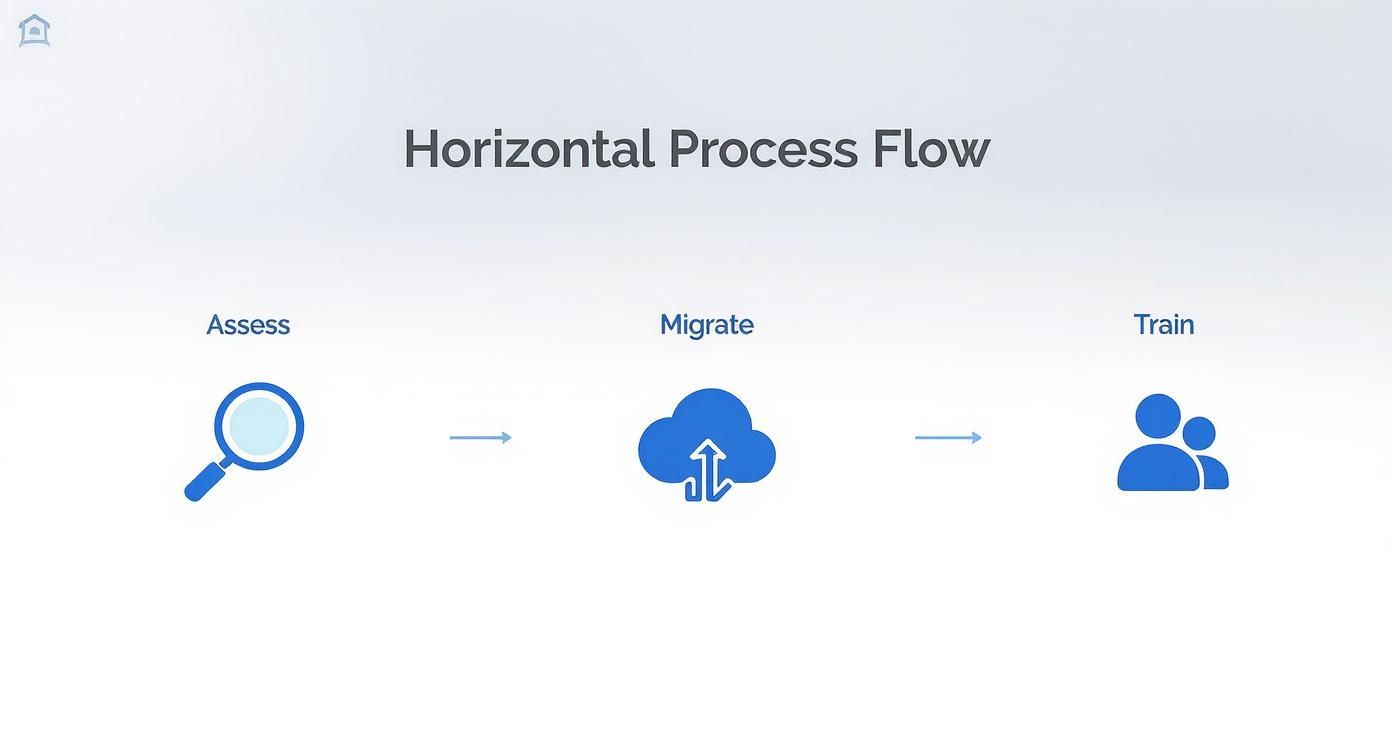
This process shows how a disciplined approach—starting with a clear needs assessment, followed by careful data migration and team training—creates the stable foundation needed for advanced tools like AI and IoT.
Digital Twins and Predictive Simulation
One of the most exciting concepts emerging from this is the Digital Twin. This is an exact virtual replica of your factory that exists in the cloud, constantly updated with live data from your physical IoT sensors. With a digital twin, you can run simulations and ask critical "what-if" questions without ever disrupting the actual production line. Want to test a new layout or predict how a machine will behave under stress? You can do it all in the virtual world first.
This kind of forward-looking capability is a big reason the manufacturing software market is shifting. While the total market has hit $44.7 billion globally, cloud solutions are quickly becoming the standard because they can integrate with these powerful new tools. The top 10 vendors, like SAP and Microsoft, now hold 46.7% of the market by offering the platforms needed for this kind of innovation. You can discover more insights on these market trends to see where the industry is heading.
Getting on the cloud is your entry ticket to this future. It’s what positions your company not just to keep up, but to lead the charge in building a smarter, faster, and more durable manufacturing operation.
Frequently Asked Questions
When you're looking at making a big technology change, you're bound to have questions. It's smart to have them. Deciding if cloud-based manufacturing software is the right fit for your shop means getting clear, straight answers.
Let's dig into some of the most common questions we hear from manufacturers who are standing right where you are.
Is My Data Actually Secure in the Cloud?
This is usually the first question out of the gate, and for good reason—your production data is one of your most valuable assets. The reality is, reputable cloud software providers invest in security on a scale that most small or mid-sized manufacturers simply can't match.
Think of it this way: keeping your data on a server in your back office is like stashing cash under your mattress. Moving to a professional cloud provider is like putting it in a modern bank vault, complete with multiple layers of protection:
- Top-Tier Firewalls: These are advanced systems built to repel unauthorized access.
- Data Encryption: Your information is scrambled both in storage and during transit, making it gibberish to anyone without the key.
- Constant Monitoring: Dedicated security teams watch for any red flags around the clock, 24/7.
- Automatic Backups: Your data is continuously copied to different secure locations, so if disaster strikes, a restore is quick and painless.
For the vast majority of businesses, switching to the cloud is a massive security upgrade.
Will This Software Even Work with My Old Machines?
Yes, absolutely. There's a common myth that you need a factory floor full of shiny, brand-new equipment to get any value from cloud software. That couldn't be further from the truth. Most modern platforms are specifically built to connect your tried-and-true legacy machines with new technology.
This is usually done with small, inexpensive IoT (Internet of Things) gateways or sensors. You can attach these devices to your existing equipment to pull out critical data—like cycle times, uptime, or error codes—and send it straight to the cloud. It’s a way to bring your older, reliable workhorses into the digital fold without a huge capital expense.
The real power of modern cloud based manufacturing software is its flexibility. It's not about forcing you to rip and replace everything. It’s about giving you the tools to connect what you already own and finally unlock the valuable data trapped inside.
How Long Is This Going to Take to Implement?
This is a "how long is a piece of string" question, as the timeline depends on the size of your operation and how organized your data is. But the good news is that it’s worlds faster than old-school, on-premise software rollouts. Those dinosaurs could easily take a year or more.
A typical cloud software implementation is much quicker, usually falling somewhere between a few weeks and a few months. The best strategy is often a phased approach. Start with a pilot program on a single production line or in one department. This lets you iron out any wrinkles and build some quick wins before you go all-in across the company.
Ready to see how a unified cloud platform could pull your manufacturing operations together? TimberCloud, Inc. brings e-commerce, ERP, and AI-powered production tools into a single system designed for custom manufacturers. Explore TimberCloud and start your digital transformation today.
Topics
TimberCloud Team
Content Team
The TimberCloud team is dedicated to helping manufacturers streamline their operations with intelligent software solutions.