Supply Chain Inventory Control for Woodworkers
Staring at stacks of expensive lumber or waiting on a critical hardware shipment? You're facing the central challenge of any custom woodworking shop: mastering supply chain inventory control. This isn't just corporate jargon—it's the practical system for having the right materials at the right time without tying up all your cash in idle stock.
Building a Smarter Woodworking Operation

Think of it like a master chef running their pantry. They always have essentials like flour and sugar on hand, but they only order rare truffles when a specific recipe calls for them. That’s the core of inventory control: a strategic balance between availability and cost.
For a custom millwork business, this means getting beyond guesswork and gut feelings. A well-oiled system turns your inventory from a headache into a real competitive edge. It's the difference between telling a client "we're waiting on parts" and confidently giving them a firm delivery date. This guide is your roadmap, taking you from the basic ideas to actionable strategies you can put to work with tools like TimberCloud.
The Shift Toward Resilient Sourcing
If the last few years have taught us anything, it's that relying on a single supplier is a recipe for disaster. Smart companies are now building resilience directly into their supply chains. By 2025, it's expected that around 50% of firms will have adopted multi-shoring strategies, splitting orders across different regions instead of putting all their eggs in one low-cost basket.
This approach cushions businesses against everything from port closures to political instability, boosting supply reliability by roughly 10 percentage points. Even a small custom shop can apply this logic. Find a secondary supplier for critical items like your go-to drawer slides or a specific species of plywood. The whole point is to create a more predictable flow of materials into your workshop.
Effective supply chain inventory control gives you options. It ensures that a delay from one supplier doesn't bring your entire production schedule to a grinding halt, protecting both your timeline and your reputation.
More Than Just Counting Stock
Ultimately, building a smarter operation is about fine-tuning every step of your process. You need to know exactly what you have, what you need, and when you'll need it. Simple improvements can have a huge impact; for example, specific handling and packaging methods can enhance your supply chain efficiency and reliability.
This guide will help you build a solid system by focusing on:
- Core Concepts: Breaking down terms like demand forecasting and safety stock with real-world, shop-floor examples.
- Key Metrics: Pinpointing the numbers that actually measure your inventory health and profitability.
- Practical Strategies: Putting proven methods for reordering, counting, and managing materials into practice.
- Modern Technology: Using tools to automate tedious tasks and get a clear, real-time view of your stock.
By getting a handle on these elements, you can create a lean, responsive, and far more profitable business.
Translating Inventory Concepts to the Shop Floor
Let's be honest, business jargon can feel a world away from the reality of sawdust and deadlines. But good supply chain inventory control isn't about memorizing formulas; it's about putting a few simple ideas to work so your shop runs like a well-oiled machine. We're going to translate these core concepts into the language of woodworking, turning abstract terms into tools you can use today.
Picture this: you're looking at the next six months of work. You've got signed contracts, a handful of promising bids out, and you pull up your job history from this time last year. That’s not just planning—that’s demand forecasting. It’s the art of looking ahead to predict what materials you'll need and when you’ll need them.
This isn’t about gazing into a crystal ball. It's about making educated guesses based on the facts in front of you, so you can get ahead of material orders instead of constantly playing catch-up.
Building Your Material Safety Net
Has this ever happened to you? You're in the middle of a huge kitchen cabinet job, and your supplier calls to say that Baltic Birch shipment is delayed by two weeks. That emergency stash of panels you keep in the back for exactly this kind of fire drill? That has a name: safety stock.
Safety stock is simply the buffer inventory you keep on hand to guard against two big unknowns:
- Supplier Uncertainty: Shipping delays, quality control problems, or your vendor suddenly running out of something you need.
- Demand Spikes: A client calls with a rush job, or a project unexpectedly expands, requiring more material than you originally planned for.
Holding safety stock isn't about hoarding materials; it's a calculated insurance policy. For your most critical, high-use items—think common sheet goods or your go-to drawer slides—having a small surplus prevents a supplier’s hiccup from turning into your production nightmare. It’s what keeps the work flowing when things don't go according to plan.
Think of safety stock as your shop’s fire extinguisher. You hope you never have to use it, but when a problem flares up, you're incredibly glad it’s there to stop a small issue from burning down your entire schedule.
Mastering Time and Quantity
Beyond that safety net, two other ideas are crucial for getting your inventory right: lead time and lot sizing. Nailing these helps you order with precision, which frees up both cash and precious shop space.
Lead Time Management is just a formal way of saying you know how long it takes to get something after you order it. That custom-milled cherry moulding might have a six-week lead time, while standard hardware shows up in two days. Tracking this is everything—it tells you exactly when to place an order so materials land on your doorstep right when you need them, not weeks before.
Lot Sizing, on the other hand, is all about how much you order at once. Sure, buying a full pallet of plywood might snag you a 15% discount, but can you afford the upfront cost and, just as importantly, where are you going to put it all? Lot sizing is the balancing act between scoring a bulk deal and tying up cash and space.
Keeping Your Counts Honest
Finally, let’s talk about cycle counting. Forget shutting down the entire shop for a dreaded, all-hands-on-deck annual inventory count. Instead, you just count small, manageable sections of your inventory on a regular, rotating schedule. This turns inventory management into a continuous, low-stress habit.
You could set up a simple schedule like this:
- High-Value Items (Weekly): A quick count of your most expensive lumber, like walnut slabs or exotic veneers.
- Medium-Value Items (Monthly): Tally up sheet goods, high-end hardware, and specialty finishes.
- Low-Value Items (Quarterly): Check your levels on screws, dowels, and other consumables you buy in bulk.
This approach keeps your inventory records accurate all the time, without the massive disruption of a full shutdown. And an accurate count is the bedrock of good supply chain inventory control. It ensures the numbers in your system actually match what’s on your shelves, preventing you from ordering material you already have or—far worse—starting a job only to realize a critical component is missing.
Tracking the Metrics That Actually Matter
If you want to truly get a handle on your supply chain inventory control, you need to stop running on gut feelings and start making decisions based on data. The only way to do that is by tracking the right numbers—the key performance indicators (KPIs) that tell you the real story about the health of your inventory. Think of these metrics as the dashboard for your shop; they show you what's working and what's silently bleeding cash.
Once you begin measuring, you get an honest look in the mirror. You can finally stop guessing which materials are dead weight and start making intelligent, fact-based purchasing decisions. Let's dig into the essential numbers every custom woodworking shop should have on its radar.
The Power of Inventory Turnover Rate
First on the list is your Inventory Turnover Rate. This is one of the most powerful indicators of how efficiently you’re using your materials. Simply put, it tells you how many times your shop sells and replaces its entire stock of materials over a given period, usually a year. A higher number is almost always better. It's a clear sign that materials aren't just sitting on the shelves collecting dust and tying up your money.
The formula is straightforward:
Inventory Turnover Rate = Cost of Goods Sold (COGS) / Average Inventory Value
Let’s say your shop’s COGS last year was $400,000, and the average value of the inventory you had on hand was $50,000. Your turnover rate would be 8. That means you burned through and replaced your entire inventory eight times. But if next year that rate drops to 4, it’s a major red flag. It might signal you’re overstocked on slow-movers, like that pricey exotic veneer you bought for a job that fell through.
Uncovering Your True Carrying Costs
What does it really cost you to hold onto all that lumber, hardware, and finishing supplies? That’s what your Carrying Costs of Inventory tell you, usually shown as a percentage of your total inventory value. This isn't just about the initial purchase price—it’s about all the hidden expenses that slowly chip away at your profits.
These costs are a mix of things you might not think about, including:
- Capital Costs: The opportunity cost of having cash tied up in inventory instead of being invested elsewhere in the business.
- Storage Costs: The rent on your warehouse space, utilities to keep it running, and insurance to protect it.
- Service Costs: The software you use to track everything and the labor costs for your team to handle and manage materials.
- Risk Costs: The very real possibility of materials getting damaged, becoming obsolete, or even getting lost or stolen.
Industry experts estimate that annual carrying costs can run anywhere from 20% to 30% of your inventory's value. So, if you're holding $100,000 in average inventory, you could be spending up to $30,000 a year just for it to sit there. Knowing this number makes the financial hit of over-ordering painfully clear.
Measuring Speed with Order Cycle Time
Last but not least, Order Cycle Time tracks the total time it takes from the moment a customer signs off on a project to the moment it's delivered. In a custom shop, this is a massive indicator of both your internal efficiency and your client's happiness. Shorter cycle times mean you're getting projects out the door faster, which means happier clients and faster payments.
This metric is fantastic at shining a spotlight on bottlenecks. Is your cycle time dragging because you’re constantly waiting weeks for a specific hardwood supplier? Or is it because projects are stalling on the shop floor while you wait for a back-ordered set of hinges? Finding these delays is the first step to fixing them and building a more predictable, reliable workflow from sale to delivery.
To give you a clearer picture, here’s a quick-glance table of the most critical inventory KPIs for a shop like yours.
Essential Inventory KPIs for Woodworking Shops
These metrics provide a snapshot of your inventory health, helping you spot problems before they escalate and turn into major financial drains.
| KPI (Key Performance Indicator) | What It Measures | Simple Formula | Ideal Outcome |
|---|---|---|---|
| Inventory Turnover Rate | How quickly materials are used and replaced. | COGS / Average Inventory Value | Higher is better. Shows efficient use of capital and less risk of obsolete stock. |
| Carrying Costs | The total cost of holding inventory. | (Sum of All Holding Costs) / Total Inventory Value | Lower is better. Reduces overhead and frees up cash for other business needs. |
| Order Cycle Time | The speed from order placement to final delivery. | Time of Delivery - Time of Order | Shorter is better. Leads to higher customer satisfaction and improved cash flow. |
| Stockout Rate | How often you run out of a needed item. | (Number of Stockouts / Total Orders) x 100 | As close to zero as possible. Prevents production delays and rush-order fees. |
Tracking these KPIs isn't just about crunching numbers; it's about building a stronger, more resilient, and more profitable business. They form the foundation of an effective supply chain, giving you the clarity needed to make the right moves.
Putting Practical Inventory Strategies to Work
Knowing your inventory metrics is like having a good set of blueprints—it shows you what needs to be built. But now it’s time to pick up the tools and put that knowledge into action. Real supply chain inventory control isn't about complex theories; it's about building smart, repeatable processes that become second nature in your shop.
This is where you move from just tracking numbers to actively steering your material flow. The goal is a system where you’re consistently making small, correct decisions that add up to major gains in efficiency and profit. These strategies are the bridge between seeing your inventory problems and actually fixing them.
Defining Your Reorder Points and Policies
One of the simplest yet most effective moves you can make is setting a reorder point (ROP) for your staple materials. Think of it as the low-fuel light on your truck's dashboard. It’s a preset inventory level that, once hit, automatically triggers an order for more. This takes all the guesswork and last-minute panic out of the equation.
Calculating a basic reorder point is pretty straightforward:
Reorder Point = (Average Daily Usage x Average Lead Time in Days) + Safety Stock
Let's say your shop goes through 50 drawer slides a week (10 per day), and it takes your supplier 5 days to deliver. You’d need 50 slides just to cover that wait time. If you add a safety stock of 25 to guard against unexpected delays, your reorder point becomes 75 slides. As soon as your stock hits that number, it's time to place a new order.
This system is perfect for high-volume items like fasteners, adhesives, and standard hardware. But for that one-of-a-kind slab of Claro Walnut, a just-in-time (JIT) approach makes more sense. You only order these expensive, slow-moving materials after you have a signed contract and a deposit in hand, which keeps cash and space from being tied up unnecessarily.
Implementing a Practical Cycle Counting Schedule
The dreaded annual inventory count—where everyone stops work to count every last screw—is a tradition most shops could do without. It's disruptive, exhausting, and often produces inaccurate numbers. A much better approach is cycle counting, which is just a continuous, low-key process of counting small sections of your inventory on a rotating basis.
This keeps your records accurate all year long without ever having to shut down production. A practical schedule for a custom millwork shop might look something like this:
- High-Value Items (Monthly): Count your most expensive materials, like live-edge slabs and premium veneers. This is where most of your money is tied up, so accuracy is crucial.
- Medium-Value Items (Quarterly): Check stock levels for common sheet goods like plywood and MDF, along with project hardware.
- Low-Value Items (Biannually): Tally your consumables—screws, biscuits, and sandpaper. A little bit of variance here won’t break the bank.
This targeted approach ensures your data is reliable, making every other decision you make, from purchasing to quoting, that much sharper. For even more great ideas, exploring valuable small business inventory management tips can provide additional ways to boost profitability.
The workflow is simple: you track what you have, analyze the data, and make smarter decisions based on it.
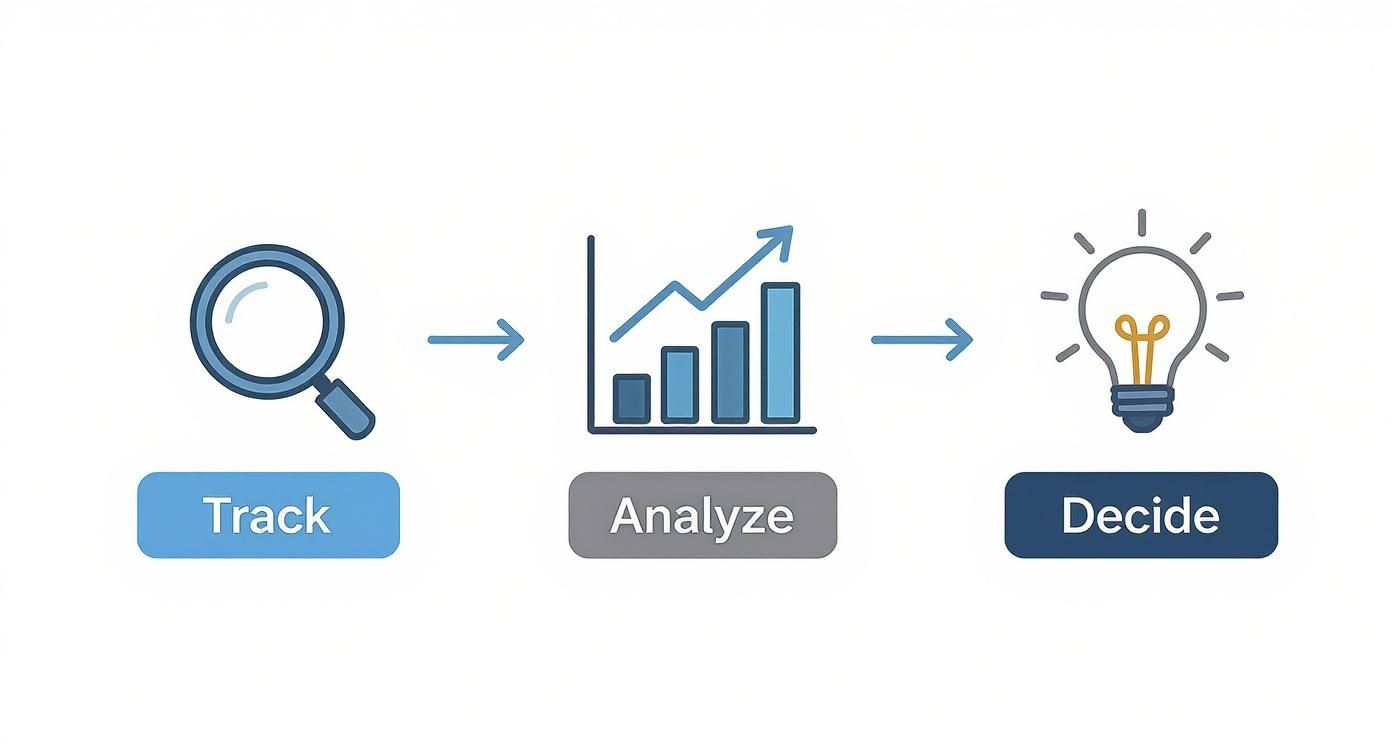
This cycle of tracking, analyzing, and deciding is the engine of continuous improvement for your inventory.
Adapting to a Changing Landscape
Inventory control isn't a "set it and forget it" task, especially with today's market volatility. By 2025, many companies are expected to shift toward reshoring and nearshoring to shorten lead times and reduce transportation risks, making their supply chains more resilient.
Smart manufacturers are already getting ahead by tightening up their inventory practices—adjusting reorder points, tracking lead times more closely, and using cycle counting with barcode scanning for better accuracy.
These proactive steps are essential for keeping materials flowing smoothly. For more insights on building efficient systems in your workshop, you can find a wealth of information on the TimberCloud blog. These are practical, real-world approaches designed for managers to use right away to cut waste and stop costly project delays in their tracks.
Using Technology to Automate and Optimize
If you're still trying to run your shop's inventory on a clunky spreadsheet, you're fighting a losing battle. Let's be honest, manual data entry is slow, it's riddled with human error, and it only tells you where you were, not where you're going. True supply chain inventory control isn't about looking in the rearview mirror; it's about moving from reactive data entry to proactive, automated management.
Modern technology completely changes the game. Instead of spending hours punching numbers into cells, you get a real-time, accurate picture of every board, screw, and hinge in your shop. This isn't about adding more complexity to your day. It’s about killing off the tedious work so you can get back to what you actually love: the craftsmanship.
Moving Beyond the Spreadsheet
The first step is simply admitting that manual tracking has its limits. A spreadsheet can't tap you on the shoulder when you're running low on Baltic Birch, and it definitely can't generate a purchase order with a single click. It’s a static document trying to keep up with a dynamic business, which inevitably leads to stockouts or overstocking—and both are profit killers.
Specialized software, on the other hand, acts like a central nervous system for your materials. These systems connect your inventory levels directly to your active jobs, giving you a live view of what's being used, what you have on the shelf, and what you need to order next. Making that jump from manual to automated tracking is the single biggest step you can take to get your inventory under control.
Think of it this way: a spreadsheet is a printed map. You have to trace your route by hand and just guess where the traffic is. An inventory platform is a live GPS, automatically rerouting you around delays and making sure you always have the fuel—or in our case, the materials—to get where you're going on time.
The Power of Specialized Platforms
While a generic Material Requirements Planning (MRP) system is a huge step up, platforms built specifically for the woodworking industry just get it. They speak our language and understand the unique headaches of managing lumber, hardware, and all the custom components that go into a project.
A purpose-built system does a lot more than just track numbers. It plugs directly into your workflow and delivers real, tangible results:
- Real-Time Stock Visibility: You can see exactly what you have from anywhere, anytime. No more walking to the back of the shop just to check a shelf.
- Automated Purchase Orders: Set your reorder points and let the system automatically draft POs when stock gets low. This ends the last-minute scrambles for materials.
- Project Integration: You can link material usage directly to specific jobs, which gives you dead-on cost tracking and makes your future quotes much more accurate.
- Supplier Management: All your supplier info, from lead times to pricing, is kept in one organized place. This makes ordering faster and a whole lot smarter.
This kind of integration frees up the one resource you can't buy more of: your time. Instead of drowning in paperwork, you and your team can stay focused on production and growing the business. Platforms like TimberCloud are designed to handle these very complexities, giving you a powerful, yet surprisingly easy-to-use, tool to manage your entire material lifecycle. By exploring the comprehensive features of TimberCloud, you can see exactly how a dedicated system puts these advantages into practice.
At the end of the day, the right technology gives you the clarity you need for top-tier supply chain inventory control. It helps you make faster, smarter decisions, cut down on waste, and build a more resilient and profitable business. The future of inventory isn't about needing a bigger warehouse; it's about having better data.
Getting Your Shop Set Up with TimberCloud
Bringing new technology into the shop for supply chain inventory control can feel like a huge job, but it doesn’t have to be. By breaking it down into a few manageable phases, you can turn what seems like a mountain of a project into a series of simple, logical steps. This roadmap will walk you through setting up TimberCloud, from basic data entry to full operational control, ensuring a smooth transition that actually delivers.
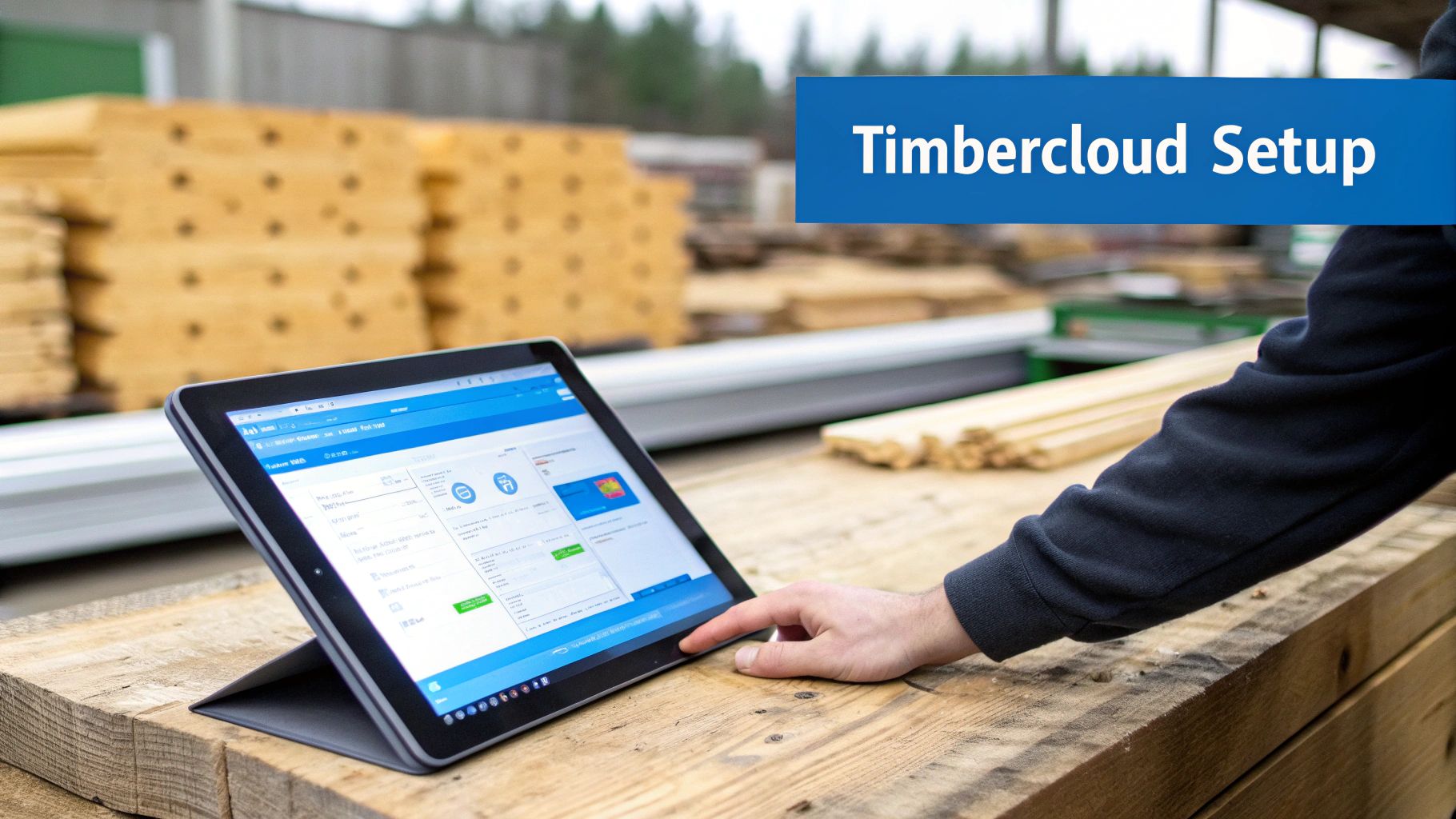
The secret is to build a solid foundation first. Rushing this initial stage is like building a custom cabinet on a warped base—the flaws will only get worse as you go.
Phase 1: Laying the Groundwork
The first goal is simple: get everything in one place. This phase is all about moving your inventory data out of scattered spreadsheets and old notebooks and into the TimberCloud system where it can finally start working for you.
- Import Your Current Stock: Start with a full physical count of everything you have. Get that data uploaded into TimberCloud, making sure to include key details like lumber species, sheet good dimensions, and hardware SKUs.
- Add Supplier Information: Next, round up all your supplier contacts and details. Enter their info, your typical lead times for common orders, and any special pricing you've negotiated.
- Define Your Products: For every single item you stock, lock in its unit of measure. Is it board feet, sheets, or individual pieces? Standardizing this now is absolutely essential for accurate tracking and automated calculations down the line.
Once this foundational data is in, TimberCloud can give you a clear, real-time picture of what you actually have on hand. That alone is the first big step toward smarter purchasing.
Phase 2: Integrating Your Processes
With your data clean and centralized, you can start automating the daily tasks that eat up so much time. This is where you connect your inventory data to your shop's real-world workflow, turning the system into an active partner in your day-to-day operations.
The main objective here is to set the rules that will manage your inventory flow from here on out.
Key Insight: This is the moment your inventory system goes from being a passive list to a proactive management tool. You're basically teaching the software how to think like your best shop manager, ensuring nothing falls through the cracks.
You'll want to focus on two key actions:
- Set Reorder Points: Using the formulas we covered earlier, establish automated reorder points and safety stock levels for your most important, high-turnover materials.
- Configure Automated Alerts: Set up notifications to ping you or your purchasing manager the moment stock levels hit those trigger points. No more surprise stockouts.
Phase 3: Optimizing for Performance
Now that the system is up and running, the final phase is all about fine-tuning. This is where you dig into TimberCloud’s reporting features to track the KPIs that really matter, allowing you to make smart, data-driven adjustments to your supply chain inventory control.
This is an ongoing process that helps you stay nimble as market conditions change. For example, recent U.S. supply chain outlooks for 2025 show many companies are shifting away from just-in-case stockpiling and moving toward more demand-driven inventory to control costs. You can learn more about these trends from S&P Global's supply chain analysis. With your system's analytics, you can make similar strategic moves.
Keep an eye on reports for metrics like inventory turnover and carrying costs. You’ll be able to spot slow-moving materials that are tying up your cash and adjust your buying habits accordingly. This phased approach makes the whole process feel straightforward and gives you the power to see powerful, lasting results.
Ready to build a smarter inventory system? You can create your TimberCloud account and start laying your foundation today.
Common Inventory Questions Answered
Even with a solid game plan, certain questions always seem to surface on the shop floor. Great supply chain inventory control isn't just about theory; it's about how you handle these real-world curveballs. Let's tackle a few of the most common challenges I see in custom woodworking and millwork shops.
How Should I Manage Materials for One-Off Projects?
This is the classic custom shop puzzle. You land a job that needs a single, stunning slab of book-matched walnut for a conference table, but keeping something that specific on hand "just in case" is a terrible business decision. The answer is to run a hybrid inventory model.
For those unique, project-specific materials, you absolutely want to use a Just-In-Time (JIT) approach. Don't even think about ordering that expensive or obscure item until you have a signed contract and a deposit in hand. This keeps your cash free and your valuable rack space open. Meanwhile, for all your bread-and-butter items—the standard plywood, fasteners, and drawer slides you burn through weekly—stick with the reorder point and safety stock methods we've already covered. That way, they're always there when you need them.
My Current Inventory Is a Mess. Where Do I Start?
Walking into a disorganized warehouse can feel completely defeating. I get it. The key is not to try and boil the ocean. You can get things under control with a simple, focused attack plan.
- Do a Full Physical Count. Pick a slow time, halt all receiving and shipping for a day or two, and count every single thing. It’s a grind, I know, but you can’t move forward without an honest, accurate baseline. It's non-negotiable.
- Clean Up Your Data. Get that physical count into your inventory system or even just a clean spreadsheet. This is your chance to standardize everything. No more "BB Plywood" and "Baltic Birch 3/4." From now on, it's "Baltic Birch Plywood 4x8 3/4in," and the unit of measure is "sheets."
- Start Cycle Counting Immediately. Don't wait. The very next week, begin a regular cycle counting routine. This is what keeps your data from getting messy again and turns inventory management from a massive annual project into a simple, manageable habit.
Is This Worth It for a Small Shop?
Absolutely. In fact, I’d argue it’s more critical for a one or two-person operation where every dollar and every minute counts. You don't need some massive, complicated system to get a huge return.
For a small shop, even minor inventory improvements have an outsized impact. Freeing up just $1,000 in overstocked material can be the difference between buying a new tool or struggling to make payroll.
Just focus on the simple things that give you the biggest bang for your buck:
- Set Reorder Points: Start with just your top five most-used items. Calculating a simple reorder point for those alone will prevent the vast majority of stockouts and those panicked, mid-job runs to the supplier.
- Track Lead Times: Just knowing it takes your primary hardwood supplier two weeks to deliver a load helps you schedule jobs with confidence. It’s that simple.
- Talk to Your Suppliers: Even as a small shop, you can often negotiate better terms. Ask about smaller minimum orders to reduce the amount of cash you have tied up in materials you don't need right away.
These small, consistent habits will directly improve your cash flow, slash your stress levels, and make your entire operation run smoother. It just goes to show that good supply chain inventory control scales down perfectly.
Ready to transform your inventory from a source of stress into a powerful asset? With TimberCloud, you can implement these strategies with an all-in-one platform built for modern woodworking. Get started today at https://timbercloud.com.
Topics
TimberCloud Team
Content Team
The TimberCloud team is dedicated to helping manufacturers streamline their operations with intelligent software solutions.