Master the standard operating procedure in manufacturing for flawless results
A standard operating procedure is simply a set of detailed, step-by-step instructions that guide your team through a specific task. It’s the proven, documented way to get things done right, every single time. Think of it as your master chef's recipe for the workshop; it’s the formula that guarantees quality, slashes waste, and makes your results predictable, no matter who is on the floor.
This simple concept is what transforms that hard-won "tribal knowledge" from your most experienced guys into a scalable, trainable, and profitable process for the whole business.
Your Blueprint for a Predictable Workshop
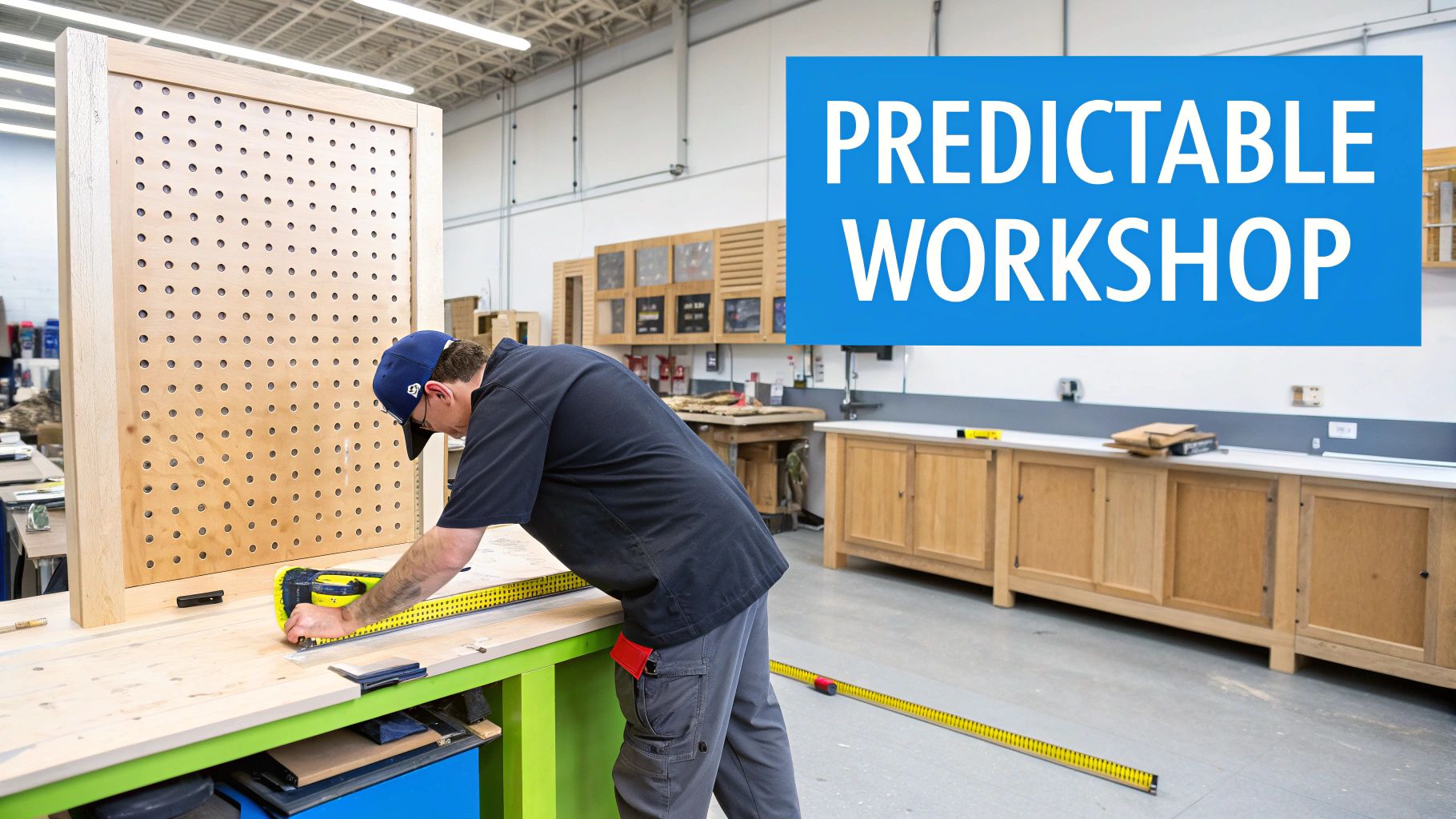
Picture every custom project—from a set of intricate cabinets to a large-scale architectural millwork job—flowing through your shop with the precision of a Swiss watch. That’s not some fantasy reserved for giant, automated factories. It’s the direct result of a well-crafted standard operating procedure in manufacturing (SOP).
For too long, SOPs have gotten a bad rap as rigid, bureaucratic rules that kill creativity on the shop floor. It’s time to flip that idea on its head.
An SOP isn't a straightjacket; it’s your workshop’s essential playbook for mastering the three pillars of any successful manufacturing business: consistency, quality, and safety. It’s the single most powerful tool you have to move from a reactive, chaotic environment to a professional operation that’s ready to grow.
The Recipe for Repeatable Success
Let’s stick with an analogy every craftsman can appreciate. A master chef doesn't just "wing it" when making a signature dish. They follow a precise recipe—a documented procedure that spells out the ingredients, measurements, temperatures, and even how to plate it. That recipe ensures that whether the head chef or a new line cook prepares the meal, the customer gets the exact same amazing experience.
Your workshop runs on the exact same principle. An SOP for assembling a cabinet door is your recipe. It details things like:
- The exact sequence of steps to prevent dumb mistakes like installing a panel backward.
- The specific tools and settings needed, like the right torque setting for a fastener so you don't strip the wood.
- The critical quality checkpoints to catch a small defect before it becomes a big, expensive problem.
- The necessary safety precautions to keep your team safe while they work.
This documented process is how you scale. It’s how you get all that priceless experience locked inside your veterans’ heads out and into a system that anyone can follow.
By documenting your best practices, you create a single source of truth that empowers every single person on your team to perform at their best. This is how you build a business that runs on proven processes, not just the heroics of one or two key people.
Without this "recipe," every new hire is a gamble and every complex job is a risk. But with a solid SOP framework, you create a predictable engine for production that turns your workshop into a lean, mean, profitable machine. This guide will show you exactly how to build that engine, step by step.
Why Great SOPs Are Your Shop’s Secret Weapon
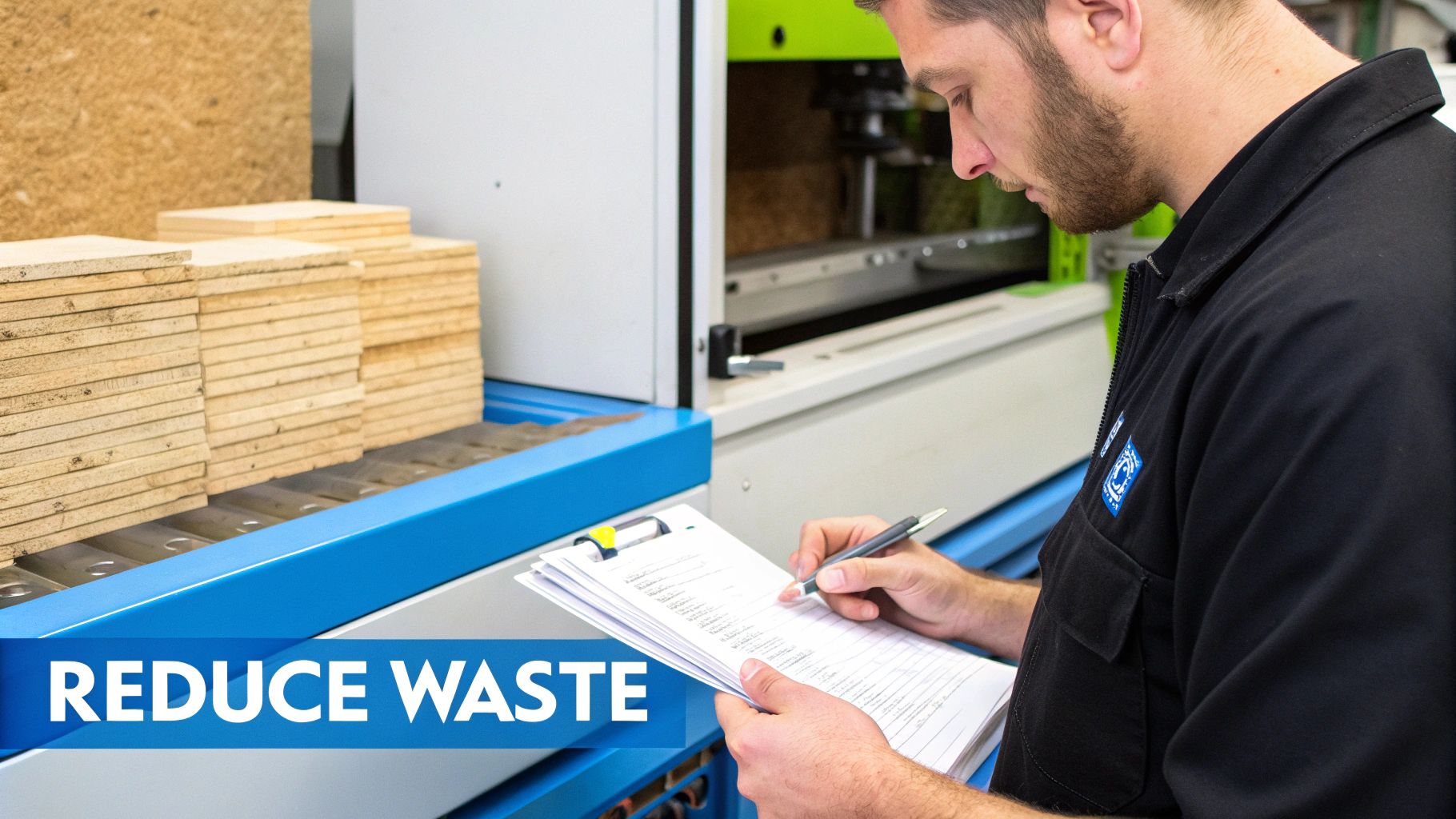
It’s easy to look at a standard operating procedure in manufacturing and see nothing but paperwork. A chore. But that’s a huge mistake. A well-built SOP isn't just a document; it's a powerful tool that turns fuzzy goals like "better quality" and "more efficiency" into concrete actions on your shop floor.
Think about all the hidden costs bleeding you dry. Every minute a new hire wastes hunting for the right tool, every piece of premium walnut tossed in the scrap bin from a miscalculation, every project stalled by rework—they all chip away at your profits. Good SOPs are your first line of defense against these silent killers.
This isn't about crushing the artistry of your craftspeople. It's about standardizing the science behind the craft. When core tasks like machine setup, finishing, and safety checks are done right every time, you free up your best people to focus on the creative, complex work that actually makes you money.
Slash Waste, Kill Rework
In any custom shop, your two biggest line items are materials and labor. A clear SOP acts as a guardrail, protecting you from the costly mistakes that drive up both.
Take finishing, for example. Imagine applying a tricky, multi-stage finish to a set of custom cabinet doors. Without a documented process, one guy might sand with the wrong grit between coats. Another might apply the topcoat before the stain has fully cured. The result? A flawed finish that has to be stripped and redone, instantly doubling your labor and material costs for that part of the job.
A simple SOP stops this dead in its tracks by defining the details:
- Sanding Grits: Use this grit for the first pass and that grit for the final scuff.
- Drying Times: Wait a minimum of four hours between coats when the shop humidity is above 50%.
- Application Method: Use a specific HVLP spray gun tip and pressure setting for a flawless sheen.
This isn’t micromanagement; it’s just smart business. It removes the guesswork, guaranteeing a predictable, high-quality result every single time.
Speed Up Training and Supercharge Safety
How long does it take for a new person to become a genuinely productive part of your team? Without SOPs, training is usually just "go follow Bob around." It's slow, inconsistent, and ties up one of your most experienced guys.
With clear, documented procedures, that onboarding time gets cut dramatically. A new hire can learn to set up a five-axis CNC or operate the edgebander by following a step-by-step checklist, complete with photos. They start contributing value on day one, and your veterans are freed up from babysitting.
SOPs are the ultimate knowledge-transfer machine. They take the hard-won wisdom locked inside your best employees' heads and turn it into a repeatable, trainable playbook for the whole company.
And when it comes to safety, standardizing tasks is absolutely non-negotiable. An SOP for operating the table saw or handling finishing chemicals ensures every safety step is followed, every time, by everyone. This protects your crew and defends your business from accidents and liability. It's no wonder the global market for SOP management software was valued at USD 1.53 billion in 2023 and is expected to hit USD 4.0 billion by 2031. You can find more on this in a detailed SOP management market research report.
The Anatomy of a Perfect Manufacturing SOP
A truly effective standard operating procedure in manufacturing isn't just a boring list of instructions; it's a communication tool designed for absolute clarity. Think of it less like a dry technical manual and more like a detailed blueprint for getting the job done right, every single time.
When one of your people picks it up, there should be zero guesswork. They need to know exactly what to do, what tools to grab, and what a "good" finished product actually looks like.
To get to that level, a solid SOP has to be built with a few key components. Leaving any of them out is like trying to bake a cake and skipping the flour—the final product might look vaguely familiar, but it just won't be right. It will lack the backbone needed for consistency, accountability, and real improvement on the shop floor.
From the high-level details down to the nitty-gritty steps, every single piece has to work together to create a foolproof guide that empowers your team, slashes errors, and protects your reputation for quality.
Core Administrative Information
Before you even get into the how-to, every SOP needs a clear header section. This is basically the document's ID card. It instantly tells everyone what they're looking at, why it exists, and whether they're holding the latest version. This simple step can prevent the all-too-common disaster of a new guy finding an old, outdated procedure on a dusty shelf and running a whole batch of parts incorrectly.
This foundational info should always include:
- A Crystal-Clear Title: Be specific. "SOP for Applying Edge Banding to ¾-Inch Plywood Panels" is a world away from a vague title like "Edge Bander SOP."
- An SOP ID Number: A unique code (like F-AS-003) makes tracking, referencing, and managing your documents simple and foolproof.
- Revision History: This is the document’s family tree. It logs the version number, the date of the last update, a quick summary of what changed, and who signed off on it.
This administrative stuff isn't just bureaucracy for the sake of it. It's the bedrock of version control, making sure everyone in the shop is always singing from the same hymn sheet.
Defining the Purpose, Scope, and Responsibility
Once the document is clearly identified, the next part sets the stage. It quickly answers the big "why, what, and who" questions before you dive into the "how." Giving your team this context is crucial—it helps them understand why the procedure matters and exactly what their role is in making it happen.
A great SOP doesn’t just tell people what to do; it explains the intent. When a team member understands the purpose behind the steps, they stop just going through the motions and start making mindful, high-quality contributions.
This section is usually broken down into three simple parts:
- Purpose Statement: A quick, one or two-sentence explanation of the goal. For instance: "The purpose of this procedure is to ensure all cabinet doors are assembled to spec, are free of defects, and are ready for the finishing department."
- Scope: This sets the boundaries. It clarifies exactly where this procedure starts and where it ends. For example: "This SOP covers the assembly process from the moment machined parts arrive from the CNC department and ends when the finished door is delivered to the sanding station."
- Responsibilities: This is where you name names—or at least, roles. You need to clearly state who is responsible for doing the work. For instance: "The Assembly Technician is responsible for performing these steps. The Shop Foreman is responsible for verifying the first-piece quality check." This kills any confusion about who owns the task.
The Heart of the SOP: The Detailed Procedure
This is it—the core of the entire document. These are the step-by-step instructions that guide the work. The golden rule here is absolute, undeniable clarity. Write every step as if you’re explaining it to a brand-new hire on their very first day. Use simple language, short sentences, and tell them what to do (active voice).
The most powerful procedures are packed with visuals. Don’t just tell them, show them. Research shows that our brains process images a staggering 60,000 times faster than text. A few well-placed photos, diagrams, or even short video clips can be the difference between a confused employee and one who gets it instantly. For a task like assembling a cabinet door, a photo showing the correct way to join a stile and rail is infinitely better than a long paragraph trying to describe it.
To help you build a bulletproof SOP, we’ve broken down the essential components you'll need. Think of this table as your checklist for creating clear, effective, and easy-to-follow instructions that will actually get used on the shop floor.
Key Components of an Effective Manufacturing SOP
| SOP Component | Purpose | Best Practice Example for Woodworking |
|---|---|---|
| Title and ID | Uniquely identifies the procedure for easy tracking. | Title: "Final Assembly of Shaker Cabinet Doors" ID: "ASM-001-REV2" |
| Purpose | Explains the "why" behind the procedure. | "To ensure all Shaker cabinet doors meet quality standards for fit, form, and structural integrity before finishing." |
| Scope | Defines the boundaries of the task. | "This procedure begins after all stiles, rails, and panels are machined and ends when the assembled door is placed on the cart for sanding." |
| Responsibilities | Assigns clear ownership for each task. | "Assembly Technician: Performs all steps. Quality Lead: Conducts final inspection and sign-off." |
| Required Materials | Lists all necessary parts and supplies. | "2 stiles, 2 rails, 1 panel (per door), Titebond II Wood Glue, specified fasteners, cleaning rags." |
| Tools and PPE | Lists all equipment and safety gear. | "Pneumatic clamp table, rubber mallet, glue bottle with roller, square, tape measure, safety glasses, hearing protection." |
| Step-by-Step Procedure | Provides clear, sequential instructions. | "1. Apply a thin, even bead of glue to all joints. 2. Insert panel into stile grooves. 3. Join rails and stiles. 4. Check for squareness using a diagonal measurement." (Include photos for each step) |
| Quality Checkpoints | Defines criteria for a successful outcome. | "Joints must be flush with no gaps. Door must be flat with less than 1/16” of warp. All excess glue must be removed while wet." |
| Approval Section | Records formal sign-off. | "Written by: [Name], Approved by: [Shop Manager], Effective Date: [Date]" |
By including each of these elements, you move beyond just writing instructions. You create a comprehensive tool that drives consistency, improves quality, and makes training new team members a whole lot easier.
How to Write and Implement SOPs on Your Shop Floor
Moving from theory to practice is where a standard operating procedure in manufacturing really proves its worth. It’s one thing to have a document; it’s another thing entirely to make it a living, breathing part of your shop floor culture. The secret isn't a top-down mandate. It’s a collaborative effort that respects the hard-won expertise of your team.
When you get this right, dusty binders transform into dynamic tools that deliver real results. The goal is to build a system that your veteran craftspeople not only accept but actively champion because it genuinely makes their jobs easier and the whole shop more successful.
Start With the Team and Target the Pain Points
The absolute worst way to begin is by locking yourself in an office and trying to document everything from memory. The best, most effective SOPs are born right on the shop floor, with direct input from the people who perform the tasks every single day.
Your first move? Get your team together and ask a simple question: “What’s the one task that causes the most mistakes, rework, or frustration?” Maybe it's a finicky machine setup, a tricky finishing technique, or the final assembly. Whatever it is, focus on that single, high-impact area first.
This approach nails two critical goals right away:
- It Guarantees Real-World Accuracy. Your team knows the little tricks and potential pitfalls that a manager behind a desk would never even consider.
- It Creates Instant Buy-In. When your crew helps write the playbook, they own it. It becomes their procedure, not just another rule handed down from management.
Draft, Review, and Simplify
Once you’ve identified the target process, work with the team to map it out. Use clear, simple language and short sentences. The golden rule is to write for the newest person on your team, not the 20-year veteran who can do it with their eyes closed.
Don't forget to use visuals. A few well-lit photos or a simple diagram can replace pages of dense text and clear up any potential for misinterpretation. As you learn how to write and implement SOPs on your shop floor, looking at practical safe operating procedure templates can give you a solid starting point.
The goal isn’t to create a perfect document on the first try. It’s to get a working draft that your team can test in a real-world setting. Let them run through the steps, mark up the draft with red pens, and call out anything that’s confusing or inefficient.
This flow chart breaks down the essential anatomy of any good SOP—from its purpose to the specific steps.
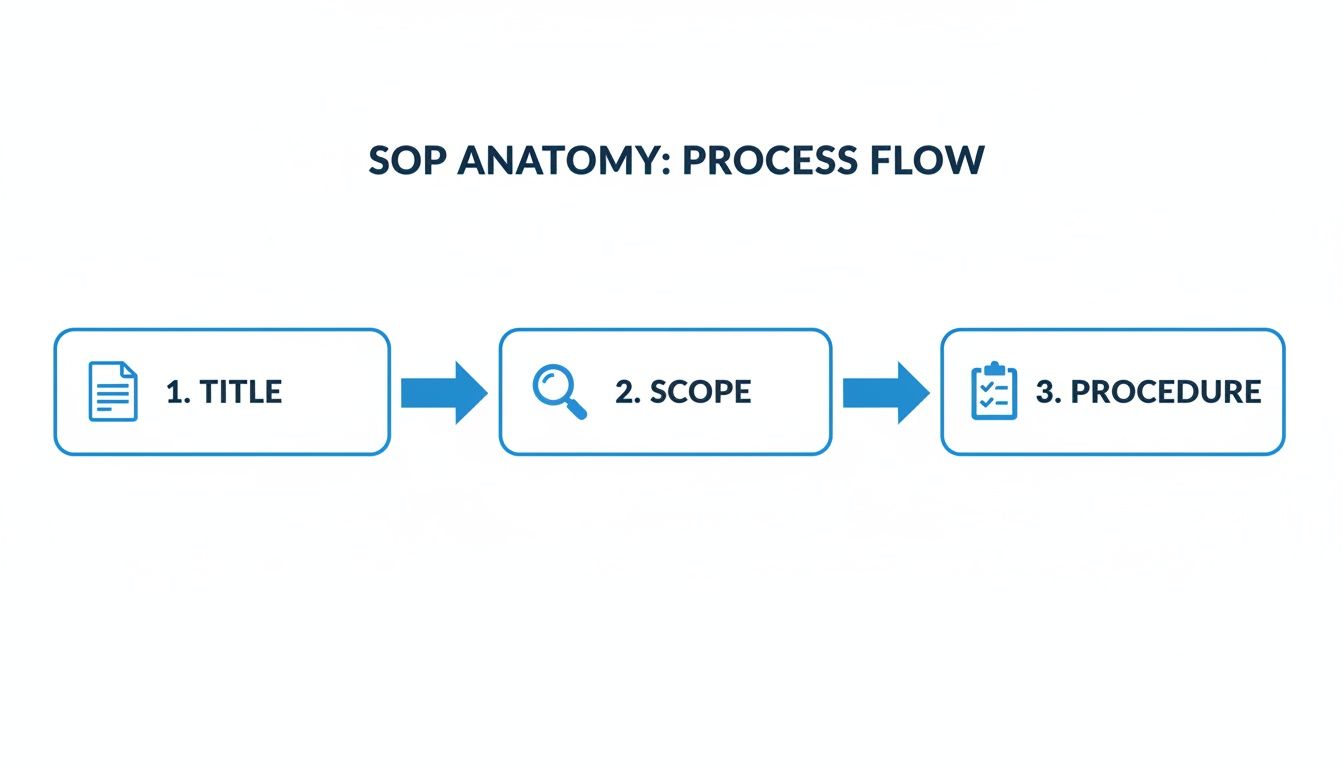
As you can see, a clear title and scope are the foundation, leading directly into the actionable procedure—the heart of the document.
Train, Launch, and Treat It as a Living Document
With a tested and refined SOP in hand, it’s time for the official rollout. Hold a quick training session to walk everyone through the final version, making sure to explain the "why" behind any changes. Emphasize that this new standard is the official way to perform the task from this point forward.
The results speak for themselves. Companies that implement standard operating procedures in manufacturing have seen staggering efficiency gains, with some reporting up to a 30% average reduction in training time. One telecommunications firm slashed its operational delays by 67% and boosted on-time deliveries by an incredible 250% after standardizing its core processes.
Finally, remember that an SOP should never be set in stone. Your shop is constantly evolving and getting better, and your procedures have to keep up. Set up a simple version control system and schedule regular reviews—maybe every six months—to ensure your SOPs stay accurate, effective, and truly representative of your best practices. For more strategies on continuous improvement, check out the resources on the https://timbercloud.com/blog.
Moving From Paper Binders to Digital Platforms
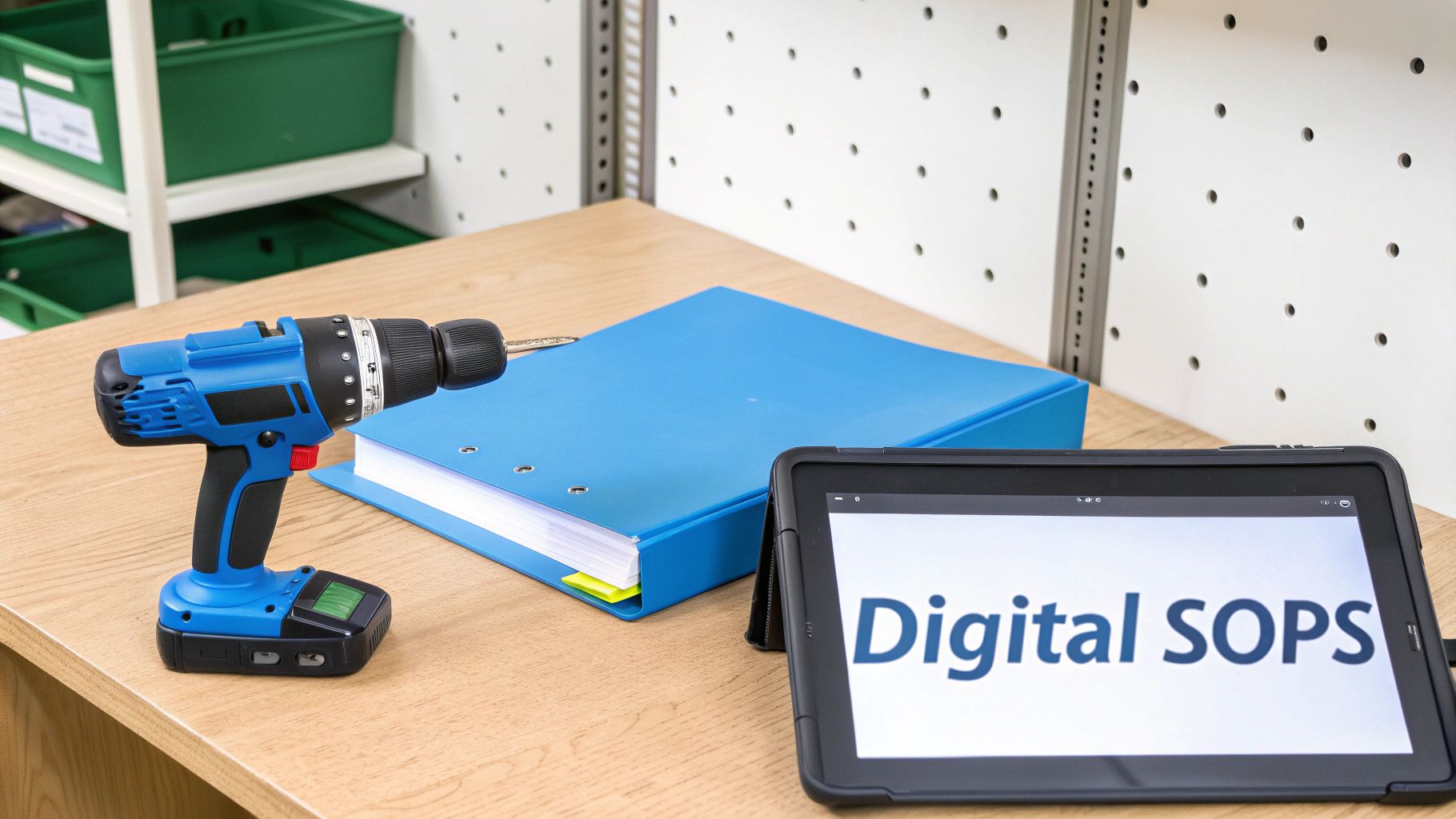
For years, the gold standard for shop floor SOPs was a three-ring binder, its pages probably smudged with grease and covered in handwritten notes. We've all seen them. But while that binder might feel familiar, it's a relic holding your shop back, quietly draining profits and creating risks you can't afford in a modern manufacturing world.
Think about the last time you updated a process. Someone had to physically track down every single binder, swap out the old page, and just hope they didn't miss one. It's a slow, frustrating game of whack-a-mole that's almost impossible to win, especially as you grow.
The biggest problem? These static documents are completely disconnected from the actual work. They sit on a shelf, out of reach the moment a technician needs guidance. This forces your crew to rely on memory or "the way we've always done it," leading to the very inconsistencies and mistakes a good standard operating procedure in manufacturing is meant to prevent.
The Limitations of Traditional SOPs
Whether it's a paper binder or a spreadsheet saved on a shared drive, the old way of doing things has some serious flaws. These methods are passive records of information, not active tools that help get the job done right.
This old-school approach creates some major headaches:
- Version Control Nightmares: Trying to ensure everyone on the floor has the latest procedure is a logistical nightmare. It’s an open invitation for someone to follow outdated instructions, leading to rework and scrap.
- Lack of Accessibility: A binder in the supervisor’s office is useless to an operator in the middle of a complex assembly. When information isn't right there when you need it, people stop using it.
- Zero Traceability: You have no idea if an SOP was even looked at, let alone followed correctly. There’s no data, no feedback loop, and no way to confirm your standards are being met.
- Static and Unengaging: Paper can't show you a video of a tricky step or link you to the exact material specs. This makes training harder and complex tasks more prone to error.
These aren't just minor annoyances. They're a massive roadblock to operational excellence, keeping your best practices locked away in a format that works against you.
The Digital Transformation of Workflow
A modern digital platform completely changes the game. It turns your SOPs from forgotten documents into dynamic, interactive guides that are woven directly into your daily production workflow.
Instead of a dusty binder, picture a tablet at each workstation that automatically pulls up the right instructions, for the right job, for the right person, at the exact moment they need it. That's the power of moving your processes into a connected system.
Digital SOPs are no longer just instructions; they become an active, intelligent part of the manufacturing process itself. They guide, track, and validate work as it happens, creating a powerful engine for consistency and continuous improvement.
This shift is happening for a reason. The SOP management market hit USD 1,625.5 million in 2024, and it's being driven by manufacturers looking for an edge. In one case, a company saw production costs fall by 20% and watched its defect rate plummet from 15% to 5% after going digital. You can dig into more details in this in-depth market report.
How Software Automates and Enforces Best Practices
The real magic of a digital platform is its ability to not just document your best practices, but to actively enforce them. It’s about moving from passive instructions to active process control.
Here’s how a modern system makes it happen:
- Integrate Checklists into Work Orders: The system can automatically attach the correct SOP and an interactive checklist to a work order. This guarantees the latest procedure is always used, no questions asked.
- Provide Real-Time Data: You can track task completion, measure how long a step takes, and log quality checks on the fly. This data gives you incredible insight into bottlenecks and opportunities for improvement.
- Enhance Training with Rich Media: Embed high-resolution photos, diagrams, and short videos directly into a procedure. Suddenly, complex tasks become much easier to understand and execute correctly the first time.
- Enforce Sequential Steps: For critical processes, you can require a sign-off on one step before the next one even becomes available. This simple feature completely eliminates out-of-sequence errors.
This level of integration is at the heart of platforms built for custom manufacturing. To see how digital tools can connect your entire operation, from sales to the shop floor, check out the features of a unified manufacturing platform. As you shift from paper to digital SOPs, you’ll find that success relies on effective knowledge management practices. By digitizing your procedures, you're not just creating documents—you're building a smarter, more responsive, and predictably profitable business.
Your Path to a Predictably Profitable Business
We've covered a lot of ground together, from figuring out what a standard operating procedure in manufacturing really is to the nuts and bolts of writing and implementing them on your shop floor. The takeaway is simple but powerful: SOPs aren't just bureaucratic red tape. They are the absolute foundation of any custom manufacturing business that wants to scale efficiently and profitably.
This is about a fundamental shift in how you run your shop. It's the move from a business that leans on a few key people and their "tribal knowledge" to one that operates on proven, documented processes that anyone can follow. That shift is what builds a rock-solid base for growth, ensuring every single project leaves your door meeting the highest standards of quality and safety.
When you embrace this kind of structure, you’re really building predictability into your business. Predictable quality means happier customers and more repeat business. Predictable workflows slash expensive rework and wasted materials. And predictable training? It gets new team members up to speed and contributing in days, not weeks.
The real goal here is to build a business that doesn't just survive on chaos but actually thrives on its systems. It's about creating a well-oiled machine where every person and every process works together, guided by clear instructions that guarantee excellence from the first cut to the final delivery.
Making this leap from reactive problem-solving to proactive control has never been more within reach. The final, most impactful step is taking your SOPs off paper and putting them into a platform that automates and enforces them for you.
When you're ready to build that predictable, profitable future, see how a digital system can bring your SOPs to life and make success a repeatable process. To see what that looks like in practice, take a look at our pricing and plans. Your journey to operational excellence starts with that first documented step.
Frequently Asked Questions
Rolling out something as fundamental as standard operating procedures in manufacturing is a big move. It's totally normal for questions to pop up. This is a real operational shift, and it’s smart to think it through from every angle. Let's tackle some of the most common things we hear from shop owners and managers as they get started.
We want to give you straight, practical answers so you can move forward with confidence and make SOPs a huge win for your shop.
Will SOPs Stifle the Creativity of My Experienced Craftsmen?
This is probably the number one concern we hear, and it’s a good one. But the short answer is no—in fact, it's quite the opposite.
Think of SOPs as the guardrails, not a cage. They handle the routine, repeatable stuff—the machine setups, the safety checks, the finishing steps—to make sure every single project meets a high-quality baseline. This actually frees up your most skilled people. Instead of getting bogged down in the mundane, their brainpower is saved for the truly custom, creative parts of the job where their talent really makes a difference. You're standardizing the science so they can perfect the art.
How Do I Start Writing SOPs Without It Becoming Overwhelming?
The secret is to eat the elephant one bite at a time. The biggest mistake you can make is trying to document every single thing in your workshop at once. That's a surefire way to burn out and give up.
Instead, find your biggest headache. What’s the one process that causes the most mistakes, wastes the most material, or creates the worst bottleneck? Maybe it’s the cabinet assembly station, or the way you receive and check raw lumber.
Start there. Create one really good SOP for that single process. Get the people who do the work every day involved. Once you see it working—reducing errors, speeding things up—you’ll have the proof and the momentum you need to tackle the next one. This is a marathon, not a sprint.
How Does a Digital Platform Help Beyond Storing Documents?
This is where the magic happens. A digital system turns your SOPs from a passive document into an active, breathing part of your daily workflow. A binder collecting dust on a shelf is easy to ignore. A digital SOP that's integrated into your process is impossible to miss.
Here’s what that looks like on the shop floor:
- Active Integration: The system can automatically attach the right SOP and checklist to a work order when it hits a new station. No more using outdated versions.
- Point-of-Use Access: Instructions, pictures, and even videos are delivered on a tablet right at the workstation. No more guesswork.
- Real-Time Tracking: You can see who completed what and when, giving you hard data on how well the process is being followed.
It’s the difference between just having SOPs and actually using them to drive real improvements in quality and output.
Ready to turn your SOPs from static documents into dynamic, automated workflows? The TimberCloud platform bakes your best practices right into your shop floor operations, ensuring consistency and boosting your bottom line. See how it works at TimberCloud.
Topics
TimberCloud Team
Content Team
The TimberCloud team is dedicated to helping manufacturers streamline their operations with intelligent software solutions.