A Practical Guide to inventory management for distributors
Distributors navigate a fine line: meeting erratic orders without carrying excess stock. Too much inventory locks up capital; too little risks disappointing a key account. Achieving that balance calls for real-time visibility and precise forecasting.
Why Distributor Inventory Management Is Hard

It’s like walking a tightrope with a stack of crates in each hand. One wrong move—say, an unexpected large order—can drain safety stock in hours and leave customers empty-handed.
- Precise Forecasting helps anticipate demand spikes and lulls
- Strategic Stock Placement cuts transit time and handling fees
- Unified Data View creates a single source of truth across all warehouses
Flying blind in inventory means guessing your reorder points—and guessing usually costs money.
Key Challenges Distributors Face
Demand swings can turn a solid plan into a scramble. Meanwhile, fluctuating supplier lead times layer on more uncertainty.
The global inventory management software market is projected to top $5 billion by 2026. Moving from spreadsheets to automated systems can reduce stockouts by 90%, boost order fulfillment rates by 25%, and shrink excess inventory by 30%. Learn more in the SimplyDepo article on wholesale inventory management tools.
- Fewer stockouts keeps orders flowing smoothly
- Improved fulfillment rates lift customer satisfaction
- Lower carrying costs free up cash for growth
Strategies To Find Your Equilibrium
Start by collecting clear demand signals from every sales channel.
- Integrate point-of-sale and warehouse data into a single dashboard
- Adjust reorder points dynamically based on recent trends
- Conduct regular cycle counts to spot variances early
These practices inject agility into your planning and trim wasted effort.
The table below distills the top goals distributors chase when refining their inventory process.
Distributor Inventory Goals at a Glance
| Objective | Key Metric | Benefit |
|---|---|---|
| Accurate Forecasting | Forecast Error Rate | Reduced stockouts |
| Optimized Stock Levels | Inventory Turnover | Lower holding costs |
| Real-Time Visibility | Update Latency | Faster decision making |
By tracking these objectives and metrics, teams can align daily operations with long-term targets.
Why Technology Matters
Modern tools give distributors live stock counts across multiple sites.
- Cloud platforms sync updates instantly everywhere
- Mobile scanning devices speed up cycle counts
This kind of visibility slashes manual errors and accelerates response times, turning inventory from a headache into a competitive edge.
Expert Tip
Review your inventory KPIs every week and tweak thresholds proactively.
Small, consistent adjustments catch trends early and keep stock levels in tune with demand peaks. Apply one change today and watch momentum build.
Building Your Foundational Inventory Strategy
Any solid inventory management plan starts with a strong strategic foundation. Before you get into the weeds of optimizing stock levels or automating reorders, you have to make two fundamental decisions: where are you going to hold your inventory, and how are you going to predict what your customers will need?
These aren't small choices. They set the stage for everything else in your operation, from what you'll spend on shipping to how quickly you can get products into your customers' hands.
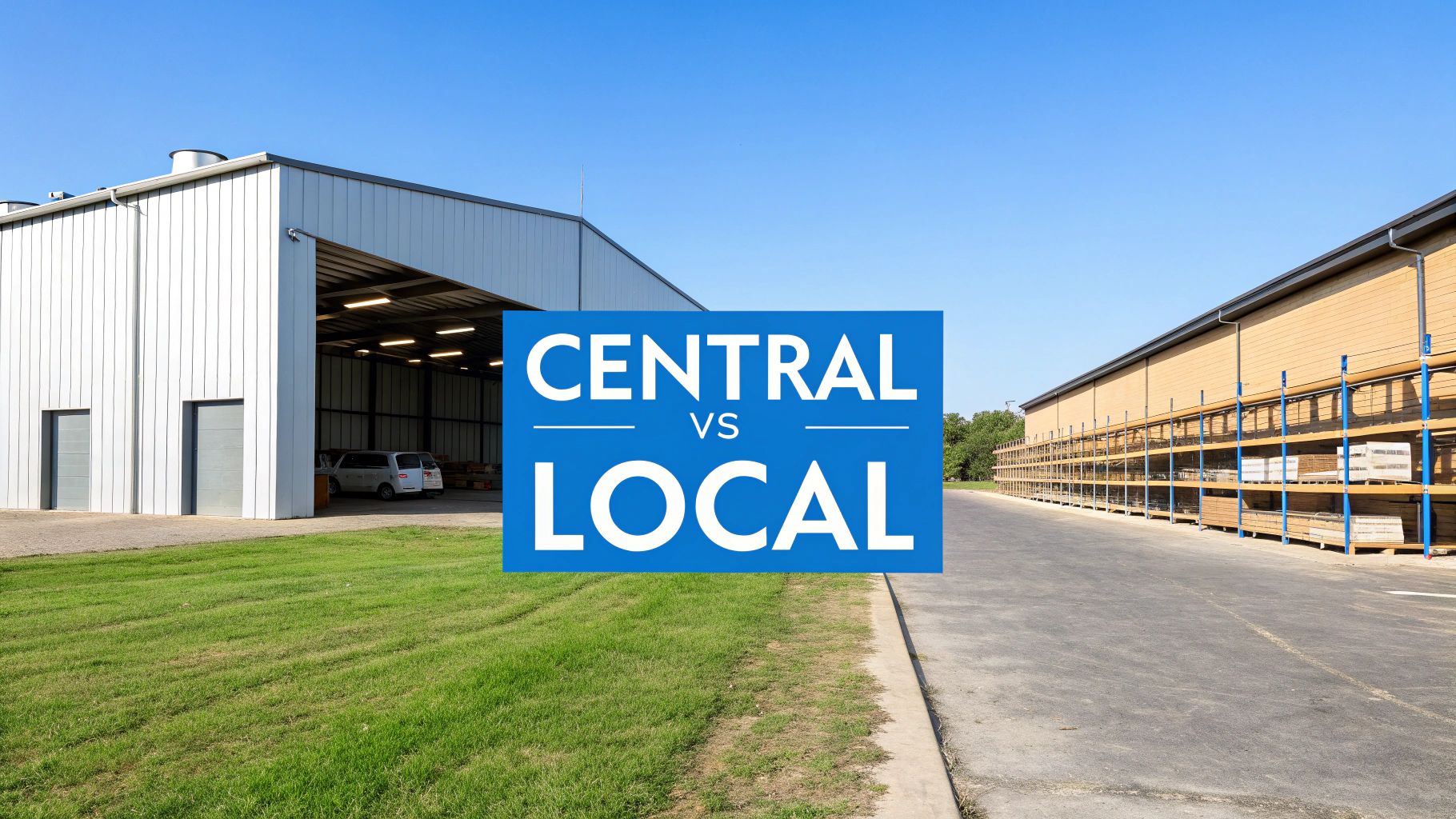
The first big question is whether to go with a centralized or distributed inventory model. Think of it like deciding between building one giant, central library for an entire city or a network of smaller, local branches.
-
Centralized Inventory Model: This is the "one big library" approach. You keep all your products under one roof in a single, large warehouse. The upside is simplified management, lower overhead from not having to run multiple facilities, and a single, clear view of your entire stock. The downside? Shipping to customers far away from that hub can be slow and expensive.
-
Distributed Inventory Model: This strategy is all about getting closer to your customers by spreading inventory across several smaller warehouses in different regions. Like a system of local library branches, it positions your products right where they're needed. The payoff is faster delivery and lower shipping costs—a massive competitive edge. The trade-off is that it's much more complex to manage inventory across all those locations.
Centralized Versus Distributed Stock
So which one is right for you? It really comes down to your customer base and what you sell. If you're a distributor serving a single, dense metropolitan area, a centralized warehouse might work perfectly. But if you have customers all over the country, you'll almost certainly benefit from a distributed network.
The big push in the industry is toward distributed inventory. It’s a direct response to customer expectations for lightning-fast delivery. By moving stock into multiple smaller warehouses, businesses slash their transportation costs and get orders out the door faster. This strategy gets even more powerful when paired with predictive picking, which anticipates orders before they’re even placed, cutting down on backorders and delays. You can find more great insights about inventory management trends on Netsuite.com.
The Art of Predicting Customer Needs
Once you've figured out where to keep your inventory, you need to decide how much to keep. This is where demand forecasting and safety stock stop being abstract concepts and become your most important tools.
Demand forecasting is all about looking into the past to predict the future. It’s less of a crystal ball and more like a grocery store manager checking last year’s sales before a big holiday weekend. They know demand for hot dog buns is about to spike, so they order more to avoid empty shelves. As a distributor, you're doing the same thing—analyzing past order volumes, seasonal trends, and customer buying cycles to make smarter purchasing decisions.
Creating Your Buffer with Safety Stock
But let's be honest, even the best forecasts can be wrong. A key customer might suddenly place a massive order, or a supplier shipment could get stuck in transit. This is exactly why you need safety stock.
Think of safety stock as the extra inventory you keep on hand just in case. It's your insurance policy against a stockout. The trick is finding the right balance. Too little safety stock, and you risk disappointing customers. Too much, and you've got precious capital just sitting on a warehouse shelf. The goal is to set a level that protects your service without creating a costly overstock problem.
Putting Smart Inventory Control into Practice
Strategy is one thing, but what you do day-in and day-out in the warehouse is what really moves the needle. Getting inventory management right comes down to a few battle-tested practices that bring discipline and clarity to your operations. By adopting these core techniques, you can completely change how you see, handle, and replenish your stock.
The first step? Stop treating every product the same. They aren't created equal. A low-cost box of screws shouldn't get the same white-glove treatment as a high-margin, fast-moving piece of equipment. This is exactly what ABC classification is for.
Think of it as applying the Pareto Principle—the classic 80/20 rule—to your warehouse shelves. You’re essentially sorting your inventory into three buckets based on how much value it brings to your business:
- A-Items: These are your superstars. They make up roughly 20% of your products but drive a massive 80% of your revenue. These items demand your full attention: tight controls, frequent checks, and your most accurate forecasting.
- B-Items: This is your solid middle group. They might be 30% of your SKUs and contribute around 15% of revenue. They need a standard level of control and a periodic review to keep things on track.
- C-Items: These are the slow-and-steady products. They can make up 50% of your SKUs but only bring in 5% of your revenue. For these, you can relax a bit with simpler controls and less frequent oversight.
By sorting your inventory this way, you focus your most valuable resources—your team's time and your company's cash—where they’ll make the biggest impact on your bottom line.
Ditch the Dreaded Annual Count for Continuous Accuracy
Now that your products are prioritized, it's time to make sure your inventory records actually match what's on the shelves. For too many distributors, the annual physical count is a chaotic, all-hands-on-deck headache. It shuts down operations for days and is notoriously prone to human error. There's a much smarter way.
Cycle counting is the answer. Instead of a once-a-year fire drill, you count small, manageable sections of your inventory on a rolling schedule. This turns inventory checks from a disruptive project into a routine part of your daily operations.
You can even tie it directly to your ABC analysis. A typical schedule might look something like this:
- A-Items: Count these MVPs once a month.
- B-Items: Check these mid-tier products every quarter.
- C-Items: A quick count every six months is plenty for these.
This approach lets you catch and fix discrepancies almost as soon as they happen. More importantly, it helps you uncover the root cause of those errors—be it theft, damage, or a broken process—and maintain shockingly accurate records all year long. This constant feedback loop is the foundation of reliable inventory management for distributors.
Adopt Reordering Logic That Breathes With the Market
Static reorder points are a relic. Setting a trigger to reorder a product and then not touching it for a year is a surefire way to end up with either stockouts or dust-collecting overstock. High-performing distributors have moved on to dynamic reorder points and adjust their safety stock based on what's happening right now.
Imagine you distribute sporting goods. Demand for ski equipment skyrockets in the fall and flatlines in the spring. A one-size-fits-all safety stock level would leave you buried in unsold skis all summer and scrambling to fulfill orders in December.
A dynamic system, on the other hand, constantly adjusts based on factors like:
- Seasonality: Bumping up safety stock right before your predictable busy season hits.
- Supplier Lead Times: If a supplier suddenly gets less reliable, you can increase your buffer stock to avoid being caught empty-handed.
- Market Trends: A competitor runs out of a key product? A hot new item is launched? You can quickly adjust your reorder points to capitalize on the surge in demand.
The goal is to build a responsive system where your inventory levels naturally expand and contract with the rhythm of the market. This agility frees up capital and ensures you’re always ready to capture a sale.
Break Down the Walls Between Your Teams
Finally, none of these practices will work if your teams are operating in silos. The age-old disconnect between the sales team and the warehouse is a classic source of inventory chaos. We’ve all seen it: Sales runs a massive promotion without telling operations, leading to an instant stockout and a wave of angry customers.
Building a unified strategy means tearing down those walls. It's about opening up communication channels and getting everyone aligned on the same goals. Sales forecasts should flow directly to the purchasing department. Warehouse stock levels need to be visible to the sales team in real time.
When sales, purchasing, and operations are all reading from the same playbook, your entire inventory process becomes smoother and far more effective. This alignment guarantees everyone is pulling in the same direction—toward perfectly optimized stock levels, satisfied customers, and a much healthier profit margin.
Choosing Your Technology and Automation Tools
Technology is the engine that drives modern inventory management. For a B2B distributor, the right software isn't just a nice-to-have; it’s the central nervous system of a responsive, accurate, and efficient supply chain. These tools are what move you from guesswork and gut feelings to a world of decisions backed by solid data.
Think of it this way: your warehouse is a physical reality, and technology's job is to create its perfect digital twin—one that updates in real time. Every pallet that comes in, every box that gets picked, and every item that ships out is instantly logged in a central system. This gives you a complete, up-to-the-minute picture of your entire operation.
This level of visibility is built on a network of simple yet powerful tools. Barcode scanners act as the eyes of your system, capturing data with every quick scan. IoT sensors can monitor everything from the temperature of sensitive goods to the location of high-value assets, feeding live information straight to your dashboard.
Core Technology Options for Distributors
When it comes to picking your tech, distributors usually have a few core options to consider. Each has its own strengths, and the best fit really depends on the scale of your business, the complexity of your inventory, and what systems you already have in place.
Here are the main categories you'll encounter:
- Dedicated Inventory Management Platforms: These are specialized tools that do one thing and do it extremely well: manage stock. They offer deep, focused features for things like cycle counting, demand forecasting, and setting reorder points.
- Integrated ERP Systems: Enterprise Resource Planning (ERP) systems are the all-in-one heavyweights. They handle inventory alongside accounting, sales, and CRM, giving you a unified view of the entire business. They're incredibly powerful but can be a bigger lift to implement.
- AI-Powered Forecasting Tools: These are the new kids on the block. Using machine learning, they analyze historical data, market trends, and even outside factors like weather patterns to predict future demand with startling accuracy. They typically plug into your existing inventory system to supercharge its capabilities.
The infographic below offers a simple but effective way to visualize how inventory prioritization logic works—a key feature you'll find in most of these systems.
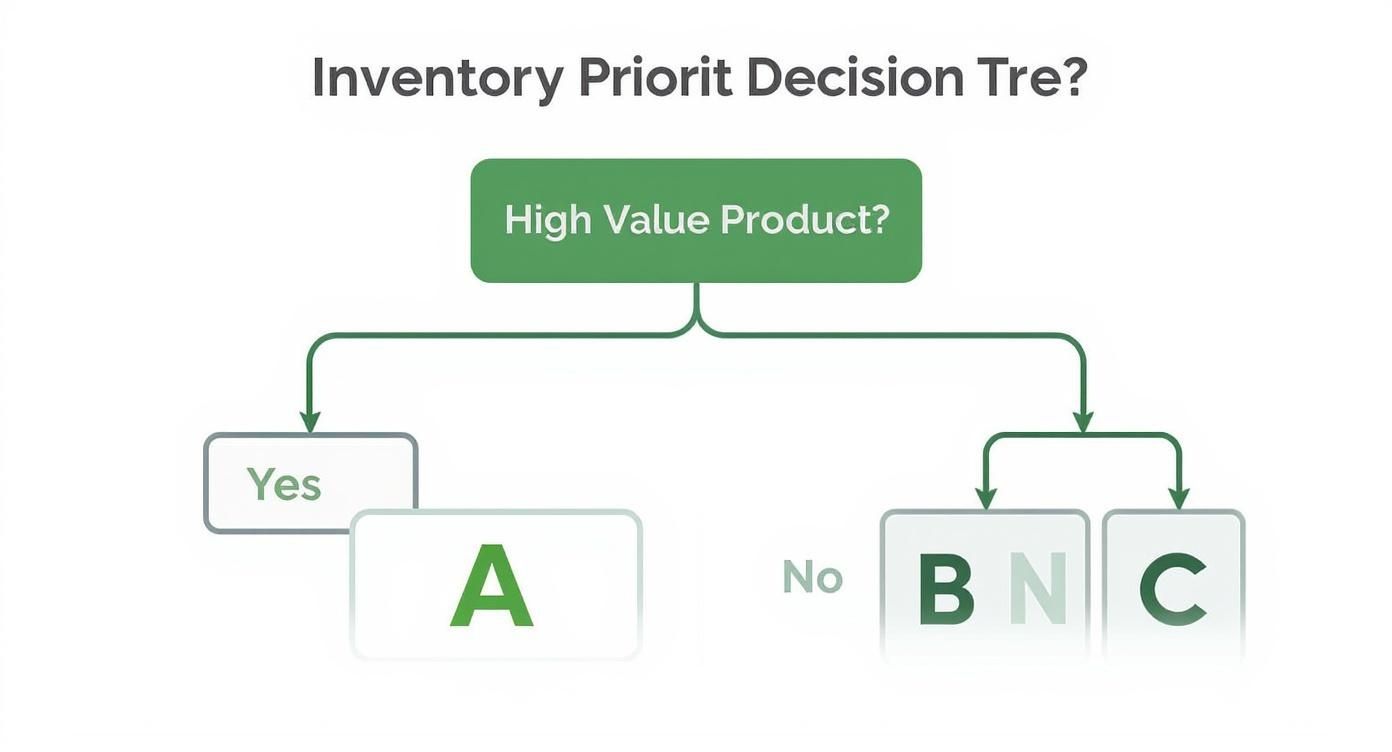
This kind of decision-making flow helps your team quickly classify products, making sure your high-value "A-items" get the attention and control they deserve within your software.
Automation From Receiving to Shipping
Today's systems don't just track your inventory—they automate the workflows that move it. This is where "no-touch" automation comes into play, creating a much more efficient and less error-prone process from the receiving dock all the way to the shipping truck.
This is more important than ever. With labor shortages being a top concern, these tools are becoming absolutely critical.
In fact, roughly 62% of distributors point to labor shortages as a major hurdle. It’s no surprise, then, that 74% are boosting their investments in automation, IoT, and AI. According to research from Procurement Tactics on supply chain trends, these technologies enable no-touch processes that boost both accuracy and speed, even when you're working with a smaller team.
Making Sense of It All: The Software Stack
Okay, so there are a lot of options out there. How do you pick the right one? It can feel overwhelming, but you can cut through the noise by focusing on a few key criteria. The goal isn't just to solve today's problems but to find a solution that will grow with you.
The best technology stack is one that fits your current workflow while offering the flexibility to adapt as your business evolves. Avoid being swayed by an endless list of features you may never use. Instead, focus on the core functionality that will drive the most significant impact on your daily operations.
Here's a practical framework to guide you through the selection process:
- Assess Your Current Needs: Start by mapping out your biggest pain points. Are you constantly dealing with stockouts? Are your inventory counts always off? Is order fulfillment painfully slow? Pinpoint these challenges and prioritize solutions that tackle them head-on.
- Evaluate Integration Capabilities: Your inventory system can't live on an island. It has to talk to your other business software, like your accounting platform or e-commerce store. Poor integration just creates data silos and more manual work for your team.
- Prioritize User-Friendliness: The most advanced software in the world is useless if your team finds it too clunky to use. Look for an intuitive interface that your warehouse staff can learn quickly and operate without frustration.
- Confirm Scalability: Ask yourself: will this solution still work for us in three to five years? Make sure the platform can handle more SKUs, a higher order volume, and maybe even additional warehouse locations as your business expands.
- Analyze Reporting and Analytics: A good tool gives you clear, actionable insights—not just a flood of raw data. For a closer look at what this means in practice, you can see the features of a modern manufacturing and inventory platform that connects sales directly to the shop floor.
By carefully working through these factors, you can confidently choose a technology partner that empowers your team, smooths out your operations, and turns your inventory management for distributors into a real competitive advantage.
Comparing Top Inventory Management Tools
To help you get started, here's a look at some of the leading inventory management solutions available. This table breaks down their primary strengths, how they are priced, and the type of B2B distributor they're best suited for.
| Tool | Primary Feature | Pricing Model | Ideal For |
|---|---|---|---|
| NetSuite | All-in-one ERP with strong inventory and financial management. | Subscription, quote-based | Mid-to-large distributors needing a single source of truth for the entire business. |
| Fishbowl Inventory | Robust integration with QuickBooks and deep manufacturing features. | One-time purchase or subscription | Distributors with complex assembly/kitting needs who already use QuickBooks. |
| Cin7 Omni | Multi-channel order and inventory sync across B2B and DTC. | Subscription, tiered | Distributors selling across multiple channels, including e-commerce and retail. |
| Unleashed | Real-time tracking and cost management for materials/finished goods. | Subscription, tiered | Small to mid-sized distributors focused on manufacturing or process-heavy industries. |
Remember, the "best" tool is subjective. The right choice for another company might not be the right choice for you. Use this as a starting point, do your demos, and find the solution that truly aligns with your operational reality and future goals.
Learning from Distributors Who Got It Right
Theory is great, but let's be honest—nothing beats seeing how these ideas play out in the real world. The best way to really understand what smart inventory management can do for a distribution business is to look at real companies that stared down huge challenges and came out on top. These stories aren't just hypotheticals; they're practical blueprints for success.
We'll look at a few common headaches distributors face, the specific changes they made, and the impressive results they saw. It’s all about seeing how the right strategy, backed by the right tools, can turn your inventory from a source of stress into your biggest advantage.
Slashing Stockouts During the Holiday Rush
Imagine an electronics wholesaler whose holiday season was a recurring nightmare. They kept all their most popular products in one massive, central warehouse. The result? A logistical logjam. Customers on the opposite coast faced long delays, orders got canceled, and tempers flared. The warehouse staff was completely overwhelmed.
The fix was to switch to a distributed inventory model. They stopped relying on a single hub and instead split their stock across three smaller, regional warehouses, placing them much closer to their biggest customer bases.
The change was immediate and dramatic:
- Faster Deliveries: Shipping times dropped from an average of five days down to just two.
- Lower Shipping Bills: With shorter distances to travel, their fulfillment costs fell by a solid 18%.
- No More Stockouts: With products right where the demand was, they could handle a sudden surge in orders. Holiday stockouts plummeted by over 90%.
By decentralizing their inventory, they built a faster, more resilient supply chain. Their busiest season went from being a crisis to their most successful time of year.
How Automation Slashed Waste and Carrying Costs
A regional food and beverage distributor was getting killed on two fronts: spoiled products and sky-high carrying costs. Their reordering process was entirely manual, based on old sales reports and a lot of guesswork. This meant their warehouses were often stuffed with items creeping dangerously close to their expiration dates. The cost of holding—and eventually throwing out—all that excess stock was destroying their profit margins.
Their solution was to bring in an inventory management system with automated reorder alerts and forecasting. The system analyzed sales data in real-time, automatically creating purchase orders when stock levels hit a pre-set minimum.
This wasn't just about making the old process faster; it was about making it smarter. The system learned from sales trends, automatically adjusting reorder points for seasonal products and flagging slow-moving items before they could become a financial drain.
The results were a game-changer. Within just six months, the distributor saw:
- A 40% reduction in waste from expired products.
- A 25% drop in overall inventory carrying costs, which freed up a huge amount of cash.
- Better availability of their top-selling items, which naturally led to more sales.
This story is a perfect example of how shifting from a reactive "gut-feel" approach to a proactive, data-driven one can radically improve a distributor's bottom line. For more stories on how distributors are improving their operations, you can explore the insights on the TimberCloud blog.
Using IoT to Guarantee Product Integrity
For a pharmaceutical distributor, the stakes couldn't have been higher. They handled temperature-sensitive medications where maintaining the "cold chain" was non-negotiable. One refrigeration failure in a truck or warehouse could mean millions of dollars in lost product and, far worse, a serious risk to patient safety. Relying on manual temperature checks just wasn't cutting it—they were too infrequent and left too much room for human error.
They turned to technology, deploying IoT (Internet of Things) sensors in their warehouses and across their entire delivery fleet. These tiny wireless devices monitored temperature and humidity around the clock, feeding a constant stream of live data to a central dashboard. If a temperature ever started to drift outside the safe zone, managers got an instant alert on their phones.
This gave them a complete, verifiable digital record of a product's journey from their door to the customer's. This kind of real-time visibility meant they could catch and fix problems before spoilage occurred. It saved them a fortune in lost inventory and cemented their reputation as a rock-solid, reliable partner in a heavily regulated industry.
Putting It All into Practice: Your Next Steps
Turning your operation into a well-oiled machine is a process, not an overnight fix. Think of it as a commitment to continuous improvement, where you build on small wins over time. The whole journey starts with a few foundational shifts we've talked about.
First, you have to get strategic about where you keep your inventory. Shifting from one giant warehouse to a network of smaller, distributed locations can be a game-changer for slashing shipping times and costs. It's also about letting data, not just gut feelings, drive your decisions on reordering and forecasting. Finally, it’s about treating technology as a partner—one that handles the repetitive tasks and gives you a crystal-clear, real-time view of your stock.
The real aim here is to build a distribution operation that’s not just efficient, but resilient and competitive. It comes from consistently looking at your processes, adapting to what the market throws at you, and seeing disruptions as a chance to get ahead.
A Quick-Start Checklist to Get Moving
You don't need to tear everything down and start from scratch. Real momentum comes from taking small, intentional steps. Use this simple checklist to figure out where to begin.
-
Audit Your Current Stock Locations: Get a map and pinpoint where your inventory is versus where your customers actually are. Look for the obvious gaps. Could you serve a key region faster by staging products closer to them?
-
Analyze Your Top Sellers: Run a quick ABC analysis to find your "A-Items"—the products that truly drive your revenue. Are these crown jewels getting the white-glove treatment they deserve when it comes to tracking and forecasting?
-
Pilot a Single New Tool: Forget replacing your whole system at once. Pick one nagging problem, like constant stock count errors, and test a simple solution. Try a cycle counting app or a new forecasting tool on just one product line to see how it works.
-
Review Your Tech Stack: Once you know your biggest pain points, you can look for platforms that tie everything together. When you’re ready to see how an all-in-one system could work for you, take a look at the transparent TimberCloud pricing plans to see which one fits your business.
Just pick one of these to tackle this week. By focusing on one improvement at a time, you'll start building the kind of momentum that leads to real, lasting change.
Your Questions, Answered
Got questions about inventory management? You're not alone. Here are some of the most common ones we hear from distributors.
What exactly is inventory management for distributors?
Think of it as the art and science of having the right product, in the right place, at the right time. It’s the entire process of overseeing your stock—from tracking and storing it to getting it into your customers' hands. A solid system moves you beyond guesswork, helping you make smart, data-backed decisions that balance having enough stock with keeping costs in check.
How do I choose the right inventory model for my business?
This really comes down to where your customers are and how quickly you need to serve them. You can go with a centralized model, keeping all your stock in one main hub for easier management. Or, you could use a distributed model, placing inventory in multiple locations closer to your key customer areas for lightning-fast delivery.
Tackling Common Setup Challenges
How can technology make my inventory counts more accurate?
Modern cloud-based systems and simple barcode scanners create a live, digital reflection of your physical warehouse. This real-time visibility can slash manual counting errors by a staggering 90%. Every scan from a mobile device or reading from an IoT sensor feeds directly into your dashboard, so you always know exactly what you have.
Here’s a simple way to think about the two main models:
| Model | Key Advantage |
|---|---|
| Centralized | Simplified control and oversight |
| Distributed | Faster delivery and reduced shipping times |
How do I stop running out of stock (or having way too much)?
Start by applying the ABC classification method. This helps you prioritize your inventory based on its impact on your revenue. From there, you can set dynamic reorder points that automatically adjust to sales trends. For your high-value A-items, you'll want very tight controls. For the slower-moving products, you can relax the rules a bit to free up cash.
"Even small tweaks to your reorder logic can cut carrying costs by up to 30%. It's about working smarter, not just harder." – Supply Chain Analyst
A Final Checklist for Success
What are the biggest mistakes to avoid?
- Going with your gut: Relying on intuition instead of solid data is a recipe for disaster.
- Skipping regular counts: Putting off routine cycle counts lets small errors snowball into massive problems.
- Working in silos: When sales and the warehouse don't share information, you get a completely disconnected operation.
I'm ready to make a change. Where do I start?
- First, take a hard look at your current stock locations. Do they actually line up with where your biggest customers are?
- Next, pick one new process to test, like automated cycle counting, but limit it to a single product line to see how it works.
- Finally, make sure your teams are trained to actually use the new system's alerts and reports to stay ahead of replenishment needs.
Which metrics should I be tracking?
Focus on the numbers that tell the real story:
- Forecast error rate: How accurate is your planning?
- Inventory turnover: How efficiently are you using your capital?
- Order fulfillment rate: Are you delivering on your promises to customers?
How often should I be looking at these KPIs?
A quick weekly review of your key performance indicators (KPIs) is perfect for spotting problems before they get out of hand. Then, set aside time each quarter for a deeper strategic session to make sure your inventory plan still aligns with market demand.
What kind of results can I realistically expect?
Getting your inventory system dialed in can lead to some serious wins. We're talking up to 25% faster order fulfillment and 30% lower carrying costs. These aren't just numbers on a page; they translate directly to better cash flow and happier, more loyal customers.
Hopefully, these answers give you a clearer path forward. The key is to start with one change, measure the impact, and build from there. If you want to see how automation can handle the heavy lifting, take a look at our platform.
Ready to take control? See what’s possible with TimberCloud, Inc. at https://timbercloud.com.
Topics
TimberCloud Team
Content Team
The TimberCloud team is dedicated to helping manufacturers streamline their operations with intelligent software solutions.