Understanding Inventory Days on Hand
Imagine your business's inventory is like the fuel in a car's gas tank. Inventory Days on Hand (DOH) tells you how many days you can keep driving before you run out, assuming you maintain your current speed. In business terms, DOH reveals how long your current stock will last based on your current sales pace.
What Does Inventory Days on Hand Mean

For any company selling physical goods, Inventory Days on Hand is a critical health check. It cuts right to the chase: is your cash actively turning into sales, or is it just sitting on a shelf collecting dust? Getting a handle on this metric is the first real step toward building a leaner, more profitable business.
This key performance indicator (KPI) has a direct line to your company's cash flow and agility. A high DOH can be a red flag, signaling that too much capital is locked up in products that aren't selling. This not only ties up your money but also drives up storage costs and increases the risk of products becoming obsolete.
On the flip side, a very low DOH isn't always a good thing. It might mean you're sailing too close to the wind and are at risk of a stockout. Nothing frustrates a customer more than an "out of stock" sign, and those lost sales can be tough to win back.
The Core Components of DOH
At its core, calculating DOH is all about measuring efficiency. It’s a simple ratio that balances the amount of stock you're holding against how quickly you're able to sell it. You might also hear it called DSI (Days Sales of Inventory), but it's the same fundamental idea.
The go-to formula is DOH = (Average Inventory / Cost of Goods Sold) × 365. To get your average inventory, you just take the value of your inventory at the start of a period and at the end, then divide by two. For more examples on how this is used across different sectors, check out this insightful resource from intuendi.com.
Once you get comfortable with this concept, you can start making much smarter decisions about:
- Purchasing: You'll know exactly when to reorder and how much to buy without tying up too much cash.
- Cash Flow: It's all about freeing up money that would otherwise be stuck in slow-moving products.
- Sales Strategy: The numbers will show you which products are flying off the shelves and which ones might need a little marketing push to get them moving.
By tracking DOH over time, you can uncover trends that signal changes in your business. A steady decline might confirm a new sales strategy is working, while a sudden spike could be an early warning of a problem.
How to Calculate Inventory Days on Hand
Figuring out your inventory days on hand is a lot simpler than it might sound. Once you know where to look on your financial statements, it’s mostly just plugging in the numbers. The whole calculation boils down to two key figures: your Average Inventory and your Cost of Goods Sold (COGS).
Let's walk through the steps. It’s a straightforward, three-part process that gives you a clear snapshot of how long your current stock will last based on your recent sales pace.
The DOH Calculation Formula
The go-to formula for calculating inventory days on hand looks like this:
DOH = (Average Inventory / Cost of Goods Sold) x 365
This simple equation tells you, on average, how many days' worth of stock you have sitting on your shelves. To get an accurate answer, you just need to pull the right numbers first.
- Find Your Average Inventory: This isn’t just your inventory value on one specific day. For a reliable metric, you need to smooth out the highs and lows over the period you’re measuring (like a quarter or a full year). To do this, add your beginning inventory to your ending inventory for that period and just divide the result by two.
- Locate Your Cost of Goods Sold (COGS): This number represents the direct costs tied to producing the products you sold. You’ll find your COGS on your company’s income statement covering that same time frame.
- Run the Calculation: Now, just plug those two numbers into the formula, and you'll have your DOH.
One of the biggest pitfalls to avoid is using revenue instead of COGS. Always stick with COGS, as it reflects the cost of the inventory you sold. Using revenue, which includes your profit margins, will throw off your numbers and make it seem like your inventory is moving much faster than it really is.
A Practical Calculation Example
Let’s see how this works in the real world. Imagine a small e-commerce furniture shop wants to calculate its DOH for the last calendar year.
Here are their numbers:
- Beginning Inventory (Jan 1): $40,000
- Ending Inventory (Dec 31): $60,000
- Cost of Goods Sold (for the year): $500,000
First, they need to find their average inventory for the year:
- ($40,000 + $60,000) / 2 = $50,000
With that number ready, they can plug everything into the DOH formula:
- ($50,000 / $500,000) x 365
- 0.1 x 365 = 36.5 days
The result tells the shop owner that, on average, an item sits in their warehouse for 36.5 days before it’s sold. Armed with this metric, they can now compare it to industry averages and their own past performance to decide if they need to tweak their ordering or marketing strategies.
Why You Can't Afford to Ignore Your Inventory Days on Hand
Your Days on Hand (DOH) isn't just another number on a spreadsheet. It's a vital sign for your business, telling you a story about your financial health and how well your operations are running. When that number is dialed in, it’s a clear signal of an efficient, well-oiled machine.
Imagine your inventory is literally stacks of cash sitting on your warehouse shelves. A low DOH means you're turning those stacks back into actual, usable money—fast. This keeps holding costs down and makes your business nimble enough to pivot when the market changes. It’s the hallmark of strong sales and even smarter purchasing.
On the flip side, a high DOH can be a serious red flag. It often points to bigger problems hiding under the surface, like slowing sales, clunky ordering systems, or simply having way too much cash tied up in products that aren't moving. Every extra day an item collects dust is another day that money isn't working for you.
How DOH Directly Impacts Your Bottom Line
Your DOH number sends ripples across the entire business, affecting everything from your profit margins to your relationship with customers. A high DOH directly inflates your carrying costs—the money you spend on storage, insurance, and the risk that your stock will become outdated or damaged. These costs are a direct drain on your profits.
An optimized inventory days on hand isn't just about cutting costs; it's about building a more resilient business. It ensures your capital is actively working for you, not just sitting on a shelf.
But it's a balancing act. While a high DOH signals inefficiency, a number that's too low can create a different kind of problem: stockouts. Nothing frustrates a customer more than finding an empty shelf where your product should be. When that happens, they’ll likely go to a competitor, costing you a sale and damaging your brand's reputation.
The Real-World Advantages of a Healthy DOH
Getting your DOH right creates a powerful positive cycle for your business. When you strike that perfect balance, you unlock some serious competitive advantages:
- Better Cash Flow: By freeing up capital from slow-moving inventory, you have more money to invest in new products, pay down debt, or jump on unexpected opportunities.
- Higher Profitability: Lower carrying costs and less obsolete stock mean more of every sale goes straight to your bottom line.
- More Business Agility: With less cash stuck in old inventory, you can react faster to new trends and get new products to market before your competitors.
- Stronger Investor Confidence: If you're looking to grow, a well-managed DOH is proof of your operational know-how and financial discipline. It makes your business far more attractive to investors.
Ultimately, tracking your DOH is about measuring efficiency. Watching this metric over time helps you see what's working, confirm if a new sales strategy is paying off, and spot trouble before it spirals out of control. It’s how you turn inventory from a necessary evil into a genuine strategic asset.
Understanding DOH Benchmarks Across Industries
So, what’s a “good” number for your inventory days on hand? The honest answer is: it depends. A DOH that signals incredible efficiency in one sector could spell disaster in another. The biggest mistake you can make is chasing a universal standard that doesn't exist.
The real key is to benchmark your business against others in your specific industry.
Think about it. A fast-fashion retailer and an automotive manufacturer are playing completely different games. The fashion brand needs to move inventory at lightning speed to keep up with trends, so a low DOH is critical. Meanwhile, the car maker has long, complex production cycles and a sophisticated supply chain, making a much higher DOH not just normal, but necessary for smooth operations.
This visual gives a great at-a-glance breakdown of how different business models affect inventory strategy.
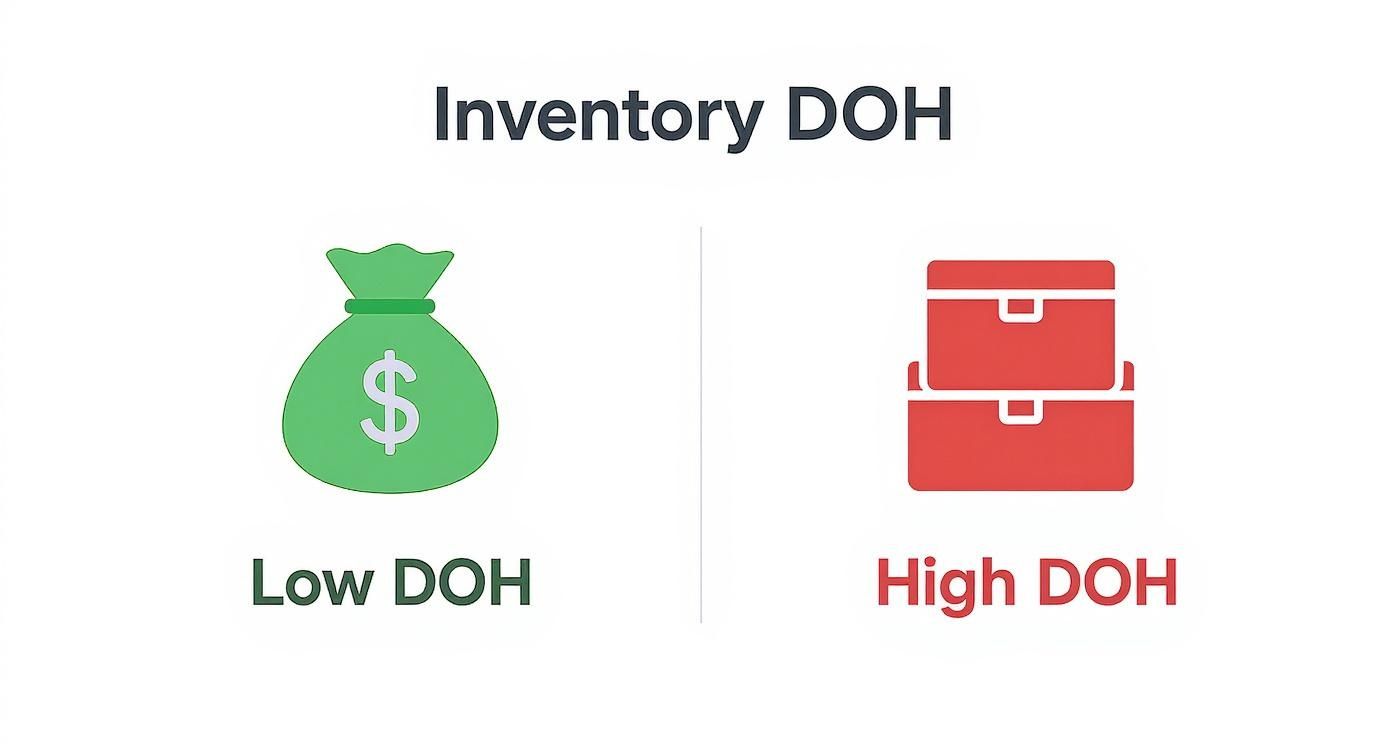
As you can see, a low DOH is often tied to high-volume, lower-margin goods. On the flip side, a high DOH is common for industries dealing with expensive items and longer, more considered sales cycles.
Why Industry Context Is Everything
Factors like product perishability, supply chain complexity, and even customer expectations shape what a normal DOH looks like. A grocery store has to sell fresh produce within days, not weeks, forcing an extremely low DOH to keep spoilage and waste to a minimum.
The numbers vary wildly. A grocer might aim for a DOH of just 2–3 days for certain fresh items. In stark contrast, a luxury watchmaker or a heavy machinery manufacturer might comfortably sit on a DOH above 90 or even 120 days. This simply reflects their slower sales cycles and the high value tied up in each product. You can find more great insights into industry-specific inventory metrics on intuendi.com.
The goal is not to hit the lowest possible DOH, but the optimal DOH for your business. Knowing your industry’s average is the first step toward setting goals that actually make sense.
Typical Inventory Days on Hand by Industry
To give you a clearer picture, let's look at what DOH ranges look like across a few key industries. This comparison really drives home how different business models directly shape inventory strategy.
| Industry | Typical DOH Range | Key Factors |
|---|---|---|
| Grocery & Food | 15-30 days | Perishable goods mean you have to sell fast to minimize waste and keep customers happy with fresh products. |
| Fast Fashion | 30-50 days | Trends change in the blink of an eye. A lean inventory is the only way to avoid getting stuck with last season's styles. |
| Consumer Electronics | 50-70 days | This is a balancing act. You need enough stock for new product launches, but you can't hold it too long or it becomes outdated. |
| Automotive | 90-120+ days | With long manufacturing lead times and expensive, specialized parts, car companies need to hold more inventory to keep production lines running. |
Looking at benchmarks like these helps you evaluate your own performance with the right perspective. If your custom furniture shop’s DOH is higher than a big-box furniture retailer’s, that’s probably not a problem—it just reflects your made-to-order process. It’s all about the context.
How the Big Players Master Their DOH
Theory is great, but seeing how world-class companies manage their inventory days on hand is where the real learning happens. These businesses don't just track their DOH; they build their entire strategy around it. By looking at how industry leaders operate, we can see how smart inventory management becomes a massive competitive edge.
Some companies win with speed, while others focus on massive scale and selection. Each approach requires a totally different DOH strategy, which just goes to show there’s no single "right" answer—only what's right for your business.
Zara: The Fast Fashion Pioneer
The Spanish fast-fashion giant Zara built its empire on an astonishingly low DOH. Their strategy is beautifully simple: get production as close to real-time customer demand as possible. Instead of gambling on huge seasonal collections months in advance, Zara produces in small, frequent batches.
This allows them to react almost instantly to what’s actually selling. If a new shirt flies off the shelves, they can have more in stores in a matter of weeks. If it’s a dud, they haven’t sunk a ton of cash into stock nobody wants.
The result is a legendary business model that slashes waste and keeps inventory exciting. By keeping their supply chain lean and responsive, Zara converts inventory into cash with incredible speed, freeing up capital to jump on the next big trend.
Walmart: The Logistics Giant
On the other end of the spectrum, a retail titan like Walmart plays a different game. Their promise is to offer a massive selection of products at low prices, and that means holding a lot more inventory. This is where you see the DOH strategy split. For example, Zara is famous for keeping its DOH under 30 days. In stark contrast, Walmart, the world’s largest retailer, uses its immense purchasing power and sophisticated supply chain analytics to maintain a DOH of around 45 days. You can dig into more data on how inventory KPIs impact major retailers at speedcommerce.com.
So how does Walmart handle the risk of a higher DOH? With an unbelievably efficient supply chain. They rely on advanced forecasting and distribution systems to get the right products to the right stores at the right time. This prevents empty shelves while carefully managing carrying costs across thousands of locations.
Toyota: The Just-in-Time Innovator
You can't talk about inventory efficiency without mentioning Toyota. The company’s just-in-time (JIT) manufacturing system fundamentally changed global production. The goal? Hold as little parts inventory as humanly possible. Components arrive at the assembly line exactly when they are needed—not a moment sooner.
This lean approach dramatically cuts down on storage costs and waste, but it demands perfect, almost surgical coordination with suppliers. JIT is the ultimate expression of DOH optimization, turning the entire supply chain into a single, seamless system. To get anywhere close to that level of control, modern manufacturers often use integrated platforms to track materials and schedules in real-time. You can see how custom manufacturing features support this level of management.
Actionable Strategies to Get Your DOH in Check

Knowing your inventory days on hand is one thing, but actually doing something about it is where the magic happens. Bringing that number down frees up cash, slashes carrying costs, and just makes your business more nimble. The good news is, there are several proven ways to get your inventory levels where they need to be and build a much more resilient operation.
Each of these strategies hits a different part of the inventory lifecycle, from the moment you place an order to the day you make a sale. Even adopting just a couple of these can make a real difference in how efficiently you turn your stock.
Get Better at Predicting the Future (Demand Forecasting)
Accurate forecasting is the bedrock of good inventory management. When you have a solid grasp of what customers are going to buy—and when—you stop guessing and start ordering intelligently. This is how you escape the nightmare of having too much of what people don't want and not enough of what they do.
- Dig Into Your Sales History: Don't just look at last month. Look for the bigger picture—seasonal spikes, recurring trends, and predictable patterns that can guide your buying.
- Embrace Modern Tools: Spreadsheets have their limits. Modern inventory systems often have forecasting features that use smart algorithms to get way more accurate than a human ever could.
- Talk to Your Sales Team: Your salespeople are on the front lines. They hear what customers are saying and see market shifts happening in real time. A quick weekly chat can make your forecasts infinitely better.
The connection between inventory days on hand and the wider economy has been crystal clear since the pandemic. We've seen global inventory turnover rates go on a wild ride, which makes tracking DOH in real time more important than ever for any business that wants to stay afloat. You can find more insights on this in the inventory management trends report from NETSTOCK.
Put an Inventory Management System to Work
If you're serious about controlling your days on hand, a dedicated system is a non-negotiable. It gives you a live look at stock levels, puts reordering on autopilot, and serves up the hard data you need to make smart calls. The right platform can completely change how you handle everything from raw materials to finished goods.
When you can connect your sales channels directly to your production floor, you create a seamless flow. You have what you need, exactly when you need it. That kind of alignment is the secret to keeping your DOH in that healthy sweet spot. It's worth exploring what's out there, and you can see how a platform like our platform's pricing fits into your budget.
Build Rock-Solid Supplier Relationships
Your suppliers have a massive impact on your DOH. If their lead times are long and all over the place, you're forced to carry extra safety stock just in case—and that inflates your days on hand number directly.
Working on building stronger partnerships can pay off big time. You'll often see:
- Shorter Lead Times: Have a conversation with suppliers about how to trim the time it takes from order to delivery.
- More Reliability: A supplier who delivers on time, every time, means you can carry less safety stock without the risk of running out.
- Better Communication: When you have an open line of communication, you'll get a heads-up on potential delays, giving you time to react and adjust.
Answering Your Top Questions About Inventory Days on Hand
Even after you've got the formula down, putting inventory days on hand (DOH) to work in the real world can bring up some tricky questions. Let's walk through a few of the most common ones that pop up.
Think of this as your quick-start guide to using this metric with confidence.
What Is a Good Inventory Days on Hand Number?
This is the million-dollar question, but the honest answer is: it depends. There’s no magic number that works for everyone. The right DOH is completely tied to your industry, your business model, and what you sell.
A grocery store dealing with fresh produce might aim for under 30 days to avoid spoilage. On the other hand, a company that manufactures heavy machinery could easily have a DOH over 100 days, and that would be perfectly normal for them.
The best way to find your "good" number is to benchmark against others in your specific industry. Even more importantly, track your own DOH over time. The real goal is to see steady improvement or stability that matches your business strategy.
How Often Should I Calculate DOH?
The right timing really hinges on your sales cycle and how quickly things change in your market. For most businesses, running the numbers on a monthly or quarterly basis hits the sweet spot. It's often enough to catch problems before they get out of hand, without getting bogged down by minor daily blips.
That said, if you're in a fast-paced industry like fashion or consumer electronics, you might want to calculate it weekly. Staying on top of the numbers helps you stay nimble.
Is DOH the Same as Inventory Turnover?
Nope, but they're definitely related. Think of them as two sides of the same coin—both tell you how efficiently you're managing your stock.
Here's the simple breakdown:
- Inventory Days on Hand tells you how many days your current inventory will last.
- Inventory Turnover tells you how many times you sell through your entire inventory in a specific period (usually a year).
A low DOH always means a high turnover rate, which is a great sign of efficiency. For more on this and other key metrics, the TimberCloud supply chain management blog is a fantastic resource.
Ready to stop guessing and start optimizing? TimberCloud, Inc. provides a complete platform for custom manufacturers to manage inventory, streamline production, and connect sales to the shop floor. Get control of your inventory and grow your business with TimberCloud.
Topics
TimberCloud Team
Content Team
The TimberCloud team is dedicated to helping manufacturers streamline their operations with intelligent software solutions.