How to Calculate Manufacturing Overhead Costs: Quick Guide

At its core, calculating manufacturing overhead is about figuring out how to fairly spread all your indirect factory costs—things like rent, supervisor pay, and machine oil—across the products you create. The goal is to arrive at an overhead rate, which you get by dividing those total indirect expenses by a logical activity measure, like machine hours or labor hours. This simple rate is the key to assigning a slice of those "hidden" costs to every item that leaves your factory floor.
What Are Manufacturing Overhead Costs, Really?
Before you can add up a single number, you have to know exactly what you're counting. Manufacturing overhead costs are all the expenses you incur during production that you can't tie directly to a single, finished product. Think of them as the essential, behind-the-scenes costs that keep the lights on and the machines humming.
This is what separates them from direct costs, which are easily linked to a specific item. If you run a custom woodworking shop, for instance, the lumber used for a table and the wages of the artisan who built it are direct costs. But the salary of the shop supervisor, the electricity powering the saws, and the rent for the workshop? That’s all manufacturing overhead.
The Three Core Buckets of Overhead
I've found it's easiest to get your arms around these expenses by sorting them into three main buckets. This simple system helps ensure you don't overlook costs that can quietly eat away at your profit margins.
- Indirect Materials: These are all the supplies you use in the production process but that don't become a primary part of the finished product. We're talking about cleaning supplies, lubricants for machinery, sandpaper, and glue.
- Indirect Labor: This covers the paychecks for everyone who supports production but doesn't physically assemble the products. This includes your quality control inspectors, maintenance crew, production supervisors, and janitorial staff.
- Other Factory Expenses: This is the catch-all category for everything else. It covers the big-ticket items like factory rent and property taxes, right down to equipment depreciation and the monthly utility bills.
The Bottom Line: The defining trait of an overhead cost is its indirect nature. While you absolutely need it to produce anything, you can't point to a single product and say, "This item used exactly $1.52 of the supervisor's time." Instead, you have to allocate these costs logically across all your products.
Don't underestimate these numbers. Manufacturing overhead often represents a huge piece of the pie, typically falling between 30% and 35% of a company's total production costs. Getting a handle on how to calculate manufacturing overhead is absolutely crucial for smart product pricing and realistic budgeting. You can explore the details of these financial benchmarks to see how your own operation stacks up.
Identifying Your Own Overhead Costs
The first practical step is to take a complete inventory of your facility's indirect costs. To help you get started, the table below breaks down some common examples. Use it as a guide to start identifying and categorizing every single overhead expense in your operation—it’s the foundation for the entire calculation process.
Identifying Common Manufacturing Overhead Costs
This table provides a breakdown of typical indirect costs you'll find in a manufacturing environment. It's designed to help you spot and correctly categorize these expenses.
| Category | Description | Examples |
|---|---|---|
| Indirect Materials | Supplies that support production without being a primary part of the final product. | Lubricants, cleaning supplies, low-cost fasteners, safety gear, sandpaper. |
| Indirect Labor | Wages and salaries for employees not directly involved in product assembly. | Production supervisors, quality assurance staff, maintenance teams, security guards. |
| Other Expenses | All other costs associated with running the factory or production facility. | Factory rent/mortgage, equipment depreciation, utilities, property taxes, insurance. |
Once you have a complete list based on these categories, you'll have a clear and accurate total to work with. This is your starting point for calculating a meaningful overhead rate.
Assembling Your Total Overhead Cost Pool
Now that you have a solid grasp on what counts as overhead, it’s time to roll up your sleeves and gather the numbers. The goal here is to create a cost pool—which is really just a fancy term for the total of all your indirect manufacturing expenses for a specific period, say a month or a quarter. Getting this pool right is the bedrock for all your other calculations.
You'll need to do a bit of a deep dive into your company’s financial records. This isn't a quick glance; it's a careful combing-through of a few key documents to make sure nothing slips through the cracks. A precise cost pool is the most important piece of the puzzle, because any mistake here will ripple through and distort your final overhead rate.
Hunting Down Every Indirect Cost
Your general ledger is the first and best place to start. Go through your expense accounts and pull the figures for everything you've already flagged as overhead. But the ledger is just the beginning. To get the full picture, you'll need to get your hands on the source documents.
Here's where you'll be looking:
- Utility Bills: Round up all the bills for the factory—electricity, water, gas, you name it. If your factory shares a building with, say, the sales office, be sure to only allocate the factory’s portion of those costs.
- Indirect Payroll Records: This isn’t just wages. You need the gross pay, payroll taxes, and benefits for everyone who isn't hands-on with production. Think supervisors, maintenance staff, and your quality control team.
- Depreciation Schedules: Your fixed asset schedule is your friend here. It will have the exact depreciation expense for the period on all your factory equipment and the building itself.
- Supplier Invoices: Sift through invoices for all those small but necessary items. We're talking about lubricants for machinery, cleaning supplies, and tiny fasteners that aren't worth tracking as direct materials.
My Two Cents: I always recommend setting up a dedicated spreadsheet or using tags in your accounting software to track these costs. It does two things: ensures you get a clean total for this period and makes the whole process a heck of a lot faster next time around.
Steering Clear of Common Pitfalls
When you're in the weeds pulling all these numbers together, a couple of classic mistakes can trip you up. The single biggest one I see is letting non-manufacturing costs sneak into the cost pool.
For instance, your sales team's salaries, the cost of a new marketing campaign, or the rent for your main administrative office are not manufacturing overhead. These fall under the umbrella of selling, general, and administrative (SG&A) expenses and they need to live in their own separate bucket. If they bleed into your overhead pool, you'll inflate your overhead rate and your product costing will be way off.
Another thing people often miss are the variable overhead costs—the expenses that go up and down with how much you produce. Fixed costs like rent are easy; they're the same every month. But variable costs, like the power needed to run the machines or the amount of indirect supplies you use, can fluctuate. Make sure you’re capturing the actual costs for the period, not just plugging in an old estimate. A little diligence here ensures your cost pool is a true reflection of what it actually costs to run your factory floor.
Choosing the Right Allocation Base for Your Business
Okay, so you’ve successfully corralled all your indirect manufacturing costs into a single pool. What now? The next step is all about building a solid bridge between that pool of money and the actual products rolling off your line. That bridge is your allocation base, and frankly, this is where the magic—or the mistakes—happen.
Picking the wrong base can completely throw off your product costing. You might end up overpricing your best-selling items and underpricing the ones that are secretly draining your resources. This isn't just an accounting exercise; it directly impacts your pricing strategy, profitability analysis, and overall business decisions.
Matching Your Base to Your Operations
At its core, the allocation base is the primary activity that drives your overhead costs. You’re looking for a clear cause-and-effect relationship. Think of it this way: what activity, when it increases, causes your indirect costs to increase too?
The three workhorses of allocation bases are direct labor hours, machine hours, and the number of units produced. There's no single "best" one; the right choice is entirely dependent on how you actually make things.
-
Direct Labor Hours: This is the go-to for any business where human hands do the heavy lifting. If your process is labor-intensive, relying on skilled craftspeople or detailed manual assembly, then the time your team spends on a product is a fantastic indicator of overhead use. A custom furniture shop is the classic example—the more hours a woodworker spends on a complex armoire, the more factory space, supervision, and utilities that single piece has consumed.
-
Machine Hours: On the flip side, if your facility is humming with automation—think CNC machines, robotic welders, or automated assembly lines—then machine hours is your best bet. In these environments, the real cost drivers are electricity, depreciation on that expensive equipment, and specialized maintenance. For a high-volume auto parts manufacturer, tracking machine runtime will give you a far more accurate picture than tracking the hours of the few technicians overseeing the process.
-
Units Produced: This is the simplest method, but be careful. It’s only accurate if you’re producing a single, uniform product or a handful of products that are almost identical in terms of resource consumption. A local bakery that only makes one type of sourdough loaf could easily use this. But it would be a terrible fit for a company that makes both simple metal brackets and complex, multi-part assemblies.
This infographic really helps put manufacturing overhead into perspective, showing how it fits within your total business expenses.
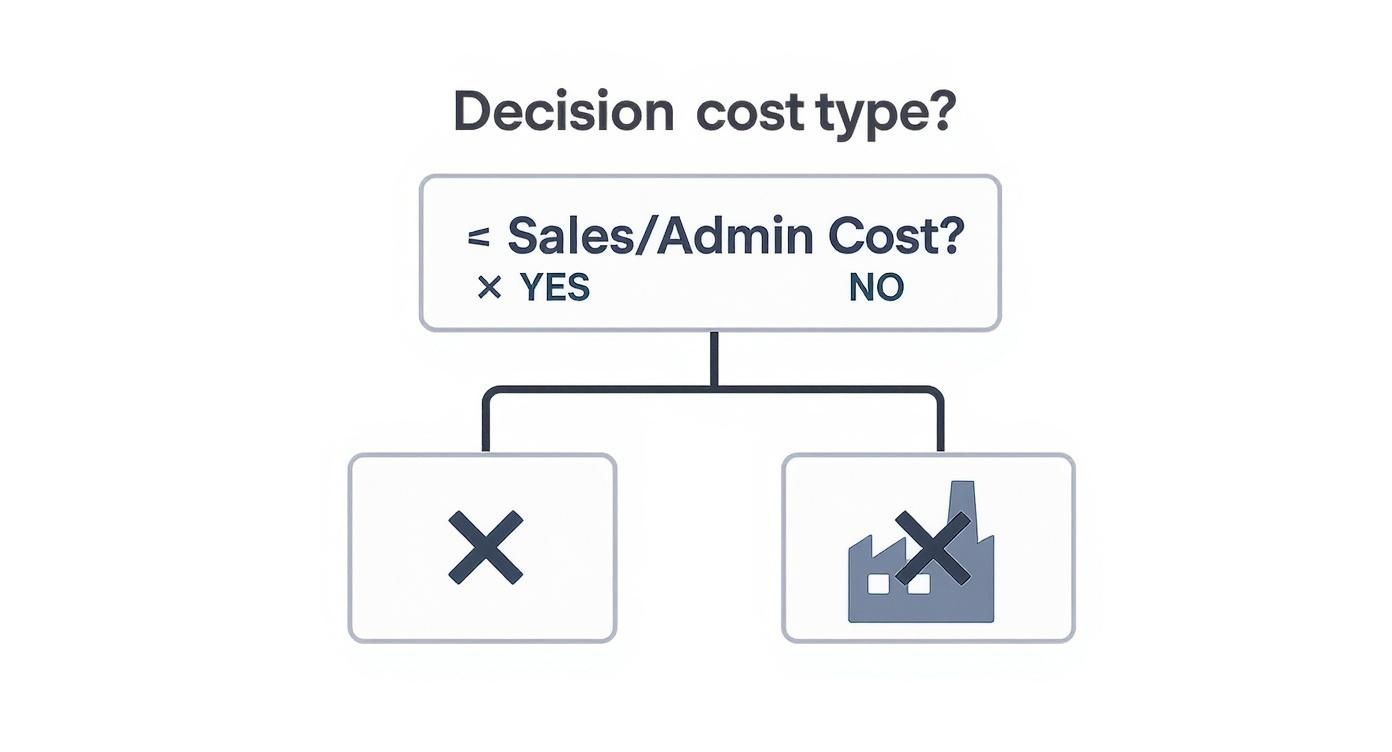
As you can see, it’s a crucial reminder to only include indirect costs tied directly to production. Keep all those sales and general admin expenses separate.
Applying the Allocation Base Correctly
Once chosen, your allocation base becomes the denominator in your overhead rate formula. This is how you translate that big, intimidating cost pool into a manageable rate that can be applied to individual products.
For example, let's say your calculated overhead rate is $22.22 per direct labor hour. If a particular product requires 2.5 labor hours to complete, you'll allocate $55.55 ($22.22 x 2.5) in overhead to that one unit. You can learn more about applying these formulas to see how this simple calculation has a major impact on your profit margins.
Here's a pro tip: Get up from your desk and take a walk through your shop floor. What do you see? If you see a lot of people working, direct labor hours is probably the way to go. If you see machines running with just a few operators in sight, you should be looking at machine hours. Your own eyes are often the best guide to what's truly driving your factory's costs.
Calculating and Applying Your Overhead Rate

Alright, you’ve done the legwork. You’ve corralled all your indirect costs into a single pool and pinpointed the best allocation base for your shop. Now comes the most important part: turning that big, abstract number into a practical tool you can use every day.
This is where we calculate the predetermined overhead rate. Don't let the name intimidate you; it's the key that unlocks accurate product costing.
The formula itself is beautifully simple. You're just doing a bit of division to find out how much overhead is "consumed" by each unit of your allocation base.
Total Overhead Costs ÷ Total Allocation Base = Overhead Rate
This little calculation gives you a dollar amount to attach to every labor hour, every machine hour, or whatever activity driver you chose. It makes your overhead tangible.
Let’s See It in Action
Theory is great, but let's put this into practice. Imagine your custom cabinetry shop racks up $50,000 in total manufacturing overhead for the month. After reviewing your operations, you've decided that machine hours are the fairest way to spread these costs, since your big-ticket equipment drives most of your utility and maintenance bills.
Looking at your production logs, you see that your machines ran for a combined total of 2,000 hours last month.
Time to plug those numbers into our formula:
$50,000 (Total Overhead) ÷ 2,000 (Total Machine Hours) = $25 per Machine Hour
There it is. Your overhead rate is $25 per machine hour. For every single hour a machine is running in your shop, it's absorbing $25 of your factory's indirect costs.
Expert Insight: This rate is more than just a number for your books. It's a powerful lens that gives you true visibility into your costs. It takes all those "invisible" factory expenses and makes them easy to assign and manage, which is absolutely critical for smart pricing.
Applying the Rate to Your Products
Figuring out the rate is the first step. The real magic happens when you start applying it to individual jobs. This is how you finally discover what each product actually costs you to make.
Let's stick with our cabinetry shop. A client orders a custom media console. You track the job through the shop floor and see that it requires two full hours on the machines for all the necessary cutting and routing.
Here’s how you apply your new rate to that specific job:
$25 (Overhead Rate) × 2 (Machine Hours for the Job) = $50
You can now confidently say that this specific media console carries $50 in manufacturing overhead.
This table breaks down the process with our numbers.
Sample Overhead Rate Calculation and Application
| Calculation Step | Description | Example Value |
|---|---|---|
| 1. Sum Total Overhead | Add up all indirect manufacturing costs for the period (e.g., rent, utilities, indirect labor). | $50,000 |
| 2. Sum Total Allocation Base | Total the chosen activity driver for the same period (e.g., total hours machines were running). | 2,000 Machine Hours |
| 3. Calculate Overhead Rate | Divide the total overhead costs by the total allocation base. | $50,000 ÷ 2,000 = $25 per Machine Hour |
| 4. Apply to a Single Product | Multiply the overhead rate by the amount of the allocation base used by one unit. | $25 × 2 Machine Hours = $50 |
Once you have this $50 figure, you add it to your direct material and direct labor costs for that console. Now you have the true, total cost of production.
This level of precision is non-negotiable for protecting your margins. Knowing these numbers ensures you're not just busy, but actually profitable on every single job that leaves your shop. For workshops looking to automate this, exploring different software options can provide valuable insights into effective product and service pricing.
Using Advanced Methods for Better Accuracy
A single, plant-wide overhead rate is a fantastic starting point. It brings much-needed clarity and control to your product costing. But as your operation grows and your product lines get more diverse, you'll find that a one-size-fits-all approach can start to mask some really important details. For any business with complex workflows, moving to more advanced methods is the key to unlocking true cost accuracy.
This becomes especially obvious when you have distinct production areas that consume resources in totally different ways. For instance, your highly automated CNC machining department has a completely different cost profile than a manual finishing and assembly area. If you lump them together under one rate, you’ll inevitably end up over-costing simple products and under-costing the complex ones.
Introducing Departmental Overhead Rates
The first logical step toward greater precision is to implement departmental overhead rates. This just means you create separate cost pools and allocation bases for each major production department. It’s a powerful way to acknowledge that not all areas of your shop floor are created equal.
By calculating individual rates, you get a much sharper picture of how resources are actually being used.
- Machining Department: The primary cost drivers here are likely electricity, expensive equipment depreciation, and specialized maintenance. It makes sense, then, that machine hours would be the most logical allocation base.
- Assembly Department: This area is probably far more labor-intensive. Its costs are driven by supervision, small hand tools, and indirect supplies. So for this department, direct labor hours makes far more sense.
Creating these separate rates ensures that a product spending most of its time in the assembly area isn't unfairly burdened with the high costs of the CNC machines it barely touched.
Unlocking Precision with Activity-Based Costing
For the ultimate level of accuracy, many businesses eventually turn to Activity-Based Costing (ABC). This is a powerful technique that drills down even deeper than departmental rates. Instead of looking at broad departments, ABC links overhead costs to the specific activities that cause them.
Activity-Based Costing moves beyond simple allocation bases to identify the true drivers of your overhead. It helps you see which products are genuinely profitable and which ones are quietly consuming a disproportionate amount of resources.
Advanced methods like Activity-Based Costing (ABC) give you incredible precision by identifying multiple activity cost drivers, rather than just relying on a single allocation base like machine hours. While the traditional single-rate method is certainly easier to get up and running, ABC uncovers the hidden cost drivers that cause overhead variance, which in turn supports process improvements and gives you far more accurate product costing. You can discover more insights about uncovering these hidden costs on makula.io.
Instead of one or two cost pools, you might create several, each tied to a specific action:
| Activity Cost Pool | Potential Cost Driver |
|---|---|
| Machine Setups | Number of setups |
| Quality Inspections | Number of inspections |
| Material Handling | Number of material moves |
| Order Processing | Number of customer orders |
When you assign costs this way, you can clearly see that a low-volume, highly custom job requiring multiple machine setups and inspections is far more costly than a simple, high-volume product—even if their direct machine hours are similar. This level of detail empowers smarter pricing and much more strategic decisions about your product mix. Exploring the advanced features of modern ERP systems can reveal how to implement these sophisticated costing methods far more efficiently.
Common Questions About Manufacturing Overhead
Even with a solid process, a few tricky questions always seem to pop up when you're wrestling with manufacturing overhead costs. Let's walk through some of the most common hurdles I've seen and how to think through them.
Fixed Versus Variable Overhead
One of the first things you have to get straight is the difference between fixed and variable overhead. Getting this wrong can throw your entire budget out of whack.
Fixed overhead costs are the stubborn ones; they don't budge no matter how much you produce. Think of your factory rent. You pay the same amount whether you're running at full capacity or just making a handful of units. Other classic examples are property taxes and the salaries of your supervisors.
Variable overhead, on the other hand, is directly tied to your output. The more you make, the more you spend. This includes costs like the electricity powering your machines or the lubricants and other indirect materials you consume during production. Nailing this distinction is absolutely critical for making smart decisions, especially when you're thinking about scaling up or down.
Recalculating Your Overhead Rate
So, how often should you be updating your overhead rate? It’s a great question, and sticking with an old number is a surefire way to mess up your pricing.
At the absolute minimum, you need to recalculate your rate annually when you do your budgeting. But honestly, that's cutting it close. A much safer, and smarter, practice is to review it quarterly.
The real pro-tip here is to recalculate immediately after any major operational change. Did you just buy a significant new piece of equipment? Did your utility costs spike? Did you renegotiate the factory lease? Any of these events should trigger an immediate review. Using an outdated rate means your product costing is fundamentally flawed.
Understanding Overhead Variance
"Why doesn't my applied overhead ever match my actual overhead?" I hear this all the time. Don't worry, it's completely normal for them not to line up perfectly.
This gap is called an overhead variance. It happens because your predetermined overhead rate is built on estimates. You're forecasting your total overhead costs and your total activity level (like machine hours) for the upcoming period. Reality rarely matches the plan exactly.
- Under-applied overhead means your actual costs were higher than you budgeted, or maybe you produced less than you expected. Either way, you didn't assign enough overhead cost to your products.
- Over-applied overhead is the flip side. You came in under budget on costs or you were more productive than planned, so you've assigned too much cost.
This variance gets sorted out at the end of the accounting period, usually by adjusting the cost of goods sold. For more practical financial insights designed for manufacturers, you can find a ton of great information on our manufacturing and woodworking blog. This final step ensures your financial statements give a true picture of your company's performance.
TimberCloud, Inc. can help you master your numbers. Our all-in-one platform connects your sales, operations, and financials, giving you real-time visibility into your true production costs. Go from blueprint to balance sheet with a single source of truth at https://timbercloud.com.
Topics
TimberCloud Team
Content Team
The TimberCloud team is dedicated to helping manufacturers streamline their operations with intelligent software solutions.