A Guide to Barcode Tracking Systems
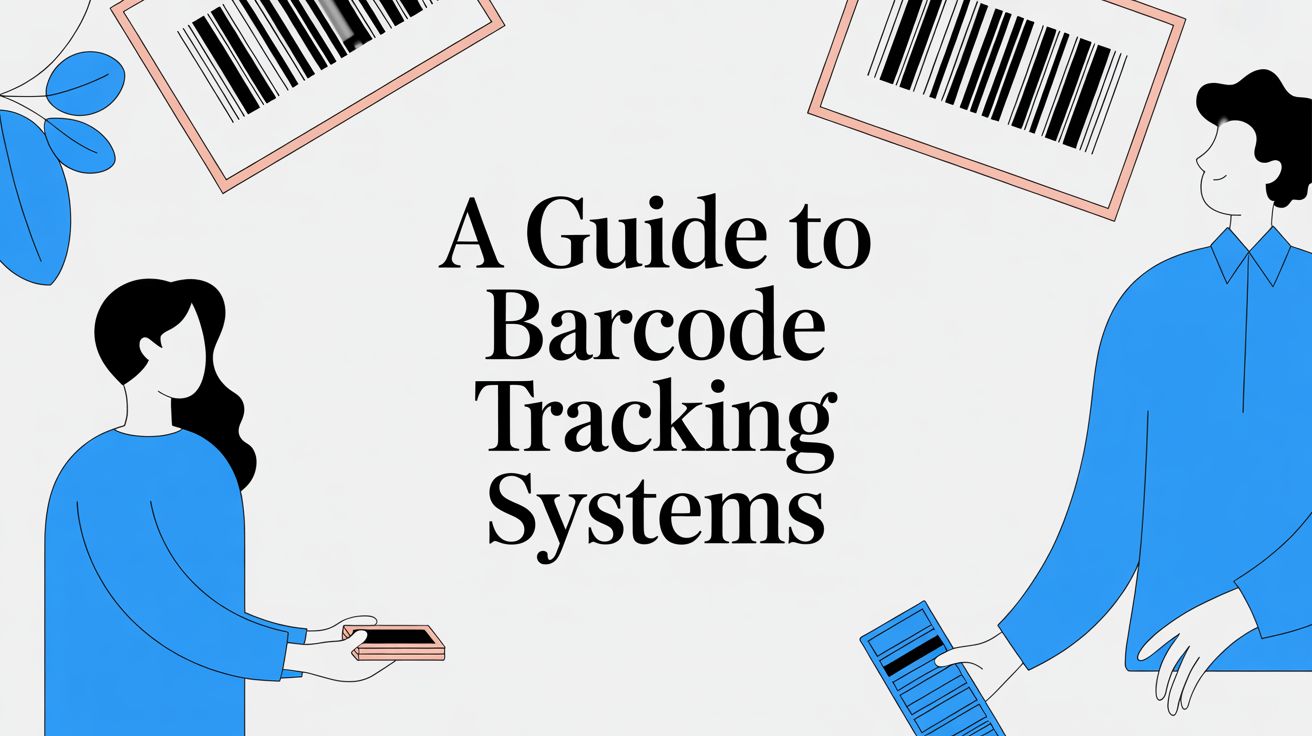
Picture your business as a sprawling library, filled with thousands of books. A barcode tracking system is like a modern, digital card catalog for that library. It gives every single item a unique fingerprint, allowing you to find, track, and manage it with just a quick scan. It's a simple idea, but it's one that completely changes how you collect data—making it faster, getting rid of human error, and giving you a live look at your operations.
How Do Barcode Tracking Systems Work?
At its heart, a barcode tracking system is all about automating how you capture information. Forget about someone scribbling down serial numbers on a clipboard or manually counting boxes. This system uses technology to do that same job in an instant, and with near-perfect accuracy. It's like having a universal translator that turns a physical object into a clean, digital record in your database.
The whole process kicks off when you stick a unique barcode label on every item you need to keep tabs on. This could be anything—a massive pallet of lumber in your yard, a specific piece of equipment in the field, or a finished product heading out the door. Each of those barcodes holds coded data, like a product code or a one-of-a-kind serial number.
The Scan and Update Cycle
When an employee needs to log an action—say, checking in a new shipment, moving a tool from one job site to another, or ringing up a sale—they simply grab a barcode scanner.
The scanner zaps the barcode, reads the pattern of black and white lines, and instantly translates it into usable information. It then sends that data straight to your central software, which could be an inventory system or a cloud ERP like TimberCloud. The software immediately updates the item's record. This simple "scan and update" loop is what makes the whole system tick.
The real magic of barcode tracking isn't just in the scan itself. It’s in the immediate, accurate data that the scan generates, bridging the gap between what's happening on your floor and what your digital records say.
This automated process gives you a crystal-clear, real-time view of your entire operation. You know exactly what you have, where it is, and what its status is, all without wrestling with messy spreadsheets or shutting down for a painful manual inventory count.
The impact is huge. Barcodes are scanned over 10 billion times every day in millions of businesses across the globe. As companies everywhere continue to digitize their operations, this technology has become more essential than ever. You can discover more insights about the barcode scanner market growth and see what's driving its adoption.
The Three Pillars of a Barcode System
At its heart, every barcode tracking system is built on three core components that have to work together perfectly. Think of it as a simple but powerful cycle: one piece creates the message (the barcode label), another reads it (the scanner), and the last one makes sense of it all (the software). When these three elements are in sync, you get a seamless flow of information from the physical world into your digital records.
It all starts with the barcode labels themselves. These are more than just stickers; they're the unique digital fingerprints you assign to your physical assets or products. The most familiar type is the traditional 1D barcode—those classic vertical lines you see on virtually every item at the grocery store. But many businesses are now moving to 2D barcodes, like QR codes, which look like small, pixelated squares.
There's a good reason for this shift. The global market for 2D barcode readers was valued at USD 8.5 billion in 2024 and is expected to climb to USD 20.4 billion by 2034. Why the massive growth? Because 2D barcodes can hold far more information and can often still be read even if they're partially torn or smudged. You can read more about 2D barcode reader market trends to see where the technology is headed.
Comparing 1D and 2D Barcode Technologies
To really get a feel for the differences, it helps to see them side-by-side. Each type has its place, but understanding their strengths and weaknesses is key to choosing the right one for your operations.
| Feature | 1D Barcodes (e.g., UPC) | 2D Barcodes (e.g., QR Code) |
|---|---|---|
| Data Capacity | Low (around 20-25 characters) | High (up to 2,000+ characters) |
| Orientation | Must be scanned in one direction (horizontally) | Can be scanned from any angle (omnidirectional) |
| Physical Size | Requires more space to store the same data | Much more compact and space-efficient |
| Error Correction | Very limited; damage can easily make it unreadable | High; can often be read even if partially damaged |
| Common Uses | Retail product identification, simple tracking | Inventory management, logistics, marketing, ticketing |
Ultimately, while 1D barcodes are still great for simple product identification, 2D codes open up a whole new world of possibilities for tracking complex information throughout your supply chain.
Scanners and Software: The Reader and The Brain
The second pillar is the barcode scanner. This is the device that actually "reads" the label. Scanners come in all shapes and sizes—from the rugged handheld "guns" you see warehouse workers use, to fixed-position scanners on an assembly line, and even simple apps on a smartphone for staff in the field. Their one and only job is to translate the lines or pixels on a barcode into digital data.
That data then gets sent to the third and most crucial pillar: the centralized software. This is the brain of the operation. It takes that raw string of numbers and characters from the scanner and gives it meaning. This software could be a specialized Warehouse Management System (WMS), an asset tracking platform, or a fully integrated cloud ERP.
The diagram below shows how these components come together to form a complete, functional system.
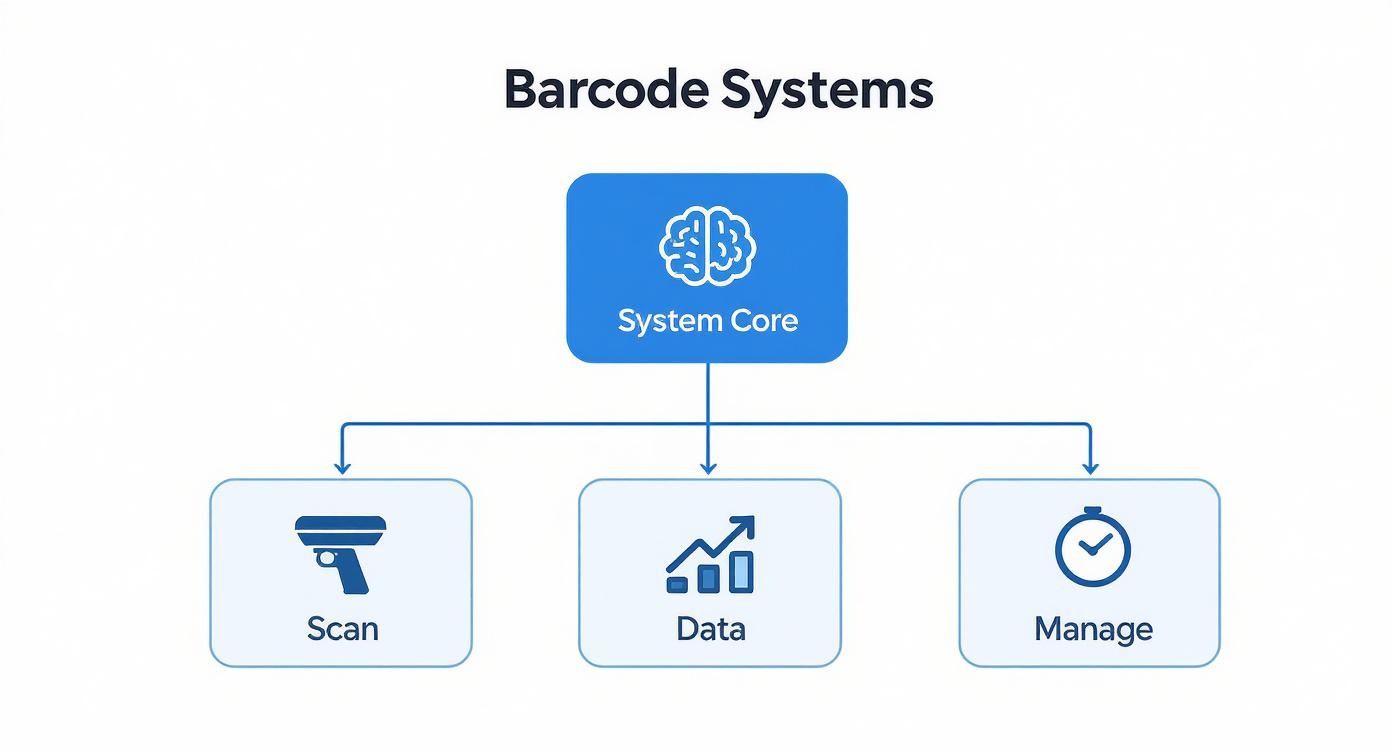
As you can see, the software sits at the center, turning simple scans into valuable actions and insights that help you run your business.
A barcode system is only as powerful as the software that interprets its data. Without a smart central hub, a scan is just a meaningless string of numbers.
This is the software that automatically updates your inventory counts, pinpoints an asset's last known location, or confirms that a crucial step in your production process is complete. It’s what transforms a quick zap from a scanner into real business intelligence. To get a better sense of this, you can explore the core features of an integrated ERP system and see how it connects barcode data directly into your day-to-day operations.
What You Really Gain from Barcode Tracking
Putting a barcode tracking system in place isn't just a minor operational tweak. It’s an investment that delivers real, measurable results that can fundamentally change how your business runs. The first and most obvious win is a massive jump in accuracy. Let's be honest, manual data entry is full of pitfalls—one slip of the keyboard can send the wrong product out the door, shortchange an invoice, or lead to ordering stock you don't need.
Barcode scanners, on the other hand, are astonishingly precise. Think about it this way: a proficient data entry professional might make one mistake for every 300 characters they type. A modern barcode scanner? Its error rate is somewhere around one in 36 trillion characters. That level of accuracy practically wipes out the costly headaches caused by human error, saving you a fortune on returns, rush shipments, and misplaced inventory.
Seriously Boost Your Operational Speed
Beyond getting things right, barcode systems make your entire operation faster. Consider the old-school approach to a full inventory count. It’s an all-hands-on-deck affair with clipboards and pens, shutting down operations for hours or even days. With barcodes, that whole ordeal becomes a thing of the past. A single employee with a handheld scanner can get the job done in a tiny fraction of the time, often without ever pausing normal business.
This injection of speed touches every part of your workflow:
- Getting Orders Out the Door: Your team can find, pick, and pack items in record time by simply scanning bin locations and product labels.
- Receiving New Shipments: Instead of manually ticking items off a paper invoice, a quick scan of each incoming box instantly confirms the delivery against the original purchase order.
- Managing Your Assets: Checking valuable tools or equipment in and out becomes an instantaneous, error-proof task, so you always know where everything is.
See What’s Happening in Real Time
Maybe the biggest game-changer is moving from old, stale information to live, actionable data. Before barcodes, your inventory records were only as good as your last physical count, which meant you were often just guessing your actual stock levels. A barcode tracking system, however, updates your main database the very second an item is scanned.
This live visibility lets you make smarter decisions on the fly. You can confidently promise a customer a delivery date because you know the item is on the shelf. You can set up automatic alerts to reorder materials before you run out. And you can finally spot slow-moving products before they become dead weight.
The real power of a barcode system isn't just about counting things faster. It’s about creating a single, reliable source of truth that connects your physical inventory to your digital records, minute by minute.
This constant stream of reliable data is the bedrock of better forecasting and smarter business planning.
Improve Accountability and Cut Down on Loss
Finally, barcode systems create an airtight audit trail. Every single scan is an event logged with a timestamp and, usually, the employee's ID. This gives you a clear history of who moved a specific pallet, who checked out that expensive piece of equipment, and exactly when an order shipped.
This level of accountability is a huge deterrent to loss and theft—a problem the industry calls "shrinkage." When every item's journey is tracked from the moment it arrives to the moment it leaves, any discrepancy gets flagged right away, not weeks later during a painful manual audit. This transparency makes it much easier to figure out where things are going wrong, helping you tighten your processes and protect your bottom line.
Barcode Systems in Real World Applications

It’s one thing to talk about the theory, but the real magic of a barcode tracking system happens when you see it at work. These systems are the quiet workhorses humming along behind the scenes in just about every industry you can think of. They’re solving unique, high-stakes problems everywhere, from your local grocery store to sprawling industrial plants.
In retail, a barcode acts like an item's passport. Imagine a new shipment of shirts arriving at a boutique. A quick scan of the box’s barcode instantly tells the store’s inventory system that the delivery is in. As each shirt is unboxed and put on a hanger, another scan confirms it’s officially on the sales floor, killing off "phantom inventory"—stock that exists in the spreadsheet but not in reality.
Then, at the checkout counter, a final scan deducts the shirt from the system the second it’s sold. This simple act does more than just speed up the line; it gives the store owner a live, accurate picture of what's flying off the shelves, which is crucial for reordering popular items before they sell out.
From Warehouse Shelves to Your Front Door
When it comes to the massive scale of warehousing and logistics, barcode tracking is the foundation everything is built on. A package's journey from a warehouse shelf to your home is really just a story told through a series of beeps from a scanner.
When you place an order, a warehouse worker’s scanner guides them directly to the right shelf and bin. A scan of the item's barcode confirms they've grabbed the right product, which cuts down on picking errors significantly. The item gets scanned again at the packing station, once more at the shipping dock, and a final time as it’s loaded onto the delivery truck. This process creates a perfect digital breadcrumb trail, making sure you get exactly what you ordered and allowing you to track it every step of the way.
Even with newer technologies out there, the barcode’s reliability is why over 80% of warehouses in the U.S. still count on it for managing their inventory. A well-implemented barcode inventory system can slash order fulfillment mistakes by up to 50%, proving just how powerful this straightforward technology remains.
Barcodes transform chaotic physical spaces into organized, data-rich environments. Each scan is a point of clarity, creating an accurate, real-time map of every item’s journey and location.
Ensuring Safety and Precision in Critical Fields
But it's not just about moving boxes. In a field like healthcare, barcodes are a lifeline for patient safety. Before giving medication, a nurse will scan the patient's wristband and then the medication itself. This simple "two-scan" check confirms the five rights of medication administration: right patient, right drug, right dose, right route, and right time. It's a small step that prevents huge, potentially life-threatening mistakes.
In manufacturing, the same principle applies to quality control. Barcodes are used to track every component and assembly as it moves through the production line. This work-in-process (WIP) tracking is a game-changer. If a defect shows up in a finished car part, for example, managers can scan its barcode to trace its entire history, quickly identifying the exact batch of steel or the specific machine that caused the problem.
You can dive into more of these real-world examples over on the TimberCloud blog.
How to Implement a Barcode Tracking System
So, you're ready to get a barcode tracking system up and running. Great. But let's be clear: success isn't about just buying a few scanners and printing some labels. It's a strategic move, and a well-planned rollout can make a world of difference in your efficiency, while a rushed job just creates new headaches.
It all starts with a simple plan. Before you even think about the tech, you have to nail down your goals. What specific problems are you trying to fix? Are you constantly dealing with surprise stockouts? Are shipping mistakes eating into your profits? Maybe you're losing expensive tools on job sites. Whatever it is, write down your top three to five pain points. Get specific.
A successful barcode system implementation is 10% technology and 90% process. If you automate a messy workflow, all you’ll do is make mistakes faster. You have to start by matching your goals to how your business actually operates.
Once you know exactly what you're trying to achieve, then you can start looking for the right tools. This is where you connect your real-world needs with the hardware and software out there.
Selecting Your Hardware and Software
Choosing your gear is a make-or-break step. The right equipment gets used; the wrong stuff collects dust. A busy warehouse that’s shipping hundreds of orders a day needs tough, dedicated scanners built for that environment. But a small retail shop? They might be perfectly fine using a smartphone app. The key is to avoid overspending on features you'll never use, but don't cheap out on durability where it counts.
The software, though, is the real heart of the system. It’s the brain of the whole operation. The big question here is whether you want a standalone app or something that plugs directly into the other systems you already use, like a cloud ERP. Integration is huge—it prevents you from having two different versions of the truth for your inventory and sales data.
And of course, there's the cost. For businesses that need predictable expenses, understanding the pricing model is non-negotiable. It's worth taking a look at a clear breakdown of subscription costs for integrated platforms to get a feel for how different plans can support your company as it grows.
Designing a Practical Workflow
Okay, you’ve picked your tools. Now it's time to figure out exactly how your team will use them every day. This comes down to two things: designing your labels and mapping out the scanning process itself.
-
Barcode Label Design: Think about what information is absolutely essential. Is a simple product ID enough, or do you also need to track lot numbers and expiration dates? Also, consider the label material. A label that works in a clean office will peel right off in a freezer or get destroyed in a dusty workshop.
-
Workflow Mapping: Don't do this from your desk. Get up and physically walk through every process you intend to track. Find the most logical places to scan an item. When it first arrives? As it moves into production? Right before it gets loaded on the truck? The goal is to make scanning a natural part of the job, not some clunky, extra step someone has to remember.
Finally, and this is the most important part, you have to train your team. A brilliant system is completely worthless if no one knows how to use it—or worse, doesn't want to. Hold hands-on training sessions. Create simple, one-page cheat sheets for common tasks. And most importantly, explain the why. Show them how this new system makes their work less frustrating and helps the company succeed. A team that's confident and on board is the single best ingredient for a smooth rollout.
Tying Barcodes Into Your Central Software
A barcode system on its own is useful, but it becomes a true powerhouse when it talks to your main business software, whether that's an Enterprise Resource Planning (ERP) system or a Warehouse Management System (WMS). This connection is what turns a simple scan into real business intelligence.
Think of your barcode scanners as data collectors out on the front lines—in the warehouse, on the production floor, or at the shipping dock. They capture what’s happening in the physical world, right now.
When that data flows directly into your central software, you close the dangerous gap between what's happening on the floor and what your digital records say. Your system isn't waiting for someone to manually type in an update; it reflects reality the moment a scan happens.
Forging a Single Source of Truth
This direct link is what creates a single, reliable source of truth for your entire operation. When a team member scans a pallet of lumber as it comes into the yard, your ERP knows about it instantly. That single action ripples through the whole business, influencing everything from sales availability to production planning.
The real magic happens when you see the knock-on effects:
- Inventory Updates on Autopilot: Every scan—whether at receiving, during production, or at the shipping bay—adjusts your stock levels automatically. No more manual data entry.
- Smoother Order Fulfillment: Pickers and packers can verify every item with a quick scan, which drastically cuts down on shipping errors and gets orders out the door faster.
- Smarter, Faster Decisions: When your data is live and accurate, managers can make much better calls on purchasing, scheduling, and forecasting.
By connecting your barcode scanners directly to a platform like TimberCloud, you make every scan a meaningful event. It’s the key to ensuring your digital records always match your physical reality.
Got Questions? We’ve Got Answers.
Let's dig into some of the most common questions we hear from businesses looking to get started with barcode tracking. Getting these answers straight can help you move forward with a lot more confidence.
What’s the Real Difference Between Barcodes and RFID?
The simplest way to think about it is line of sight. A barcode scanner has to physically “see” the barcode to read it, just like your eyes reading this sentence.
RFID (Radio-Frequency Identification), on the other hand, uses radio waves. This means an RFID reader can scan tags from a distance, without a direct line of sight, and even read hundreds of tags packed inside a box all at once.
While RFID sounds amazing for bulk scanning, barcode tracking systems are dramatically cheaper and easier to get up and running. Their proven reliability and incredibly low cost per label make them the go-to choice for the vast majority of inventory and asset tracking needs.
Can I Just Use My Smartphone as a Scanner?
Yes, you absolutely can! Most modern inventory software comes with a mobile app that turns your smartphone’s camera into a pretty good barcode scanner. It’s a great, low-cost way for a small business or a team out in the field to get started.
But here’s the reality check: for high-volume environments like a busy warehouse or a fast-paced production line, dedicated scanners are a must. They are built to be dropped, scan thousands of times a day without missing a beat, and have batteries that will outlast even the longest shifts.
The right tool always depends on the job. For a handful of scans here and there, your phone is perfect. For thousands of scans a day, a dedicated device isn't just a tool—it's an essential investment in your team's efficiency.
How Do I Know Which Barcode Type to Use?
This really comes down to one question: how much information do you need to pack into that code?
-
1D Barcodes (UPC, EAN): Think of the classic vertical lines you see on products at the grocery store. They’re fantastic for simple product identification because they hold a small string of numbers. Simple, effective, and universally understood.
-
2D Barcodes (QR Codes): Those pixelated squares can hold a ton more information—we’re talking thousands of characters. This makes them perfect for things like website links, detailed serial numbers, or complex batch information. A big bonus is their durability; they can often be read even if a part of the code is smudged or torn.
Ready to see how a modern, integrated system can pull all this together for your operations? The team at TimberCloud can show you how to connect barcode data directly to your sales, production, and inventory workflows. Get started with TimberCloud today!
Topics
TimberCloud Team
Content Team
The TimberCloud team is dedicated to helping manufacturers streamline their operations with intelligent software solutions.