16 Best Cost Estimating Software for Manufacturing (2026 Pricing)
Last verified: August 2026. We checked pricing directly on every vendor's own site. Ten of the sixteen refuse to publish a number.
The short answer
The best cost estimating software for manufacturing depends entirely on what you make. There is no single winner, and any list that gives you one is guessing.
- Custom woodworking, cabinets, doors, millwork: TimberCloud, Microvellum, Allmoxy, Innergy, CABINET VISION xBidding
- Metal fabrication and machine job shops: Paperless Parts, Costimator, SecturaFAB, ProShop ERP, JobBOSS², MIE Trak Pro
- Enterprise should-cost and design-stage costing: aPriori, Siemens Teamcenter PCM
- General SMB manufacturing where inventory matters more than quoting: Katana, MRPeasy, ShopVOX
The fastest way to waste a quarter is buying a metal-fab estimator for a cabinet shop, or an enterprise should-cost platform for a 12-person operation. Below, each tool is grouped by who it actually serves, with verified pricing where the vendor publishes it.
Quick pick: find your shop, get your shortlist
Find the line that describes you and start there.
Cabinet shop selling custom to dealers or direct: Start with TimberCloud. Also consider Allmoxy or Innergy. Skip aPriori and Teamcenter — they're built for a different world.
Door or window manufacturer: Start with TimberCloud. Also consider Innergy or Microvellum. Skip Paperless Parts and Costimator.
Commercial casework on bid projects (school, hospital, lab, retail fixtures): Start with Innergy or Microvellum, because on bid work your real problem is project accounting, not quoting. Also consider TimberCloud if you also sell custom product directly. Skip Katana and MRPeasy.
Millwork and trim shop selling custom work: Start with TimberCloud. Also consider Microvellum or Innergy. Skip Katana and MRPeasy.
Closet, furniture, or component maker: Start with CABINET VISION xBidding or TimberCloud. Also consider Allmoxy. Skip JobBOSS² and MIE Trak Pro.
CNC machine shop quoting from prints: Start with Paperless Parts or Costimator. Also consider ProShop ERP. Skip Microvellum and Allmoxy — those are wood tools.
Sheet metal or laser fabricator: Start with SecturaFAB. Also consider Paperless Parts. Skip Teamcenter and Katana.
Precision shop in aerospace, defense, or medical: Start with ProShop ERP. Also consider JobBOSS². Skip Katana and MRPeasy — neither will carry your quality system.
Mixed job shop, make-to-order: Start with JobBOSS² or MIE Trak Pro. Also consider Paperless Parts. Skip aPriori.
Enterprise doing design-stage should-cost analysis: Start with aPriori. Also consider Siemens Teamcenter PCM. You can skip everything else on this list.
Small manufacturer who mainly needs inventory plus light costing: Start with MRPeasy. Also consider Katana. Skip aPriori, Teamcenter, and ProShop.
Sign, print, apparel, or general custom shop: Start with ShopVOX. Also consider Katana. Skip Microvellum and Costimator.
First, the thing nobody else will tell you: what these actually cost
We went to all sixteen vendors' own pricing pages in August 2026. Here is what we found.
The six that publish a number
- TimberCloud — Request a written quote covering the tools, users, locations, setup, and applicable platform fees for your shop. Book a demo →
- MRPeasy — $49, $69, $99, or $149 per user per month depending on tier, two-user minimum. Add $79/mo per ten-user bundle past user ten.
- Katana — Free tier capped at 30 SKUs, Core from $299/mo, Advantage custom. Add-ons run $149–$249/mo each.
- ShopVOX — Express $109/mo plus $29 per user; PRO $249/mo plus $49 per user. Onboarding packages from $499.
- SecturaFAB — $500 to $1,800/mo depending on tier, unlimited users on every tier, plus transaction fees the site does not quantify.
- Allmoxy — partial credit. The $250 one-time sign-up fee is published; the monthly fee is negotiated with you after your first month.
The ten that won't
- aPriori — four packages listed, no numbers attached.
- Siemens Teamcenter PCM — sold as a Teamcenter Premium-tier capability, no standalone rate.
- Costimator (MTI Systems) — contact form only.
- Paperless Parts — the "pricing" page is a request form.
- ProShop ERP — "customized to match the unique needs of your shop," priced by user count.
- JobBOSS² (ECI) — "scalable packages," no amounts anywhere.
- MIE Trak Pro — quote promised within one business day.
- Microvellum — annual subscription, one package, no rate published.
- CABINET VISION xBidding — contact sales.
- Innergy — request a demo.
Why this matters more than it looks. Quote-only pricing is not automatically a red flag, as genuinely configurable enterprise software is hard to list-price. But it does three things to you as a buyer: it front-loads a sales conversation before you know whether you can afford the thing, it makes honest comparison impossible until you are deep in a pipeline, and it correlates strongly with implementation fees and annual contracts that only surface late.
Budget accordingly. If you are a shop under 25 people and a vendor won't give you a range on a first call, that is information.
A warning on the published numbers, too. Headline prices are floors, not totals. Katana's "$299/mo" excludes usage-based sales-order pricing and the $149–$249/mo add-ons most shops end up needing. ShopVOX's $109 base becomes $399+ once you add five users and inventory. SecturaFAB's tiers carry transaction fees the site does not quantify. MRPeasy is per-user, so a 10-person shop on Professional is $690/mo, not $69. Always model your real seat count and add-on set before comparing.
Custom woodworking, cabinets, doors, and millwork
This category is genuinely different from the rest of the list, and the difference is the reason generic manufacturing estimators fail in wood shops.
A machine shop quotes a part. A cabinet shop quotes a configuration — a door style, a wood species, a finish, a hinge, a set of dimensions that drive a formula, multiplied across 40 line items on one order, then repeated with three revisions before anyone signs. The estimating problem isn't "what does this part cost to machine," it's "what does this configurable assembly cost, priced consistently, fast enough to send today, and does it flow to the shop floor without anyone retyping it."
Tools built for metal fab handle the first problem well and the second one badly.
1. TimberCloud — best for all-in-one sales, estimating, and production for cabinet, door, and millwork shops selling configurable products
TimberCloud is built for cabinet shops, door manufacturers, and millwork and trim shops that sell made-to-order products. Rather than treating estimating as a standalone module, it runs the whole path: a customer or dealer configures a product on a storefront, formula-based pricing calculates the number, and the accepted order carries straight into cut sheets and production tracking without re-entry.
That last part is key. In most shops, the expensive error is not a slightly wrong estimate; it's a correct estimate that gets manually retyped into a work order and loses a dimension on the way.
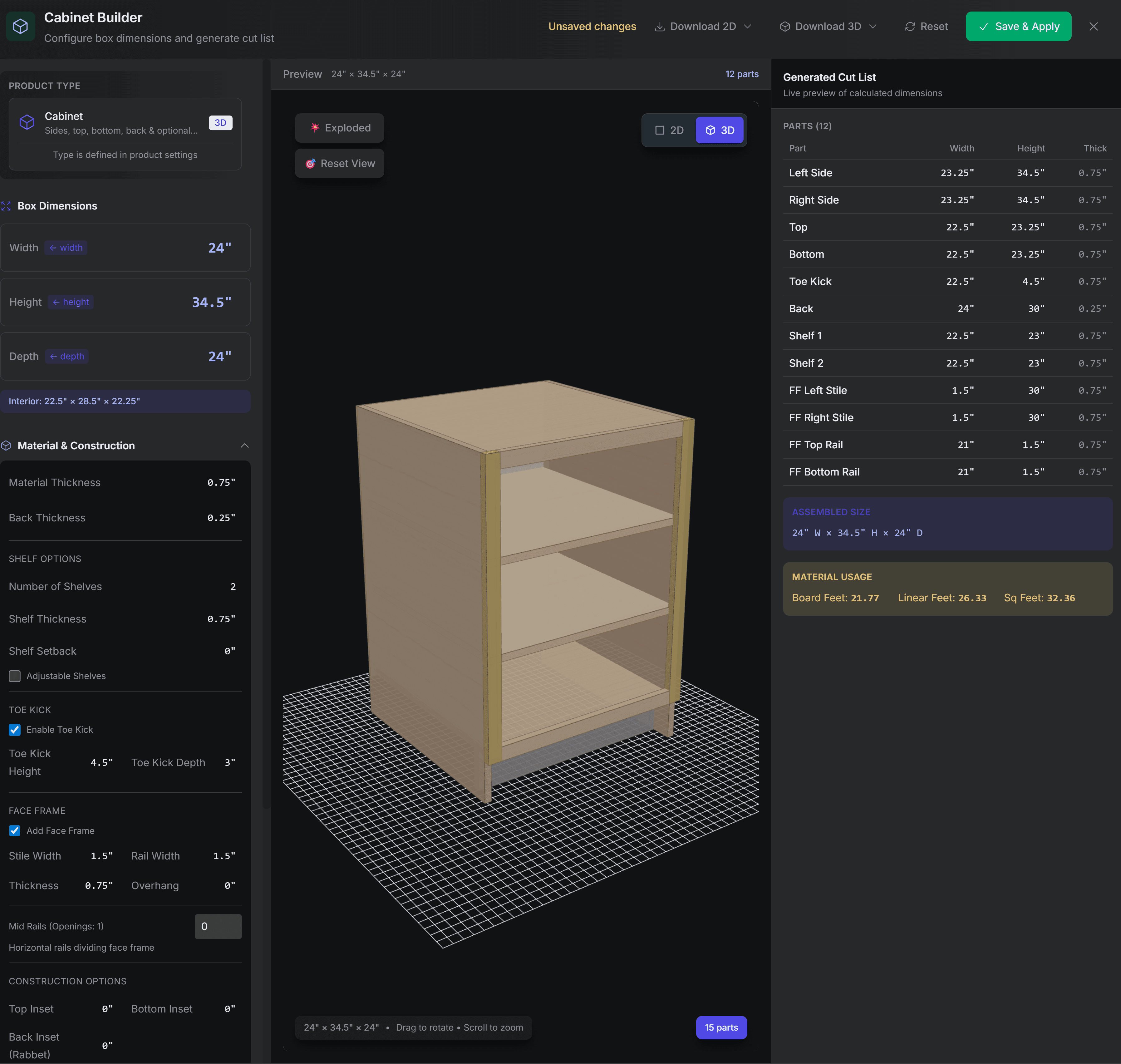
Start with one representative product. Configure its options and pricing rules, compare the result with your approved quoting method, and test the resulting order before expanding the catalog.
See how woodworking CPQ and formula-based product configuration work, or explore dealer and contractor ordering.
Core strengths
-
Formula-based pricing that handles dimensional and option-driven products, not flat SKU price lists
-
Visual product configurator, embeddable on your own site or a dealer portal
-
Quote → order → cut sheet → production → shipment in one system
-
AI Order Assistant for parsing incoming orders
-
AI Formula Assistant translates plain-english into pricing formulas, reducing manual inputs
-
Published pricing, which on this list is rarer than it should be
Key considerations
-
Budget for the base subscription, the users your team needs, and the applicable operational add-ons
-
Review current platform and payment-processing fees on the pricing page alongside subscription costs
Pricing: A base subscription with optional operational add-ons and additional users. Price the complete workflow your shop needs, including payment fees. See full pricing →
See it on your own products. A 30-minute working session using your catalog, your pricing model, and the way orders actually flow through your shop today. No slides. Book a demo →
Website: timbercloud.com
2. Microvellum — best for CNC-heavy shops running parametric engineering
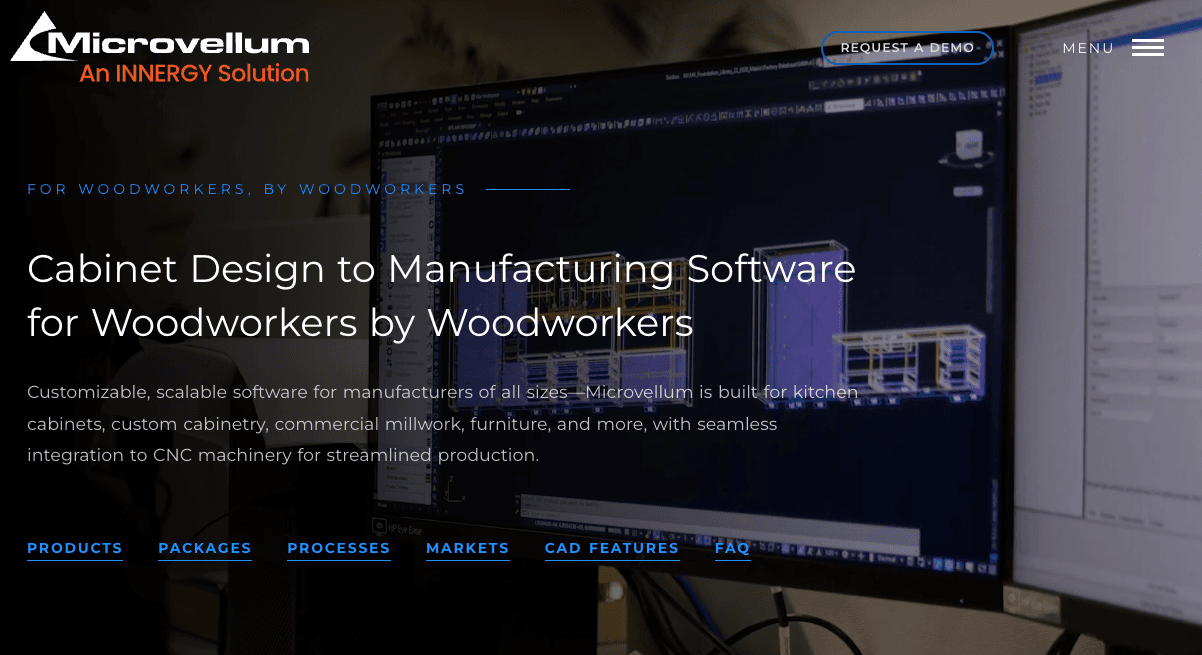
Consider it if: you run heavy CNC, do engineered-to-order commercial work, and have the internal capacity to build and maintain a parametric library.
Watch for: implementation depth. This is a system you commit to, not one you try. No published pricing — annual subscription, quote only.
Website: Microvellum.com
3. Innergy — best for large commercial casework and project-based bid work
Innergy positions itself as ERP for custom woodworking and millwork businesses, covering estimating through project management and financials. It skews mid-market and works best for shops running large commercial projects with real project-accounting needs.
Consider it if: you're a larger millwork operation where the estimate is one input into a multi-month project P&L.
Watch for: it's an ERP commitment, with the implementation timeline that implies. Quote-only pricing. See how TimberCloud compares to Innergy →
Website: Innergy.com
4. Allmoxy — best for cabinet component and door manufacturers selling wholesale
Allmoxy is built for cabinet, cabinet door, drawer box, and component manufacturers — shops selling into a dealer or trade base. Its online ordering and quoting flow is well understood by that market, and unlimited users is a genuine advantage for shops with many dealer accounts.
Consider it if: you're a component supplier whose customers order repeatedly through a portal.
Watch for: the pricing model. The $250 sign-up fee is published; the monthly fee is set in a negotiation during your first month, which makes budgeting before commitment difficult. See how TimberCloud compares to Allmoxy →
Website: allmoxy.com
5. CABINET VISION xBidding (Hexagon) — best for design-led cabinet and closet manufacturers
xBidding brings estimating into Hexagon's CABINET VISION design-to-manufacture environment, serving cabinet, closet, and furniture manufacturers. If your team already designs in CABINET VISION, keeping the bid in the same model is a real workflow win.
Consider it if: CABINET VISION is already your design backbone.
Watch for: it is an add-on to a larger platform, not a standalone estimating purchase. Contact sales for pricing.
Website: Hexagon.com
Metal fabrication and machine job shops
Different problem, different tools. Here the estimate starts from a drawing or a 3D model, and the winning software is the software that gets from print to price fastest without a senior estimator doing it by hand.
6. Paperless Parts — best all-round quoting platform for job shops
Paperless Parts serves job shops and contract manufacturers from roughly five people to five hundred, across sheet metal, CNC machining, Swiss screw, additive, and rubber. It reads geometry from uploaded models, applies your costing logic, and produces a professional quote fast. ITAR and GovCloud options make it viable for defense work.
Consider it if: you quote from customer-supplied CAD and want speed plus a modern buyer-facing experience.
Watch for: quote-only pricing, and the fact that its value depends on you doing the up-front work to encode your real shop rates and processes.
7. Costimator (MTI Systems) — best for should-cost and estimating consistency

Consider it if: consistency across multiple estimators matters more than a slick front end, or you need defensible should-cost numbers.
Watch for: the interface shows its age relative to newer entrants. Quote-only pricing.
Website: mtisystems.com
8. SecturaFAB — best for metal fabricators who want geometry-driven quoting
SecturaFAB drives estimates from part geometry, aimed at metal fabricators and metals service centers. It is one of the few on this list that publishes tiers: $500/mo to $1,800/mo with unlimited users.
Consider it if: you're a fabricator or service center and want per-shop rather than per-seat pricing.
Watch for: transaction fees are referenced but not quantified anywhere public. Ask for the number in writing before signing.
9. ProShop ERP — best for precision shops in regulated industries
ProShop is a full ERP with estimating built in, aimed at precision machine shops in aerospace, defense, medical, and space. Its paperless, compliance-oriented approach is genuinely strong for shops carrying AS9100 or ISO 13485.
Consider it if: quality-system documentation and traceability are as important to you as the quote itself.
Watch for: it's a whole-business system. Quote-only, priced by users.
10. JobBOSS² (ECI) — best for classic make-to-order job shops
JobBOSS² is purpose-built for job shops and make-to-order manufacturers, covering quoting through scheduling and job costing. A long track record and a large installed base mean plenty of people know how to run it.
Consider it if: you want a proven, conventional job-shop ERP and short-run production is your normal.
Watch for: "scalable packages" with no published amounts. Get the full picture including implementation before comparing.
11. MIE Trak Pro — best for small-to-mid fab shops needing flexibility
MIE Trak Pro serves small-to-mid metal fabrication, machining, and tooling shops, with quoting, job costing, and production scheduling in one place. It's known for being configurable to unusual workflows.
Consider it if: your processes don't fit neatly into an off-the-shelf template.
Watch for: configurability cuts both ways — budget for setup time. Quote within one business day, per their site.
Enterprise should-cost and design-stage costing
These two are a different species. They are not quoting tools; they are cost-engineering platforms used to decide what a product should cost before it is designed, and to negotiate with suppliers from a position of knowledge.
12. aPriori — best for design-stage should-cost at enterprise scale
aPriori simulates manufacturing cost from CAD geometry, letting engineering see cost consequences during design. It serves large global manufacturers in automotive, aerospace and defense, industrial equipment, and high-tech electronics.

Watch for: this is an enterprise commitment in both price and program. Quote-only. If you're under 200 people, this is almost certainly not your tool.
Website: https://www.apriori.com
13. Siemens Teamcenter Product Cost Management — best inside an existing Siemens PLM stack
Teamcenter PCM brings product costing, tooling costing, and should-cost analysis into Siemens' PLM environment, connecting engineering, procurement, and finance.

Watch for: it surfaces as a Premium-tier capability, so it is a PLM decision, not an estimating decision. Quote-only.
Website: https://www.siemens.com/en-us/products/teamcenter/solutions/product-cost-management/
General SMB manufacturing: inventory-first systems with costing attached
These aren't estimating tools in the strict sense. They're production and inventory systems where costing rides along. For plenty of small manufacturers, that's the right trade — but go in knowing what you're buying.
14. MRPeasy — best budget entry point for small manufacturers
MRPeasy targets small and mid-sized manufacturers and distributors up to about 200 employees, covering production planning, inventory, and product costing. Its published per-user pricing starts at $49.
Consider it if: you need real MRP fundamentals on a small budget and your quoting is straightforward.
Watch for: per-user pricing scales. Ten users on Professional is $690/mo. It is not a configurator-driven quoting engine.
15. Katana — best for product businesses that manufacture, not manufacturers that sell

Consider it if: you make repeatable products, sell through e-commerce channels, and inventory accuracy is the bottleneck.
Watch for: made-to-order custom work with option-driven pricing is not what this is for. Free tier caps at 30 SKUs; Core starts at $299/mo before add-ons.
Website: https://katanamrp.com
16. ShopVOX — best for general custom shops outside wood and metal
ShopVOX serves custom shops in sign, print, apparel, and general fabrication, with quoting, job management, and invoicing. Published pricing and a low entry point make it easy to evaluate.
Consider it if: you're a custom shop that doesn't fit the wood or metal categories above.
Watch for: base price plus per-user plus add-ons stacks quickly. See how TimberCloud compares to ShopVOX →
How to actually choose: five questions that decide it
Most software evaluations go wrong in the same way — the shop demos four tools, likes the one with the best-looking interface, and discovers the mismatch in month four. These five questions surface the mismatch in week one.
1. Does it price the way you actually sell? If you sell configurable products where dimensions and options drive the price, you need a formula engine, not a price list. Ask the vendor to price one of your real products, with a species change and a size change, live on the call. Most tools built for discrete parts will struggle visibly.
2. What happens to the quote after the customer says yes? This is the question that separates estimating tools from systems. If accepting a quote means someone retypes the specs into a work order, you have bought a faster way to produce an error. Ask to see the accepted quote become a cut list or a router without human retyping. If job costing matters to you, ask how actuals flow back against the estimate.
3. Can a non-estimator produce a quote? Shops that depend on one senior estimator have a bus-factor problem and a throughput ceiling. The real ROI in this category is usually not accuracy — it's letting a salesperson or the customer themselves produce a reliable number.
4. What is the all-in first-year number? Subscription plus implementation plus per-user plus platform or transaction fees plus training. Ten of the sixteen tools here won't publish a base rate, so you have to ask. Get it in writing and get it annualized.
5. How long until it's actually running? Two weeks and six months are both plausible answers on this list, and vendors rarely volunteer which one they are. Ask for the name and contact of a shop your size that implemented in the last year.
If you want to sharpen your inputs before you evaluate anything, our guides on calculating manufacturing cost and building a job cost sheet cover the underlying math these tools automate.
Choosing the tool that matches how you actually sell
The pattern across every shop that regrets a software purchase is the same: they evaluated features and ignored fit. A precision machining ERP is excellent software and completely wrong for a cabinet shop. A woodworking platform is the wrong answer for a laser fabricator. The list above is grouped the way it is because that grouping is the decision.
If you make custom wood products — cabinets, doors, millwork, furniture — the specific thing to test is whether the system can price a configurable product with a formula and then send that exact configuration to the floor without anyone retyping it. That single path is where wood shops lose margin, and it is the reason general manufacturing estimators keep disappointing them.
Ready to ship custom without the spreadsheet?
See TimberCloud running on your own products — a 30-minute working session tailored to your catalog, your pricing model, and how orders flow through your shop today. It's a working session, not a pitch deck.
Building cabinets? See TimberCloud for cabinet makers. Doors? Door manufacturers. Millwork and trim? Millwork & trim shops.
Pricing verified against each vendor's own published pages in August 2026. SaaS pricing changes frequently — confirm current rates directly with any vendor before purchasing. TimberCloud is our product; we've grouped it by the segment it actually serves and pointed you elsewhere where another tool fits better.
Frequently asked questions
For discrete machined or fabricated parts, Costimator and aPriori are the strongest at true cost calculation because both work from time standards and geometry rather than from your historical prices. For made-to-order assemblies where the "part" is a configuration — a cabinet, a door, a millwork run — a formula-based system like TimberCloud fits better, because the cost driver is the option set and dimensions, not machining time.
Paperless Parts and SecturaFAB lead for estimating directly from drawings and models, since both derive cost from part geometry. For job costing that follows the work through the floor afterward, ProShop ERP and JobBOSS² are stronger, because they carry actuals back against the original estimate. Many fabricators run a quoting tool alongside a shop ERP rather than expecting one product to do both well.
For a small shop, the practical answer is a system that captures labor at the point of work — a scanner or mobile app on the floor — and posts it against the job automatically. MRPeasy and MIE Trak Pro do this affordably for general manufacturing; TimberCloud handles it for wood shops via production tracking tied to the original order. Standalone time-tracking apps are cheaper but leave you reconciling two systems by hand.
Genuinely free options are limited and generally not viable past the smallest scale. Katana offers a free tier capped at 30 SKUs, which suits a very small product business but not a job shop. Most shops that start with spreadsheets do so because spreadsheets are free, and most leave once a mis-keyed formula costs them a job. If budget is the binding constraint, MRPeasy at $49/user/mo is the realistic floor for real functionality.
CAD/CAM contributes two things to an estimate: geometry (dimensions, features, material volume) and process data (toolpaths, cycle times). Tools like Paperless Parts and aPriori read geometry directly to generate cost. In woodworking, CABINET VISION and Microvellum link design models to both bids and CNC output. The limitation is that CAD/CAM knows the part but not your business — your labor rates, overhead, margin policy, and lead times still have to be configured, and that configuration is where estimating accuracy actually comes from.
Costimator and Paperless Parts are the two most commonly shortlisted, with ProShop ERP as the choice when quality-system requirements come with the work. The deciding factor is usually whether you want a dedicated quoting layer over your existing ERP (Paperless Parts) or a single system doing both (ProShop, JobBOSS²).
Based on published rates as of August 2026: a small shop can run real software from roughly $50–$300/mo, a mid-sized operation typically lands between $500 and $1,500/mo, and enterprise should-cost platforms are six figures annually. Because ten of the sixteen vendors here don't publish rates, treat any budget built without written quotes as a guess.
Topics
TimberCloud Team
Content Team
The TimberCloud team is dedicated to helping manufacturers streamline their operations with intelligent software solutions.