Mastering Serial Number Tracking in Custom Woodworking

For a custom woodworking shop, serial number tracking isn't just another box to check for inventory control. It's the very foundation of your quality, customer service, and ultimately, your profitability. You're moving beyond just counting items and starting to understand the entire life story of every unique piece that leaves your workshop. It creates a bulletproof chain of custody from start to finish.
Why Serial Number Tracking Is a Game-Changer for Woodworkers
Think about the last time a client called about an order from a year ago. Maybe it was a finish issue on a cabinet door or a question about the specific hardware you used. Without serial numbers, that call probably sent you scrambling through old emails, paper job folders, or just trying to jog your memory. It’s a frustrating and inefficient fire drill.
Now, imagine that same scenario with a serial number. A quick scan or lookup instantly pulls up that item's complete lifecycle. This isn't just about knowing where a product is; it's about knowing everything about it.
Unlock Pinpoint Accuracy in Operations
Implementing serial numbers brings a new level of precision to your inventory management. Those mysterious discrepancies that used to pop up during cycle counts become painfully obvious, because every single unique identifier has to be accounted for. It's no surprise that many shops report inventory accuracy rates jumping above 95% after getting a solid tracking system in place.
This granular detail delivers some serious advantages:
- Warranty Management: A customer files a claim. You punch in the serial number and instantly see the purchase date, warranty terms, and even the manufacturing batch. Guesswork is gone, and resolutions happen fast.
- Theft Deterrence: A serialized inventory means you have a verifiable record of ownership for every high-value piece—from finished cabinets to expensive tools and hardware. It makes theft much harder to get away with and easier to prove.
- Quality Control: This is a big one. If you notice a batch of finish is starting to fail, you can quickly identify every single piece that was coated with it. A potential disaster becomes a targeted, manageable fix.
The control you gain is similar to what logistics companies experience; for instance, the benefits of vehicle tracking systems show clear parallels in improved efficiency and oversight.
Elevate Your Customer Service and Brand Reputation
Let's say a customer reports an issue with a custom vanity. With its serial number, you can see in seconds who built it, the exact materials used, and its entire production history. This allows you to respond with total confidence and offer a solution based on hard facts, not fuzzy memories.
A serial number transforms a generic product into a unique, traceable asset. This capability is critical for resolving customer issues, managing recalls, and protecting your brand's integrity. It moves your shop from reactive problem-solving to proactive quality assurance.
Ultimately, serial number tracking is your first real step toward building a data-driven workshop. It provides the rock-solid data you need to fine-tune your processes, cut down on waste, and build a reputation for quality and reliability that speaks for itself. When you know the story behind every piece you create, you gain complete control over both your craft and your business.
Designing Your Serial Numbering System
Before you can track anything, you need a system that makes sense. A well-designed serial number isn't just a random string of characters; it's a dense packet of information that’s easy for both your team and your software to read. The goal here is to create a consistent, scalable naming convention that tells you a story with every scan.
Without a solid structure, you’re just asking for data chaos. Inconsistent formats, missing details, and confusing codes can quickly turn your tracking efforts into a bigger headache than they're worth. A good system, on the other hand, creates unwavering consistency across the entire shop floor.
Building Blocks of a Smart Serial Number
A truly useful serial number usually includes a few key pieces of data. Think of it like building a code where each segment has a specific meaning. When you put them together, they give you a complete picture of the item's origin and purpose.
For a custom woodworking or millwork shop, here are the components you'll want to consider:
- Project ID: This is what links a specific part back to a customer order or internal job. It’s the primary thread connecting a single cabinet door to the entire kitchen it belongs to (e.g., ).
PROJ451 - Item Type or Category: A short code identifying what the piece actually is. This helps you quickly tell the difference between a drawer front and an end panel within the same project (e.g., ,
DOOR,DRWR).PNL - Creation Date: Stamping the month and year (like for August 2024) gives you immediate context for when an item was made. This is a lifesaver for handling warranty claims and tracking down quality control issues.
0824 - Unique Sequence: This is just a simple running number (e.g., ,
001,002) that guarantees every single item has its own unique ID, even if it's identical to another part made on the same day for the same job.003
Putting these pieces together gives you a serial number that’s packed with information. For example, PROJ451-DOOR-0824-007 instantly tells you it's the seventh door made for project 451 back in August 2024.
Choosing a Format That Works for You
There’s no single "right" format for everyone, but whatever you choose, consistency is king. The key is to pick a structure and stick to it religiously. To get this right, it helps to understand serial number lookup and how different formats help with identification and tracing.
Below are a couple of common approaches I've seen work well in different types of shops.
Sample Serial Number Naming Conventions
This table shows a few different ways to structure your serial numbers, embedding useful information right into the code itself.
| Item Type | Example Convention | Breakdown | Use Case |
|---|---|---|---|
| Custom Cabinetry | | Project ID - Item Type - Date - Sequence | Perfect for shops handling large, multi-part custom jobs like kitchens or complex built-ins. |
| Architectural Millwork | | Architectural Work Order - Item Type - Date - Sequence | Great for commercial projects where work orders are central to the workflow. |
| Furniture Piece | | YYMMDD - Item Type - Craftsman ID - Sequence | Suited for shops producing smaller, individual pieces where craftsman accountability is a top priority. |
| Component/Part | | Material Code - Item Type - Unique Sequence | Useful for tracking individual parts or components made from specific materials before assembly. |
Ultimately, the best system is the one that fits your shop’s actual workflow. Don't overcomplicate it. The simpler and more intuitive the format, the more likely your team is to use it correctly without errors.
The point of a serial number isn't just to be unique; it's to be useful. If a craftsman can glance at a label and know what they're looking at without needing a scanner, you've nailed it.
Let Software Handle the Details
Trying to create and assign these numbers manually is a recipe for mistakes. It's tedious, and it's far too easy for someone to accidentally assign duplicate numbers, throwing your entire system off. This is where a platform designed for manufacturers, like TimberCloud, becomes a game-changer.
Systems like this offer pre-built fields you can customize for your specific needs. Instead of fiddling with a spreadsheet, your team can generate compliant serial numbers automatically as part of their regular production workflow. This ensures every piece, from raw material to finished product, gets logged correctly from the start. That automation is what sets the stage for accurate serial number tracking and gives you a clean, reliable dataset as you grow.
Mapping Your Production Workflow with Serial Tracking
Alright, you’ve designed a smart numbering system. Now comes the fun part: making it a real, working piece of your shop's daily rhythm. This is where serial number tracking goes from an idea on a whiteboard to a living process, creating an unbreakable chain of custody for every single part and finished product that leaves your floor.
This isn't about adding more paperwork or bureaucratic hoops for your team to jump through. It's about weaving data capture into the tasks they're already doing. When you map this out correctly, every scan is quick, makes sense, and actually adds value. The goal is to build a detailed history for each item without slowing anyone down.
From Raw Materials to Work in Progress
The life story of a serialized product really begins the moment raw materials hit your receiving dock. Getting this first step right is the key to genuine end-to-end traceability.
- Receiving: When a truck drops off a shipment of premium walnut or a pallet of high-end drawer slides, you'll assign a batch serial number. You don't need to tag every single board; just tag the batch or pallet. A quick scan links that material's origin, supplier, and arrival date to a unique ID in your system.
- Kitting and Processing: Later, when your team pulls materials for a specific job, they scan the batch serials and connect them to the project. This is your first critical link—tying raw inputs to a specific customer order before a single cut has been made.
This early data is gold. Imagine you discover a defect in a batch of hardware months down the line. With this system, you can instantly pull up a list of every single finished product that used a piece from that specific delivery.
The Build Phase: Forging the Connections
The shop floor is where individual parts and raw materials come together to become something more. It's also where your serial number tracking needs to be the sharpest. As your team creates new components—cabinet doors, drawer boxes, face frames—each one gets its own unique serial number.
Here’s the crucial part: as these serialized components are assembled, their individual serials get linked to a single "parent" or "master" serial number for the final assembled cabinet. It’s like a family tree. The finished cabinet is the parent, and all its doors, drawers, and panels are the children, each with its own traceable history.
This is where simple tools make all the difference. Putting a basic USB barcode scanner at each workstation practically eliminates the fat-finger errors that happen with manual data entry. A craftsman finishes an assembly, scans the parts, scans the new master label, and gets back to work. The whole process should take just a few seconds.
Your serial number tracking system is only as reliable as the data you feed it. By making data capture an effortless part of the production process with tools like scanners, you ensure the information is both fast and, more importantly, accurate.
Quality Assurance and Final Sign-Off
The Quality Assurance (QA) checkpoint is the perfect place to put all this captured data to work. When a finished piece gets to the QA station, a quick scan of its master serial number can pull up its entire life story.
Suddenly, the QA inspector’s job becomes much more data-rich:
- Scan the Item: The product's complete bill of materials and production history pop up on their screen.
- Perform Inspection: The inspector can follow a digital checklist, confirming dimensions, finish quality, and hardware function.
- Log Results: Their sign-off, plus any notes or photos of defects, is digitally attached to that serial number's permanent record.
This creates a time-stamped, unchangeable record of quality approval. It provides total accountability and gives you a powerful way to spot trends. If you start seeing recurring issues at the QA stage, you can trace them back to specific materials, processes, or even workstations by analyzing the data tied to those serials.
This is how a simple, informative serial number is built from a few key pieces of information.
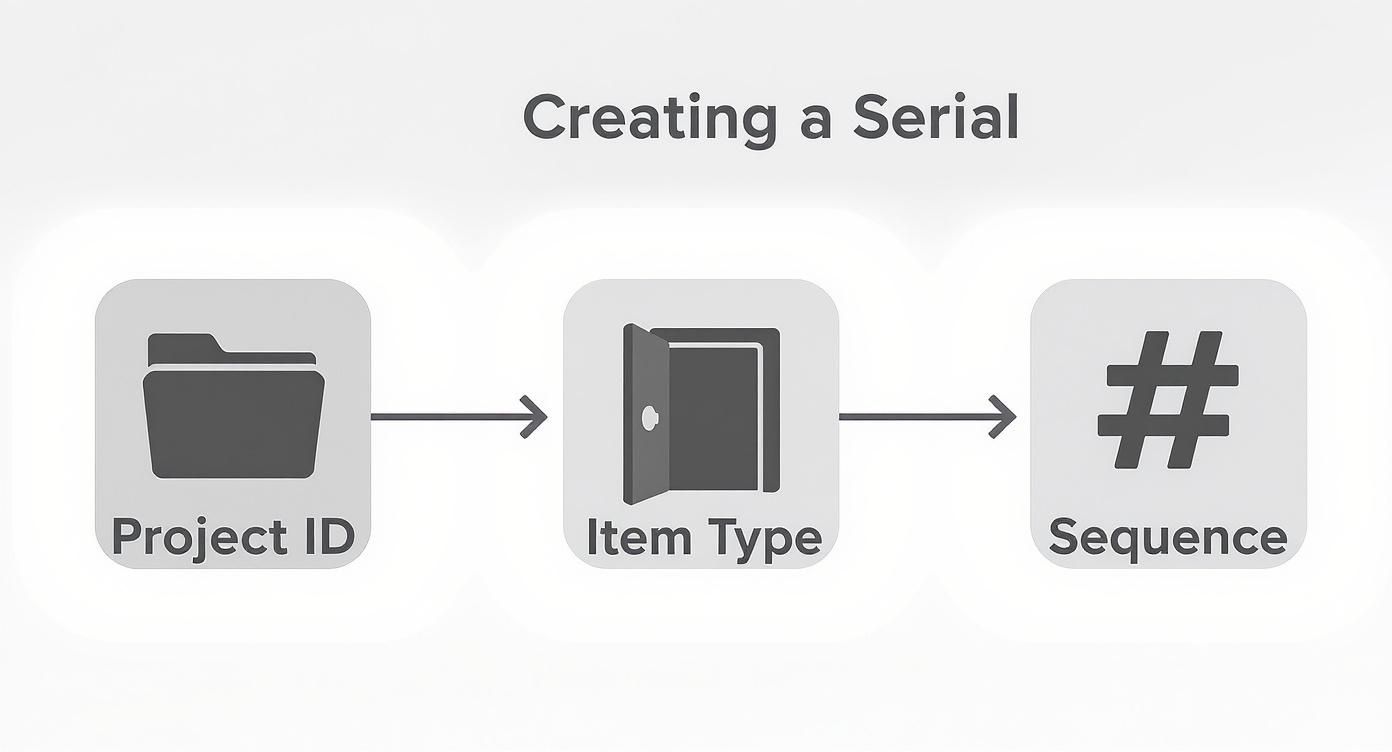
By combining a project ID, an item type, and a sequence, you create a powerful identifier that tells you a lot with just a glance.
The Final Mile: Shipping and Beyond
The last stop in your internal workflow is the shipping department. As an item is being boxed up, its serial number gets scanned one last time. This scan connects it to a sales order, an invoice, and the shipping carrier’s tracking number. This closes the loop on production and opens the next chapter: its life with the customer.
This step is more important than ever, especially as customers expect to know where their order is at all times. The global parcel shipping volume is projected to hit a staggering 217 billion parcels this year, fueled by the explosion in e-commerce. Logistics giants manage this scale with meticulous tracking. By linking your internal serial number to the external shipping tracker, you're adopting a best practice that provides a seamless, professional experience for your customers. You can see more about these global shipping trends and understand just how vital this has become.
And if a product ever comes back? Its journey comes full circle. A scan of the serial number as it's returned instantly pulls up its entire history—from the raw lumber it was made from to the day it shipped out. This makes handling warranty claims, repairs, or restocking decisions fast, easy, and based on facts. That complete, lifecycle view is the ultimate payoff of a well-designed serial tracking workflow.
Making Your Software Talk: Integrating Tracking Systems
A serial number tracking system sitting by itself is a missed opportunity. Its real power is unleashed when it’s connected to the other software that runs your business—your ERP, your accounting package, and your e-commerce storefront. This is how you break down the walls between departments and create one reliable source of information for the entire company.
When everything is connected, your tracking data stops being just a shop-floor tool and becomes a strategic asset. Your sales team can look up an order and tell a customer exactly where it is in the production line. Your bookkeeper can see the precise material costs tied to every finished piece. Best of all, your customers get accurate, real-time updates without having to pick up the phone.
Connecting Your Workshop to Your Website
If you sell your work online, syncing your inventory is absolutely critical. Imagine this: a custom cabinet gets its final QA scan in the shop. That scan should instantly update the inventory on your Shopify site, marking the piece as ready to ship. This simple connection prevents the nightmare of selling a one-of-a-kind item that's already gone or, even worse, hasn't been built yet.
This data needs to flow in both directions:
- From the Shop to the Store: When a serialized piece is marked "complete" in your production software, it automatically shows up as "in stock" on your website. No manual updates needed.
- From the Store to the Shop: As soon as an online order comes through, the system can reserve a specific serial number or kick off a new work order. This ensures the correct item is picked and packed every single time.
This is exactly what platforms like TimberCloud are built for. By linking what happens on the floor directly to your sales channels, the information your customers see is always the truth. You can dig into the details of TimberCloud's integrated e-commerce and ERP features to see how all the pieces fit together.
From Production Updates to Financial Health
The benefits go way beyond just selling online. When you connect your serial number tracking data to your Enterprise Resource Planning (ERP) system or accounting software, you get a much clearer picture of your financials. By linking the serial numbers of your raw materials (like a specific batch of walnut) to the final product's serial number, you create an airtight trail for your cost of goods sold (COGS).
Think about the power of a single barcode scan in the shipping bay. That one action can update inventory levels, trigger an invoice in QuickBooks, and send a shipping notification to the customer—all at once. This isn't just about saving time; it's about eliminating the human errors that creep in with manual data entry.
When a serialized table is scanned as "shipped," for example, your system can automatically generate the correct invoice in your accounting software, complete with the right costs. Your financial records stay perfectly in sync with your production output. This is a game-changer for accurate job costing, letting you see the real profit margin on every single piece you create.
A Page from the Global Supply Chain Playbook
This idea of interconnected, real-time data isn't new; it's what keeps the entire global supply chain moving. The world of container shipping has been forced to get very good at this, pushed by demands for more transparency. They use IoT devices and sophisticated tracking to give real-time location and condition data for every container on the planet.
You can get a sense of how modern tools are changing global shipping to see these same principles applied on a massive scale. The logic is identical for your shop: a connected system brings clarity, efficiency, and control, whether you’re tracking a shipping container or a custom vanity.
Turning Tracking Data into Business Intelligence
Capturing data with serial number tracking is just the start. The real magic happens when you turn that raw information into business intelligence that can actually grow your shop. A database full of serial numbers is just a long list until you start asking it the right questions. When you do, you’ll shift from just managing inventory to strategically improving your entire operation.
Think of each serial number as leaving a breadcrumb trail that details an item's complete journey through your shop. By analyzing these trails together, you start to see powerful insights that were completely invisible before. It’s the difference between knowing what you built and truly understanding how you built it—warts and all.
Spotting Production Bottlenecks Before They Hurt
One of the first things you'll notice when you start analyzing tracking data is where work grinds to a halt. By generating reports that measure the time between key production scans—from raw material receiving to assembly, finishing, and QA—you can pinpoint exactly where projects are getting stuck.
For instance, you might run a report and find that a particular style of cabinet consistently spends 48 hours longer in the finishing department than any other product. That single data point gives you a clear starting point for a real investigation.
- Is it a complex multi-step finish? The time might be justified, but now you know how to price those jobs more accurately in the future.
- Is the finishing booth always tied up? This could point to a capacity issue that needs to be addressed with better scheduling or maybe even new equipment.
- Is a specific product causing delays? Maybe a certain stain has an unusually long cure time, and a different product could speed things up without sacrificing quality.
Without this data, you’re just guessing. With it, you're making informed decisions that improve your shop's throughput and profitability.
Nailing Down Quality Control and Warranty Claims
Your serial number history is also a secret weapon for quality assurance. When a customer calls with a warranty claim, you can instantly pull up that item’s entire production record. This lets you spot trends you’d otherwise miss completely.
Let’s say you get a couple of calls about peeling veneer on drawer fronts. By analyzing the serial numbers of the affected items, you discover they were all produced in the same week and used materials from the same batch of plywood. Right away, you know the problem is almost certainly a bad material lot, not your team’s craftsmanship.
By assigning a unique serial number to each product unit, companies can precisely monitor the product's journey from manufacturing to sale and beyond. This detailed level of tracking helps prevent stockouts, directly improving inventory accuracy and reducing holding costs.
This kind of detail transforms your warranty process from a reactive, frustrating expense into a proactive tool for improving quality across the board.
How Tracking Shines in a Real-World Recall
The ultimate test of any tracking system is how it performs during a crisis. Imagine your finish supplier sends an urgent alert: a specific batch of lacquer they sold you three months ago was defective and might fail prematurely.
Without serial numbers, you're facing a logistical nightmare. You'd have to contact every single customer who bought a finished product in the last few months, causing widespread panic and costing a fortune.
With a solid serial number tracking system in place, the response is surgical and calm:
- You find the batch number of the defective lacquer in your system.
- You run a quick report to find every finished product serial number that was ever associated with that specific lacquer batch.
- You generate a precise list of only the 15 affected customers, leaving everyone else completely undisturbed.
This capability turns a potential brand-damaging disaster into a manageable customer service issue. It’s how tracking evolves from a simple shop floor convenience into a critical risk management tool. Systems that provide this level of reporting are essential; you can see how different software tiers support these analytics by checking out the pricing and feature breakdowns from TimberCloud.
Common Pitfalls in Serial Tracking and How to Avoid Them
Putting a new system into a busy workshop is never as clean as it looks on paper. Even the best-laid plans for serial number tracking can hit a snag when they meet the reality of the shop floor. I’ve seen it happen time and again, so let’s walk through the most common mistakes and, more importantly, how to get around them.
Think of this as your field guide to troubleshooting before the trouble starts. A little foresight here can be the difference between a system that empowers your team and one that just causes headaches.
Inconsistent Data Entry
This is the big one. Hands down, it's the most common reason tracking systems fail. A system is only as good as the data going into it, and if one person is scanning religiously while another skips a step or punches in numbers by hand, your entire dataset is compromised.
The root cause is almost never laziness. It’s usually a clunky process or a lack of understanding. If scanning feels like an interruption instead of a natural part of the workflow, people will find a way to work around it.
The Fix: Make it dead simple to capture the data.
- Get Good Scanners: Put simple, durable barcode scanners at key workstations. This eliminates manual entry and turns scanning into a quick, reflexive action.
- Bake it Into the Process: Build scanning into your existing checkpoints. For example, a piece can't move from assembly to the finishing booth until its serial number is scanned. It becomes a tollgate, not a chore.
- Show, Don't Just Tell: Explain to your team why this matters. Show them how it helps with warranty claims or pinpoints a bad batch of finish. It stops being a "management thing" and becomes a tool that protects their own craftsmanship.
Choosing the Wrong Labeling Technology
A woodworking shop is a brutal environment for a flimsy label. Between the sawdust, overspray, oils, and general abrasion, a standard paper sticker doesn't stand a chance. It’s a classic mistake to pick a label that can't survive your shop, leading to unscannable products and a dead end in your tracking.
Picture a finished cabinet sitting in QA, but the barcode has been smudged into oblivion during the finishing process. The tracking chain is broken. Now someone has to stop what they're doing to manually look up the item and print a new label, killing momentum.
Your serial number label isn't just a sticker—it's a critical piece of data that has to survive the entire production journey. Investing in durable labeling isn't optional; it's essential for keeping your tracking system honest.
The Fix: Match the label to the environment.
- Raw & In-Process Goods: Look at industrial-grade polyester or vinyl labels. They need a strong adhesive that can grab onto rough surfaces and handle the chaos of production.
- Finished Products: After finishing, you can use something a bit more refined but still tough. Many shops apply these in a discreet spot, like inside a cabinet door. For high-end custom pieces, some even opt for small metal tags or laser etching.
- Test Them: Before you buy a thousand labels, get some samples and abuse them. Run them through your exact process—sanding, finishing, assembly—and see which ones come out readable on the other side.
Failure to Secure Team Buy-In
You can have the best software and the toughest labels on the market, but if your crew sees serial tracking as just another bureaucratic hoop to jump through, the system is doomed. Resistance, or even just apathy, from the people using it every day will kill its effectiveness.
This usually happens when a new process is handed down from on high without any input from the team on the floor. If you're looking for more ideas on building better shop processes, the TimberCloud blog is a great resource for workshop management insights.
The Fix: Get your team involved from the very beginning.
- Explain the "Why": Connect the dots for them. Show how serial numbers protect their hard work, make it easier to isolate quality issues, and cut down on frustrating rework.
- Ask for Input: Before you lock in the process, walk through it with your lead craftsmen. They’ll see practical problems you’d never spot from behind a desk.
- Frame the Benefits for Them: This isn't just about making management's life easier. Good tracking means fewer interruptions, faster problem-solving, and less time wasted hunting for a lost part or a misplaced order. It's a tool that helps them do their job better.
Ready to implement a serial number tracking system that avoids these pitfalls? TimberCloud provides an all-in-one platform with integrated tools designed for the realities of a custom woodworking shop. Discover how TimberCloud can streamline your operations.
Topics
TimberCloud Team
Content Team
The TimberCloud team is dedicated to helping manufacturers streamline their operations with intelligent software solutions.