A Guide to Manufacturing Quoting Software for Custom Woodworking
At its core, manufacturing quoting software is a system designed to automate your cost estimation, proposal generation, and sales process for anything custom or configurable. Think of it as the brain that connects a customer's unique request to your shop's reality, replacing slow, error-prone spreadsheets and guesswork with instant, accurate quotes. It bridges the often-painful gap between an online order and a production-ready plan.
From Hours to Minutes: How Manufacturing Quoting Software Works
Let’s use a simple analogy from the shop floor. Imagine building two identical custom cabinets.
For the first cabinet, you do everything the old-fashioned way: measure each piece by hand, sketch out a cut list on a notepad, and run every component through a table saw. It works, but it's slow. For the second cabinet, you feed the design into a CNC machine. It instantly calculates the most efficient material layout, generates a perfect cut list, and machines every part with flawless precision in a fraction of the time.
That’s the difference between manual quoting and using manufacturing quoting software.
The manual quoting process is the table saw of the sales world. It gets the job done, but it’s a huge bottleneck. You're stuck juggling spreadsheets, calling suppliers for material costs, and chasing down approvals, all while your customer is waiting... and likely getting quotes from your competitors.
The Modern Alternative to Manual Quoting
Quoting software, on the other hand, is your CNC machine. It acts as a central command center that understands the DNA of your business—your products, your materials, your labor rates, and your machine capabilities. When a customer customizes a cabinet on your website, the software crunches all those variables in real-time to generate a precise, professional quote on the spot.
This infographic paints a pretty clear picture of just how stark the difference is.
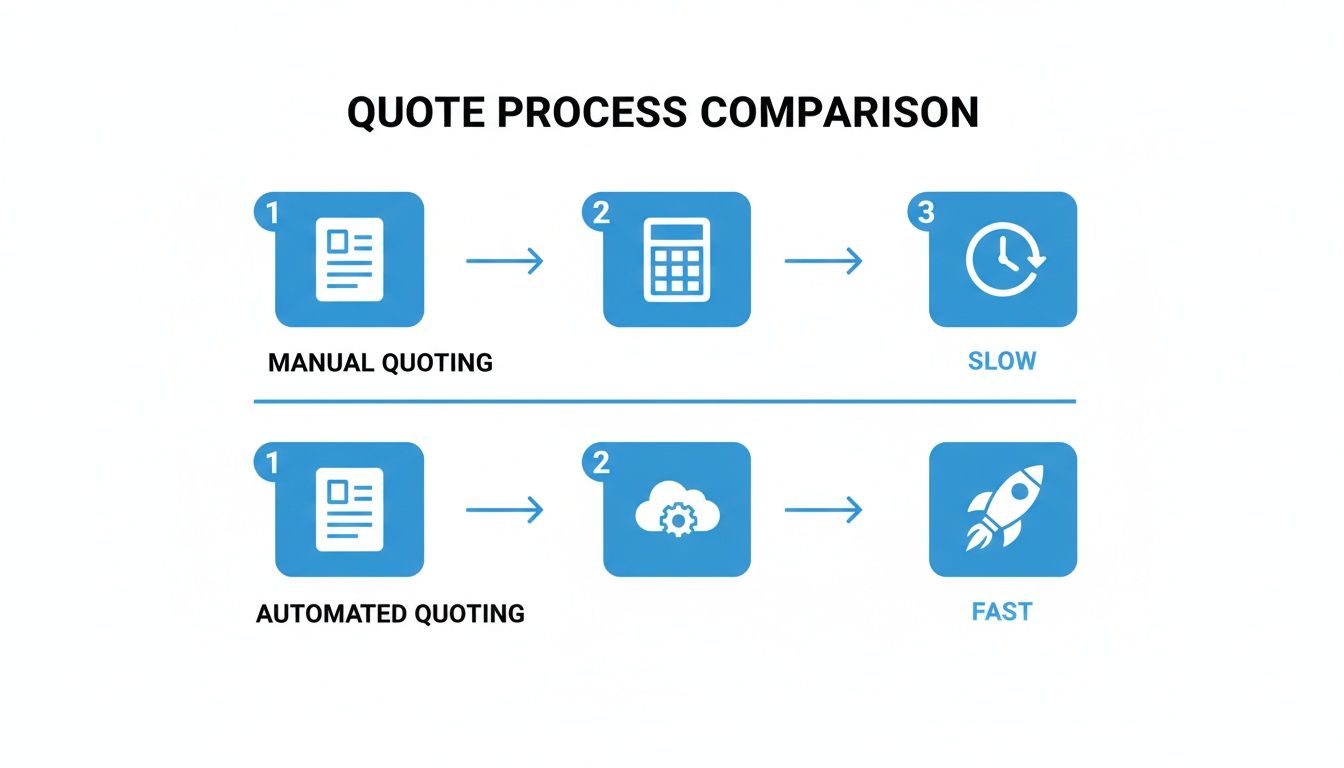
You can see immediately how automation cuts out the endless back-and-forth and manual work that grinds your sales cycle to a halt.
Bridging the Gap From Sales to Production
Modern platforms take this even further. They create a seamless, unbreakable link from an online customer order directly to a work order that’s ready for the shop floor. This integration is critical because it eliminates the dangerous disconnect where sales promises something that production can't actually deliver profitably or on time.
This unified approach delivers some massive wins:
- Speed and Responsiveness: You're sending out quotes in minutes, not days. In this business, the first accurate quote in the door often wins the job.
- Guaranteed Accuracy: Costly math errors are a thing of the past. Pricing is automated based on your pre-set rules, live material costs, and labor inputs. No more "oops" moments that kill your margins.
- Improved Customer Experience: You’re giving clients what they want: the ability to visually customize their product and see the price instantly. It’s a professional, modern buying journey that builds trust from the very first click.
Ultimately, this technology transforms a chaotic, reactive quoting process into a well-oiled engine for growth. It’s no longer a "nice-to-have" but a must-have for any woodworking shop that’s serious about scaling. For more practical advice on building a more efficient manufacturing business, check out the articles on the TimberCloud blog.
Why Spreadsheets Are Costing Your Woodworking Business
For so many custom woodworking and millwork shops, spreadsheets feel like an old friend. They’re flexible, everyone knows how to use them, and best of all, they seem free. But that “free” tool comes with a hefty price tag—one that quietly drains your profits, frustrates customers, and puts a ceiling on your growth.
Sticking with manual calculations is like trying to navigate a dense forest with a hand-drawn map instead of a GPS. It’s painfully slow, you’re bound to make mistakes, and you’ll probably get lost along the way.
Each quote turns into a high-stakes scavenger hunt. Your estimator opens a master spreadsheet (if they can find the latest version), digs through a separate supplier list for material costs, guesses at labor hours based on memory, and then painstakingly pulls it all together. This messy process is a breeding ground for costly mistakes.
The True Cost of Manual Errors
Think about it: a single misplaced decimal or a busted formula can completely wipe out your profit margin on a custom kitchen cabinet job. When pricing is all over the map depending on who creates the quote, it doesn't just confuse clients—it shatters their trust. One customer gets a fair price, the next gets an inflated quote for something similar, and suddenly you have a reputation for being unreliable.
This chaotic workflow also creates a massive disconnect between what sales promises and what the shop floor can actually deliver. A salesperson might quote a specific type of walnut, not realizing you're out of stock or that its price jumped 20% since that spreadsheet was last touched. What happens next? You either eat the cost, delay the project, or have to make that awkward call to the customer with bad news. All three hurt your bottom line and your reputation.
The hard truth is that quoting errors can bloat project costs by a staggering 10-15%. For a shop doing any real volume, these "small" mistakes add up to tens of thousands of dollars in lost revenue every single year.
It’s no wonder the global sales automation market is on track to hit USD 1.5 billion by 2033. Industries like manufacturing are finally waking up and moving away from these error-prone manual methods. In fact, studies show that while manual errors are a budget killer, automation can slash quote response times by up to 70%—a massive advantage for winning more B2B deals. You can find more data about the quoting software market's rapid growth on StrategicRevenueInsights.com.
Speed Is a Competitive Weapon
Beyond just getting the numbers right, the real killer is time. While your team is spending hours, or even days, piecing together a single quote, your competitor using manufacturing quoting software has already sent a professional, accurate proposal and is on the phone following up. In this market, the first solid quote in the door often wins the business.
Slow response times scream inefficiency. They make potential customers wonder if you’ll be just as slow delivering the final project. It plants a seed of doubt before you’ve even had a chance to win them over.
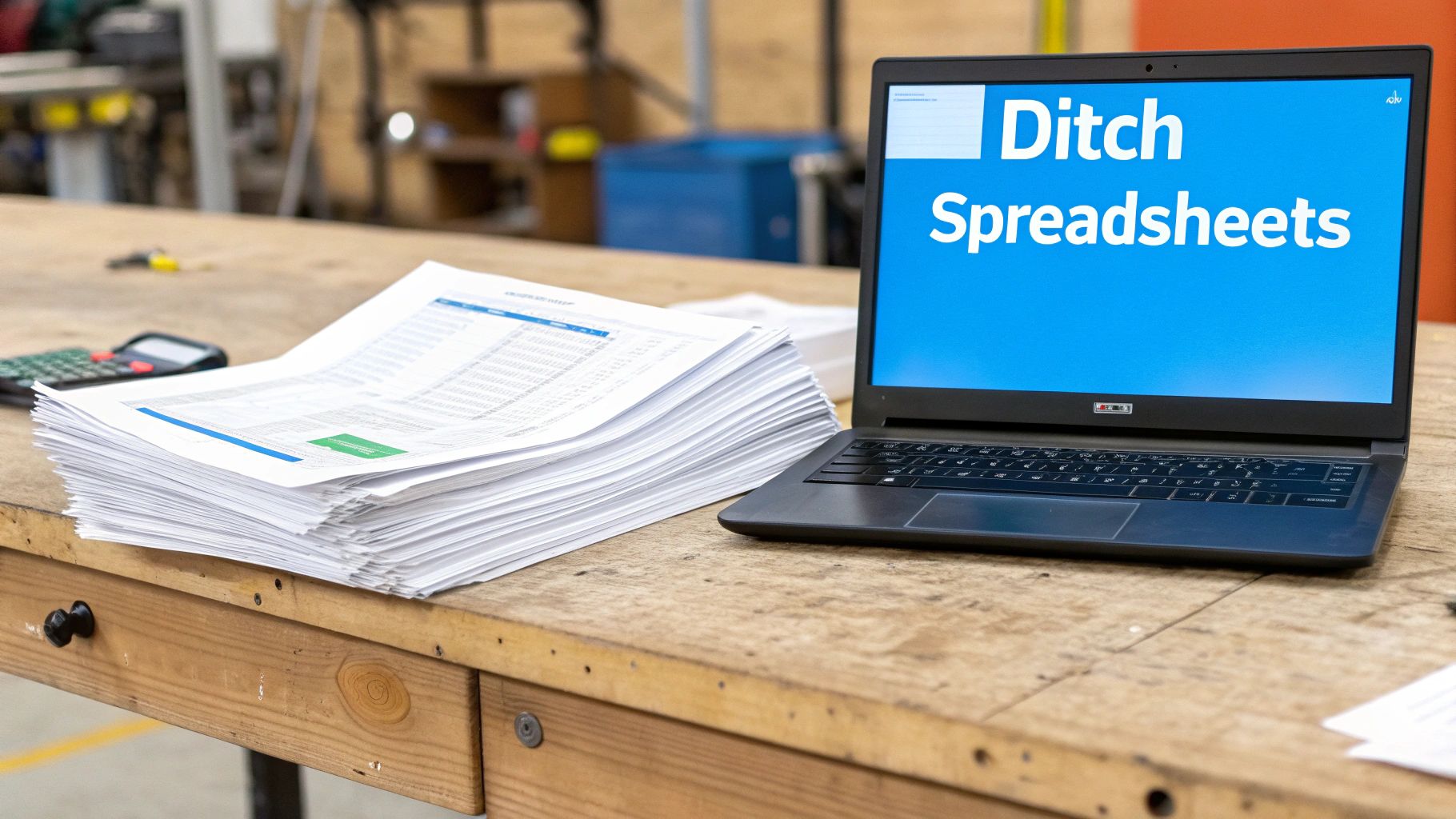
The image above says it all. The contrast between the chaotic, paper-based old way and the clean, digital interface of a modern solution highlights the leap from clutter to clarity. It’s a move every woodworking shop needs to make if they want to scale.
At the end of the day, clinging to spreadsheets isn't just inefficient; it's a strategic liability. It traps your business in a reactive cycle, constantly putting out fires caused by bad data and slow processes. The alternative is a proactive, streamlined engine for growth, where manufacturing quoting software turns your biggest headache into your most powerful sales tool.
7 Must-Have Features of Modern Quoting Software
Not all manufacturing quoting software is built the same. While plenty of platforms can crunch basic numbers, the real magic for a custom woodworking shop lies in a specific set of features—the ones designed to tame the beautiful chaos of custom millwork. These aren't just flashy add-ons; they are the gears that drive efficiency, accuracy, and growth.
Think of it like this: you can build a cabinet with a hand saw and a tape measure, sure. But a fully integrated CNC machine with automated dust collection? That changes the entire game. It's about what you can produce, how fast you can do it, and the quality you can deliver. The right software features give your sales and production workflows that same massive leap forward.
Let's dive into the non-negotiable features you should be looking for when you evaluate any system.
H3: 1. Configurable and Rules-Based Pricing
For a custom cabinet shop, a static price list is completely useless. The heart of any truly powerful quoting tool is its ability to handle complex, configurable pricing without someone needing to pull out a calculator. You need a system that can dynamically calculate costs based on a dizzying number of variables.
This is where you build your business logic—your secret sauce—directly into the software.
- Material Costs: The system should instantly adjust the price whether the client chooses walnut, a high-gloss finish, or specific Blum hardware.
- Labor Rates: It needs to understand the difference in labor between a simple shaker door and a complex, multi-panel assembly, and price it accordingly.
- Custom Options: Need to add costs for extras like glass inserts, custom moldings, or specialized drawer slides? The software should handle it on the fly.
You set the rules one time, and the engine applies them perfectly every single time. It's your guarantee that every quote is both competitive and, most importantly, profitable.
H3: 2. Visual Customization and Quoting
Today’s clients don't want to read a list of options; they want to see their vision come to life. Visual customization is a total game-changer, turning a dry, text-based quote into an engaging, interactive design session.
Imagine your customer adjusting cabinet dimensions, swapping out wood grains, or changing handle styles and seeing a real-time 3D rendering update with every click. This visual confirmation builds incredible confidence and just about eliminates the risk of miscommunication. It's the digital equivalent of showing a client a physical sample, but infinitely faster and more powerful.
A visual product configurator isn't just a "nice-to-have" for the customer. It actively shortens the sales cycle. When clients can see exactly what they're getting and how each choice impacts the price, they make decisions faster and with far more certainty.
H3: 3. Automated Quote and Proposal Generation
Okay, your customer has finalized their dream kitchen. The last thing you want is to tell them, "Great! I'll have a formal proposal over to you in a day or two." That delay is a deal-killer. Manually creating proposals is a notorious bottleneck, and every hour you wait is an opportunity for a competitor to swoop in.
Modern manufacturing quoting software gets rid of that wait entirely.
With a single click, the system should instantly generate a professional, beautifully branded PDF proposal that includes everything:
- Detailed product specs
- High-quality renderings of their exact design
- A clear, itemized price breakdown
- Your company's terms and conditions
This instant turnaround means you can get a binding quote into their hands while they're still excited. That speed dramatically increases your win rate.
H3: 4. Real-Time Inventory Synchronization
What’s worse than quoting a job you can't build on time? Nothing. Your quoting system needs to know exactly what you have on hand, right now.
When your quoting software is synced with your inventory, it can check material availability before a quote is even finalized. This prevents you from selling a product made with out-of-stock lumber or hardware, saving you from awkward phone calls and production delays down the line. It turns your sales team into an extension of your supply chain, ensuring every promise you make is one you can keep.
H3: 5. Automated Cut Sheets and Production Orders
This is where the best software truly shines, bridging the gap between the front office and the shop floor. A top-tier system doesn't just stop once the sale is made; it uses that finalized order data to automatically generate the documents your production team needs to get to work.
Imagine a world with zero manual data re-entry from a sales order into a CAM program. The software instantly creates optimized cut lists for your CNC, detailed work orders for each station, and bills of materials for purchasing. This direct connection from sales to production slashes errors, minimizes material waste, and gets jobs on the floor faster than ever before.
H3: 6. Seamless ERP and E‑commerce Integration
Your quoting software can't be an island. For your business to run like a well-oiled machine, it has to talk to the other critical systems you rely on every day. A seamless integration creates a single, unified workflow from the first website click to the final delivery.
When a customer places an order through your e-commerce storefront, the data should flow automatically into your ERP. This triggers inventory adjustments, production scheduling, and accounting updates without a single person having to type anything. It eliminates costly errors and frees up your team to focus on building, not on paperwork. You can explore the full range of TimberCloud features to see how these powerful integrations work in the real world.
H3: 7. AI-Powered Plan-to-Production
The next frontier is here. Emerging systems are now using AI to interpret architectural plans and automatically generate a full production-ready quote. Instead of manually measuring and inputting every single cabinet from a PDF, you upload the file, and the AI does the heavy lifting.
It identifies components, applies your pricing rules, and produces a complete bill of materials and a customer-facing quote in minutes, not days. This isn't science fiction; it's a capability that is collapsing the sales cycle and giving early adopters a massive competitive advantage.
Choosing a platform with these essential features is the key to unlocking new levels of speed, precision, and profitability for your shop. Here's a quick summary of how these components work together to impact your bottom line.
Key Quoting Software Features and Their Impact
| Feature | Description | Business Impact |
|---|---|---|
| Configurable Pricing | A rules-based engine that dynamically calculates costs based on materials, labor, and custom options. | Ensures profitability on every job. Eliminates manual pricing errors and guarantees consistent, accurate margins, even on the most complex custom work. You stop leaving money on the table. |
| Visual Customization | A real-time 3D product configurator that lets clients see their choices as they make them. | Dramatically shortens the sales cycle. Visual confirmation builds client confidence, reduces back-and-forth changes, and helps close deals faster. It's a powerful sales tool. |
| Automated Quote Generation | One-click creation of professional, branded proposals including specs, renderings, and pricing. | Increases win rates by up to 30%. Getting a quote to a prospect while their interest is high is critical. Instant proposals beat competitors who are still manually building theirs. |
| Inventory Synchronization | Real-time connection between your quoting tool and inventory levels for materials and hardware. | Prevents costly production delays. Avoids selling out-of-stock items, which improves on-time delivery rates and maintains customer trust. It makes your supply chain more predictable. |
| Automated Cut Sheets/Orders | Automatic creation of production-ready documents (cut lists, BOMs, work orders) from the final quote. | Reduces shop floor errors and material waste. By eliminating manual data transfer from sales to production, you ensure that what was quoted is exactly what gets built, minimizing rework and scrap. |
| ERP/E-commerce Integration | A seamless data connection between your quoting software, your ERP, and your online storefront. | Creates a single source of truth for your business. This eliminates redundant data entry, reduces administrative overhead, and gives you a complete, real-time view of your operations from lead to final payment. |
| AI Plan-to-Production | The ability to upload architectural plans (like a PDF) and have AI automatically generate a quote and BOM. | Massively reduces quoting time for complex projects. What used to take days of manual takeoff can now be done in minutes, allowing you to bid on more projects and focus your team's expertise on high-value tasks. |
Ultimately, investing in software with these capabilities isn't just about making quoting faster. It's about building a more resilient, efficient, and profitable manufacturing business from the ground up.
Here’s the rewritten section, designed to sound completely human-written and natural.
The Buyer's Checklist: How to Choose the Right Quoting Software
Picking the right manufacturing quoting software isn't like buying another tool for the shop. It's more like hiring a new operations manager. Get it right, and this system becomes the central nervous system of your business—driving sales, simplifying production, and making you more profitable. But get it wrong, and you’ve just created more work, more headaches, and more bottlenecks than you started with.
To make a confident choice, you need a solid game plan. Think of this checklist as your interview script for potential software partners. The answers you get will tell you whether they actually understand the unique grind of custom woodworking or if they're just pushing a generic, one-size-fits-all product. Let's arm you with the right questions to cut through the sales fluff and find a platform that’s truly built for your shop's future.
Can It Play Nice With Your Existing Systems?
Your business already has a rhythm. It’s powered by the tools you already know and trust for accounting, e-commerce, and design. Any new software has to plug into that ecosystem seamlessly, not force you to tear everything down and start over. A system that can’t integrate creates frustrating "data islands," condemning your team to the mind-numbing (and error-prone) task of manually copying and pasting information between programs.
Don't be shy. Ask vendors these direct questions:
- Accounting: Does your software talk directly to platforms like QuickBooks or Xero to automate invoicing and keep the books clean?
- E-commerce: Can it link to my Shopify, BigCommerce, or WooCommerce store to pull in new orders without me lifting a finger?
- Design and CAM: Will it work with the design files and CAM software we already use every day, creating a smooth handoff from quote to production?
A truly connected solution means information flows freely from the first customer click all the way to the final financial report. No interruptions, no duplicate entry.
Will It Grow With You, or Hold You Back?
The software that works for a five-person shop had better work when you scale to fifty. Scalability isn't just about handling more quotes. It’s about effortlessly managing more complex workflows, a bigger team, and a much deeper product catalog. A system that can’t grow with you is a ticking time bomb, guaranteeing a costly and painful switch just when you can least afford the disruption.
The market for small business manufacturing software is booming, growing at a CAGR of 15.9% through 2034. Why? Because shops are finally ditching fragmented, makeshift tools for cloud-based platforms that can scale on demand. It's a clear shift toward integrated systems that grow as you do. You can dig into more insights about this growing market at DataInsightsMarket.com.
Before you sign on the dotted line, get clear answers on how they handle growth:
- Can the system manage a product catalog with thousands of items and ridiculously complex configuration rules?
- What happens to the price as we add more users from the sales team, the shop floor, and the front office?
- Does the platform stay quick and responsive when our quote volume really starts to ramp up?
Is It Actually Easy to Use?
The most powerful software in the world is junk if your team hates using it. The right platform has to feel intuitive for everyone, from the sales rep who lives on their laptop to the master craftsman who’d rather be making sawdust. A steep learning curve just means slow adoption, frustrated employees, and a terrible return on your investment.
Look for a vendor that clearly cares about the user experience:
- Can we get a live demo? Better yet, a free trial so our actual team can get their hands on it?
- Is the system designed with the language and flow of a real woodworking shop in mind?
- Honestly, how long does it take to get a new hire up and running on this thing?
What Happens After You Sign? A Look at Support and Onboarding
A great software provider is a partner, not just a salesperson. Their job isn’t done the moment your payment clears. A well-structured onboarding process and genuinely helpful support are non-negotiable. Without them, you're left to figure out a complex system on your own, burning valuable time you should be spending running your business.
Don’t even think about committing until you get straight answers:
- Onboarding: Do you provide a dedicated person to help us get our data moved over and our products configured correctly?
- Training: What do you offer beyond a user manual? Are there live sessions, video tutorials, or an easy-to-search knowledge base?
- Support: When we run into a problem, are we talking to an expert who actually understands manufacturing, or are we stuck in a generic call center queue?
Choosing the right manufacturing quoting software is one of the most important strategic decisions you’ll make. By using this checklist, you can move beyond the sales pitch and find a partner like TimberCloud—one that delivers not just a powerful piece of technology, but a solid foundation for profitable, sustainable growth.
Making the Numbers Work: ROI and a Smart Rollout
Bringing in any new piece of technology really boils down to one simple question: will it make us more money than it costs? When it comes to manufacturing quoting software, the answer is almost always a hard "yes," but you have to prove it. That means taking a clear-eyed look at your Return on Investment (ROI).
This isn't just about fuzzy feelings or "making things better." Calculating your ROI makes the benefits real. It shifts the conversation from "this should save us time" to "this will add $50,000 to our net profit this year." It's how you build a rock-solid business case for the investment, focusing on tangible dollars and cents.
How to Calculate Your Software ROI
The formula itself is pretty straightforward. You take the financial benefits you gain from the software, subtract what you paid for it, and then divide that number by the original cost.
The basic formula looks like this: ROI = (Financial Gain - Cost of Investment) / Cost of Investment
The real challenge, of course, is figuring out those "financial gains." Here’s where the magic happens:
- Time Saved on Quoting: Think about it. How many hours does your team burn every single week just putting quotes together? If software can slash that time by 70%, you can multiply those saved hours by your team's hourly rate (don't forget benefits and overhead!) to see your direct labor savings.
- Increased Win Rate: What’s your current quote-to-win ratio? Even a small bump—say, from 25% to 30%—translates directly into more revenue from the exact same number of leads you're already generating.
- Healthier Profit Margins: We've all done it—accidentally underbid a job and watched our profit evaporate. Accurate, data-driven costing puts an end to that. Getting a handle on your numbers is key, and it all starts with knowing how to calculate profit percentage.
- Less Material Waste: When your quotes instantly create optimized cut-sheets, you stop throwing money in the scrap bin. Even a tiny reduction in waste adds up to a surprisingly large number by the end of the year.
Best Practices for a Smooth Implementation
Let's be honest, even the best tool is useless if it just sits on a shelf. Rolling out new software doesn’t have to be a headache. A smart, structured approach will get you value from day one and help you hit that ROI you worked so hard to project.
I've seen it time and again: a successful implementation is less about the technology and more about the people. Getting buy-in from your sales team and your shop floor crew is the single most important thing you can do for a smooth transition.
Here are four steps I always recommend for a successful rollout:
- Start with a Pilot Project: Please, don't try to boil the ocean. Pick one product line or a small, motivated team to test the software first. This gives you a controlled space to iron out the wrinkles and, more importantly, create an internal success story that gets everyone else excited.
- Secure Team Buy-In: Pull your key sales and production people into the process from the beginning. Let them help you choose and set up the software. When they feel like they have some skin in the game, they become your biggest champions.
- Dedicate Time for Data Migration: Your software is only as smart as the information you feed it. Block out real, uninterrupted time to get your product catalogs, pricing rules, and material costs loaded in correctly. A clean data setup is the foundation for everything that follows.
- Leverage Vendor Training: The people who built the software know it best. Use their onboarding and training. Seriously. A few hours invested upfront will save you from hundreds of hours of frustration and mistakes down the road.
By carefully calculating your return and following a thoughtful implementation plan, you can bring in manufacturing quoting software with confidence. It stops being an expense and starts becoming a powerful engine for your shop's profitability. Looking into different pricing models can also help you find a plan that fits your budget and ROI targets perfectly.
The Future Is Automated From Quoting to Production
In the custom woodworking and millwork business, the line between just getting by and truly growing is razor-thin. It all comes down to efficiency. For far too long, manual processes have been an anchor, holding back even the most talented shops from what they could be. Relying on spreadsheets and back-of-the-napkin math isn't just slow—it's a direct hit to your profit, your customer's trust, and your ability to grow.
Making the switch to modern manufacturing quoting software isn't just a nice idea anymore; it’s what you have to do to stay in the game.
The real magic here is how this technology pulls your entire business together. It tears down the old walls that have always separated your showroom, your sales team, your engineers, and the guys on the shop floor. Forget about scattered information and miscommunication. You get one single, reliable source of truth that guides every step, from the first customer inquiry to the final delivery. This is how you build a shop that's ready for anything.
A Unified Path to Growth
When everything works together, you see real-world results almost immediately:
- Improved Efficiency: Automation gets rid of the soul-crushing double-entry and manual math. Your team is freed up to focus on work that actually makes money.
- Enhanced Accuracy: Pricing rules and direct handoffs to production slash the expensive mistakes that chip away at your profit margins.
- Greater Customer Satisfaction: Instant quotes, visual customization, and hitting your deadlines create a top-notch experience that turns one-time buyers into loyal fans.
The market is catching on, and fast. The cost estimating and quoting software market is projected to explode from USD 525.1 billion in 2023 to over USD 1,138.2 billion by 2031. What’s driving this? Manufacturers are finally ditching old methods that cost them as much as 20-30% in lost jobs due to quoting delays and errors. You can find more detail on this software market's trajectory at Verified Market Research.
The takeaway is clear: the future of custom manufacturing isn't just about crafting exceptional products. It's about building an exceptionally efficient business around them.
It's time to stop letting clunky, manual processes decide how much you can grow. The tools are here to help you build a more profitable, predictable, and scalable business. By adopting an all-in-one platform, you can finally connect your sales engine directly to your production floor, creating a seamless path from the first quote to the final payment.
Got Questions? We've Got Answers
Stepping into new technology always brings up good questions. It’s smart to be thorough. We hear the same handful of concerns from custom woodworking and millwork shops when they first look at manufacturing quoting software, so let’s tackle them head-on.
These are practical, real-world answers to help you see how this kind of tool actually fits into your daily grind. It's a much more manageable leap than you might think, whether you're a one-person operation or a growing team.
"How Long Does This Take to Set Up? We Don't Have Months to Spare."
This is probably the number one question, and the answer is usually a pleasant surprise. We’re talking weeks, not months. Modern, cloud-based platforms aren't built from scratch for you; they're powerful, existing systems that just need to be configured to match your business.
A typical setup usually breaks down into a few straightforward steps:
- Getting Your Data In: This just means importing your product lists, materials, and hardware choices.
- Setting Up Your Rules: This is where you teach the system your pricing DNA—how you calculate costs for different materials, your labor rates, and any custom options.
- Training the Team: A little bit of hands-on time to get your sales and production folks comfortable with the new, faster way of doing things.
A good software partner will give you a dedicated person to walk you through it all, making the whole process feel less like a project and more like a guided tour.
"Can It Handle Our Crazy Custom, One-Off Jobs?"
Absolutely. In fact, that's where this kind of software really shines. Generic quoting tools fall apart when a customer asks for something truly unique, but software built for manufacturing is designed for exactly that.
Instead of being stuck with a fixed catalog, these systems use a flexible, rules-based approach. You define your core building blocks—the components, materials, and labor steps you use every day. When a completely bespoke project comes in, you simply assemble a quote from those blocks. It ensures that even the most out-there jobs are priced accurately and, most importantly, profitably.
Think of it this way: You're moving away from a static price list and toward a dynamic system that actually understands how you build things. That’s what allows it to accurately cost out nearly any configuration you can imagine.
"Is This Actually Affordable for a Small Shop Like Mine?"
Yes. The old days of needing a six-figure check just to get started with powerful software are over. The subscription model (often called SaaS, or Software as a Service) has completely changed the game, making top-tier tools accessible to shops of any size.
It's less like buying a new CNC and more like paying for Netflix. You have a predictable monthly or annual fee, which gets rid of that terrifying upfront capital expense. When you crunch the numbers on the ROI—all the time you save, the costly errors you avoid, and the extra deals you win—the software often pays for itself within a few months. It's an investment in efficiency that lets smaller shops punch well above their weight.
"Will My Team Revolt? Learning New Software Can Be a Nightmare."
A valid concern. A tool is only as good as the team's willingness to use it. The best software developers know this and obsess over user experience. Modern platforms are built with clean, intuitive interfaces that feel less like work and more like a helpful guide.
The key is to look for a system built specifically for the woodworking world. When the software speaks your language—using the same terms and following the same logic you already use in the shop—the learning curve flattens out dramatically. Add in good training resources like video guides and real human support, and your team won't just learn it; they’ll soon be asking how you ever got by without it.
Ready to see how an all-in-one platform can get rid of these headaches and bring your entire operation together? TimberCloud, Inc. combines a powerful quoting engine with shop floor management and e-commerce to create a seamless workflow from click to production.
Schedule a demo today to discover a smarter way to quote, build, and grow your business.
Topics
TimberCloud Team
Content Team
The TimberCloud team is dedicated to helping manufacturers streamline their operations with intelligent software solutions.