Lean Manufacturing Downtime: Reduce lean manufacturing downtime in Woodshops

Lean manufacturing downtime isn’t some abstract concept you read about in a textbook; it’s a direct hit to your shop's profitability. It's any moment a machine goes quiet or an operator is left standing around, waiting. When your shop floor stops making sawdust, it stops making money. Getting a handle on this is probably the single most important thing you can do for the health of your custom woodworking business.
The True Cost of a Silent Shop Floor
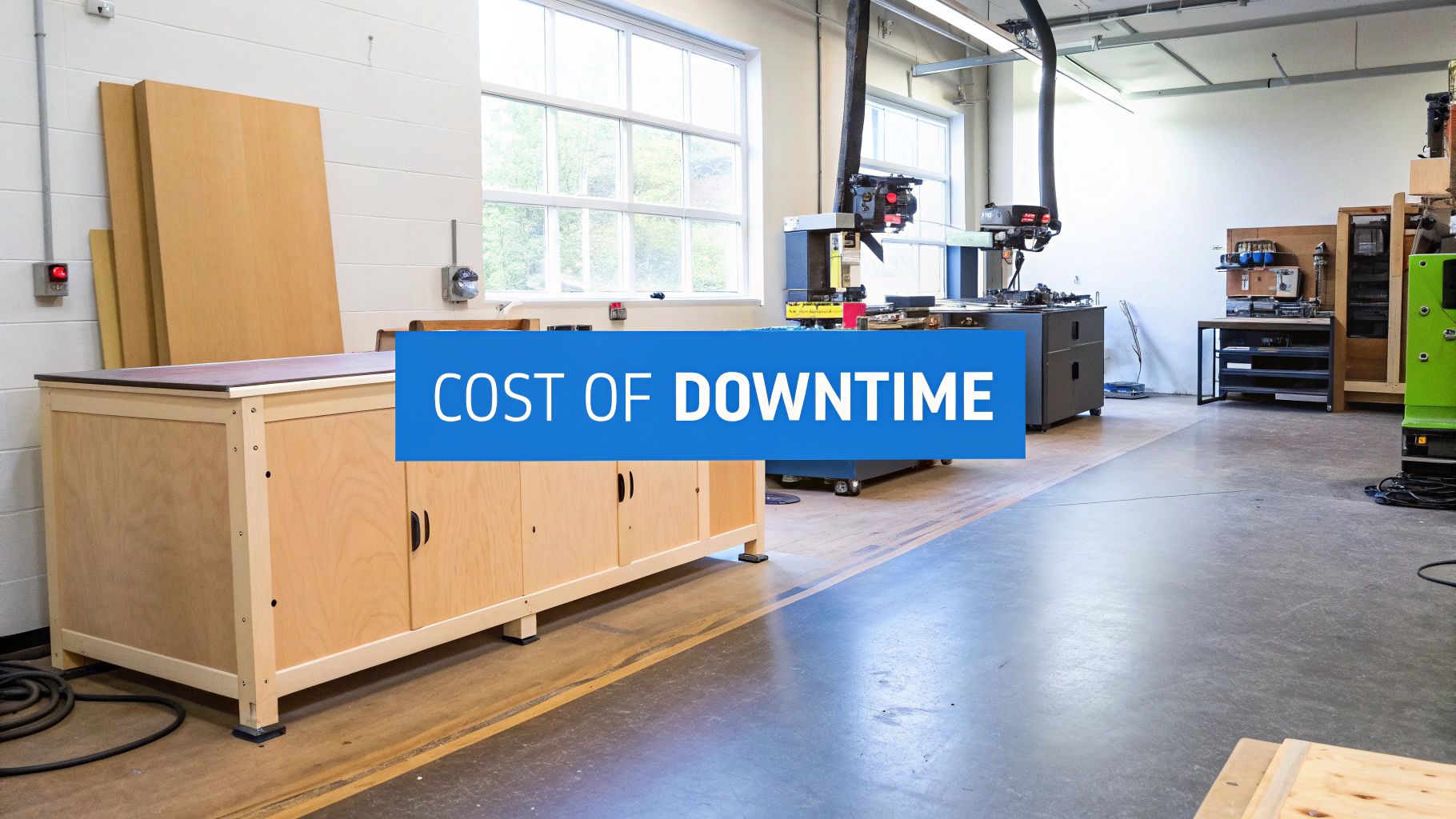
When a CNC stops cutting or a team member is waiting for parts, the obvious cost is lost production time. But that’s just the tip of the iceberg. The real damage goes much deeper, sending ripples through your entire operation that can throw everything off schedule. Every quiet moment is a drain on your profitability, a missed deadline waiting to happen, and a potential crack in a client relationship.
This isn’t just a small problem; it’s a massive one that's getting worse across all industries. Consider this: the Fortune Global 500 industrial giants collectively lose nearly $1.5 trillion a year to unplanned downtime. That's a staggering 11% of their annual turnover. While your shop isn't operating at that scale, the principle is the same. Those numbers should be a wake-up call for any custom shop trying to protect already tight margins. If you want to dig deeper, you can discover more insights about the escalating costs of downtime.
Identifying the Enemies of Productivity
Before you can fight back, you need to know what—or who—you’re up against. Downtime in a custom millwork or cabinet shop isn’t always a dramatic, sparks-flying machine failure. More often, it’s a thousand tiny cuts—small, persistent interruptions that bleed your schedule and budget dry.
To get a clearer picture, let's break down the common culprits you'll find on almost any shop floor.
Downtime Types and Their Hidden Costs in Woodworking
| Downtime Type | Example in a Millwork Shop | Primary Cost Impact |
|---|---|---|
| Equipment Failures | A CNC router's spindle seizes up mid-cut, or an edgebander's glue pot fails unexpectedly. | Immediate: Repair costs, lost production. Hidden: Rush shipping for parts, overtime to catch up, potential project delays. |
| Waiting & Delays | An assembler waits for a cart of finished parts from the CNC, or an operator hunts for a specific router bit. | Immediate: Wasted labor hours. Hidden: Bottlenecks in workflow, decreased team morale, disrupted production rhythm. |
| Changeovers & Setups | The time spent switching from running walnut cabinet doors to pre-drilling maple drawer boxes. | Immediate: Non-productive machine time. Hidden: Reduced overall capacity, temptation to run larger, less-efficient batches. |
| Material Shortages | Realizing you're one sheet of specialty veneer short for a high-end job, halting production. | Immediate: Stalled projects, idle workers. Hidden: Expedited material costs, damaged client trust, potential for order cancellation. |
| Rework & Defects | A mis-cut panel has to be remade, requiring a new setup and fresh material. | Immediate: Wasted material and labor. Hidden: Disrupted schedule for other jobs, wear and tear on tools, reputational damage. |
Each of these interruptions, big and small, erodes your bottom line. A delayed project damages your reputation. Rush shipping fees for a replacement part eat into profits. The constant stress on your team leads to burnout and more mistakes.
A silent machine doesn't just stop producing parts; it stops producing profit. Reframing downtime from a simple inconvenience to a primary financial threat is the foundational mindset shift required for lean transformation.
When you start to see it this way, the fight against lean manufacturing downtime stops being a technical problem for the shop foreman and becomes a core business strategy for the entire company.
Diagnosing Downtime Before It Derails Production
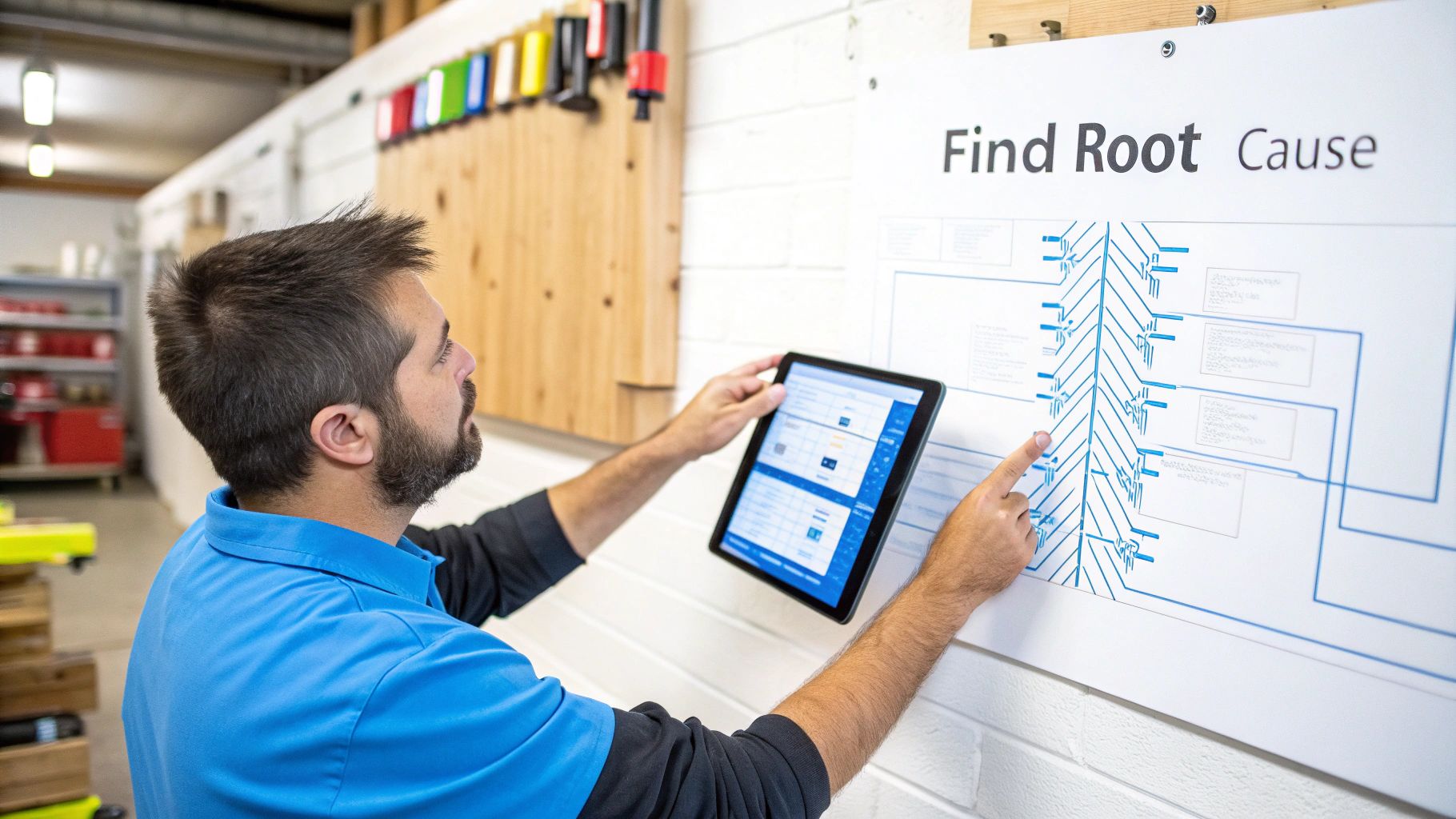
You can't fix what you can't find. When you're in the thick of it on a busy shop floor, the easiest thing to do is slap a patch on a problem and keep the line moving. But we’ve all been there—that "firefighting" mode just guarantees the same issue will flare up again next week.
If you’re serious about reducing lean manufacturing downtime, you have to stop treating the symptoms. It’s time to start digging for the root cause. Most production stoppages aren't just bad luck; they’re the predictable result of a hidden flaw in a process. The trick is to find that flaw before it costs you a fortune in lost time and wrecked schedules.
Peeling Back the Layers with the 5 Whys
One of the most effective tools I’ve seen in action is the 5 Whys technique. It’s deceptively simple but incredibly powerful. The whole idea is to get past the obvious, surface-level problem by repeatedly asking "Why?" until you hit the real systemic issue.
Let's walk through a scenario that’s probably all too familiar in a custom cabinet shop: the main CNC router grinds to a halt mid-job. That's the problem, but it’s not the real problem.
Here’s how you drill down with the 5 Whys:
- Why did the CNC stop? The spindle seized up because it overheated. (Okay, that’s the immediate technical issue.)
- Why did the spindle overheat? There wasn't enough coolant. (Getting warmer...)
- Why was the coolant low? Nobody topped it off during the morning startup check. (Aha, a process failure.)
- Why didn’t anyone refill it? The new guy on that machine wasn't trained on that specific task. (Now we’re getting somewhere.)
- Why wasn’t he trained? Our onboarding checklist is out of date and completely misses the coolant check. (Bingo.)
In five simple questions, we went from "a broken machine" to "a broken training process." Fixing the spindle gets you running for a day. Fixing the training checklist prevents this from ever happening again with any new hire. That’s the difference.
Mapping Out Complex Problems with a Fishbone Diagram
Sometimes, a problem is bigger than a single failure point. For those messier issues where a dozen things could be going wrong, a fishbone diagram (you might hear it called an Ishikawa diagram) is your best friend. It’s a great way to get the team brainstorming and visually mapping out all the potential causes.
Let's say your "effect" or problem is a "High rate of panel rework." You draw a horizontal line to that problem, and then branch off with the potential causes, grouping them into standard categories that form the "bones" of the fish:
- Man (People): Is the operator fatigued? Does someone need more training?
- Method (Process): Are the work instructions confusing? Is the workflow inefficient?
- Machine (Equipment): Is a saw blade getting dull? Is the edgebander out of calibration?
- Material: Are the panels warped from the supplier? Is there too much inconsistency in the veneer?
- Measurement: Are our tape measures or calipers accurate?
- Environment: Is poor lighting in the QC station causing people to miss defects?
Laying it all out like this helps the team see the whole picture and spot the most likely culprits to investigate first. We cover more strategies like this over on the TimberCloud blog.
The goal of any root cause analysis is to make a process failure so visible and understood that it becomes impossible to ignore. True lean progress happens when you fix the system, not just the single event.
Ultimately, tools like the 5 Whys and fishbone diagrams run on data, not guesswork. This is where modern production tracking comes in. When you can pull up a report and see that machine #3 has dozens of micro-stoppages every morning between 7:00 and 7:30 AM, you know to look at a warm-up or calibration issue, not just blame an operator. For a deeper dive, understanding what predictive maintenance is and how it works can give you an even bigger edge. Using hard data turns your investigation from a frustrating art into a focused science.
Your Lean Toolkit for Smashing Downtime
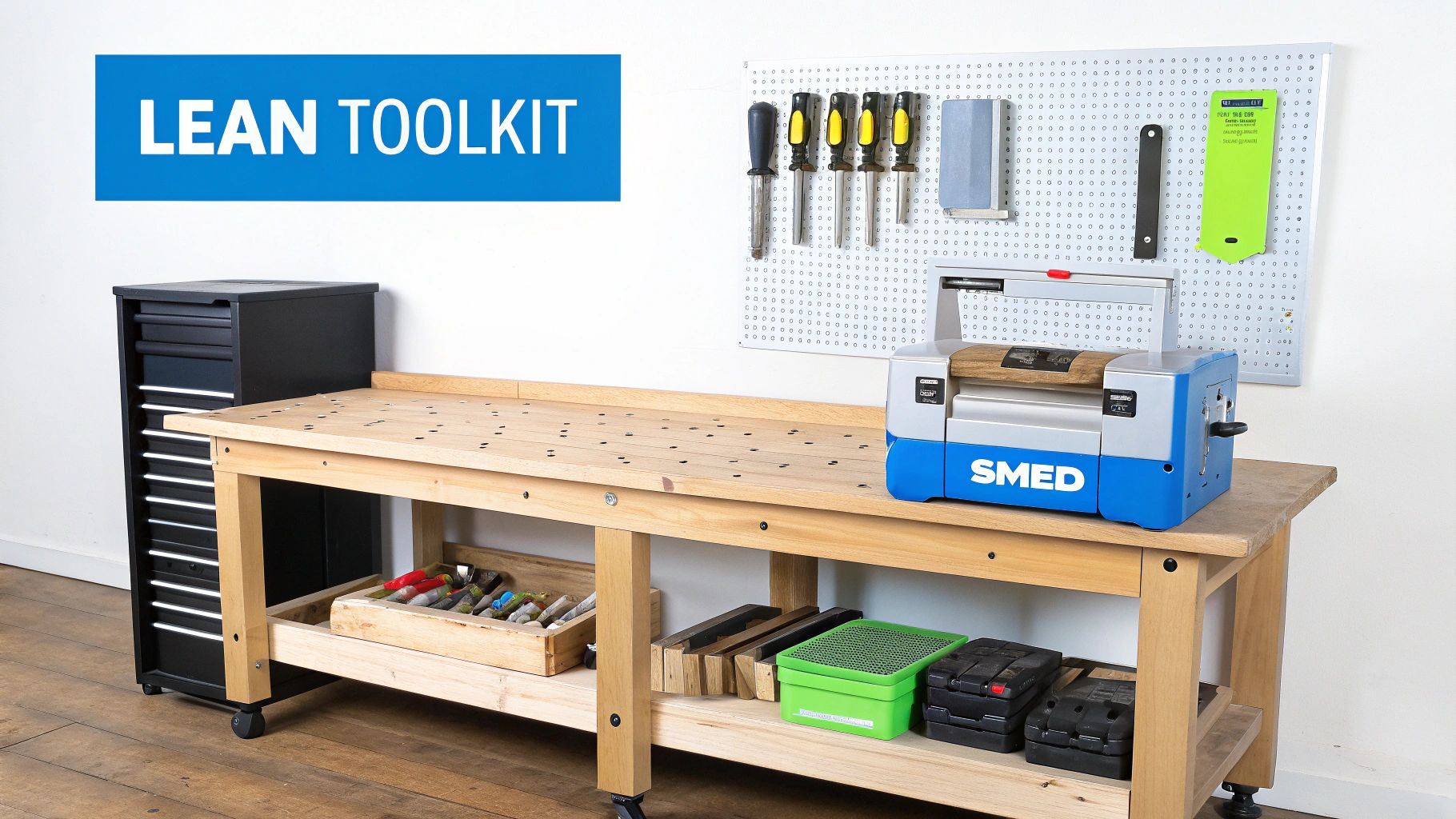
Once you've pinpointed what’s really causing your delays, it's time to fight back. And for that, you need the right tools. Lean manufacturing isn't some magic bullet; it's a collection of proven, practical methods that systematically hunt down and eliminate waste. In a custom woodworking shop, that waste is anything that doesn't add value to the finished piece—especially downtime.
Let’s dig into the core lean principles that will give you the biggest bang for your buck, right away. These aren't just abstract theories. They are actionable strategies you can start using tomorrow to cut your lean manufacturing downtime and get that lost productivity back.
Creating Order from Chaos with 5S
If your team wastes even a few minutes each day hunting for a specific clamp, a router bit, or the right jig, you're bleeding cash. The 5S methodology is the bedrock of a lean shop because it attacks that chaos head-on. It's a simple, five-step process for building and keeping an organized, efficient, and safer workspace.
The steps are deceptively simple and build on one another:
- Sort (Seiri): Pick a work area—say, an assembly station—and get rid of everything that isn't absolutely essential for the work done there. If a tool hasn’t been touched in a month, tag it and move it to a central storage area. You have to be ruthless.
- Set in Order (Seiton): Now, arrange the essential items logically. This is all about creating a designated home for every single tool and supply. Think shadow boards for hand tools, labeled bins for fasteners, and clearly marked floor spaces for carts and works-in-progress. The old saying is the guiding principle here: "a place for everything, and everything in its place."
- Shine (Seiso): This goes way beyond just sweeping up sawdust. It means a thorough cleaning of the area and the equipment in it. This regular cleaning pulls double duty as an inspection; you’re far more likely to spot a leaking hydraulic line or a frayed power cord on a machine that’s actually clean.
- Standardize (Seiketsu): This is where you turn the first three S's into habits. Create simple, visual checklists or daily routines for sorting, organizing, and cleaning. It's the only way to ensure the workspace doesn’t slowly slide back into its old, messy state.
- Sustain (Shitsuke): The final step is the hardest. It’s about building a culture of discipline through regular audits, team accountability, and recognizing a job well done. When you truly sustain 5S, it just becomes "the way we do things around here."
In a cabinet shop, a 5S project at the edgebanding station could be as simple as creating a color-coded system for the different edge tape rolls. That small change alone could shave several minutes of searching off every job, which adds up to hours of saved time by the end of the week.
Slashing Changeover Times with SMED
In a custom shop, every job is different. This high-mix, low-volume world means machine changeovers—like switching a CNC from cutting cabinet backs to drilling drawer fronts—are a massive source of downtime. SMED (Single-Minute Exchange of Die) is a system built specifically to crush that setup time, often taking it from hours down to just a few minutes.
The core idea is to separate your setup tasks into two buckets:
- Internal Elements: Things that can only be done when the machine is stopped (like swapping out the cutting tool on the CNC).
- External Elements: Things that can be prepared while the machine is still running the last job (like grabbing the next set of tools, loading the next program, or staging the raw materials).
The whole game is to convert as many internal tasks into external ones as you possibly can.
Think about a typical changeover on a wide belt sander. The operator shuts it down, hunts for the right grit belts for the next job, removes the old ones, installs the new ones, and then calibrates the machine. That process could easily eat up 30 minutes.
But by applying SMED, the operator would gather the new belts and any tools needed while the sander is still finishing the previous batch. The only "internal" task left is the quick swap of the belts themselves. By externalizing all that prep work, you could cut that changeover time by more than half.
"The true power of lean is in making problems visible and empowering the people who do the work to solve them. Principles like 5S and SMED aren't top-down mandates; they are tools your team uses to make their own jobs less frustrating and more productive."
Empowering Your Team with Total Productive Maintenance
Nothing kills a day's production faster than a machine breaking down. Total Productive Maintenance (TPM) is a philosophy that shifts the responsibility for basic equipment care from a dedicated maintenance person to the machine operators themselves. After all, nobody knows a machine’s quirks, sounds, and smells better than the person who runs it all day long.
This doesn't mean your cabinetmakers need to become expert mechanics overnight. It's about empowering them with what's called "autonomous maintenance."
This boils down to creating simple, daily checklists for operators to run through:
- Cleaning: Wiping down key components and clearing away debris.
- Lubricating: Checking and topping off fluid levels.
- Inspecting: Listening for odd noises, checking for loose bolts, and verifying sensor lights.
- Tightening: Making minor adjustments to make sure everything is secure.
When an operator makes these small checks part of their daily startup and shutdown routine, they start catching potential problems long before they become catastrophic failures. That tiny oil leak they spot on Monday is a quick fix; the seized bearing it would have caused by Friday means days of lost production. TPM builds a sense of ownership and turns your team into the first line of defense against unplanned lean manufacturing downtime.
When you combine these three lean tools—5S for organization, SMED for quick changeovers, and TPM for equipment reliability—you create a powerful, self-reinforcing system. Each one supports the others, helping you build a resilient, predictable, and highly efficient shop where silent machines become a rarity.
How Technology Makes Lean Principles a Reality on the Shop Floor
Look, we all know the theory behind lean principles is solid. It’s a powerful blueprint for cutting out waste and making your shop run like a well-oiled machine. But let’s be honest—trying to implement it with a mess of spreadsheets, paper checklists, and shouting across a noisy shop floor often feels like a losing battle. It can create more chaos than it solves.
This is where the right technology completely changes the game. It acts as a force multiplier, weaving lean thinking right into your daily workflow. It automates the very things that cause lean manufacturing downtime in the first place.
Instead of just talking about lean, the right platform makes it practical. It lifts the heavy burden of constant monitoring and manual data entry off your team. This frees them up to focus on what they do best: building incredible custom work. A well-designed system doesn't just support lean principles; it brings them to life and makes them stick.
The whole point is to close the gap between your big-picture goals and what your team is actually doing moment-to-moment. When technology handles the grunt work of production planning, your shop can finally hit that smooth, predictable rhythm that lean manufacturing promises.
From Blueprint to Production Without the Guesswork
One of the biggest black holes for time in any custom shop is the "translation" phase. You know the drill. Someone has to take a complex architectural drawing and manually turn it into cut lists, material orders, and work instructions. It’s not just painfully slow; it’s a minefield for errors that lead to expensive rework and wasted materials.
An AI plan-to-production engine blows this bottleneck right out of the water. You simply upload a design file, and the system instantly analyzes every spec, identifies every single component, and spits out production-ready instructions in minutes.
- Automated Cut Sheets: It creates perfectly optimized cut lists for your CNCs and saws, squeezing every last inch out of your materials and killing manual calculation errors for good.
- Material Lists: You get a precise bill of materials for every job, which means no more projects grinding to a halt while someone waits for parts to show up.
- Work Order Creation: It sends clear, standardized instructions to the right people and machines on the floor.
This kind of automation gets right to the root causes of downtime—information gaps and human error. It naturally enforces standardized work because every single job is planned and executed the exact same way. You can explore these features in more detail and see for yourself how this works in a modern shop.
Here’s a perfect example of how TimberCloud's AI engine takes a design file and turns it into a concrete, actionable plan.
Just like that, the platform breaks the cabinet down into every last component, complete with dimensions and material specs. It’s ready to go straight to production.
Real-Time Visibility That Stops Delays Before They Start
Lean manufacturing is built on visual management—knowing what’s going on everywhere at a glance. Technology puts this concept on steroids by giving you a live, digital dashboard of your entire operation. With real-time production tracking, you’re no longer managing based on last week's reports. You’re making smart decisions based on what’s happening right now.
Imagine an assembler is about to run out of a specific part. A digital system can automatically trigger an alert, telling the upstream work center to prioritize getting those components ready. This is proactive. It stops the small hiccups from turning into massive schedule-killing disasters. It’s a world away from the old method of an employee having to stop working and walk across the shop just to ask for an update.
The numbers on this are pretty sobering. The average large plant loses about 27 hours of production every month to downtime. A recent report found that two-thirds of companies deal with unplanned downtime at least once a month, with the cost averaging a jaw-dropping $125,000 per hour. For custom shops, those figures are a stark reminder that real-time visibility isn't a "nice-to-have"—it's a survival tool.
Technology transforms lean principles from a set of rules you try to follow into an automated system that guides your shop toward efficiency. It makes the right way to work the easiest way to work.
At the end of the day, bringing in the right tech is about creating a more resilient and agile shop. When your sales, planning, and shop floor teams are all working from the same playbook on a single platform, you demolish the information silos that cause so much friction and delay. For shops looking to get ahead of equipment failure, it’s even worth exploring technology-enabled predictive maintenance solutions that use IoT monitoring. This seamless flow of information is what will make your lean transformation not just a success, but something that lasts for the long haul.
Your 90-Day Roadmap to Less Downtime
All the theory in the world doesn't mean a thing until you get your hands dirty. So, let’s get practical. This isn't about a massive, disruptive overhaul that brings your shop to a standstill. It's about making steady, intelligent changes that build momentum and deliver real results you can see on the floor and in your bottom line.
Think of this as a clear path from chaotic to controlled. Here’s how you can systematically reclaim lost time and boost your shop's productivity over the next three months.
Month 1: Laying the Foundation and Scoring Quick Wins
The first 30 days are all about building a solid base and grabbing some low-hanging fruit. The goal here is simple: prove to yourself and your team that this stuff actually works. That creates the buy-in you’ll need for the bigger changes down the road.
Start small. Pick one machine or one area that’s a known source of frustration.
Your checklist for this month is straightforward:
- Get Your Baseline: Before you touch a thing, you need to know where you stand. Start tracking your current downtime. A simple log sheet taped to a machine is more than enough to get started.
- Run Your First 5S Event: Choose one workstation—maybe the assembly table or the edgebander—and run a full 5S (Sort, Set in Order, Shine, Standardize, Sustain) event. Get the team involved; they know the pain points better than anyone.
- Start Daily Checks: Roll out simple, five-minute machine startup checklists. This is your first tiny step toward Total Productive Maintenance (TPM) and it helps catch problems before they become full-blown breakdowns.
This initial phase is less about massive transformation and more about building habits. A successful 5S event not only organizes a space but also visually demonstrates the power of lean thinking, making it tangible for everyone on the floor.
By the end of Month 1, your chosen work area should be noticeably cleaner and more efficient. Even more important, your team will have seen a direct improvement in their daily work, making them much more receptive to what comes next.
Month 2: Going Deeper with Implementation and Training
With a quick win under your belt, it's time to go deeper. In Month 2, you'll expand your efforts and start embedding these practices into your shop’s culture through hands-on training and broader implementation.
The focus now shifts from a single area to key processes:
- Analyze a Changeover (SMED): Pick a machine with frequent, time-consuming changeovers, like your CNC. Get a stopwatch, time the current setup process, and then get the team to brainstorm ways to turn "internal" tasks (done while the machine is off) into "external" ones (done while it's running).
- Roll Out Visual Management: Start using visual cues. This can be as simple as colored tape on the floor marking work-in-progress zones or a whiteboard showing the day's production goals. Make the status of the shop visible at a glance.
- Train on Root Causes: Hold a short workshop to teach your team the "5 Whys" technique. The next time a minor stoppage happens, walk them through the process of digging past the symptoms to find the true root cause.
This timeline shows how lean principles and technology aren't separate paths—they're two lanes on the same highway to efficiency.
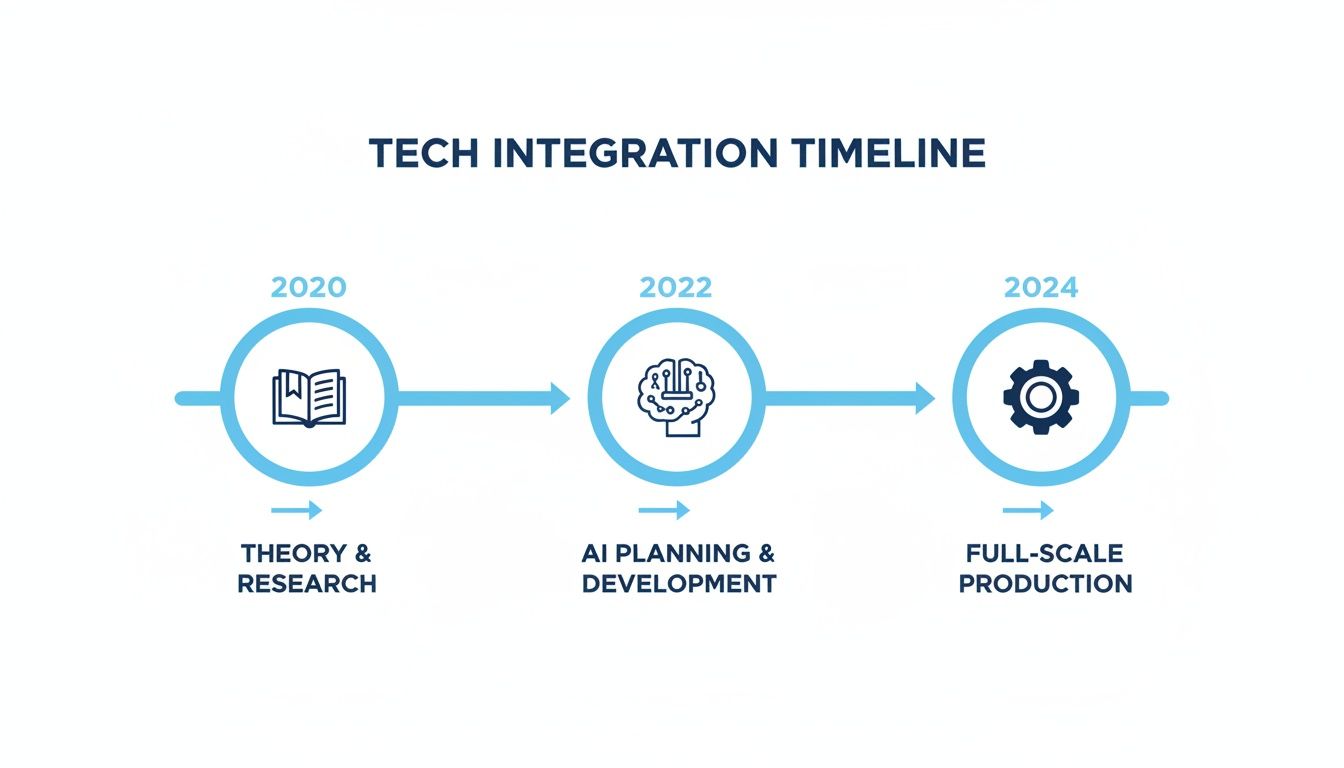
The key takeaway here is that modern tools don't replace lean principles; they accelerate their adoption and make them stick.
Month 3: Optimizing and Building the Culture
The final month of this initial push is all about refining your new processes and making continuous improvement part of your shop's DNA. This is where your lean initiative stops being a "project" and starts becoming "the way we work."
Your final push involves these key actions:
- Introduce KPIs: It’s time to formalize your tracking. Introduce a key performance indicator (KPI) like Overall Equipment Effectiveness (OEE). More importantly, display it where the team can see it and understand how their actions move the needle.
- Standardize One Key Process: Pick one critical task—a complex machine changeover or a final quality control check—and create the official, best-practice Standard Operating Procedure (SOP).
- Launch a Kaizen Board: Put up a simple "Continuous Improvement" board where employees can jot down ideas for small improvements. Review these suggestions weekly and, most importantly, act on them.
To make sure your efforts are paying off, you need to measure what matters. This table lays out some essential KPIs, how to track them, and some realistic goals to shoot for.
Lean Implementation KPIs and Target Goals
| Metric (KPI) | How to Measure It | 90-Day Goal |
|---|---|---|
| Unplanned Downtime % | (Total Unplanned Downtime Hours / Total Planned Production Hours) x 100 | 15% reduction from baseline |
| Overall Equipment Effectiveness (OEE) | Availability x Performance x Quality (as a %) | 10% increase from baseline |
| Mean Time Between Failures (MTBF) | Total Uptime / Number of Breakdowns | 20% increase from baseline |
| Number of 5S Audits Passed | Weekly audit score (e.g., out of 5) for a target workstation | Consistently score 4 out of 5 or higher |
| Employee Improvement Ideas | Count of suggestions submitted to the Kaizen board | At least 1 suggestion per employee per month |
Setting clear targets like these turns your improvement efforts from a vague idea into a tangible mission for the whole team.
By the end of these 90 days, you won't just have a cleaner shop—you'll have a powerful system for hunting down and eliminating waste. You’ll be making data-driven decisions and have an engaged team that is actively looking for ways to reduce downtime. To see how a fully integrated system can supercharge these efforts, you can explore the transparent pricing and plans for platforms like TimberCloud.
Answering Your Lean Manufacturing Questions
Making the leap to a leaner shop always brings up some tough, practical questions. The theory sounds great, but how does it work when you've got a deadline breathing down your neck and orders stacking up? Let's tackle the real-world concerns I hear most often from shop owners trying to cut down on lean manufacturing downtime.
Is Lean Too Complex for a Small Shop?
Not a chance. In my experience, lean principles actually deliver the biggest and fastest wins in smaller, more agile shops. The whole point isn’t to turn your custom shop into a Toyota factory. It's about systematically getting rid of the wasted time and motion that are already frustrating your team.
Forget the fancy jargon and complex systems for a minute. Just start with one thing. Run a 5S cleanup in a single work cell. Create a visual tool board for one machine. A simple, standardized checklist for your CNC setup could easily save you hours every single week—that’s a massive victory whether you have five guys or fifty.
The goal of lean in a small shop isn't to add complexity; it's to remove frustration. It’s about making the workday smoother for the skilled people you rely on.
When you focus on these small, incremental wins, you build momentum without ever having to shut down production or overwhelm your crew.
How Do I Get My Experienced Team on Board?
This is the big one, isn't it? The answer is simpler than you think: involve them from day one and focus on solving their problems first. Your veteran cabinetmakers and machine operators are your most valuable asset. Any new process has to be presented as a way to make their jobs easier, not as more red tape from the office.
Instead of announcing top-down changes, start by asking questions. Walk the floor and ask, "What’s the most aggravating part of your day?" or "If you could fix one thing about this process, what would it be?" Use that feedback to pick your first project.
When they see that a newly organized workstation means they aren't hunting for that one specific clamp anymore, they'll be sold. When you show them how a tool like TimberCloud can automatically generate a perfect cut list in seconds, they'll see it for what it is: a way to get them off the computer and back to the craft they actually enjoy.
We Are Too Busy for a New System
I hear this all the time. But that feeling of being constantly buried is exactly why you need this. If your team is always firefighting, you're trapped in a cycle that burns people out and eats your profit margin alive. The trick is to stop thinking about this as implementing a "whole new system."
Just start with the one fire you're always putting out.
- Is there one machine that’s always causing a bottleneck?
- A certain type of job that throws the whole schedule into chaos?
Pick that single, recurring headache and use a simple tool like the 5 Whys to figure out what's really going on. By solving just one of those persistent problems, you’ll free up more time and mental energy than you can imagine. That’s the capacity you can then reinvest into tackling the next issue. This is how you break the cycle and shift from a reactive, "firefighting" culture to a proactive, "fire-prevention" one.
Ready to stop firefighting and start building a more efficient, profitable shop? TimberCloud integrates these lean principles directly into your workflow, from AI-powered planning to real-time production tracking. See how we can help you reduce downtime and reclaim your shop floor at https://timbercloud.com.
Topics
TimberCloud Team
Content Team
The TimberCloud team is dedicated to helping manufacturers streamline their operations with intelligent software solutions.