Discover 5 inventory management best practices to save time

For custom woodworking and small manufacturing shops, inventory is more than just stock. It's capital, potential, and risk, all sitting on a shelf. The difference between a profitable quarter and a frustrating one often lies in how well you manage your lumber, hardware, finishes, and finished goods. Mismanagement leads directly to project delays, wasted materials, and shrinking profit margins. A disorganized stockroom isn't just a nuisance; it's a silent drain on your resources. But what if you could transform your inventory from a source of stress into a strategic asset, driving efficiency and growth?
This article cuts through the generic advice to provide a deep dive into 10 actionable inventory management best practices specifically designed for the unique challenges of your craft. We move beyond theory to offer practical, implementable strategies that deliver tangible results. You will learn how to gain precise control over your stock, from raw materials arriving at your door to the final product being delivered to a client. We'll explore everything from leveraging technology for real-time tracking and adopting Just-In-Time principles for custom work, to using data analytics for smarter purchasing and optimizing your shop layout for maximum efficiency. Forget vague tips; get ready to implement systems that reduce costs, improve accuracy, and streamline your entire operation. By mastering these techniques, you can build a more resilient, organized, and profitable business.
1. Implement Real-Time Inventory Tracking Systems
For a custom woodworking or manufacturing shop, an "out of stock" notification is not just an inconvenience; it's a project shutdown. Real-time inventory tracking replaces guesswork and manual counts with data-driven certainty. This practice is foundational to modern inventory management best practices, providing instant visibility into every piece of lumber, every box of hardware, and every finished product. It's about knowing precisely what you have, where it is, and when you need more.
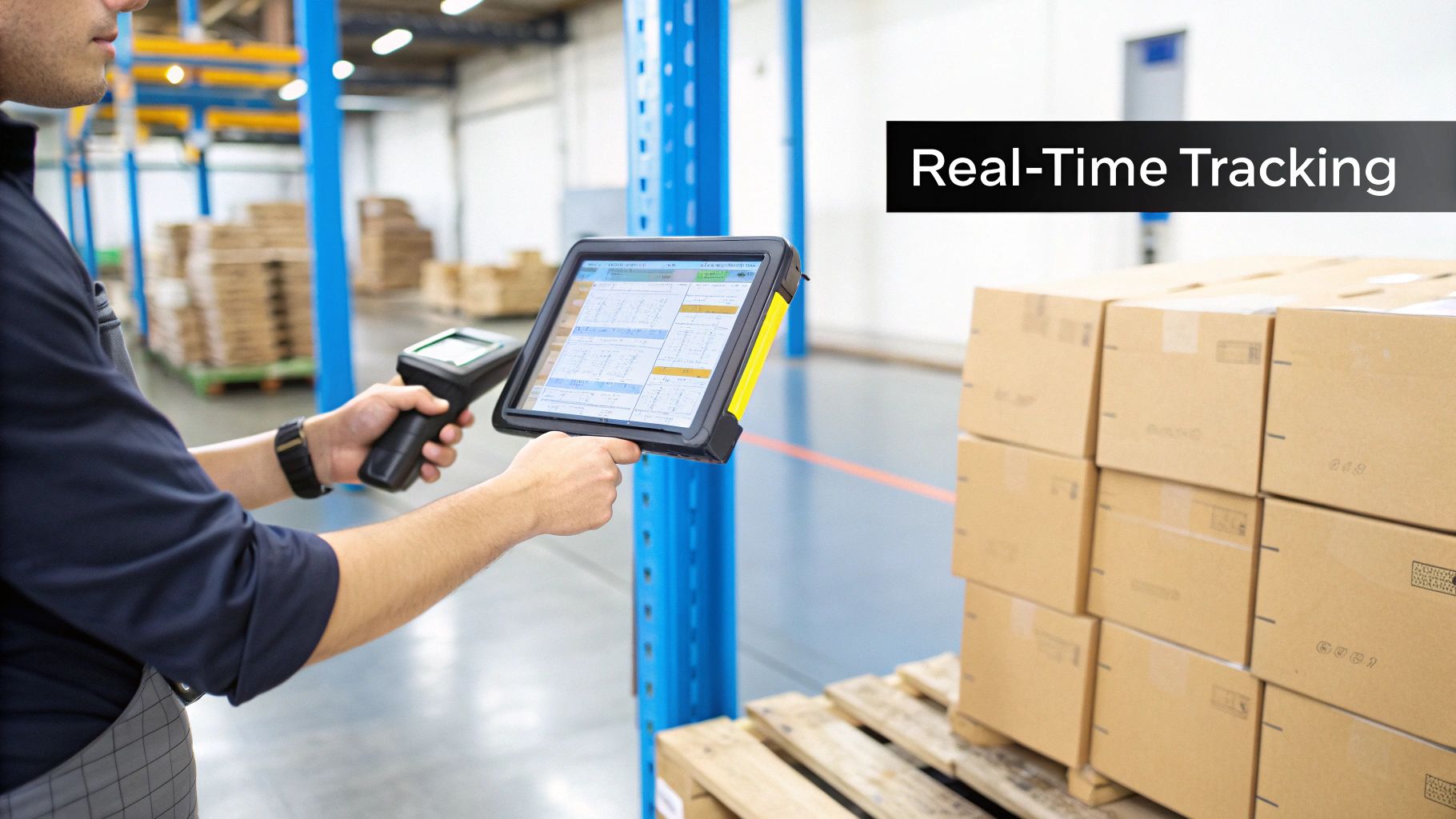
This immediate clarity allows you to make informed decisions on purchasing and production scheduling, eliminating costly surprises and ensuring project timelines are met with precision. For shops moving from clipboards to cloud-based systems, the transition creates a single source of truth that prevents over-ordering, reduces waste, and minimizes carrying costs associated with excess stock.
Practical Implementation and Examples
Adopting a real-time system doesn't require a massive overhaul. It can start small and scale with your operation.
- Barcode Scanning: A custom cabinet shop can apply barcode labels to sheet goods upon arrival. As each sheet is moved to a CNC machine and cut, a quick scan automatically depletes the raw material inventory and allocates it to a specific job.
- Cloud-Based Platforms: A furniture maker using an e-commerce platform can integrate a system to sync material levels. When an online order for a walnut desk comes in, the platform automatically reserves the required board feet, preventing the same material from being sold twice.
- Automated Alerts: A millwork shop can set a minimum threshold for a popular crown molding profile. When on-hand inventory drops below a pre-set two-week supply, the system automatically triggers a low-stock alert or even generates a draft purchase order.
Actionable Tips for Getting Started
- Start Simple: Begin with a straightforward barcode or QR code system before considering more complex technologies like RFID. The goal is accuracy and adoption, not complexity.
- Set Reorder Points: Configure automatic reorder points based on historical usage, material lead times, and current project velocity. This automates purchasing and prevents stockouts.
- Integrate Systems: Connect your inventory software with your accounting or quoting software. This streamlines the purchasing-to-payment cycle and provides a clearer financial picture. Many specialized platforms offer seamless integration; you can explore options when you set up a system like TimberCloud.
- Verify Accuracy: Conduct regular "spot checks" or mini-audits on high-value or fast-moving items to ensure the digital count matches the physical reality on the shop floor.
2. Adopt Just-In-Time (JIT) Inventory Management
Imagine raw materials arriving on your loading dock just as they are needed on the shop floor, rather than sitting for weeks and tying up valuable cash and space. This is the core principle of Just-In-Time (JIT) inventory management, a strategy where materials are ordered and received precisely when required for production. This lean approach is a cornerstone of modern inventory management best practices, transforming your warehouse from a storage liability into a dynamic flow-through point.
Pioneered by Toyota, JIT is not just about reducing stock; it's about eliminating waste in all its forms, including waiting time, excess motion, and overproduction. For a custom shop, this means less capital tied up in slow-moving exotic woods and more agility to respond to unique client requests. It forces a disciplined approach to planning and strengthens supplier relationships, making your entire operation more efficient.
Practical Implementation and Examples
Adopting JIT is a strategic shift that hinges on precision and strong partnerships. It’s about building a highly responsive supply chain.
- Custom Cabinetry Projects: A shop specializing in high-end kitchen remodels can partner with a local hardwood supplier. Instead of stocking dozens of wood species, they order job-specific lumber packs that arrive just two days before the project is scheduled for cutting, minimizing on-site storage needs.
- Hardware and Finishing Supplies: For items like drawer slides or specific finishes, a furniture maker can establish a JIT agreement with a distributor. When a new batch of tables enters the finishing stage, an automated order is placed, and the required supplies are delivered the next day.
- Build-to-Order Models: An e-commerce furniture business can use a JIT model for components. When a customer orders a specific chair model, the system automatically orders the pre-cut legs and seat frames from a partner facility, which arrive just in time for final assembly.
Actionable Tips for Getting Started
- Build Strong Supplier Partnerships: JIT is impossible without reliable suppliers. Work with vendors who understand your production schedule and can guarantee delivery times.
- Forecast with Precision: Use historical data and current project pipelines to accurately forecast material needs. A rolling forecast is more effective than a fixed annual plan.
- Start Small: Begin by implementing JIT for non-critical or standard items first. Use the success from these categories to gradually expand the practice to more vital materials.
- Establish Clear Communication: Create dedicated communication channels with your key suppliers. They need to be aware of your production schedule, and you need to be aware of their lead times and potential disruptions.
3. Use ABC Analysis for Inventory Categorization
Not all inventory is created equal. The exotic hardwood slab for a live-edge table holds far more value and risk than a box of standard wood screws. ABC analysis is a categorization method that applies the Pareto Principle to your stock, allowing you to focus management efforts where they matter most. This is a core tenet of effective inventory management best practices, ensuring your high-value assets receive the attention they deserve.
This method divides your inventory into three categories. 'A' items are your most valuable, making up the bulk of your inventory cost but a small portion of your total items. 'C' items are the opposite, low-value but high-volume. 'B' items fall in between. By categorizing, you can tailor your control strategies, from security to reordering frequency, saving time and protecting capital.
Practical Implementation and Examples
Implementing ABC analysis provides immediate clarity on where to direct your resources for maximum impact.
- Custom Furniture Shop: Live-edge walnut slabs and high-end hardware are 'A' items, requiring precise tracking and secure storage. Plywood and common fasteners are 'C' items, managed with simpler, bulk-reordering systems. Drawer slides and standard finishes might be 'B' items, checked on a regular schedule.
- Cabinetry Manufacturer: High-end, imported drawer pulls and specialty finishes are 'A' items, subject to frequent cycle counts. Melamine sheets and basic hinges are 'C' items. Standard cabinet door styles are 'B' items.
- Millwork Operation: Exotic wood species like teak or mahogany used for custom projects are 'A' items. Standard poplar or pine trim, sold in high volumes, are 'C' items. This focus prevents tying up cash in slow-moving, expensive materials.
Actionable Tips for Getting Started
- Calculate Annual Value: For each item, multiply its unit cost by its annual consumption quantity to determine its total annual value. This is the primary metric for categorization.
- Set Your Tiers: Use the 80/15/5 rule as a starting point. 'A' items typically represent 80% of your value, 'B' items 15%, and 'C' items the remaining 5%.
- Vary Your Control Levels: Apply stringent controls and more frequent inventory checks (cycle counting) to 'A' items. Use more relaxed controls and automated reordering for 'C' items.
- Review and Adjust Periodically: Market prices and project demands shift. Conduct an ABC analysis quarterly or semi-annually to ensure your categories remain accurate and reflect current business conditions.
4. Establish Safety Stock Levels Based on Demand Variability
Even with the best forecasting, unexpected demand spikes or supplier delays can halt production. Safety stock is the buffer inventory you hold to protect against these variables, ensuring a project isn't derailed by a sudden shortage. Calculating this buffer is a critical component of inventory management best practices, moving you from "just in case" guessing to a calculated risk management strategy. It's about balancing the cost of holding extra material against the greater cost of a stockout.
For a custom shop, a stockout means idle machines, delayed timelines, and disappointed clients. By establishing safety stock levels based on actual demand variability and supplier lead times, you create a resilient supply chain. This practice minimizes disruptions, maintains production momentum, and protects your reputation for reliability, all without tying up excessive capital in unnecessary inventory.
Practical Implementation and Examples
Implementing safety stock requires analyzing historical data to prepare for future uncertainty. It's a proactive, not reactive, approach.
- Seasonal Demand: A manufacturer of outdoor furniture can analyze past sales data to identify peak season in spring. They would increase safety stock levels for popular wood species like teak and cedar starting in late winter to absorb the inevitable surge in orders.
- Supplier Unpredictability: A cabinet shop relies on a specific type of European hardware with a variable lead time of 4 to 7 weeks. They calculate safety stock to cover the maximum potential lead time, ensuring that even a worst-case shipping delay doesn't stop cabinet assembly.
- High-Value Components: For a high-end millwork company using premium, hard-to-source veneers, running out is not an option. They maintain a higher safety stock for these critical, high-margin materials, even if demand is stable, because the cost of a stockout is catastrophic to project deadlines and profitability.
Actionable Tips for Getting Started
- Analyze Variability: Don't just look at average demand. Calculate the standard deviation of both your demand and your supplier's lead time to understand the true level of unpredictability you need to buffer against.
- Set Service Level Targets: Decide on an acceptable risk of stockout for different items. You might set a 99% service level (lower risk of stockout) for A-items (high-value, fast-moving) and a 90% level for C-items (low-value, slow-moving).
- Review and Adjust Quarterly: Market conditions, supplier performance, and demand patterns change. Re-evaluate and adjust your safety stock levels at least quarterly to ensure they are still aligned with current reality.
- Differentiate Your Items: Avoid applying a one-size-fits-all safety stock formula. Maintain higher levels for materials that are critical to production, have unreliable suppliers, or are tied to your most profitable products.
5. Implement Cycle Counting for Inventory Accuracy
The annual physical inventory count is a disruptive, all-hands-on-deck event that often shuts down operations. Cycle counting replaces this once-a-year headache with a continuous, low-impact process. It's a method of counting a small portion of inventory on a recurring schedule, making it one of the most effective inventory management best practices for maintaining data integrity without halting production. This ongoing verification identifies and corrects discrepancies in real-time.
By regularly auditing high-value or fast-moving items, you ensure the inventory data in your system accurately reflects the physical stock on your shelves. For a shop managing various hardware, fasteners, and sheet goods, this prevents the sudden discovery of a critical shortage mid-project. It transforms inventory accuracy from a once-a-year goal into a daily operational standard.
Practical Implementation and Examples
Cycle counting integrates seamlessly into the daily rhythm of a manufacturing or woodworking shop, providing constant feedback on inventory health.
- High-Value Items: A custom furniture builder can schedule a weekly cycle count for high-cost materials like live-edge slabs or exotic hardwoods. This ensures these critical, expensive assets are always accounted for.
- A-B-C Analysis: A millwork company can classify items based on value and turnover (A-items being high-value, C-items low-value). They might count all "A" items monthly, "B" items quarterly, and "C" items semi-annually.
- Location-Based Counting: A cabinet shop can assign specific zones of the warehouse (e.g., the hardware aisle, the sheet good racks) to be counted each day of the week, ensuring the entire facility is audited over a set period.
Actionable Tips for Getting Started
- Assign Trained Counters: Designate specific team members to perform counts. Their familiarity with the process and products will improve consistency and accuracy.
- Count During Off-Peak Hours: If possible, conduct counts at the start or end of a shift to minimize disruption and reduce the chance of items being moved during the count.
- Investigate All Variances: Even small discrepancies can indicate a larger systemic issue, such as a flawed receiving process or unrecorded scrap. Dig into the root cause of every variance.
- Implement Blind Counts: Have staff count items without seeing the expected quantity in the system first. This prevents confirmation bias and leads to a more accurate physical count.
- Track Accuracy Metrics: Monitor your inventory accuracy rate over time. Share the results with your team to highlight the importance of the process and celebrate improvements.
6. Leverage Demand Forecasting and Sales Analytics
Moving from a reactive to a proactive inventory strategy is a hallmark of sophisticated operations, and it begins with accurate demand forecasting. Instead of simply restocking what you've sold, this practice uses historical sales data and market trends to predict what customers will want in the future. For a custom shop, this is one of the most critical inventory management best practices because it directly informs purchasing, production scheduling, and cash flow management.
By anticipating demand, you can order raw materials like specific lumber species or hardware sets just in time, minimizing carrying costs while ensuring you have what you need for upcoming projects. This predictive approach helps balance the risk of stockouts against the cost of overstocking, transforming your inventory from a static asset into a dynamic, strategic tool that supports growth and profitability.
Practical Implementation and Examples
Forecasting allows businesses to align their inventory with anticipated customer needs, preventing both lost sales and excess waste.
- Seasonal Trends: A furniture maker specializing in outdoor cedar pieces can analyze past sales data to predict a surge in demand starting in early spring. They can then increase raw material orders in late winter to prepare for the busy season without tying up capital year-round.
- Promotional Planning: A cabinet door manufacturer planning a promotion on shaker-style doors can use forecasting to estimate the required increase in maple and MDF stock. This ensures they can fulfill the higher volume of orders without creating production bottlenecks.
- New Product Introduction: When launching a new line of live-edge tables, a shop can use data from similar product launches or market trends to make an educated forecast. This guides their initial purchase of unique wood slabs, mitigating the risk of investing too heavily in an unproven product.
Actionable Tips for Getting Started
- Start with Simple Methods: Begin with moving averages or linear regression based on your past sales data. You don't need complex AI models to gain valuable insights.
- Incorporate Your Calendar: Factor in seasonal events, planned promotions, and even local economic trends that could influence sales. A simple calendar overlay on your sales data can reveal powerful patterns.
- Use Rolling Forecasts: Instead of a rigid annual plan, adopt a rolling 12-month forecast that you update monthly or quarterly. This makes your planning more agile and responsive to market changes.
- Segment Your Data: Analyze sales not just as a whole but by product category, customer type, or sales channel. You may find that online B2C sales have different demand patterns than B2B contractor orders. For more insights on optimizing your operations, you can find valuable strategies when you read more on the TimberCloud blog.
7. Develop Strong Supplier Relationships and Diversification
In a custom manufacturing environment, your suppliers are more than just vendors; they are extensions of your production line. A delayed shipment of a specific wood veneer or a quality issue with hardware can halt a high-value project instantly. Developing strong supplier relationships transforms a transactional process into a strategic partnership, while diversification builds resilience against unforeseen disruptions. This is a critical component of inventory management best practices because it directly impacts material availability, cost, and quality.
This dual approach ensures you aren't reliant on a single source for critical materials. A primary supplier might offer the best pricing due to volume, but having vetted secondary suppliers provides a crucial safety net. This strategy prevents production shutdowns caused by a single supplier's stockout, logistics issue, or business closure, safeguarding your project timelines and client commitments.
Practical Implementation and Examples
Building these relationships and a diverse supply chain is a proactive, ongoing process.
- Shared Forecasts: A cabinet shop that shares its three-month production forecast with its primary plywood supplier can help them manage their own stock, often leading to better pricing and guaranteed availability for large jobs.
- Performance Scorecards: An architectural millwork firm can track suppliers based on on-time delivery rates, material quality (e.g., defect percentage), and responsiveness. This data-driven approach allows for objective conversations about performance and improvement.
- Strategic Diversification: A furniture maker might source 70% of their North American hardwood from a large, reliable distributor but maintain relationships with two smaller, local sawmills. These smaller suppliers can provide unique live-edge slabs or fulfill urgent, smaller orders when the primary vendor cannot.
Actionable Tips for Getting Started
- Implement Vendor Scorecards: Create a simple scorecard to measure suppliers on key metrics like quality, on-time delivery, pricing consistency, and communication.
- Conduct Regular Reviews: Schedule quarterly or bi-annual business reviews with your key suppliers to discuss performance, upcoming needs, and potential challenges.
- Maintain a Qualified Vendor List: For every critical material, identify and pre-qualify at least two alternative suppliers, even if you don't use them regularly.
- Communicate Proactively: Provide your top suppliers with as much notice as possible for large or unusual orders. This collaboration builds goodwill and improves fulfillment rates.
- Visit Supplier Facilities: When possible, visit a supplier’s operation. Understanding their capacity, processes, and challenges helps build a stronger, more empathetic partnership.
8. Optimize Warehouse Layout and Organization Systems
A poorly organized shop floor or warehouse is a direct drain on productivity and profitability. Time wasted searching for materials, navigating cluttered aisles, or retrieving the wrong item adds up quickly. Optimizing your layout is one of the most impactful inventory management best practices because it transforms your physical space into a strategic asset. It’s about creating a logical flow that minimizes movement, reduces handling errors, and makes every square foot work for you.
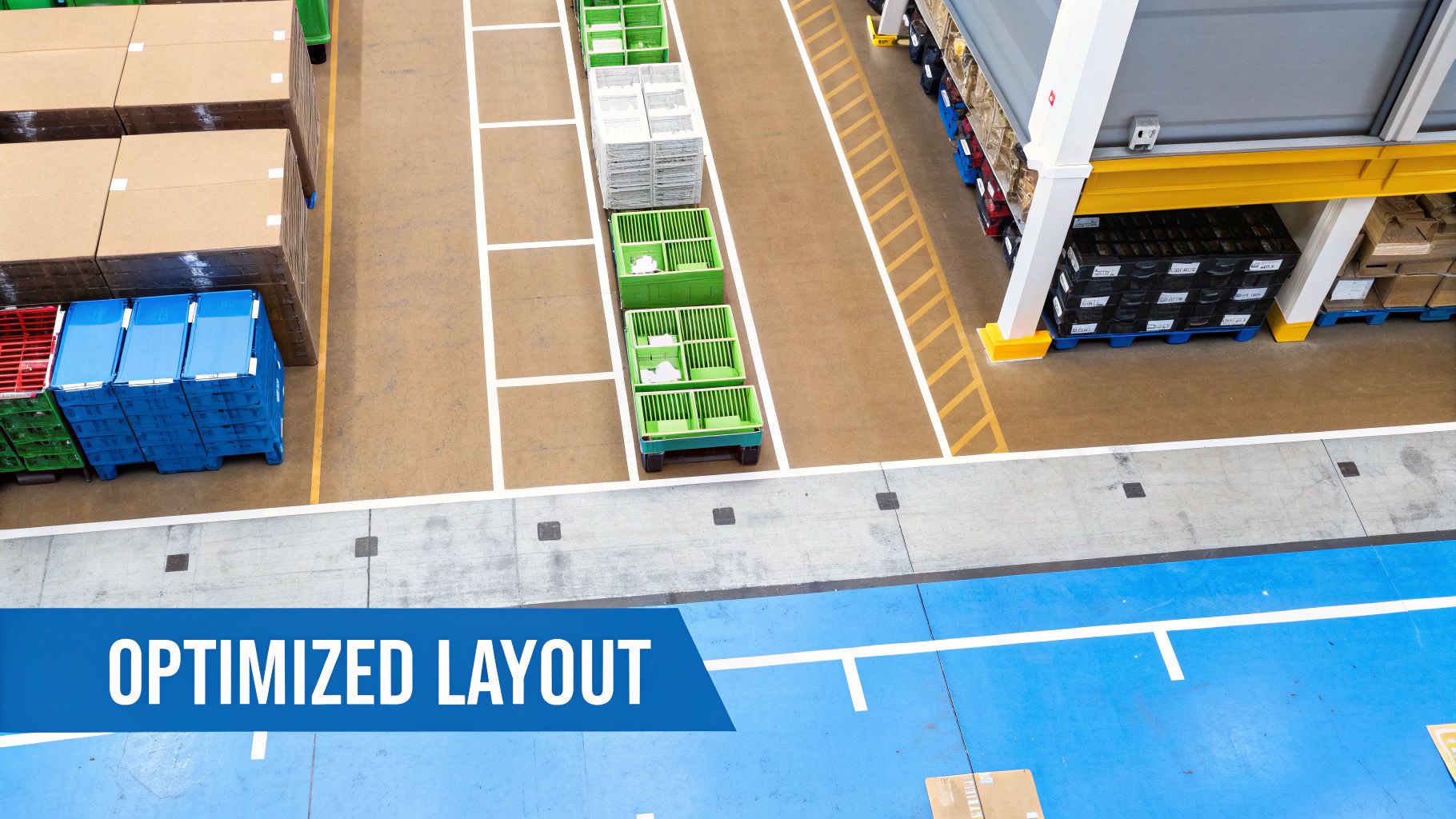
This systematic approach ensures that your most-used materials are the most accessible, that receiving and shipping are distinct and efficient processes, and that your team can locate and pick items with speed and accuracy. For a custom shop, this translates to faster job turnaround, fewer production bottlenecks, and a safer, more professional working environment.
Practical Implementation and Examples
A well-designed layout directly supports your workflow, from raw material arrival to finished product shipment.
- Zoning by Frequency: A custom cabinet shop can place its most frequently used sheet goods (like 3/4" birch plywood) and hardware (like standard drawer slides) closest to the CNC machine and assembly benches. This cuts down on travel time for nearly every project.
- Vertical Space Utilization: A furniture maker with limited floor space can use high-quality pallet racking to store less-frequently used lumber slabs vertically, freeing up valuable floor area for active projects and machinery.
- Dedicated Work Cells: A millwork operation can organize its space into dedicated cells for different processes like cutting, sanding, and finishing. Materials flow logically from one cell to the next, preventing cross-contamination and inefficient movement.
Actionable Tips for Getting Started
- Map Your Flow: Draw a diagram of your current workflow, from receiving raw materials to shipping finished goods. Identify and eliminate areas of backtracking or unnecessary movement.
- Apply the ABC Method: Place your high-value, fast-moving "A" items in the most accessible, waist-high locations near production or shipping zones. "C" items can be stored higher up or farther away.
- Use Clear Labeling: Implement a clear, consistent labeling system with barcodes or QR codes for all racking, shelving, and bin locations. This ensures anyone can find anything quickly and supports accurate digital tracking.
- Maintain Wide, Clear Aisles: Design aisles that are wide enough for forklifts or carts to pass each other safely and efficiently. Keep them clear of clutter at all times.
9. Automate Inventory Processes with Technology and Software
Manual inventory counts and data entry are prone to human error, creating a cascade of problems from inaccurate stock levels to flawed purchasing decisions. Automating inventory processes with technology is a critical step in scaling operations efficiently. This approach leverages tools like barcode scanners, RFID, and specialized software to minimize manual labor, increase accuracy, and provide real-time data for better decision-making. It's a key part of any modern inventory management best practices framework.
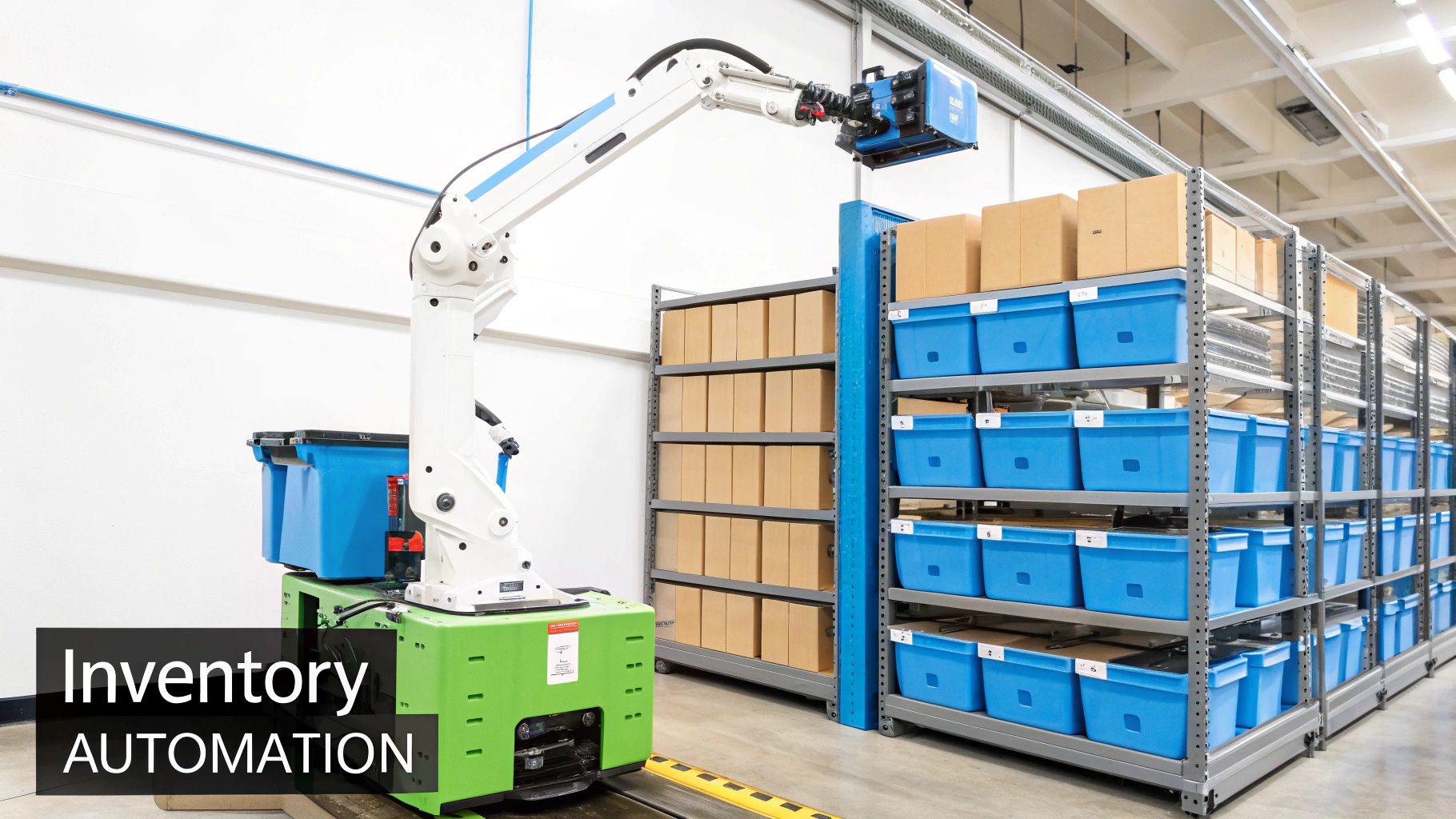
By replacing clipboards with scanners and spreadsheets with integrated systems, you create a more resilient and responsive supply chain. Automation handles the repetitive, error-prone tasks, freeing up your team to focus on value-added activities like quality control and production optimization, rather than just counting boxes. This shift not only improves data integrity but also boosts overall operational speed and efficiency.
Practical Implementation and Examples
Automation scales from simple tools to fully integrated systems, making it accessible for shops of all sizes.
- Barcode-Driven Receiving: A high-volume millwork distributor can automate its receiving process. As pallets of material arrive, staff use handheld scanners to scan barcodes on the shipment paperwork, instantly updating inventory levels in the warehouse management system (WMS) without manual data entry.
- RFID for High-Value Assets: A custom furniture maker specializing in exotic hardwoods can embed small RFID tags in valuable slabs. This allows for instant location tracking within the facility, preventing loss and ensuring the right material is pulled for a high-stakes project.
- Integrated Software for Production: A cabinet shop can use an integrated platform where a designer's CAD file automatically generates a bill of materials. This list then communicates directly with the inventory system to allocate the necessary hardware and panel stock, flagging any potential shortages before production begins.
Actionable Tips for Getting Started
- Start with Barcodes: Begin with a simple, cost-effective barcode system for receiving, picking, and shipping. This technology is mature, reliable, and provides an immediate ROI by reducing manual entry errors.
- Choose Cloud-Based Software: Opt for a cloud-based inventory platform that offers flexibility, scalability, and accessibility from any device. This is crucial for teams that need to access information on the shop floor, in the office, or on the road.
- Prioritize Integration: Ensure any new software integrates seamlessly with your existing systems, like accounting, quoting, or ERP software. This creates a unified data ecosystem and prevents information silos. You can explore the features of an integrated platform to see how this connectivity works.
- Implement in Phases: Roll out automation in manageable stages. Start with the receiving process, then move to storage and picking, and finally shipping. This phased approach minimizes disruption and allows your team to adapt gradually.
10. Monitor Key Performance Indicators (KPIs) and Metrics
What gets measured gets managed. Establishing and tracking inventory KPIs is a crucial practice that transforms your management from reactive to strategic. For a custom shop, metrics go beyond simple stock counts; they provide a health check on your entire operation, from purchasing efficiency to production flow. Monitoring these figures is one of the most effective inventory management best practices for identifying problems early and validating the success of new processes.
Regularly tracking KPIs creates accountability and drives continuous improvement. It allows you to see the direct impact of your inventory decisions on profitability, project timelines, and customer satisfaction. Instead of guessing if a change was effective, you have hard data to prove it, enabling smarter, data-driven decisions that optimize cash flow and reduce waste.
Practical Implementation and Examples
KPIs are most effective when they are specific, measurable, and relevant to your shop's goals.
- Inventory Turnover Ratio: A high-volume cabinet manufacturer can track this metric to ensure raw materials like plywood and MDF are being converted into finished goods efficiently, not sitting on shelves tying up capital. A healthy turnover (e.g., 8-12x annually, like Costco) indicates strong sales and efficient purchasing.
- Carrying Costs: A custom furniture maker specializing in expensive exotic hardwoods can calculate the cost of holding unsold inventory, including storage, insurance, and potential damage. This KPI highlights the financial drag of excess stock and encourages leaner purchasing.
- Order Fill Rate: A millwork supplier can monitor the percentage of orders shipped completely from stock on the first attempt. A high fill rate (e.g., 98%+) is a direct measure of customer satisfaction and inventory availability, preventing project delays for clients.
Actionable Tips for Getting Started
- Establish a Baseline: Before implementing any new system or process, measure your current KPIs. This baseline will be the benchmark against which you measure all future improvements.
- Focus on a Few Key Metrics: Start with 3-5 critical KPIs, such as inventory turnover, carrying costs, and stock-to-sales ratio. Avoid "analysis paralysis" by focusing on the metrics that most directly impact your bottom line.
- Use Visual Dashboards: Implement software that presents your KPIs in a simple, visual dashboard. This makes it easy for you and your team to see performance at a glance and spot trends quickly.
- Review and Adjust Regularly: Don't wait for a quarterly review. Look at your key metrics weekly or monthly. If a KPI is off target, investigate the root cause immediately and adjust your strategy accordingly.
Top 10 Inventory Management Best Practices Comparison
| Strategy | Implementation Complexity 🔄 | Resource & Operational Effort ⚡ | Expected Outcomes ⭐📊 | Ideal Use Cases 💡 |
|---|---|---|---|---|
| Implement Real-Time Inventory Tracking Systems | 🔄 High — complex integrations, staff training | ⚡ High — hardware, software, ongoing maintenance | ⭐⭐⭐⭐ — Instant visibility; fewer stockouts; improved forecasting | High-volume retail, omnichannel fulfillment, large warehouses |
| Adopt Just-In-Time (JIT) Inventory Management | 🔄 High — process redesign; supplier synchronization | ⚡ Medium — frequent logistics, reliable suppliers required | ⭐⭐⭐ — Lower carrying costs & waste; higher supply risk | Manufacturing with stable demand, lean operations, assembly lines |
| Use ABC Analysis for Inventory Categorization | 🔄 Low–Medium — data analysis and periodic review | ⚡ Low — analytics effort; minimal system changes | ⭐⭐ — Focused control on high-value items; reduced carrying costs | Large SKU lists, businesses prioritizing capital allocation |
| Establish Safety Stock Levels Based on Demand Variability | 🔄 Medium — statistical calculations and reviews | ⚡ Medium — additional inventory holding and monitoring | ⭐⭐⭐ — Fewer stockouts; higher service levels; increased holding cost | Long lead times, seasonal demand, critical spare parts |
| Implement Cycle Counting for Inventory Accuracy | 🔄 Medium — scheduling, procedures, baseline counts | ⚡ Medium — recurring staff time, training, scanning tools | ⭐⭐⭐ — Higher accuracy (95–99%); faster discrepancy detection | Regulated industries, high-value SKUs, continuous operations |
| Leverage Demand Forecasting and Sales Analytics | 🔄 Medium–High — model selection, data integration | ⚡ Medium–High — analytics tools, data quality processes | ⭐⭐⭐ — Better planning, reduced stock & stockouts; requires refinement | Retail chains, seasonal products, promotions planning |
| Develop Strong Supplier Relationships & Diversification | 🔄 Medium — relationship management, contracts | ⚡ Medium — sourcing effort, supplier audits, backups | ⭐⭐⭐ — Improved reliability, pricing, resilience to disruption | Critical components, single-source risk mitigation, global sourcing |
| Optimize Warehouse Layout and Organization Systems | 🔄 Medium — assessment and physical redesign | ⚡ Low–Medium — one-time redesign; possible equipment costs | ⭐⭐⭐ — Faster picking, fewer errors, better space utilization | E‑commerce fulfillment, high-pick-volume warehouses |
| Automate Inventory Processes with Technology & Software | 🔄 High — phased implementation; integration challenges | ⚡ High — capital investment, maintenance, training | ⭐⭐⭐⭐ — Major efficiency & accuracy gains; scalable operations | Large operations, high SKU velocity, rapid growth environments |
| Monitor Key Performance Indicators (KPIs) and Metrics | 🔄 Low–Medium — dashboarding and data feeds | ⚡ Low — BI tools, routine analysis | ⭐⭐⭐ — Objective performance insight; drives continuous improvement | All organizations aiming for measurable inventory improvements |
Integrating Your Practices into a Cohesive System
Mastering the art and science of inventory management isn't about cherry-picking a single strategy from the list above. It's about recognizing that each of these ten inventory management best practices is a gear in a much larger machine. When they turn in unison, they create a powerful, self-sustaining system that drives efficiency, profitability, and resilience for your entire woodworking or manufacturing operation. A standalone practice is helpful, but an integrated system is transformative.
Think of it as building a custom piece of furniture. You wouldn't use just a saw or just a sander; you use a sequence of tools, each with a specific purpose, to turn raw lumber into a finished product. Similarly, your inventory strategies must build upon one another to create a seamless flow from raw material procurement to finished goods delivery.
Weaving the Threads Together: A Systemic Approach
The true power of these concepts is unlocked when they are interconnected. Your ABC analysis, for example, shouldn't exist in a vacuum. It directly informs how you implement other practices:
- A-Items: These high-value materials demand rigorous oversight. They should be subject to more frequent cycle counting, have meticulously calculated safety stock levels, and be managed with a precise Just-In-Time (JIT) approach to minimize carrying costs.
- B-Items: These moderately important items can have less frequent cycle counts and more generous safety stock buffers. Your supplier relationships become crucial here to ensure consistent availability without tying up excessive capital.
- C-Items: For these low-value, high-volume items (like screws or fasteners), a simpler two-bin system or a higher safety stock level is often more cost-effective than constant monitoring.
This interconnectedness extends across the board. Your demand forecasting data is the fuel that powers your JIT and safety stock calculations. Your warehouse layout optimization makes cycle counting and real-time tracking physically easier and more accurate. And the entire system is held together by the digital glue of automation and software, which captures the data needed to monitor your key performance indicators (KPIs).
From Reactive Firefighting to Proactive Strategy
Without a cohesive system, many shops operate in a constant state of reaction. You're expediting a shipment of walnut because a big order came in unexpectedly. You're writing off obsolete hardware that was over-ordered a year ago. You're stopping the CNC machine because the team can't find the right sheet of plywood in a disorganized warehouse. These are symptoms of disconnected processes.
By implementing these inventory management best practices as an integrated framework, you shift from a reactive posture to a proactive one. You are no longer guessing; you are predicting. You are no longer searching; you are locating. You move from putting out daily fires to strategically planning for the next quarter, year, and beyond. This is the ultimate benefit: gaining strategic control over a core component of your business, which directly translates to reduced waste, improved cash flow, and a stronger bottom line.
Your Actionable Path Forward
Embarking on this journey doesn't require a complete operational overhaul overnight. The key is to start small, build momentum, and prove the value with measurable results.
- Identify Your Biggest Pain Point: Is it constant stockouts of critical materials? Or is it the high cost of carrying too much dead stock? Start there.
- Select 1-2 Foundational Practices: If stockouts are the issue, focus on implementing safety stock levels and improving demand forecasting. If excess inventory is the problem, start with an ABC analysis and cycle counting to understand what you have.
- Measure and Adapt: Track your KPIs before and after implementation. Did your stockout rate decrease? Did you reduce your carrying costs? Use this data to justify expanding your efforts.
- Embrace Technology: As you prove the concepts, leverage a centralized software system to connect the dots. Manual tracking on spreadsheets becomes unsustainable as you scale. An integrated platform becomes the central nervous system that makes this cohesive system a daily operational reality.
The path to optimized inventory is a marathon, not a sprint. But each step forward moves you closer to a more efficient, predictable, and profitable future for your shop.
Ready to turn these best practices from a list into a living, breathing part of your daily operations? TimberCloud, Inc. provides an end-to-end platform designed specifically for the custom woodworking industry, integrating sales, inventory, and production into a single source of truth. Stop wrestling with spreadsheets and start building a smarter, more connected business at TimberCloud, Inc. today.
Topics
TimberCloud Team
Content Team
The TimberCloud team is dedicated to helping manufacturers streamline their operations with intelligent software solutions.