How to Calculate Board Feet Like a Pro Woodworker

Calculating Board Feet
Figuring out board feet boils down to measuring wood volume in a single, simple step. Imagine a piece of lumber that’s 1 inch thick, 12 inches wide, and 12 inches long—that’s exactly one board foot. Nail this concept, and you’ll dodge budget blowouts at the lumberyard every time.
What Exactly Is a Board Foot And Why It Matters
A board foot isn’t about length or area; it’s all about volume. By focusing on cubic measurement instead of linear feet or square footage, you get a true sense of how much material you’re buying. This clarity is why hardwood dealers have relied on the board-foot system since the late 1700s.
That historic choice set 144 cubic inches of wood as the standard unit, giving merchants and woodworkers a shared language. Once you internalize that number, conversations with suppliers and cost estimates become smooth and reliable.
Here’s why nailing this definition will save you headaches:
- Accurate Budgeting: Pinpoint exactly what your project will cost, whether you’re crafting a jewelry box or outfitting an entire workshop.
- Inventory Management: Keep stock levels in check, plan your builds, and avoid last-minute scrambles for material.
- Clear Communication: Speak the same “wood language” as your supplier, so nobody’s surprised by hidden fees or mismatched quantities.
The image below shows a simple visual representation of one board foot.
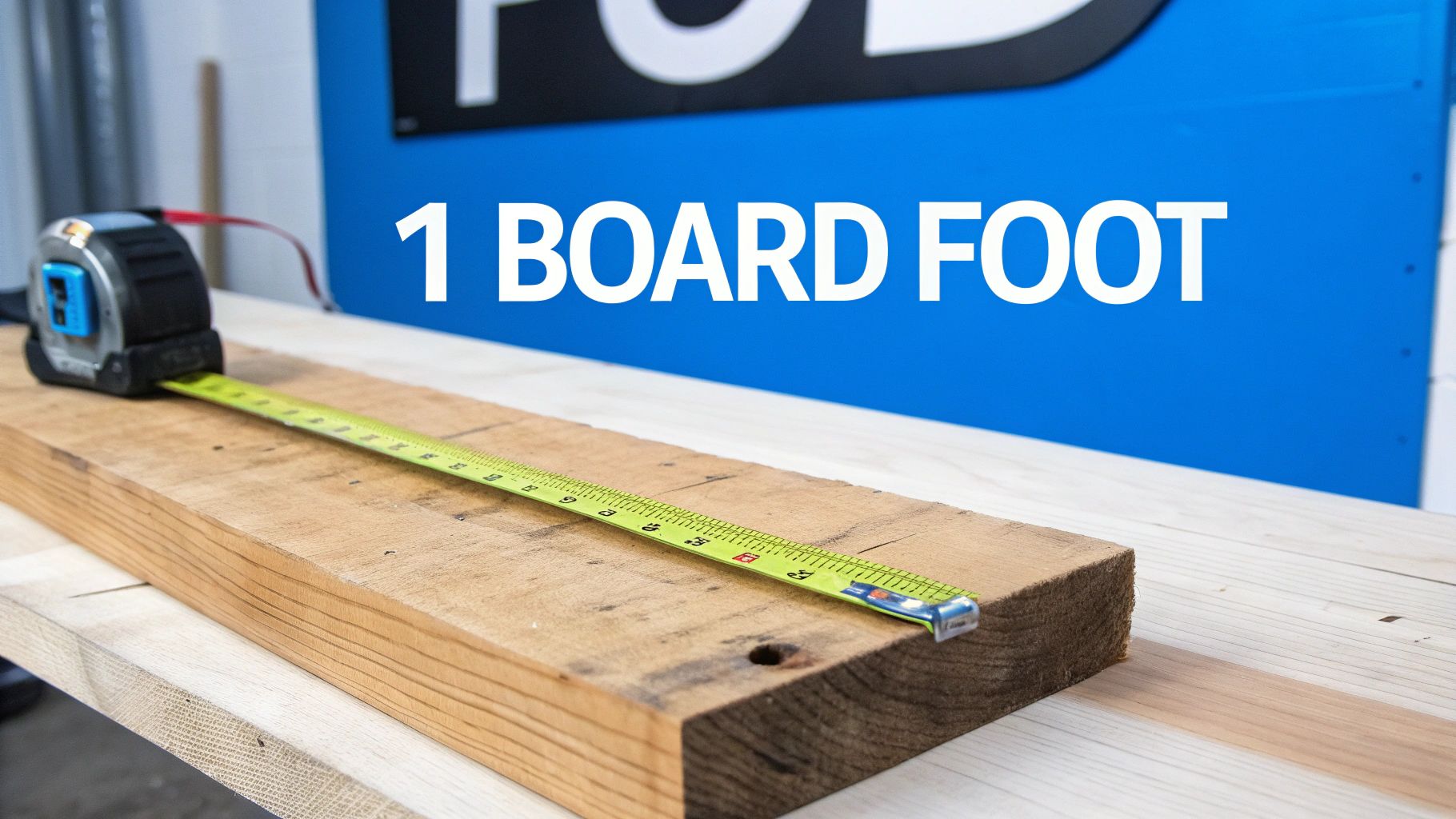
That snapshot—1" × 12" × 12"—turns an abstract formula into something you can almost grab. Keep that mental picture handy next time you’re staring down a pile of rough-sawn boards.
The Two Core Formulas You Absolutely Need to Know
Alright, let's get down to brass tacks. Calculating board feet isn't some dark art; it just comes down to one of two simple formulas. Which one you use just depends on how you measured your board's length—in feet or in inches.
Most of the time, especially when you're at the lumberyard or dealing with standard lengths, you'll have a mix of measurements. This is where the most common formula shines.
(Thickness in inches × Width in inches × Length in feet) / 12 = Board Feet
Simple, right? It's the one I use for quick estimates on the fly.
The All-Inches Alternative
But what about when you're back in the shop, working with offcuts or smaller project pieces where everything is measured in inches? To avoid the headache of converting inches to feet and potentially making a mistake, there's a formula just for that.
The only thing that changes is the number you divide by. Instead of 12, you use 144. Why? Because you're converting square inches to square feet (12 inches x 12 inches = 144). I personally prefer this one for precise shop calculations.
(Thickness in inches × Width in inches × Length in inches) / 144 = Board Feet
Let's see this in action with a common board size: one that's 2 inches thick, 6 inches wide, and 8 feet long (which is 96 inches).
-
Using the first formula (length in feet): (2″ × 6″ × 8′) / 12 = 8 Board Feet
-
Using the second formula (length in inches): (2″ × 6″ × 96″) / 144 = 8 Board Feet
As you can see, you get the exact same result. It's all about using the right formula for the measurements you have in front of you.
Board Foot Formulas at a Glance
To make it even easier, here’s a quick-reference table. Just pick the formula that matches the units you're working with.
| Scenario | Formula | Example (2" thick, 6" wide, 8' long board) |
|---|---|---|
| Length measured in feet | (T″ × W″ × L′) / 12 | (2″ × 6″ × 8′) / 12 = 8 BF |
| Length measured in inches | (T″ × W″ × L″) / 144 | (2″ × 6″ × 96″) / 144 = 8 BF |
Getting comfortable with both of these formulas is the key. Once you have them down, you’ll be able to calculate the volume of any piece of lumber with confidence.
Putting Board Feet to Work: Real-World Calculations
Knowing the formulas is one thing, but the real test comes when you're standing in front of a stack of rough-sawn lumber. Let's walk through how this works in situations you'll actually run into at the yard or in your shop.
Imagine you've spotted a gorgeous piece of 4/4 cherry, perfect for a tabletop. The price is by the board foot, so you need to know the volume. You whip out your tape measure and get the vitals: 1 inch thick, 8 inches wide, and 10 feet long.
Time for some quick math using the standard formula:
(1" T × 8" W × 10' L) / 12 = 6.67 Board Feet
It’s that simple for a single board. This quick calculation is your best tool for double-checking the yard's math and making sure you're getting exactly what you pay for.
This chart is a great visual for remembering which formula to use—it all depends on whether you measured your length in feet or inches.
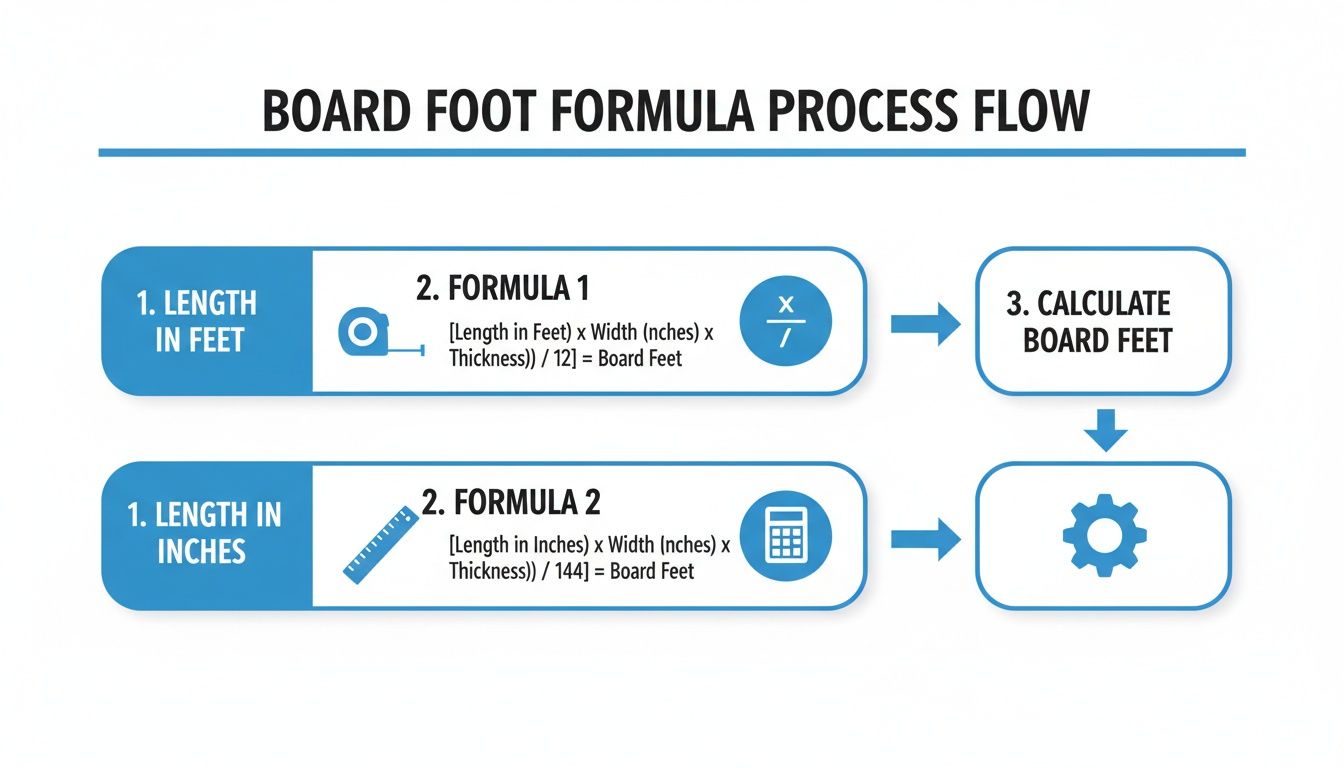
As you can see, both paths get you to the same place. Just pick the one that matches the units you're working with to avoid an extra conversion step.
Tackling Thicker Stock and Stacks
Okay, let's step it up a bit. You need a beefy leg for a workbench, so you grab a piece of 8/4 hard maple. Remember, "8/4" is lumber-speak for a board that’s nominally 2 inches thick. Let's say this piece is 6 inches wide and 4 feet long.
Plugging it into the formula:
(2" T × 6" W × 4' L) / 12 = 4 Board Feet
But what about buying in bulk? When you're looking at a whole unit of lumber, measuring every single board is a waste of time. The common lumberyard shortcut is to find an average width.
Pro Tip: For a full stack, pull out 5-10 boards from different spots and measure their widths. Add them up, divide by the number of boards you measured, and use that average. It’s far more accurate than just eyeballing the one on top.
Dealing with Irregular Shapes and Slabs
Live-edge slabs or boards with a heavy taper are a different beast entirely. Since the width isn't consistent, you have to find the average. It's easier than it sounds.
Here’s the process:
- Measure the width at its narrowest point.
- Measure the width at its widest point.
- Add the two measurements together and divide by 2.
Let's try it with a slab that's 1.5" thick, 10' long, 14" wide on one end, and 20" on the other:
Average Width = (14" + 20") / 2 = 17 inches
Now, just pop that average width into our trusty formula:
(1.5" T × 17" W × 10' L) / 12 = 21.25 Board Feet
Getting a handle on these real-world calculations is a game-changer for managing your inventory. Of course, managing wood doesn't stop with the math; you also have to store it properly, often using specialized solutions like a cantilever pallet rack for lumber. For any serious operation, integrating these calculations into a central system is the next logical step. You can see how modern shops handle this by exploring the inventory and production management features on platforms built for the industry.
Understanding the Lumberyard Lingo
Ever get back to the shop with a beautiful 4/4 cherry board, only to find it doesn't actually measure a full inch thick? It’s one of the most common—and frustrating—misunderstandings in woodworking. This isn't a mistake; it's just how the hardwood world works, and knowing the difference can save you a lot of money and headaches.
The confusion all boils down to nominal vs. actual dimensions. When you buy hardwood, you’re paying for the nominal size. Think of this as the rough, chunky dimension of the lumber right after it came off the sawmill, before it was dried and planed smooth. That milling process shaves off material, leaving you with the board's final, or actual, size.
Decoding the Quarter System
To talk shop like a pro, you have to understand the "quarter system." This is the standard language for hardwood thickness in the U.S. and Canada, and it describes a board’s nominal thickness in quarters of an inch. It’s been around since the 19th century, but it’s still the system we use today.
Here's a quick rundown of what those numbers actually mean for your projects:
- 4/4 (four-quarter): This is your standard "one-inch" board. Nominally, it's 1" thick, but after planing, it usually ends up around 13/16".
- 5/4 (five-quarter): A nominal 1.25" thick board that typically finishes out closer to 1-1/16".
- 6/4 (six-quarter): Nominally 1.5" thick, this will usually measure around 1-5/16" once surfaced.
- 8/4 (eight-quarter): This is your hefty "two-inch" stock. It starts at a nominal 2" thick and generally planes down to about 1-13/16".
So, when you calculate your board feet, you're always using that thicker, nominal dimension—even if the board in your hand is only 13/16" thick. One industry survey found that miscalculations around this are a frequent source of costly disputes, which is why getting it right matters. You can dig deeper into the history and details of how hardwood is measured over at Beilersawmill.com.
The key takeaway is simple: Board foot calculations are always based on the rough, nominal thickness, not the final, actual dimension you measure with your tape.
Getting this lingo down is your best defense against confusion at the checkout counter. It ensures you know exactly what you’re paying for and can speak the same language as your supplier. It's the difference between making a smart purchase and a frustrating, expensive mistake.
Common Mistakes and Pro Tips for Accurate Measurement
Getting your board foot calculation wrong is more than just a math error—it's a mistake that can derail a project, blow your budget, or leave you scrambling for more material mid-build. Even seasoned pros can slip up, but keeping a few key things in mind will help keep your numbers honest and your shop running smoothly.
One of the easiest traps to fall into is mixing up your units. Remember, the classic board foot formula requires the length measurement to be in feet, while the thickness and width are in inches. It's a simple thing to overlook when you're in a hurry, but it will throw your entire calculation off. If you find yourself converting back and forth, a good feet to inches conversion tool can be a real lifesaver.
Planning for the Real World: Kerf and Waste
Your calculator doesn't know about saw blades. Every time you make a cut, the blade's kerf turns a thin strip of that beautiful hardwood into nothing but sawdust. That, plus trimming off knots, snipe, or weird grain, means you'll always need more wood than your final cut list suggests.
Always add a waste factor to your final board footage total. A safe bet for most projects is 10-15% extra material. This buffer covers kerf, minor mistakes, and wood defects, ensuring you have enough lumber to finish the job without a last-minute trip to the supplier.
This isn't about overbuying; it's smart planning. Nothing kills momentum like having to stop everything for an emergency lumber run.
The quest for accurate lumber measurement has a long history, dating back to colonial sawpits. Early methods had error rates as high as 15%, a far cry from today’s precision. Understanding these measurement standards gives you a deeper appreciation for how modern lumber pricing evolved.
Finally, just take a second to double-check your work. Before you start punching numbers, confirm your initial measurements, especially when dealing with rough-sawn lumber. You should be using the nominal thickness (like 4/4 for 1-inch stock), but it’s always wise to verify the boards are what you expect. For more shop-tested advice on managing your inventory, feel free to check out the articles over on the https://timbercloud.com/blog.
Clearing Up Common Questions About Board Feet
Even after you get the hang of the formulas, a few tricky questions always seem to surface. Let’s tackle some of the most common ones I hear in the shop so you can calculate board feet with total confidence, no matter the situation.
People often ask about calculating board footage for logs. This is a different ballgame altogether. You can't just measure a log and plug it into the standard formula. Instead, you need to use specific log scaling rules—like Doyle, Scribner, or the International ¼-Inch Rule—which are designed to estimate how much usable lumber you can get from a round log. These rules account for the inevitable waste that comes from milling a cylinder into flat boards.
Board Feet vs. Square Feet: What's the Difference?
It’s incredibly common to mix these two up, but they measure completely different things.
- Board feet (BF) is a measure of volume. That’s why thickness is a non-negotiable part of the formula.
- Square feet (sq. ft.) measures area (just length multiplied by width), completely ignoring how thick the material is.
You’d use square feet to figure out how much plywood you need for a subfloor or the amount of veneer needed to cover a cabinet door. But when you’re buying the rough lumber to build a solid wood dining table, you need board feet—you're buying the total volume of wood.
The easiest way to remember it is this: board feet tells you "how much wood" you have, while square feet tells you "how much surface" you can cover.
How Do I Convert to Board Feet From Other Units?
Switching between units is a necessary evil, especially if you're sourcing materials internationally or working from different types of plans.
If you’re dealing with metric measurements, you’ll need a handy conversion factor. As a rule of thumb, one cubic meter of lumber equals approximately 424 board feet.
You'll also run into pricing listed per thousand board feet, often abbreviated as MBF. So, if you see cherry priced at $1,200/MBF, it simply means a single board foot costs $1.20. Understanding how to break down these units is crucial for accurate job costing. This is where dedicated software really shines. You can explore different inventory management pricing plans to see how they automate these conversions and take the guesswork out of it.
Ready to stop scribbling calculations on scrap wood and start streamlining your entire operation? TimberCloud pulls inventory management, automated quotes, and production tracking into one place. See how our tools can save you time and seriously boost your accuracy. Get a demo today!
Topics
TimberCloud Team
Content Team
The TimberCloud team is dedicated to helping manufacturers streamline their operations with intelligent software solutions.