10 Actionable Cost Reduction Ideas in Manufacturing for 2025

The quickest savings often come from less scrap, fewer repeat jobs, and less machine downtime. Start by measuring those costs. Then test one improvement at a time. This guide covers ten ways to reduce manufacturing costs and shows where each fits a custom shop.
Top 10 Ways to Reduce Manufacturing Costs
- Lean manufacturing — strip waste out of the work itself
- Targeted automation — hand repetitive, error-prone tasks to machines
- Predictive maintenance — fix failing components before they stop production
- Supply chain and procurement — buy on total cost, not unit price
- Energy efficiency — cut a fixed cost that scales with nothing
- Six Sigma and quality programs — stop paying to build the same part twice
- Material substitution and yield — get more finished product per board foot
- Digital prototyping and 3D printing — fail cheaply before you fail in hardwood
- Employee training and cross-training — flexibility beats idle specialists
- Production scheduling — sequence work so machines and people aren't waiting
The Cost of Doing Nothing
- 83% of industrial decision-makers say unplanned downtime costs at least $10,000 per hour, and 76% put the ceiling as high as $500,000 per hour. (ABB / Sapio Research survey of 3,600 senior decision-makers, October 2025)
- Manufacturers expect raw material and input costs to climb 5.8% over the next 12 months, up from 4.1% the prior quarter. (NAM Manufacturers' Outlook Survey, Q2 2026)
Those two numbers frame the whole exercise: input costs are rising whether or not you act, and a single avoided breakdown can fund an entire improvement program.
1. Lean Manufacturing
Lean Manufacturing is a systematic method for waste minimization within a manufacturing system without sacrificing productivity. Originating from the Toyota Production System, this approach focuses on eliminating non-value-adding activities to simplify operations. The core principle is simple: identify and remove waste, which Toyota categorized into seven key areas: transportation, inventory, motion, waiting, overproduction, over-processing, and defects.
This method is one of the most powerful cost reduction ideas in manufacturing because it forces a full review of your entire production process. By focusing on continuous improvement (kaizen), you can systematically reduce operational costs, shorten lead times, and enhance product quality, leading to greater customer satisfaction and profitability.
For custom woodworking shops, this could mean reorganizing the shop floor to reduce the distance a piece travels or standardizing joinery techniques to prevent defects.
How to Implement Lean Principles
Getting started with lean doesn't require a massive overhaul. Begin with a single, targeted area to build momentum.
- Value Stream Mapping: Map your entire process from raw material to finished product to visually identify bottlenecks and areas of waste.
- Pilot Projects: Choose one specific process, like cabinet door assembly, to test lean principles before a company-wide rollout. This allows you to learn and adapt on a smaller scale.
- Employee Engagement: Train your team on lean concepts and empower them to suggest improvements. Create a formal system for submitting and rewarding ideas, as they are closest to the work and often see waste first.
- Gemba Walks: Regularly walk the shop floor (the gemba) to observe processes firsthand and engage with your team about challenges and opportunities.
The following graphic summarizes the large impact lean implementation can have on key performance metrics.
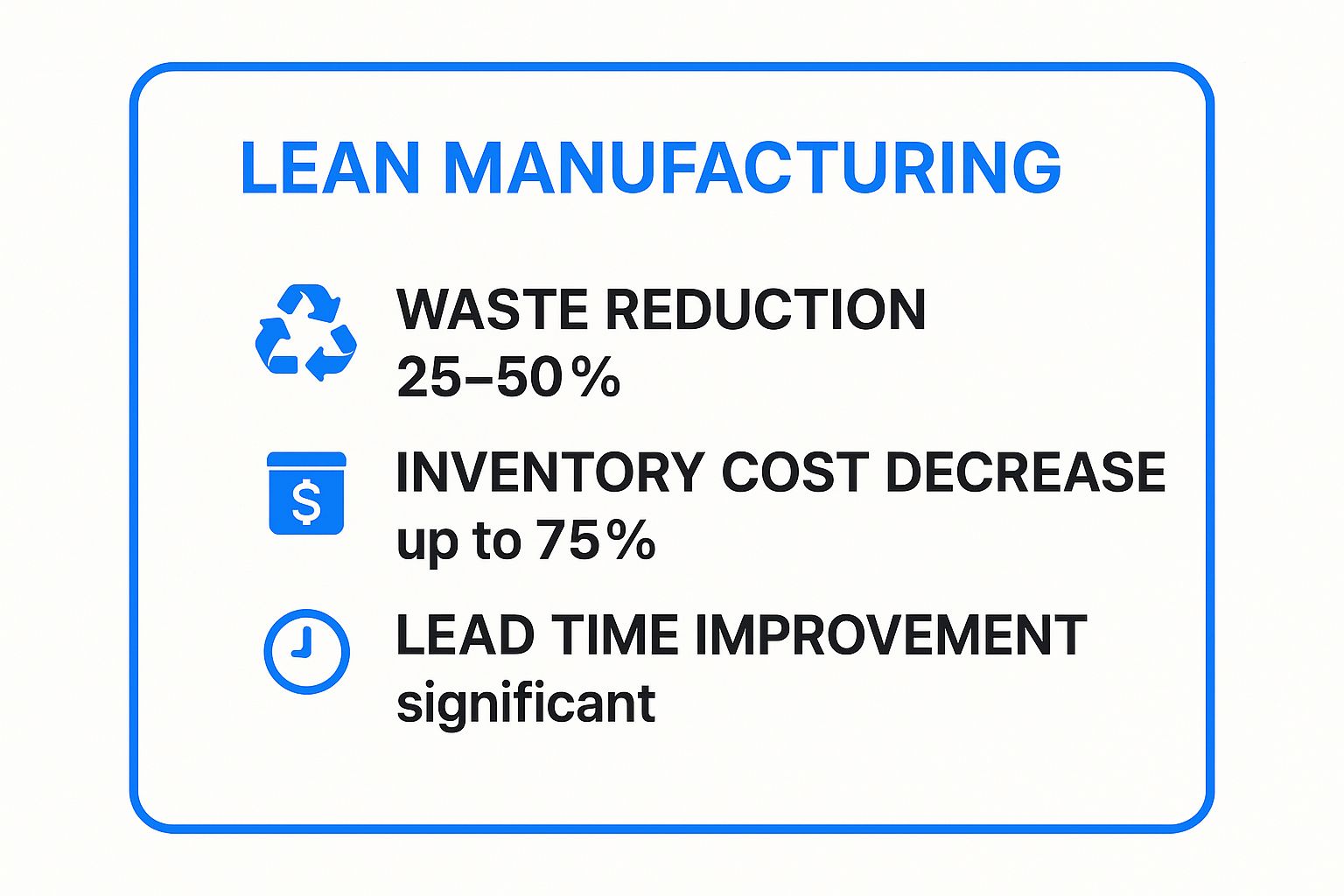
As the data shows, lean isn't just about minor tweaks. It can drive transformative results by drastically cutting waste and inventory costs while speeding up production.
2. Automation and Robotics
Automation and Robotics involve using technology and robotic equipment to perform manufacturing tasks with minimal human intervention. This ranges from simple automated conveyors to complex collaborative robots (cobots) that work alongside employees. For a custom cabinet shop, this could mean an automated CNC router for precision cutting or robotic arms for sanding and finishing, tasks that are repetitive and physically demanding.

While the initial investment can be large, this strategy is one of the most impactful cost reduction ideas in manufacturing for long-term savings. Automation dramatically reduces direct labor costs, improves consistency and quality, and increases production speed. It also enhances workplace safety by taking over dangerous or ergonomically challenging jobs, leading to fewer injuries and lower insurance premiums.
How to Implement Automation
Integrating automation effectively requires careful planning and a phased approach. Start small to manage costs and learn from the process.
- Start with Repetitive Tasks: Identify high-volume, repetitive, or physically strenuous tasks like material handling, sanding, or panel cutting. These offer the quickest and clearest return on investment.
- Consider Collaborative Robots (Cobots): Cobots are designed to work safely alongside humans, are typically less expensive than industrial robots, and are easier to program and integrate into existing workflows.
- Conduct a Thorough ROI Analysis: Look beyond the sticker price. Factor in all associated costs, including installation, employee training, maintenance, and potential downtime during implementation, to get a true picture of the investment.
- Invest in Employee Retraining: Proactively retrain your team to manage, program, and maintain the new automated systems. This shifts their roles from manual labor to higher-value technical oversight.
The following video shows how a modern woodworking shop leverages robotics to boost efficiency and precision.
By starting with a focused project, you can build expertise and demonstrate the value of automation before scaling up to more complex processes.
3. Predictive Maintenance
Predictive Maintenance uses data analytics and real-time monitoring to forecast when equipment failure might occur, allowing for repairs to be performed just before they are needed. Instead of reacting to breakdowns or performing scheduled maintenance that might be unnecessary, this data-driven approach uses sensors to track equipment health through metrics like vibration, temperature, and acoustics.
This allows you to address potential issues before they cause catastrophic failures.
This strategy is one of the most impactful cost reduction ideas in manufacturing because it directly prevents unplanned downtime, which is a massive source of lost revenue and production delays. By extending the lifespan of machinery and reducing emergency repair costs, you can optimize your maintenance budget and improve overall equipment effectiveness (OEE).
For a custom woodworking shop, this could mean placing sensors on a critical CNC router to predict spindle failure, preventing a costly mid-production halt.
How to Implement Predictive Maintenance
Adopting predictive maintenance can be scaled to fit your operations, starting with your most essential machinery.
- Identify Critical Assets: Begin by focusing on the equipment where unplanned downtime would cause the most significant financial or operational impact, such as your primary edgebander or CNC machine.
- Establish Baselines: Collect data on your equipment's normal operating parameters to create a baseline. This is crucial for teaching the system to recognize anomalies that signal an impending issue.
- Start Small with Sensors: Choose sensors and a monitoring platform compatible with your existing systems. Start with a single machine to pilot the program, learn from the data, and demonstrate ROI before expanding.
- Train Your Team: Ensure your maintenance team is trained to interpret the data from the new system and trusts its recommendations. Shift their focus from a reactive schedule to a proactive, data-informed one.
4. Supply Chain Optimization
Supply chain optimization is the strategic management of goods, information, and finances as they move from supplier to manufacturer to customer. The goal is to minimize total costs while ensuring high service levels and product availability. This involves everything from negotiating better prices with suppliers to streamlining logistics and managing inventory more effectively.
For a custom cabinet maker, this could mean consolidating lumber orders with a few key suppliers to get volume discounts or finding a more efficient logistics partner to reduce shipping costs.
This strategy is one of the most impactful cost reduction ideas in manufacturing because it directly targets major expense categories like raw materials and freight. By creating a more efficient, visible, and collaborative supply chain, you can reduce procurement costs, lower inventory holding expenses, and minimize the risk of costly production disruptions.
Companies like Dell and Walmart have famously used supply chain mastery to dominate their industries by driving down operational costs and passing savings to consumers.
How to Implement Supply Chain Optimization
Optimizing your supply chain is an ongoing process of analysis and improvement. Start with a clear view of your current spending and supplier performance.
- Conduct a Spend Analysis: Begin by thoroughly analyzing what you buy, from whom, and at what price. This data will reveal immediate opportunities for consolidating suppliers or renegotiating contracts.
- Segment Your Suppliers: Not all suppliers are equal. Categorize them based on their strategic importance to your business. This allows you to focus relationship-building efforts on critical partners while seeking maximum cost efficiency from others.
- Implement Vendor Scorecards: Track key supplier metrics like on-time delivery, quality, and price accuracy. Use this data to hold suppliers accountable and drive continuous improvement.
- Invest in Visibility: Use technology to gain a clearer view of your inventory levels, material transit times, and supplier performance. Even simple cloud-based inventory systems can prevent stockouts and reduce excess holding costs.
5. Energy Efficiency and Management
Energy Efficiency and Management focuses on systematically reducing energy consumption across all manufacturing operations. With energy accounting for 5-20% of total production costs, optimizing its use presents a massive savings opportunity. This approach involves a combination of equipment upgrades, process optimization, and behavioral changes, from installing high-efficiency motors and LED lighting to implementing full energy management systems like ISO 50001.
This strategy is one of the most impactful cost reduction ideas in manufacturing because it delivers direct, measurable savings on utility bills while also enhancing corporate sustainability. For a woodworking shop, this could mean optimizing compressed air systems, which often waste 30-50% of the energy they consume, or scheduling dust collection and other high-draw equipment to run during off-peak electricity rate periods.
These efforts reduce operational overhead and can qualify for valuable government incentives.

How to Implement Energy Management
Implementing an energy efficiency plan can start small and scale up for maximum impact.
- Conduct an Energy Audit: Hire a professional or use an internal team to perform a detailed energy audit. This will identify the largest consumers of energy and pinpoint specific areas for improvement, like inefficient machinery or air leaks.
- Target Low-Hanging Fruit: Begin with quick, high-return projects. Swapping out old fluorescent or metal-halide shop lights for modern LEDs is a common starting point that can reduce lighting energy costs by over 75%.
- Optimize Equipment and Processes: Install variable frequency drives (VFDs) on motors for dust collectors and CNC machines so they only use the power needed. Ensure regular maintenance on all equipment, as poorly maintained machinery consumes more energy.
- Engage Your Team: Create an energy-aware culture. Train employees to power down equipment when not in use, report energy waste like air leaks, and contribute ideas for further savings.
6. Quality Improvement and Six Sigma
Quality Improvement, particularly through methodologies like Six Sigma, offers a data-driven approach to minimize defects and reduce process variation. Developed by Motorola, Six Sigma is a disciplined framework that aims for near-perfect quality, targeting no more than 3.4 defects per million opportunities.
It uses a structured problem-solving method known as DMAIC (Define, Measure, Analyze, Improve, Control) to identify root causes and implement lasting solutions.
This strategy is one of the most impactful cost reduction ideas in manufacturing because poor quality is incredibly expensive. Costs from scrap, rework, warranty claims, and customer returns can consume 15-30% of a company's revenue. By systematically eliminating defects, a woodworking shop can dramatically cut these direct costs, enhance its reputation, and improve customer satisfaction.
Combining these principles with lean manufacturing (Lean Six Sigma) creates a powerful system for full operational excellence.
How to Implement Quality Improvement
You can introduce these principles by focusing on high-impact areas first, rather than attempting a complete organizational overhaul.
- Start Small: Select a project with a clear, measurable financial impact, such as reducing finishing defects on cabinet doors or minimizing mis-cuts at the CNC station.
- Train Key Personnel: Invest in training a few team members as "Green Belts" to lead initial projects. Their success will demonstrate the value of the methodology and build internal expertise.
- Focus on the Customer: Use the DMAIC framework to identify what quality characteristics are most critical to your customers. Focus your initial improvement efforts on these areas to deliver immediate value.
- Establish a Governance Process: Create a simple system to track project progress and ensure that improvements are sustained over time. This helps maintain momentum and accountability.
7. Material Substitution and Value Engineering
Material substitution and value engineering involve a systematic review of your products to reduce costs while maintaining or improving functionality and quality. This process scrutinizes every component, material, and feature, asking the critical question: "Does its value justify its cost?" Since raw material costs often account for 45-75% of a product's total expense, optimizing them presents a massive opportunity.
This approach is one of the most effective cost reduction ideas in manufacturing because it targets the foundational cost drivers of a product. For a custom furniture maker, this could mean switching from a rare, expensive hardwood to a more sustainable and cost-effective alternative with similar aesthetic and structural properties, or redesigning a table leg to use less material without sacrificing stability.
The goal is to engineer value in, not just cut costs out.
How to Implement Value Engineering
Integrating value engineering requires a cross-functional effort, ideally starting early in the design process before large costs are locked in.
- Form a Cross-Functional Team: Bring together designers, engineers, purchasing agents, and shop floor staff. Their diverse perspectives are crucial for identifying opportunities.
- Analyze High-Cost Components: Focus your initial efforts on the most expensive or highest-volume parts. Use a Pareto analysis (80/20 rule) to identify where you'll get the biggest return.
- Involve Suppliers Early: Your suppliers are material experts. Engage them for suggestions on alternative materials or manufacturing processes that could lower costs without compromising quality.
- Question Every Specification: Review all tolerances, finishes, and features. Over-engineering is a common source of hidden costs. Ask if a tighter tolerance or a premium finish truly adds value for the customer. For example, Tesla simplified its Model 3 design to reduce part count by 30% compared to the Model S, dramatically lowering manufacturing complexity and cost.
8. Additive Manufacturing and 3D Printing
Additive manufacturing (AM), more commonly known as 3D printing, builds components layer-by-layer from a digital file. This contrasts with traditional subtractive methods that cut material away from a larger block. While once used mainly for prototyping, AM is now a viable production method for complex, custom, and low-volume parts, fundamentally changing how products are designed and made.
This technology represents one of the most innovative cost reduction ideas in manufacturing by enabling on-demand production, eliminating expensive tooling, and minimizing material waste. For a woodworking shop, this could mean 3D printing custom jigs and fixtures for a specific project, or even creating unique hardware prototypes without the need for traditional casting or machining.
The ability to consolidate multiple parts into a single, optimized component also reduces assembly time and potential points of failure.
How to Implement Additive Manufacturing
Integrating AM doesn't require replacing all your existing processes. Instead, focus on specific areas where it provides a clear advantage.
- Identify High-Value Applications: Start by identifying low-volume, high-complexity parts where traditional methods are costly or slow. Custom jigs, fixtures, and replacement parts for machinery are excellent starting points.
- Design for Additive (DfAM): Don't just convert existing designs. Use topology optimization software to create lightweight, strong parts that use minimal material. This is where the biggest cost savings are often found.
- Start with Service Bureaus: Before investing in expensive equipment, partner with a 3D printing service bureau to produce parts. This allows you to validate the technology and its benefits with minimal upfront capital investment.
- Establish Quality Control: Develop clear processes for material traceability, part inspection, and testing to ensure that 3D-printed components meet your quality and performance standards, especially for end-use parts.
9. Employee Training and Skills Development
Investing in employee training and skills development is a proactive strategy to improve efficiency, quality, and long-term cost performance. A more capable and knowledgeable workforce makes fewer errors, operates machinery more effectively, and is better equipped to identify and solve problems on the shop floor. This approach focuses on building internal expertise to reduce dependency on external specialists and minimize costly mistakes.
This method is one of the most impactful cost reduction ideas in manufacturing because it directly addresses the root causes of waste: human error, inefficiency, and lack of adaptability. For a custom cabinet shop, a well-trained CNC operator can optimize toolpaths to reduce material waste and machining time, while cross-trained assemblers can prevent bottlenecks during peak demand.
The initial investment in training delivers large ROI through reduced rework, lower employee turnover, and enhanced productivity.
How to Implement Training and Development
A structured training program ensures your investment yields tangible results. Start by identifying the most critical skills needed to support your business goals.
- Conduct a Skills Gap Analysis: Assess your team's current capabilities against the skills required for optimal performance. This helps prioritize training on areas like specific machine operation, blueprint reading, or finishing techniques.
- Develop Standard Work Documentation: Create clear, visual instructions for every key process. This documentation becomes the foundation for consistent on-the-job training and ensures everyone follows best practices.
- Leverage Experienced Mentors: Pair new or less-experienced employees with seasoned veterans. This mentorship approach accelerates learning, transfers valuable tribal knowledge, and builds a stronger team culture.
- Track Progress with a Skills Matrix: Use a simple chart to track each employee's proficiency across various skills and machines. This visual tool helps manage cross-training efforts and identify who is ready for new responsibilities.
10. Production Scheduling and Advanced Planning
Advanced production scheduling optimizes the allocation of resources like machines, labor, and materials to maximize efficiency and meet customer deadlines. This strategic approach moves beyond simple spreadsheets, using sophisticated software and methodologies like finite capacity scheduling and demand-driven material requirements planning (MRP) to create a highly efficient production flow.
It allows manufacturers to see the impact of decisions before they are made, preventing bottlenecks and optimizing resource use.
This is a critical cost reduction idea in manufacturing because it directly tackles operational inefficiencies. For a custom millwork shop, advanced planning can mean perfectly timing material orders to reduce inventory costs and scheduling jobs across CNC machines to maximize throughput.
Instead of reacting to production fires, you proactively organize work, which reduces idle time, minimizes work-in-progress inventory, and improves on-time delivery rates, ultimately protecting your profit margins.
How to Implement Advanced Scheduling
Integrating advanced planning requires a systematic approach, starting small and building on successes.
- Start with a Pilot: Test a new scheduling software or methodology on a single product line or work cell. This allows you to refine the process and demonstrate value before a full-scale implementation.
- Ensure Data Integrity: Advanced scheduling tools are only as good as the data they receive. Ensure your data on cycle times, material availability, and labor capacity is accurate and frequently updated.
- Involve Your Team: Production planners, supervisors, and shop floor operators must be involved from the start. Their input is crucial for creating realistic schedules, and their buy-in is essential for successful adoption.
- Use Simulations: Leverage the software's ability to run "what-if" scenarios. Simulate the impact of a rush order or machine downtime to develop contingency plans without disrupting actual production.
Bonus: Standardize the Work Itself
Cost reduction sticks only when the improved method becomes the method. Document your best-known process for recurring operations — edgebanding setup, finish schedules, hardware installation — as short, visual SOPs at the workstation. Standardization exposes deviation instantly, cuts training time for new hires, and makes every other idea on this list repeatable instead of dependent on your most experienced builder.
Where errors recur, add simple mistake-proofing: a drilling jig that only fits one way beats a tribal-knowledge reminder every time.
Apply the same discipline to suppliers: evaluate on total cost of ownership — delivery reliability, defect rates, and rush-order flexibility — not just price per board foot. The cheapest lumber quote often costs the most by the time a late delivery stalls a job.
Cost Reduction Strategies Comparison
| Methodology | Implementation Complexity 🔄 | Resource Requirements ⚡ | Expected Outcomes 📊 | Ideal Use Cases 💡 | Key Advantages ⭐ |
|---|---|---|---|---|---|
| Lean Manufacturing | Medium to High (6 months to 3 years) | Moderate (training, culture change) | Waste reduction 25-50%, inventory ↓ up to 75% | Reducing waste, improving flow & quality | Significant cost savings, quality & engagement improvements |
| Automation and Robotics | High (3 months to 2 years) | High (capital investment, expertise) | Labor cost ↓ 20-50%, production speed ↑ | Repetitive/high-volume tasks, safety | Labor cost reduction, increased speed & consistency |
| Predictive Maintenance | Medium (3-12 months deployment) | Moderate to High (sensors, software) | Downtime ↓ 30-50%, maintenance cost ↓ 20-40% | Equipment maintenance, downtime reduction | Extends equipment life, reduces unplanned failures |
| Supply Chain Optimization | Medium to High (6 months to 2 years) | Moderate to High (analytics tools) | Supply chain costs ↓ 15-30%, inventory ↓ 20-40% | Procurement, logistics, inventory management | Cost reduction, improved resilience & cash flow |
| Energy Efficiency and Management | Medium (3 months to 2 years) | Moderate (equipment upgrades) | Energy costs ↓ 15-30%, carbon footprint ↓ | Energy-intensive operations | Cost savings, sustainability, regulatory benefits |
| Quality Improvement and Six Sigma | Medium to High (project based; 3 mos-5 yrs) | Moderate (training, data analysis) | Defects ↓ 50-90%, poor quality cost ↓ 20-40% | Defect reduction, process improvement | Structured methodology, big quality & cost savings |
| Material Substitution & Value Eng. | Medium (3-18 months) | Moderate (engineering, testing) | Product cost ↓ 15-30% | Product design cost reduction | Significant material cost savings, simplified manufacturing |
| Additive Manufacturing & 3D Print | Low to Medium (1-6 months initial) | Moderate to High (equipment, design) | Cost ↓ 20-60% for complex/low volume parts | Complex geometries, customization, tooling | Tooling elimination, design freedom, inventory reduction |
| Employee Training & Skills Dev. | Low to Medium (ongoing; initial 3-6 months) | Moderate (programs, time) | Productivity ↑ 15-25%, defects ↓ 20-40% | Workforce capability and retention | Quality & productivity gains, lower turnover, flexible workforce |
| Production Scheduling & Planning | Medium to High (6 months to 2 years) | Moderate (software, data) | Inventory ↓ 5-15%, throughput & delivery ↑ | Scheduling, resource allocation | Better delivery, lower inventory, optimized resource use |
Turning Ideas into Action: Your Path to a Leaner Operation
The journey toward a more profitable and efficient manufacturing operation isn't a single destination. It's a continuous process of refinement and strategic improvement. We've explored ten powerful cost reduction ideas in manufacturing, moving from foundational philosophies like Lean Manufacturing and Six Sigma to cutting-edge technologies like automation and predictive maintenance.
Each strategy offers a unique lever to pull, whether it's optimizing your supply chain, managing energy consumption, or empowering your team through full skills development.
For custom woodworking shops and millwork manufacturers, the sheer volume of ideas can seem overwhelming. The key is not to implement everything at once. Instead, view these strategies as a menu of opportunities. Your path to sustainable cost savings begins with a focused, deliberate approach.
From Insight to Implementation: Your Next Steps
The most successful cost reduction initiatives are not born from grand, sweeping changes but from small, consistent, and well-measured steps. To transform these concepts into tangible results, consider the following action plan:
- Identify Your Biggest Pain Point: Which area causes the most significant financial drain or operational friction? Is it material waste from inefficient cutting? Downtime from unexpected equipment failure? High energy bills? Pinpoint the single most pressing challenge to tackle first.
- Select a Relevant Strategy: Match your identified pain point with one of the ideas discussed. For example, if material waste is your primary issue, focus on Lean Manufacturing principles or explore Material Substitution and Value Engineering. If machine downtime is the culprit, a pilot program for Predictive Maintenance could be your starting point.
- Engage Your Team: Your shop floor team holds invaluable insights. Involve them in the process. Ask for their feedback on inefficiencies they see daily. This not only generates better ideas but also builds buy-in, making implementation smoother and more effective.
- Define and Measure Success: Establish clear, simple metrics before you begin. What does success look like? A 5% reduction in scrap material? A 10% decrease in machine downtime over a quarter? A 7% reduction in energy costs? Tracking these key performance indicators (KPIs) is the only way to know if your efforts are truly paying off.
The Cumulative Effect of Smart Savings
Mastering these cost reduction concepts is about more than just trimming expenses. It's about building a more resilient, competitive, and future-proof business. Each improvement, no matter how small, contributes to a cumulative effect. Reducing waste frees up capital for investment in new technology.
Improving energy efficiency lowers your overhead, giving you more flexibility in pricing. Empowering your employees creates a culture of continuous improvement that becomes a powerful competitive advantage.
Ultimately, these cost reduction ideas in manufacturing are about creating a smarter, leaner, and more agile operation. By embracing a data-driven mindset and committing to incremental change, you can build a robust foundation for long-term growth and profitability in an increasingly competitive market. The journey starts today, with a single, well-chosen step.
Ready to unify your operations and unlock powerful, data-driven cost savings? TimberCloud, Inc. provides a centralized platform that integrates your sales, production planning, and operational data, making it easier to implement the strategies discussed in this article. Discover how you can optimize material usage, streamline scheduling, and gain total visibility into your manufacturing process by visiting TimberCloud, Inc. today.
Article created using Outrank
Frequently asked questions
Start with waste: track scrap and rework, apply lean principles to cut them, and put predictive maintenance on your most critical machines to avoid unplanned downtime. Then work down the list — renegotiate supplier terms, cut energy use, automate repetitive tasks, and cross-train your crew so one absence does not stall a station.
Direct materials are usually the largest single cost, typically followed by direct labor. In custom woodworking, lumber and sheet goods often run 30–50% of job cost, which is why material yield, nesting, and scrap reduction tend to deliver the fastest savings.
Attack scrap and rework first. They need no capital, only measurement and process discipline. A shop that cuts scrap from 8% to 4% of material spend recovers thousands per month without buying a single machine.
Yes, when it is aimed at repetitive, error-prone tasks rather than at replacing headcount — CNC nesting, automated finishing, or software that eliminates re-keying orders. Payback windows of 12 to 24 months are realistic for targeted automation in shops of any size.
It catches failing components before they stop production, converting expensive surprise breakdowns into scheduled fixes. With 83% of industrial decision-makers putting unplanned downtime at $10,000 per hour or more, avoiding even one breakdown a quarter can fund the monitoring program outright.
Process standardization on one recurring bottleneck operation. It costs almost nothing, takes weeks rather than months, and creates the documented baseline you need before lean, automation, or scheduling improvements can show measurable results.
Topics
TimberCloud Team
Content Team
The TimberCloud team is dedicated to helping manufacturers streamline their operations with intelligent software solutions.