Job Order Costing Example: Boost Your Project Profitability

Picture this: a custom furniture maker is hired to build a one-of-a-kind bookshelf. To figure out a fair price that still turns a profit, they need to know exactly what it costs them to make it. This is a perfect job order costing example. The business would track the precise cost of the wood (direct materials), the carpenter's wages for the time spent on that piece (direct labor), and a slice of the workshop's rent and utilities (manufacturing overhead).
Understanding Job Order Costing in the Real World

Let's cut through the accounting jargon. Job order costing is really just a way for businesses that handle unique projects to figure out what each specific job costs to get done. Think of it as a financial scorecard for individual projects, rather than lumping everything together and averaging it out.
This method is the go-to for any company that isn't churning out thousands of identical items on an assembly line. It’s essential in industries where every order is a little different:
- Custom Manufacturing: A shop building bespoke cabinetry for a kitchen remodel.
- Construction: A contractor building a custom home with unique specifications.
- Professional Services: A marketing agency running a tailored campaign for one specific client.
- Repair Services: An auto body shop repairing collision damage on a single vehicle.
The Three Core Cost Ingredients
To nail down an accurate total, job order costing requires you to meticulously track three key components for every single job. This level of detail is what makes the system so powerful for smart pricing and analyzing profitability.
The whole point is to separate a project's expenses into direct, easily traceable costs and a fair share of the indirect costs that keep the lights on. For instance, a contract to produce 100 custom tables might break down like this: $25,000 in direct materials, $15,000 in direct labor, and $10,000 in allocated overhead. This brings the total job cost to $50,000, or $500 per table. If you want to dive deeper into how this accounting method is used across different fields, you can find some great insights on agn.org.
These three pillars—direct materials, direct labor, and manufacturing overhead—form the foundation of any job cost sheet.
Core Components of Job Order Costing
To truly get a handle on this, let's break down those three essential cost buckets. Each one plays a distinct role in calculating the total cost of a specific job.
| Cost Component | Description | Example |
|---|---|---|
| Direct Materials | The raw materials that are physically part of the final product and can be easily traced to it. | The lumber, screws, varnish, and hardware used to build a custom desk. |
| Direct Labor | The wages and benefits paid to the employees who directly work on manufacturing the specific job. | The salary of the carpenter who cuts, assembles, and finishes the custom desk. |
| Manufacturing Overhead | All indirect factory costs that are necessary for production but aren't tied to a single, specific job. | Rent for the workshop, electricity to power the saws, and depreciation on the equipment. |
Getting these three components right is the key. Once you have them, you can confidently determine the true cost of any project you take on.
A Complete Job Order Costing Walkthrough
Theory is great, but let's get our hands dirty with a real-world job order costing example. We'll follow a fictional custom furniture shop, "Artisan Woodworks," as they build a custom solid oak bookshelf for a client. This is Job #101. The whole point is to track every cost that goes into this specific project so the final price is both fair to the customer and profitable for the business.
To do this right, we have to meticulously document the direct materials, log every hour of direct labor, and assign a fair slice of the factory's overhead costs. The visual below gives you a bird's-eye view of how the key documents and stages fit together.
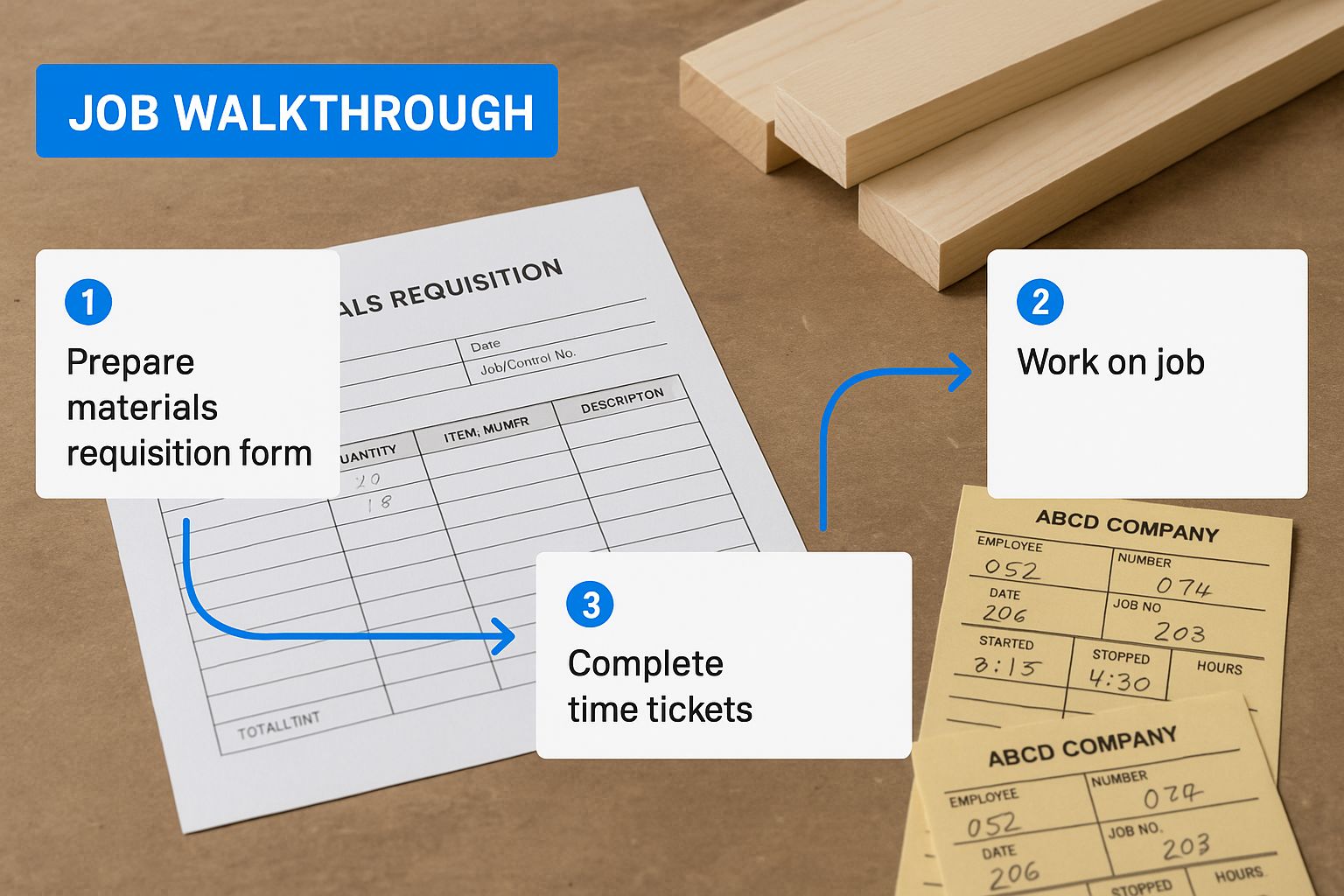
As you can see, documents like materials requisition forms and time tickets are the building blocks. They all feed into a central job cost sheet, which gives us a clear path from raw materials to the final, calculated cost of the job.
Tracking Direct Materials for Job #101
First things first, Artisan Woodworks needs to get the raw materials from the storeroom. The production manager doesn't just grab what they need; they fill out a materials requisition form. This isn't just paperwork—it's the official source document for tracking every piece of wood and hardware that goes into the bookshelf.
Here’s what Job #101 requires:
- Oak Lumber: 80 board feet at $9.00 per foot = $720.00
- Hardware (handles, screws): 1 kit at $45.00 = $45.00
- Wood Stain and Varnish: 1 can at $35.00 = $35.00
The total direct material cost for this specific bookshelf comes out to $800.00. This number goes straight onto the job cost sheet for Job #101. For any business in this space, keeping a sharp eye on lumber and material costs is critical. You can find more industry-specific insights and resources by exploring the TimberCloud blog.
Recording Direct Labor Hours
Next up is the hands-on work. At Artisan Woodworks, the carpenters use time tickets to log every hour they spend working specifically on Job #101. This simple step ensures their wages are correctly assigned to the project they’re actually building, not just thrown into a general labor pool.
Two carpenters worked on this bookshelf:
- Senior Carpenter: 12 hours at a rate of $30.00/hour = $360.00
- Apprentice Carpenter: 8 hours at a rate of $20.00/hour = $160.00
This brings the total direct labor cost to $520.00. This is the second major component we add to our job cost sheet.
Key Takeaway: The entire foundation of accurate job costing rests on these source documents. If you aren't diligent with materials requisitions and time tickets, it's virtually impossible to know the true direct costs of any custom project.
Applying Manufacturing Overhead
Finally, we have to account for all those indirect costs—the stuff like workshop rent, the electricity bill, and wear-and-tear on the equipment. Artisan Woodworks has already done its homework and applies overhead at a predetermined rate of $15 per direct labor hour.
Since the job took a total of 20 direct labor hours (12 from the senior carpenter + 8 from the apprentice), the calculation is pretty straightforward:
- 20 hours x $15/hour = $300.00
That $300.00 is the final piece of our cost puzzle.
So, let's add it all up: $800 (materials) + $520 (labor) + $300 (overhead) gives us a total job cost of $1,620 for the bookshelf. Armed with this number, Artisan Woodworks can confidently set a final price that covers every expense and hits their target profit margin.
Calculating and Applying Manufacturing Overhead
When you're figuring out the cost of a specific job, overhead is usually the biggest headache. It’s easy enough to track the wood used for a custom table (direct materials) or the hours a carpenter spent building it (direct labor). But what about the factory rent, the electricity bill, or the depreciation on the saws? Those costs are real, but they’re shared across every single project that comes through the shop.
You can't just wait until the end of the month to get the actual utility bill before you can price a job for a customer. This is exactly why we use a predetermined overhead rate. It's a smart estimate you calculate at the beginning of the year to smoothly and consistently apply these indirect costs to each job as it happens.
Finding the Predetermined Rate
Let's stick with our example, Artisan Woodworks. At the start of the year, they sat down and estimated their total manufacturing overhead would be $60,000. They also looked at their production schedule and figured their team would log about 4,000 direct labor hours.
The formula to get the rate is pretty straightforward:
Estimated Total Overhead Costs / Estimated Allocation Base = Predetermined Overhead Rate
For Artisan Woodworks, that looks like this:
$60,000 / 4,000 Direct Labor Hours = $15 per Direct Labor Hour
This $15 is the magic number. It's the rate we used in the previous section to allocate a fair slice of the factory's costs to Job #101. Having a solid handle on this is more critical than ever, especially when supply chain hiccups are increasing material delivery times by around 25%. A granular costing model helps capture the true expense of a job. If you're interested in how these factors are changing business operations, the Future of Jobs Report has some fascinating data.
Overapplied vs. Underapplied Overhead
So, what happens when your estimate isn't perfect? Because let's be honest, it never is. At the end of the year, you'll need to compare the total overhead you applied to all the jobs (using that $15 rate) with the overhead costs you actually paid for.
This comparison leads to one of two outcomes:
- Overapplied Overhead: This happens when you've applied more overhead to jobs than you actually spent. It essentially means your jobs were slightly over-costed throughout the year.
- Underapplied Overhead: The opposite situation. You didn't apply enough overhead, meaning your jobs were under-costed. This can be a nasty surprise, as it means they weren't as profitable as you thought.
Pro Tip: Don't panic if there's a small difference—that's normal. A minor variance is usually just closed out to the Cost of Goods Sold account. But if you find a significant gap, it’s a clear sign that you need to revisit your estimation process for next year. Your predetermined rate might need a tune-up to better match your real-world operating costs.
Ditch the Spreadsheets: How Modern Software Supercharges Job Costing

If you're still wrestling with manual spreadsheets for job costing, you know the pain. It's a constant grind of tedious data entry, and the risk of a simple typo throwing off your entire profitability calculation is always looming. Worse, there's a frustrating lag between when work gets done and when you actually know what it cost. This is where dedicated job costing software steps in, turning a reactive chore into a proactive business strategy.
These platforms are built to handle the nitty-gritty of tracking direct materials and labor automatically. Forget deciphering handwritten time tickets or manually keying in material requisitions. Modern tools capture this data in real-time, often straight from the shop floor, creating a single, reliable source of truth for every project. The result is an instant, accurate picture of where each job stands financially.
Get Ahead of Problems with Real-Time Insights
Imagine being able to see, at a glance, exactly how a project is tracking against its budget. That’s the power of job costing software. By allocating costs as they happen, you can spot potential budget overruns the moment they occur, not weeks later when it's too late. This ability to make quick, informed adjustments is a major reason the global job costing software market is expanding so rapidly.
The real game-changer is speed. Software closes the gap between action and insight. This empowers you to make smarter, data-backed decisions on everything from quoting new work to optimizing how you use your team and resources.
A Single Source of Truth for Your Whole Operation
When you integrate job costing with your other business systems, like accounting and production management, you create a powerful, unified workflow. Everyone from sales and estimating to the team on the floor is working from the same playbook, with the same numbers.
Exploring different job costing software features can help you find a platform that brings everything under one roof. Think about it: inventory, labor, overhead, and reporting all in one place. This gives you a complete, up-to-the-minute view of your company's financial health. To see what a fully integrated system looks like, you can explore the features at https://timbercloud.com/features.
Common Job Order Costing Mistakes to Avoid
Even with a perfect job order costing example on paper, putting it into practice in the real world is where things can get messy. Small errors have a nasty habit of snowballing, throwing off your job costs, leading to bad pricing decisions, and chipping away at your profits. Getting reliable data from your system means knowing what these common pitfalls are and how to sidestep them.
One of the most frequent slip-ups I see is using a busted or outdated predetermined overhead rate. It’s so easy to set this rate at the start of the year and then just forget about it. But what happens when your utility costs suddenly spike, or you invest in new machinery? Your actual overhead can shift dramatically, leaving you way off in how you apply those costs to your jobs.
Another classic mistake is simply misclassifying costs. It sounds simple, but you'd be surprised how often a direct cost—say, a specific piece of hardware for Job #101—gets accidentally recorded as a general, indirect overhead expense. This mistake doesn't just understate the true cost of that one job; it unfairly inflates the costs you're allocating to every other project.
Inaccurate Data Capture
Let's be blunt: a job order costing system is only as good as the data you feed it. If the information coming from your materials requisition forms or employee time tickets is wrong, every single calculation that follows will be skewed. This isn't just a minor bookkeeping headache; it directly torpedoes your ability to quote future jobs accurately.
Keep an eye out for these common data capture blunders:
- Incorrect quantities: An employee jots down 10 feet of lumber when 15 were actually used for the job.
- Wrong job numbers: A technician assigns their labor hours to Job #102 when they were really working on Job #101.
- Delayed entries: People wait until Friday afternoon to fill out a week's worth of time tickets, guessing at what they did on Monday morning.
These aren't just little slip-ups. Over time, they completely erode the integrity of your costing data.
My Advice: Create a system of checks and balances. Have a shop foreman or supervisor review time tickets and material forms every single day. Even better, use software that forces real-time, accurate data entry right from the shop floor. The whole point is to catch these errors before they have a chance to contaminate your job cost sheets.
Ignoring Variances
When you get to the end of an accounting period, it’s perfectly normal to have a bit of overapplied or underapplied overhead. The critical mistake is to see a large variance and just ignore it or write it off without digging deeper. A significant difference isn't just a rounding error—it's a massive red flag that your initial estimates were way off base.
If you fail to analyze that variance, you're essentially guaranteeing you'll make the same estimation errors next year. Think of it as a missed opportunity. It’s your chance to fine-tune your predetermined overhead rate and make your entire costing process more accurate for every future project.
Common Questions About Job Order Costing
Even with a full example laid out, a few questions always seem to pop up when businesses start using a job order costing system. Let's dig into some of the most common ones I hear from people who are putting this into practice.
Getting these details ironed out is the key to feeling confident that your numbers are truly telling you the right story.
How Is This Different From Process Costing?
This is probably the most frequent question, and it gets to the heart of why you'd choose one method over the other. The distinction is actually pretty simple.
- Job Order Costing: This is your go-to when you're making unique items or handling distinct projects. Think custom furniture, a one-off marketing campaign, or a set of architectural plans. You track every cost directly to that specific job.
- Process Costing: This is for mass production of identical units. We're talking about things like cans of soda, bags of cement, or bottles of ketchup. Costs are averaged out over massive, continuous production runs.
At the end of the day, if you can point to a specific, separate "job" for a customer, you're in job order costing territory.
How Do I Pick the Right Way to Allocate Overhead?
Another area that trips people up is choosing the best allocation base for overhead. You're looking for whatever "driver" has the strongest cause-and-effect link to your indirect costs.
If your shop is humming with the work of skilled craftspeople, then direct labor hours or direct labor cost are almost always your best bet.
But what if you run a highly automated operation with a lot of expensive machinery? In that case, using machine hours will give you a much more accurate picture, as it better reflects costs like electricity, maintenance, and equipment depreciation. The goal is to match the allocation base to what's actually causing the overhead.
I see a lot of companies make the mistake of sticking with an old allocation base that doesn't fit how they work anymore. If you just invested a ton in new automated equipment but still allocate overhead based on labor hours, your job costs are going to be way off.
Can Service Businesses Use Job Order Costing?
Definitely. Job order costing isn't just for businesses that build physical things. Service firms use it all the time to figure out how profitable each client or project really is.
Think about an accounting firm. They track direct labor (the time their accountants spend on a specific client's tax return) and then apply a portion of the firm's overhead (like rent, admin salaries, and software subscriptions) to that client's "job." This tells them precisely which clients are driving their profits.
As you think through your own pricing, seeing how different software solutions are structured can be a big help. You can get a sense of what might work for you by looking at the clear pricing models on TimberCloud.
Ready to move beyond spreadsheets and gain real-time control over your job costs? TimberCloud, Inc. provides a powerful, all-in-one platform designed for custom manufacturing. See how our tools can improve your accuracy and profitability today!
Article created using Outrank
Topics
TimberCloud Team
Content Team
The TimberCloud team is dedicated to helping manufacturers streamline their operations with intelligent software solutions.