Ecommerce for Manufacturers A Complete D2C Playbook
For a long time, the world of manufacturing had a pretty straightforward rulebook. You made great products, and then a whole network of distributors and retailers took on the messy job of selling them. It was a comfortable setup, keeping the factory floor separate from the final customer.
But that separation? It's quickly becoming a major weak spot.
The Inevitable Shift to Selling Online
Today’s buyers, whether they’re procurement managers or just everyday shoppers, live online. They expect to find detailed product specs, see clear pricing, and buy directly from the source with a few clicks. When you rely solely on middlemen, you’re essentially handing over the keys to your brand and your customer relationships.
This isn't just about adding a "buy now" button to your website. We're talking about a fundamental change in how manufacturers operate—a move to sell products directly online through your own digital storefront. It's about taking back control, building a stronger business, and owning your future.
Why the Old Way Doesn't Work Anymore
The classic distribution model creates a gap between you and the people who actually use your products. This distance leaves you with some serious blind spots that an e-commerce strategy can fix. Without that direct line to your customers, you’re often:
- Flying blind on data: You have no idea who your customers are, how they use your products, or what they really think. This turns innovation into a high-stakes guessing game.
- Losing control of your brand: Your reputation is completely in the hands of your partners. One bad experience with a third-party seller can tarnish the brand you’ve worked so hard to build.
- Watching your margins shrink: Every intermediary in the chain takes their cut. That’s profit you’re leaving on the table with every single sale.
The Power of Going Direct
This is exactly why e-commerce for manufacturers has become so critical. It’s not just a trend; it's a necessary evolution.
Think of it like this: a farmer has only ever sold their crops to big grocery chains. By opening a stall at the local farmers' market, they suddenly get to meet the people eating their food, hear what they love, and build a base of loyal customers who come back week after week.
Selling directly online lets a manufacturer stop being a faceless name on a box and start becoming a brand people know and trust. It's about building real value, owning the entire customer journey, and creating a more predictable, profitable business.
This pivot empowers you to bypass the middlemen and forge a real connection with your end-users. It’s a chance to build a community, get honest feedback, and create a business that isn’t entirely at the mercy of its retail partners.
Unlocking the Strategic Value of Selling Direct
Thinking about selling direct? It’s a lot more than just tacking on another way to make money. This is a fundamental shift in how you operate, moving you from simply being a product creator to a brand that truly owns its customer relationships. When you make that pivot, you unlock some serious advantages that ripple through your entire business.
The first thing you'll notice is a major boost to your profit margins. Think about it: every middleman—distributors, wholesalers, retailers—takes a cut. By selling directly to your customers, you cut out those layers and keep the full value of your hard work. That extra profit isn't just a number on a spreadsheet; it's the fuel you can use for growth, innovation, and R&D.
Gain Deeper Customer Insights
When you sell through partners, you're getting a filtered, second-hand story about your own customers. You see the sales numbers, sure, but you completely miss the "why" behind those purchases. Shifting to direct e-commerce flips that script entirely.
Suddenly, you have a firehose of first-party customer data at your fingertips. And I'm not just talking about email addresses. You get a direct line into understanding how people actually use and think about your products.
- Smarter Product Development: You can see which features are a hit, what accessories people are buying together, and read unfiltered reviews. This is gold for informing your next product iteration.
- Laser-Focused Marketing: You’ll learn who your real buyers are—their industries, job titles, and buying cycles. This lets you craft marketing campaigns that speak directly to their pain points, making your ad spend work a whole lot harder.
This direct feedback loop becomes your new secret weapon for staying ahead of the curve.
Build a Lasting Brand Asset
Relying on retailers means your brand's reputation is often out of your hands. A bad in-store experience or a poorly trained sales rep can tarnish the brand you’ve spent years building.
Selling direct gives you control over the entire customer journey, from the moment they land on your website to the unboxing experience and beyond. This control is how you build a powerful, lasting asset: your brand. You get to tell your story, your way. You can showcase your expertise and build a loyal community that trusts you, not just a reseller.
By owning the customer relationship, you create a more resilient business that isn't at the mercy of retail partners. Your brand becomes your direct connection to the market, giving you stability and control over your own destiny.
This isn't just a hunch; the numbers show a massive shift toward online sales, reinforcing why it's so critical for manufacturers to establish a direct channel.
The data is clear: B2B e-commerce isn’t just a trend; it's becoming the dominant way business gets done, with sales volumes that are already dwarfing traditional B2C channels.
This move is also backed by a huge shift in general buying behavior. Global e-commerce sales are on track to blow past $6.42 trillion by 2025. With more than 2.77 billion people shopping online, you have to meet your customers where they are. This is an opportunity you simply can't afford to ignore.
Ultimately, a direct e-commerce strategy is an investment in your company’s future. It gives you the data, the margins, and the brand control you need to not just survive, but thrive. For any manufacturer thinking about this, the first step is understanding the investment required. Taking a look at clear pricing structures can give you a much better picture of the road ahead.
Building Your Ecommerce Operations From the Ground Up
Moving from a traditional manufacturing model into direct online sales is a major project. You're not just flipping a switch or launching a simple website; you're building a brand-new D2C and B2B sales engine. Getting it right means carefully choosing the right parts and making sure they all work together without a hitch.
The absolute foundation of this entire venture is your ecommerce platform. Think of it like the chassis of a vehicle—it has to be strong enough to handle what you build on top of it, scalable for the future, and designed for the specific demands of a manufacturer. We're talking complex product configurations, custom pricing tiers for B2B clients, and potentially huge order volumes.
Choosing Your Core Technology Stack
Making the right platform choice is probably the most critical decision you'll face. A generic, off-the-shelf solution designed for a simple t-shirt shop is going to buckle under the weight of a manufacturer's needs. You need a system built from the ground up to handle your unique complexities.
Here are a few of the heavy hitters in this space:
- Shopify Plus: It's famous for being user-friendly and having fantastic D2C features. This makes it a solid choice if you're just dipping your toes into selling directly to consumers.
- BigCommerce: This platform comes ready with powerful B2B tools right out of the box, like customer-specific pricing and features built for bulk ordering.
- Magento (Adobe Commerce): For large-scale manufacturers with unique technical needs and the developer resources to match, Magento offers incredible power and customization.
Ultimately, the best platform depends on your specific goals, in-house technical skills, and budget. The key is to find one that won't just solve today's problems but can also grow with you for years to come.
The infographic below really drives home the value you unlock by building out these operations—it’s all about protecting your margins, owning your customer data, and taking control of your brand.
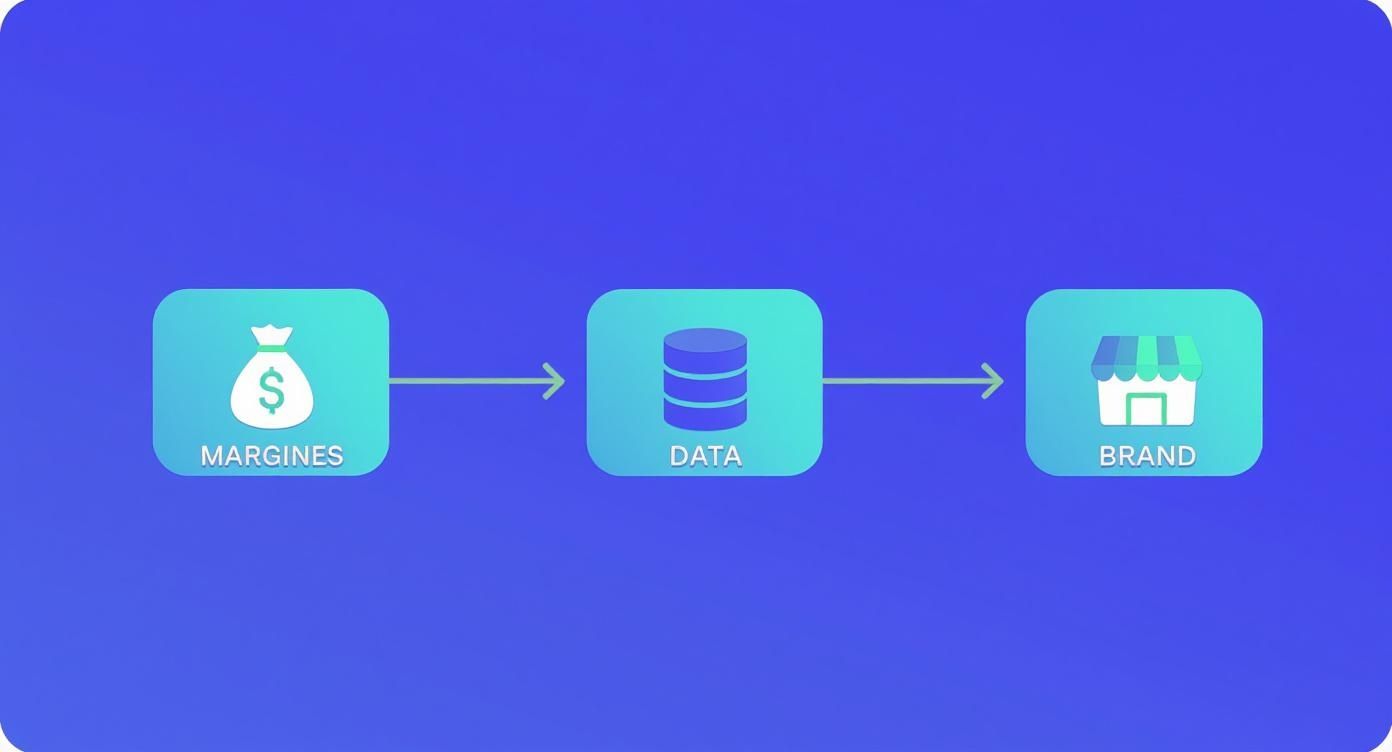
As you can see, a well-built ecommerce channel has a direct line to improving profitability, giving you priceless customer insights, and cementing your place in the market.
Integrating Your Essential Business Systems
Here’s a hard truth: your ecommerce site can't be an island. If it’s not talking to your other core business systems, you're setting yourself up for a nightmare of manual data entry, fulfillment delays, and costly mistakes. Proper integration is what turns a basic online store into a true operational hub.
An integrated system means that from the moment an order is placed to the second it ships, data flows automatically. This doesn't just create efficiency—it eliminates human error and establishes a single source of truth for your entire company.
There are two integrations you absolutely cannot skip:
- Enterprise Resource Planning (ERP): This is non-negotiable. Connecting your ecommerce platform to your ERP syncs inventory levels, order details, customer data, and financials. It keeps your production floor and your sales team perfectly in sync.
- Customer Relationship Management (CRM): A CRM integration gives your sales and support teams a 360-degree view of every customer. They can see every touchpoint, from their first visit to the website to any post-purchase support tickets.
The number of online stores is ballooning, with estimates hitting around 28 million ecommerce sites globally by 2025. For manufacturers, just being online isn't enough anymore. A deeply integrated site that delivers a frictionless experience is what will make you stand out. You can dive deeper into these trends by checking out some recent ecommerce statistics.
Comparing Top Ecommerce Platforms for Manufacturers
Choosing the right technology can feel overwhelming. To help clarify the options, this table breaks down some of the leading platforms based on what they do best for manufacturers.
| Platform | Best For | Key B2B Features | Pricing Model |
|---|---|---|---|
| Shopify Plus | Manufacturers focused on D2C with growing B2B needs. | Wholesale channel, custom pricing apps, password-protected storefronts. | Tiered subscription based on revenue. |
| BigCommerce | B2B-centric manufacturers needing robust out-of-the-box functionality. | Customer groups, price lists, bulk ordering, quote management. | Tiered subscription based on sales volume. |
| Adobe Commerce (Magento) | Large enterprises with complex, custom requirements and development teams. | Highly customizable quoting, complex catalogs, multi-warehouse support. | Custom licensing based on Gross Merchandise Value. |
| Custom Solution | Unique business models that don't fit any standard platform. | Anything you can imagine—fully tailored to your exact workflows. | High upfront development cost + ongoing maintenance. |
Each platform has its strengths. The key is to map your specific operational needs—from quoting to fulfillment—against the features offered to find the perfect long-term partner for your business.
Crafting the User Experience
Finally, let's talk about what the customer actually sees and feels. Your online product catalog needs to be far more than just a list of part numbers. We're talking high-resolution images from every angle, detailed technical spec sheets, downloadable CAD files, and maybe even installation videos.
If you do custom work, giving customers tools to visually configure their orders is a game-changer. Seeing what’s possible with the advanced features of modern platforms can spark a lot of ideas for how to present even the most complicated products online.
And don't forget logistics. Today's buyers—whether B2B or D2C—expect fast, transparent shipping. Your site must provide accurate delivery estimates, real-time tracking, and a straightforward returns process. Nailing this part of the experience is how you build the trust that brings customers back again and again.
How to Manage Distributor Relationships and Avoid Channel Conflict
Going direct-to-consumer as a manufacturer can feel like you're walking a tightrope. On one side, you've got the huge potential of D2C sales. On the other? Your long-standing network of distributors, the very partners who helped build your business. The biggest fear, and it's a real one, is that you'll step on their toes and create a mess of channel conflict.
But it doesn't have to be that way. With some smart planning and open communication, you can launch a successful D2C channel without torpedoing the relationships you've spent years building. The goal isn't to replace your distributors, but to evolve the partnership so everyone wins.
Think of it less as a competition and more as a collaboration. Your distributors have deep market knowledge and logistical muscle that you can't easily replicate. Your new online store can, and should, complement their strengths.
Communicate Openly and Honestly
Whatever you do, don’t surprise them. Launching your new e-commerce site out of the blue is the fastest way to destroy trust and make your distributors feel betrayed. You need to get out in front of it and bring them into the loop early on.
Explain that this move is about strengthening the entire brand, not cutting them out. A direct channel gives you firsthand customer data, a place to test-drive new products, and a way to build brand recognition. All of this ultimately sends more educated, motivated buyers straight to their showrooms.
Proactive communication turns a potential fight into a strategic conversation. When you involve your distributors in the plan, you're showing them they’re still a critical part of your future.
Lay out the "rules of engagement" right from the start. That kind of clarity prevents a lot of headaches later and demonstrates that you respect their business.
Create Clear and Fair Policies
For this to work, you have to create a system where both your direct channel and your distributors can thrive. This all comes down to setting fair and transparent policies.
Here are three strategies that have proven to work time and time again:
- Implement a MAP/MSRP Policy: This is non-negotiable. A Minimum Advertised Price (MAP) or Manufacturer's Suggested Retail Price (MSRP) policy ensures you aren't undercutting your own partners on your website. It’s the single most powerful tool for preventing a race to the bottom on price.
- Offer Online-Exclusive Products: Give customers a unique reason to buy directly from you. Develop specific product variations, limited-edition bundles, or accessories that are only available on your site. This way, you’re not in a head-to-head battle over the exact same SKUs your distributors carry.
- Explore Hybrid Fulfillment Models: Turn your distributors into a core part of your e-commerce logistics. You could set up a "buy online, pick up in-store" option or use their facilities as regional fulfillment hubs to slash delivery times. This gives them a real stake in your online success, transforming a potential conflict into a genuine partnership.
By setting these boundaries and creating shared incentives, you can navigate the tricky waters of ecommerce for manufacturers and grow your entire business—with your trusted partners right alongside you.
Developing a Marketing Engine to Attract Direct Buyers

Having a great product and a slick e-commerce site is a fantastic start, but it’s really only half the job. For years, you’ve likely relied on distributors to do the marketing heavy lifting. Now, the ball is in your court. You have to become your own best marketer, and that requires a completely new playbook designed to pull buyers directly to you.
This isn’t just about putting up a “buy now” button. It’s a fundamental shift from being an invisible part of the supply chain to becoming a visible, go-to brand in your industry. You need to build a marketing engine that doesn't just drive clicks, but one that educates prospects, builds unshakable trust, and turns them into loyal customers.
Mastering Technical SEO for Complex Products
When a procurement manager or an engineer searches for a highly specific component—down to the exact part number or material spec—your website absolutely has to show up. This is where technical Search Engine Optimization (SEO) becomes your secret weapon. It’s all about structuring your site so that search engines can easily understand and rank your complex product catalog.
Think of it like giving Google a crystal-clear blueprint of your inventory. Get it right, and your product pages, with all their technical jargon and specs, will be seen as the most authoritative answer to a buyer's search.
- Structured Data: Use schema markup on your product pages. This feeds search engines critical details like model numbers, dimensions, and material composition, helping you stand out in search results.
- Logical Site Architecture: Organize your website so it’s intuitive. If an engineer can't navigate your massive catalog to find a specific part in a few clicks, they're gone. A clean structure helps both users and search engine crawlers.
- Page Speed: Technical buyers have zero patience for slow websites. A page that lags, especially on a mobile device, will send them right over to a competitor.
Creating Content That Builds Trust and Educates
Content marketing for manufacturers isn't about flashy ads or clever taglines. It’s about proving you know your stuff. Your buyers aren’t just looking for products; they’re looking for solutions to their problems. Your content needs to position you as a trusted advisor who can help them get the job done right.
This approach builds a solid relationship long before a purchase order is ever signed. When you consistently provide real value, you become the first name they think of.
Creating high-quality educational content transforms your website from a simple catalog into an indispensable industry resource. It’s how you prove your expertise and build the credibility needed to win direct sales.
Here are a few types of content that work incredibly well for manufacturers:
- In-Depth How-To Guides: Walk customers through a tricky installation or a critical maintenance procedure.
- Application Case Studies: Show, don't just tell, how your products solved a real-world problem for another company.
- Technical Spec Sheets and CAD Files: Give engineers and designers the detailed information they absolutely need to do their jobs.
- Installation and Demo Videos: A quick video showing how something works is often far more powerful than a 20-page manual.
Driving Leads with Paid Ads and Email Marketing
While organic strategies like SEO and content marketing build long-term authority, sometimes you need to get in front of people now. Targeted paid advertising can deliver those immediate results. Platforms like Google Ads and LinkedIn let you target buyers with specific job titles, in certain industries, or who are actively searching for the exact solutions you sell.
Once you have their attention, email marketing is how you keep the conversation going. You can set up automated campaigns to send them useful technical resources, follow-up information, or special offers that nudge them closer to a decision. This direct line of communication is vital for winning that first sale and encouraging repeat business.
The entire retail world is moving online, and a strong digital presence is no longer just a "nice to have." Projections show that by 2025, e-commerce will account for 21.9% of all retail sales, a huge leap from 14.2% in 2021. This trend makes it clear: manufacturers need to adapt their entire operation for online sales, and they need to do it now. You can get a deeper look at these changes by exploring recent ecommerce statistics.
Answering Your Top Questions About Manufacturing Ecommerce
Jumping into direct online sales can feel like uncharted territory. It’s only natural to have a few questions about how it all works, the hurdles you might face, and what it’s going to cost. We've pulled together the questions we hear most often from manufacturers who are thinking about making the switch.
Think of this as a straightforward Q&A to tackle your biggest concerns. The goal is to give you the confidence to make smart decisions as you plan out your move online.
What Is the Biggest Challenge for Manufacturers Starting Ecommerce?
Without a doubt, the biggest headache is often managing channel conflict. Your distributors and retailers have been your trusted partners for years, so launching a website where you sell directly to customers can feel like you’re stepping on their toes. If you don't handle it with care, you risk damaging those relationships.
The key is to have a clear plan from the get-go that shows everyone how they still win. Maybe you offer exclusive products online that your partners don't carry, or you lock in strict pricing rules so you aren't undercutting them. Beyond that, just shifting your internal teams to think about direct customer service, individual order fulfillment, and online marketing is a massive learning curve in itself.
Can a Manufacturer Sell B2B and D2C on the Same Website?
Yes, absolutely. This setup is often called a hybrid or B2B2C model, and today's e-commerce platforms are built specifically to handle this kind of complexity.
A unified platform can show different pricing, product catalogs, and payment options to users depending on who they are. A wholesale partner sees one thing when they log in, while a regular retail customer sees something completely different. This keeps your operations tidy and your brand looking consistent for everyone.
This integrated approach saves you from the nightmare of managing two totally separate websites, which is a huge drain on time and money. For more ideas on how to improve your business, you can explore additional strategies on our manufacturing ecommerce blog.
How Much Does an Ecommerce Website Cost for a Manufacturer?
The cost can swing wildly depending on how complex your project is. There's no one-size-fits-all price tag because the final investment is tied directly to what you need the site to do.
- Basic D2C Site: For a simple storefront with a straightforward product line, you could use a platform like Shopify and get started for just a few thousand dollars.
- Complex B2B Portal: A more powerful system that has to connect deeply with your ERP, CRM, and product information management (PIM) software can run anywhere from $25,000 to well over $250,000.
The main things that drive the cost are the platform you choose, the amount of custom design you want, how many other systems it needs to talk to, and just how big and complicated your product catalog is.
Ready to build a powerful sales engine that connects your shop floor directly to your customers? TimberCloud, Inc. provides an all-in-one platform that combines ecommerce, ERP, and AI to help custom manufacturers grow. Learn more about TimberCloud.
Topics
TimberCloud Team
Content Team
The TimberCloud team is dedicated to helping manufacturers streamline their operations with intelligent software solutions.