Demand Planning vs Supply Planning: Key Differences for Woodworking

Let's get one thing straight: the difference between demand planning and supply planning isn't just semantics. It's the core of your operation. Demand planning is all about predicting what your customers will want, while supply planning is figuring out how to actually build and deliver it.
One is the art of looking into the future; the other is the science of making it happen. For any custom woodworking shop, trying to master one without the other is a recipe for disaster. Getting them to work together is the only way to stay profitable.
Two Sides of the Same Coin
In custom woodworking and millwork, you can't treat demand and supply planning like separate departments. They're two sides of the same coin. One looks out at the market—your customers, your sales pipeline, and industry trends. The other looks inward—at your shop floor, your team's capacity, and your material inventory.
When these two fall out of sync, you start bleeding money. You either end up with stacks of expensive lumber collecting dust or you’re scrambling to meet deadlines, damaging the trust you’ve built with your customers. A smooth, profitable shop floor is a direct result of how well you connect these two critical functions.
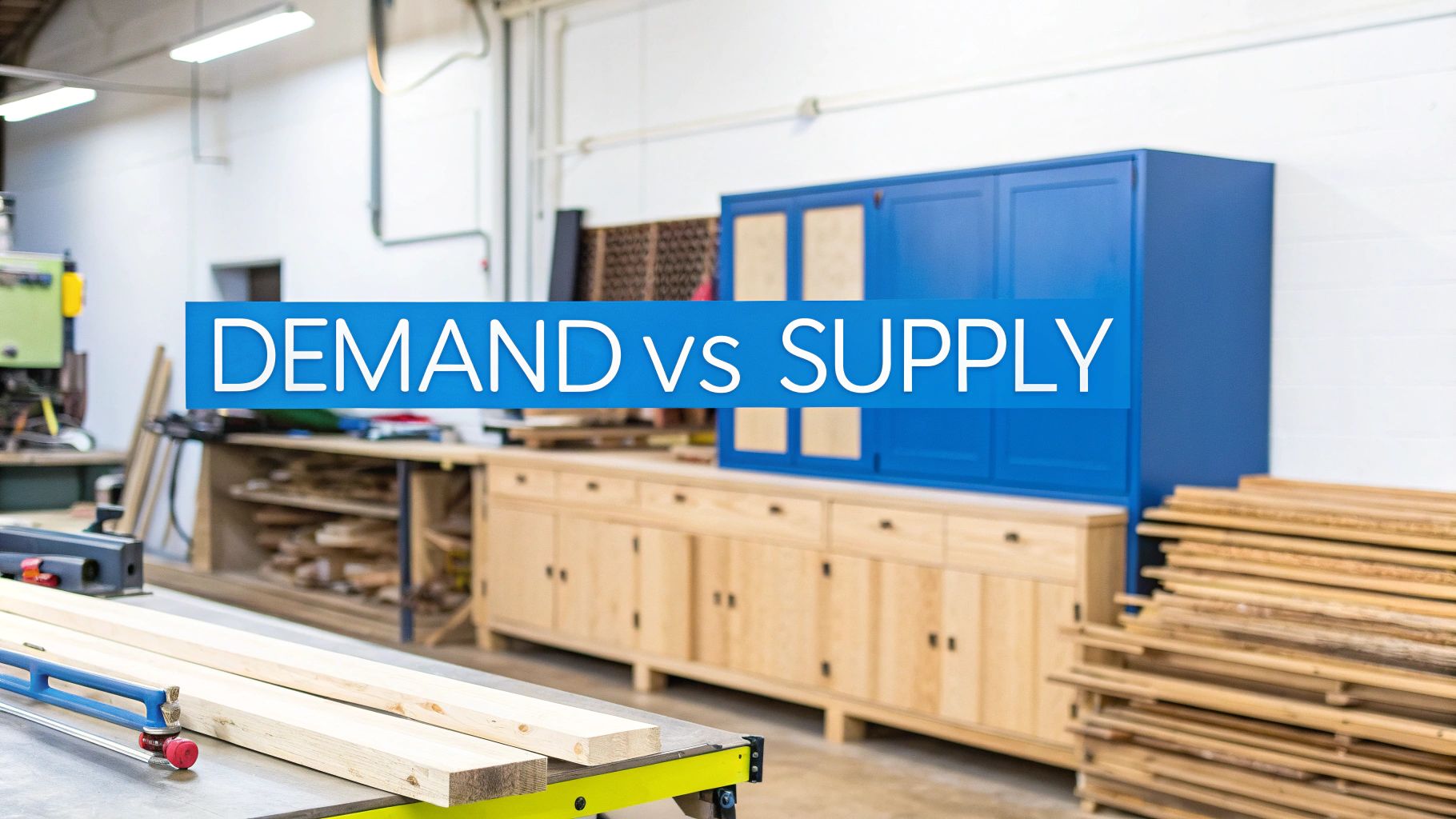
Defining the Core Functions
At its core, demand planning is the work you do to anticipate future sales. For a cabinet shop, this isn’t just guesswork. It's a calculated process that involves:
- Digging into past sales data to find patterns, like a rush on kitchen remodels every spring.
- Keeping a close eye on your quotes and customer inquiries to see what new styles or finishes are gaining traction.
- Watching external market factors, like new housing developments or shifts in interior design trends.
Supply planning, on the other hand, takes that forecast and turns it into a concrete action plan. It’s about organizing all the resources you need to deliver on those predictions. This means:
- Scheduling your crew and your machinery to handle the expected workload without creating bottlenecks at the CNC or the finishing booth.
- Managing your inventory of lumber, hardware, and finishes so you avoid costly project delays or tying up cash in overstocked materials.
- Mapping out the production workflow to make sure every job moves from one station to the next without a hitch.
The real challenge isn’t just forecasting or scheduling; it's ensuring the forecast directly and accurately informs the schedule. A disconnect here is where most custom shops lose margin and create production bottlenecks.
At a Glance Demand Planning vs Supply Planning
To truly get these two functions working together, you have to understand where they differ. This table cuts right to the chase, breaking down the fundamental distinctions.
| Aspect | Demand Planning | Supply Planning |
|---|---|---|
| Primary Goal | Accurately predict future customer orders and sales revenue. | Efficiently meet forecasted demand with available resources. |
| Time Horizon | Mid-to-long term (months, quarters, years). | Short-to-mid term (days, weeks, months). |
| Key Question | "What and how much will our customers buy?" | "How can we build and deliver what they want on time?" |
| Main Focus | Market trends, sales history, customer behavior, economic data. | Production capacity, inventory levels, labor, machine uptime. |
| Success Metric | Forecast Accuracy | On-Time Delivery, Capacity Utilization |
If you're looking to really sharpen your predictive game, we break down how to improve demand forecast accuracy in another guide.
Ultimately, it comes down to this: a brilliant demand plan is worthless if the shop can't execute it. And a highly efficient shop is just wasting time and money if it's building products nobody wants. The real competitive advantage is found when you get these two sides talking to each other, constantly.
The Strategic Goals That Drive Each Plan
While demand and supply planning are two sides of the same coin, they're chasing fundamentally different things. Getting these goals straight is the first real step to making them work together for better control over your operations and, ultimately, your bottom line.
Think of it this way: demand planning looks outward. Its entire purpose is to use sales data, market trends, and even customer conversations to get as close to the truth of what your customers will want next.
Supply planning, on the other hand, looks inward. It’s all about the nuts and bolts of your shop—your machines, your people, and your materials. It answers the question, "Given the forecast, what’s the smartest, most efficient way to actually build and deliver this stuff?"
Demand Planning: The Quest for an Accurate Forecast
The main goal here is pinpoint forecast accuracy. This isn't just about making a good guess. It’s about getting ahead of market shifts, planning for seasonal rushes, and making sure you’re ready to capture sales instead of turning away business. A custom furniture maker, for instance, uses demand planning to predict the summer surge for outdoor tables, ensuring they can cash in on that revenue.
Solid demand planning has a direct impact on your cash flow by preventing you from tying up money in inventory you don't need. In fact, businesses that use statistical forecasting can cut their excess inventory by 20-30% compared to just winging it. For a woodshop with $500,000 in materials and WIP, that’s freeing up $100,000-$150,000 in cash.
The real point of demand planning is to move from just taking orders to actively anticipating the market. It’s about knowing what your customers want before they even ask.
Supply Planning: The Drive for Shop Floor Excellence
Supply planning goals are all about operational excellence and efficiency. This side of the equation is less concerned with what customers might buy and far more focused on the practical reality of getting work done. Its key objectives are:
- Optimizing Production Capacity: Making sure every machine and every person is working effectively, without creating bottlenecks or burning out your best people.
- Shrinking Lead Times: Finding ways to systematically shorten the time from a confirmed order to a delivered product.
- Controlling Material Costs: Buying lumber and hardware at the right time and in the right amounts to avoid overspending, waste, and rush order fees.
- Maintaining Machine Uptime: Scheduling smart maintenance to keep your critical equipment, like CNC routers, running reliably.
This internal focus is what protects your profit margins. To really get into the weeds on this, our guide on production and capacity planning lays out more detailed strategies.
Where the Two Plans Collide: A Real-World Scenario
Let’s imagine a custom cabinet shop. An influencer just featured a specific shaker-style door, and suddenly, demand explodes. The demand plan, fueled by an aggressive new sales forecast, calls for a 40% increase in production for that door style.
But the supply plan throws up a red flag. The shop’s primary CNC machine is already running at 95% capacity, and the lead time for the specific grade of maple needed has just doubled because of a regional shortage.
Right here is where the tension builds. The external goal (capture all this new demand!) is in direct conflict with the internal constraints (we're maxed out!). This is exactly why the demand planning vs supply planning conversation is so critical. Without a unified strategy, the shop either fails to meet demand and loses customers, or it pays a fortune in overtime and rush material costs, completely wiping out the profit on those new orders.
Comparing Core Processes, Metrics, and Tools
While demand and supply planning both drive toward the same end goal—a healthy, profitable business—their day-to-day worlds couldn't be more different. The real distinction snaps into focus when you look at their core processes, how they measure success, and the tools they use. For any custom woodworking or millwork shop, nailing down these differences is the key to aligning sales promises with production reality.
At its heart, demand planning is an analytical, forward-looking discipline. It's all about gathering clues from the past and present to make an educated guess about the future. A demand planner in a millwork shop isn't just looking at the current order book; they’re asking what’s coming around the corner.
In contrast, supply planning is all about logistics and execution. It takes that forecast and turns it into a concrete action plan for the shop floor. It’s less "what if?" and more "here's how."
This infographic neatly sums up the core mission for each side of the house.
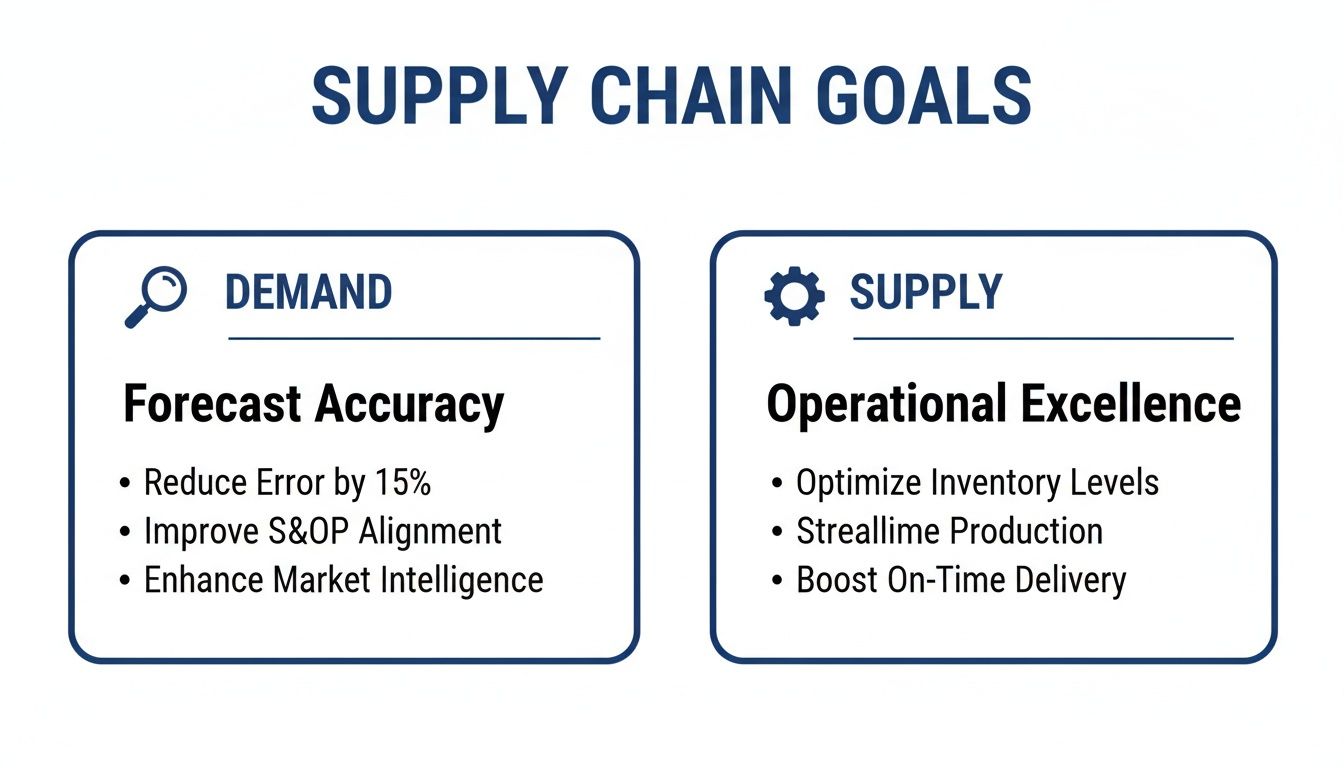
As you can see, demand planning is obsessed with forecast accuracy, while supply planning is all about achieving operational excellence.
Contrasting Core Processes
The demand planning process is a deep dive into data. Planners are constantly sifting through historical sales figures, analyzing the quote pipeline, and keeping an eye on market trends to build a statistical picture of future business. It's an information-heavy job that results in a sales forecast.
Supply planning, on the other hand, is a game of resource allocation and scheduling. It starts with the demand forecast and translates it into a master production schedule. This means ordering lumber and hardware, assigning jobs to specific work centers, and making sure the right people are in the right place at the right time. It’s the practical blueprint for getting things done.
A demand planner’s job is to create an accurate map of where the business is going. A supply planner’s job is to navigate that map with the shop's resources without driving off a cliff.
Key Performance Indicators That Tell Different Stories
Because their goals are so different, each function measures success with its own set of Key Performance Indicators (KPIs). These numbers don't lie—they tell you exactly how healthy and effective each part of your planning process is.
Demand Planning KPIs are all about predictive accuracy:
- Forecast Accuracy: The big one. This measures how close your forecast was to what you actually sold. A high number means less wasted material and fewer missed opportunities.
- Forecast Bias: This KPI tells you if you're consistently aiming too high or too low with your forecasts, helping you correct systemic errors in your assumptions.
Supply Planning KPIs are focused on operational efficiency:
- On-Time Delivery (OTD): This is the percentage of customer orders that shipped by the promised date. It's a direct reflection of how well your supply plan is working.
- Capacity Utilization: This tracks how much of your shop’s total production potential is actually being used. It ensures your expensive machinery and skilled craftspeople aren't just sitting idle.
These metrics are the pulse of your planning operations. This table breaks down what matters most and why it’s so critical for a custom woodworking business.
Critical KPIs for Demand and Supply Planning
| Planning Type | Key Performance Indicator (KPI) | What It Measures | Importance for a Custom Shop |
|---|---|---|---|
| Demand | Forecast Accuracy | The percentage difference between forecasted and actual sales. | Prevents over-ordering expensive lumber or being caught unprepared for a seasonal rush. |
| Demand | Forecast Bias | The tendency to consistently over- or under-forecast demand. | Helps fine-tune sales projections to avoid perpetual shortages or excess stock. |
| Supply | On-Time Delivery (OTD) | The rate at which orders are completed and shipped by the due date. | A critical factor in customer satisfaction and winning repeat business. |
| Supply | Capacity Utilization | The percentage of available machine and labor hours being used. | Maximizes the return on expensive equipment and skilled labor, which directly boosts margins. |
Ultimately, a strong set of KPIs for both demand and supply planning ensures you’re not just guessing. You're making informed decisions that protect your bottom line.
The Right Tools for the Right Job
Finally, demand and supply planners live in different software ecosystems designed for their unique tasks. In fact, the gap between these toolsets is often where friction and miscommunication start.
Demand planning relies heavily on Customer Relationship Management (CRM) systems to track sales pipelines and customer history. They also use specialized forecasting software that applies statistical algorithms to predict future demand. These are tools built for analysis and prediction.
Supply planning operates with a completely different toolkit. Material Requirements Planning (MRP) systems are used to calculate the raw materials needed for production, while Manufacturing Execution Systems (MES) track and manage work on the factory floor in real time.
For woodworking shops, modern all-in-one platforms like TimberCloud are designed to bridge this gap. They translate an approved order directly into production schedules, automated cut lists, and inventory management—focusing squarely on flawless execution and control.
Why Integration Is Your Secret Weapon
Knowing the difference between demand and supply planning is one thing. Actually treating them as separate functions in your shop? That's a surefire way to create operational chaos. The real competitive edge doesn't come from being great at one or the other; it comes from weaving them together so tightly they act as a single, intelligent system.
When demand and supply planning operate in their own silos, your shop floor is stuck in a purely reactive mode. You're not executing a profitable plan—you're just constantly putting out fires.
This disconnect creates a painful, and expensive, cycle. Let's say your sales team lands a huge B2B contract for custom millwork, but they have no real visibility into the shop's actual capacity. That sudden demand spike hits your production team like a tidal wave, creating instant bottlenecks. The result is all too familiar: delayed projects, last-minute material orders at sky-high prices, and broken promises to your best customers.
But when you integrate these functions, you transform that reactive mess into a proactive, profit-making machine.
From Reactive Chaos to Proactive Control
Picture this: a custom furniture maker sees a sudden surge in online orders for a new configurable table that just went viral.
-
Without Integration: The sales team is high-fiving over the revenue spike. But on the shop floor, it's a completely different story. They’re caught flat-footed. They don't have enough of a specific wood species, the finishing department is already slammed, and the CNC machine is booked solid for the next three weeks. Absolute chaos.
-
With Integration: The second those orders hit, the system automatically checks your raw material inventory and flags a potential shortage. At the same time, it analyzes the production schedule, sees the upcoming bottleneck in finishing, and pings the operations manager. This heads-up gives the team time to proactively order materials and tweak the schedule to absorb the new work without breaking a sweat.
This is the power of having a single source of truth. It connects what your customer wants directly to what your shop can realistically deliver, turning potential disasters into manageable, profitable jobs.
When your sales forecast automatically drives material procurement and production scheduling, you stop reacting to the past and start planning for the future. Your workshop shifts from being a cost center to a strategic asset.
The Financial Impact of a Unified Strategy
Tying demand and supply planning together isn't just about making life less stressful on the shop floor; it delivers a real, measurable impact on your bottom line. The financial impact of coordinated demand-supply planning is significant, with organizations reporting 10-15% cost reductions across their supply chains. For a custom shop, these savings show up in key areas like lower labor costs from better scheduling and better pricing on materials because you're not always placing rush orders. You can read more about the financial benefits of planning alignment and see how it directly boosts your profitability.
This alignment turns your operational efficiency directly into healthier margins. It's that simple.
Building a More Resilient Operation
In the custom manufacturing game, uncertainty is the only thing you can count on. A key supplier will inevitably miss a delivery, a critical machine will go down at the worst possible time, or a customer will call with a last-minute change. An integrated planning system is what builds the resilience you need to handle these curveballs.
When your demand signals are tied directly to your supply-side data, you can start running "what-if" scenarios. What happens if the lead time on walnut doubles? How will a rush order for a commercial client impact our residential projects? An integrated platform gives you the data to answer these questions intelligently, letting you make strategic trade-offs instead of just guessing.
That capability is what separates a modern, resilient, and highly competitive manufacturing business from the rest.
How Technology Bridges the Gap Between Demand and Supply
Knowing the difference between demand planning and supply planning is one thing. Actually getting them to talk to each other is where the real magic happens. For custom woodworking and millwork shops, using technology to build this bridge isn't a luxury anymore—it's absolutely critical for protecting margins and keeping customers happy.
Modern platforms are built to smash the silos that traditionally separate the sales office from the shop floor. They create a clean, unbroken line of communication from the moment a customer asks for a quote to the day their order ships. This connected workflow gets rid of the guesswork and constant fire-fighting that drains so many shops. Instead of running on assumptions, every decision is backed by live data, ensuring you can actually build what you promised, on time and profitably.
Capturing Real Demand as It Happens
Great demand planning starts with clean, immediate data, not stale reports. Technology like an embeddable e-commerce storefront turns your website from a digital brochure into your most powerful demand-sensing tool. When a customer configures a cabinet, requests a quote, or places an order directly on your site, they're not just buying—they're feeding your system invaluable, real-time demand signals.
This isn't just about making it easier to sell. It's about building a rich, forward-looking dataset. Every automated quote and confirmed order helps paint a clearer picture of market trends, which products are hot, and seasonal swings. You're no longer just looking in the rearview mirror at past sales; you're capturing future intent, which is the secret to a proactive and accurate demand plan.
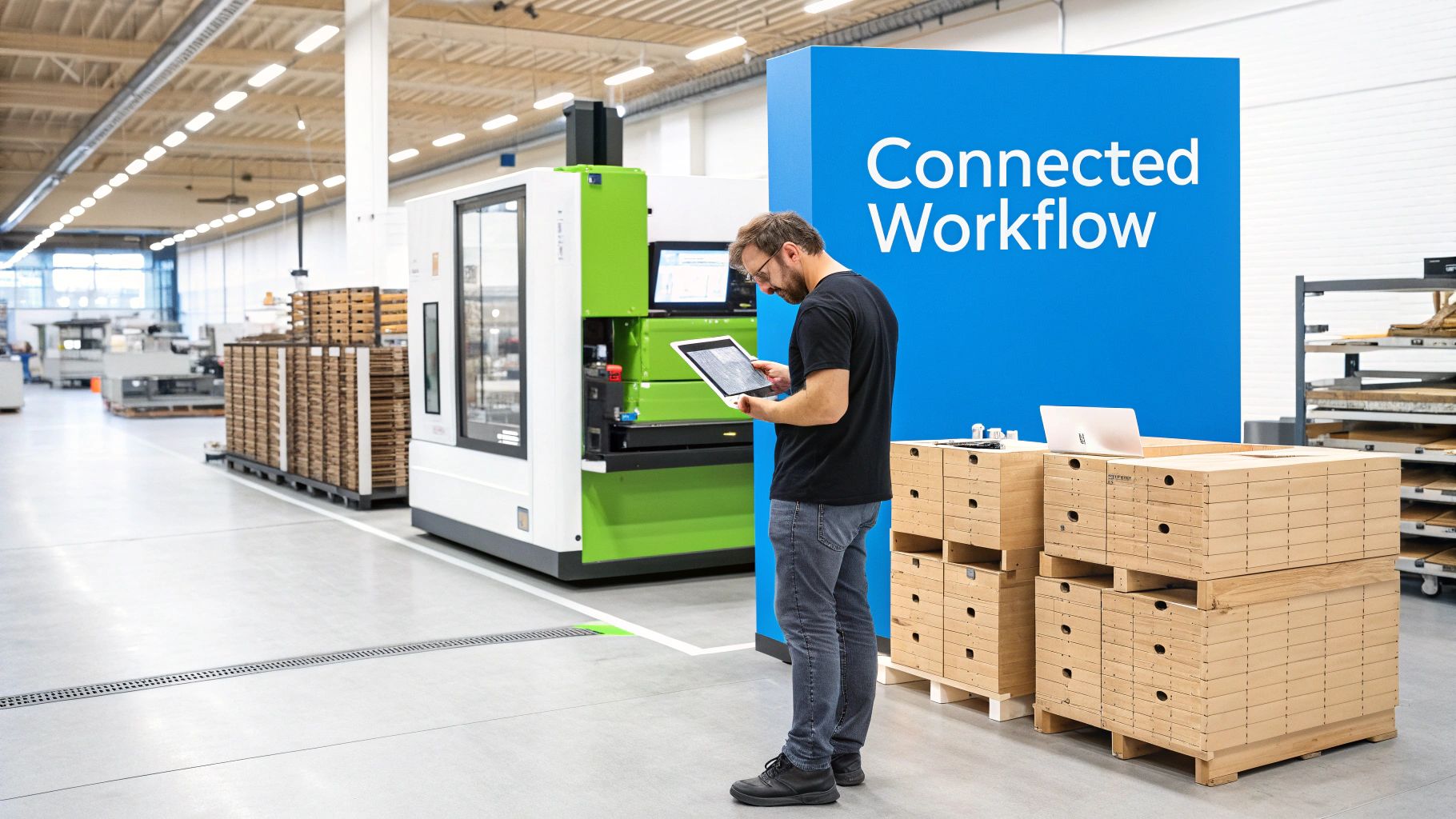
When this data lives in one central place, managers can see instantly how a new order affects everything else, from material inventory to machine availability.
Executing the Supply Plan with Surgical Precision
Once a customer commits, the ball is in your court. The focus snaps to execution—the heart of supply planning. This is where an integrated system truly flexes its muscles. A platform with a smart production engine can take a confirmed order and, in seconds, translate it into a perfectly sequenced plan for the shop floor.
This automation cuts out days of manual data entry and kills the opportunity for human error. Here’s how the technology connects the dots:
- Automated Cut Lists: The system instantly generates optimized cut lists from the order specs, squeezing the most out of every sheet of material and slashing waste.
- Real-Time Inventory Tracking: As materials are assigned to a job, they're automatically deducted from inventory. This keeps stock levels accurate and can even trigger reorder alerts before you run out.
- Dynamic Production Scheduling: Work orders are intelligently slotted into the production schedule, assigned to the right machines and people based on real-world capacity and deadlines.
To really get a leg up, many growing manufacturers explore dedicated supply chain optimization software that turns operational challenges into a competitive advantage. With these tools, your supply plan is no longer a static spreadsheet; it's a living, dynamic set of instructions that adapts to whatever the day throws at you.
The ultimate goal is to connect a customer's click to a CNC machine's cut with zero friction. That seamless handoff is what eliminates bottlenecks, fattens margins, and builds a rock-solid reputation for reliability.
This tight integration is often part of a bigger operational picture. To see how these pieces fit together, you can learn more about the role of a modern https://timbercloud.com/blog/cloud-erp-for-manufacturers in our detailed guide. In the end, technology stops the demand planning vs supply planning debate and turns them into two sides of the same powerful coin.
Your Roadmap to Integrated Planning
So, how do you actually bridge the gap between demand and supply planning? It's not about a massive, overnight overhaul. For most woodworking and millwork shops, it’s about taking smart, deliberate steps to get sales and production on the same page. Here’s a practical way to get started.
First, do a quick data audit. Just look back at your sales and production records from the past year. Where did you run out of a specific type of hardwood unexpectedly? Which jobs got stuck waiting for the CNC machine? These moments of friction tell you exactly where your sales promises are out of sync with what your shop can realistically deliver.
Once you’ve identified those pain points, you can start building a simple forecast. You don't need a fancy algorithm for this. Start by tracking your quote volume and win rates for different product lines, like stock cabinetry versus high-end custom built-ins. You’ll quickly spot trends that can inform your supply-side decisions.
Mapping Your Production Workflow
Next up, get out on the shop floor and map your entire process, from the moment an order is confirmed to when it's loaded onto the truck. Follow a job’s journey and note every single handoff, every potential delay. This gives you a brutally honest look at your real-world constraints—the bottlenecks that a rosy sales forecast can't just wish away.
With a clear picture of your constraints, you can finally align them with your demand signals. Let’s say your finishing booth is always the bottleneck. Armed with a decent sales forecast, you can schedule finishing work more strategically, preventing a pile-up of unfinished projects and keeping everything moving smoothly.
An integrated plan isn't about perfectly predicting the future. It's about building a system that can gracefully absorb the unexpected by ensuring your sales team and your shop floor are looking at the same set of facts.
The final step is to use technology to make this connection stick. A unified platform is the glue that holds your integrated plan together. Imagine a system that takes a customer's online order and instantly turns it into a production-ready work order, complete with an optimized cut list and a real-time inventory check. This is how you eliminate the manual gaps where mistakes and delays fester, paving the way for sustainable growth and much healthier margins.
Frequently Asked Questions
Even with a solid strategy in hand, bringing demand and supply planning together can feel like a monumental task. Here are some of the most common questions I hear from woodworking shop owners and managers as they work to build a more connected, profitable business.
As a Small Cabinet Shop, Do I Really Need Separate Plans?
You might not have formal departments, but I can guarantee you're already doing both. Every time you have a sales conversation or send out a quote, that's your informal "demand plan." When you order lumber or schedule jobs on the whiteboard, that's your "supply plan."
The point isn't to add layers of bureaucracy. It's about digitally connecting those two activities. When a quote officially becomes an order, your system should be able to instantly check your material stock and production capacity. This simple connection is what stops you from selling a job you can't actually deliver on time, creating a much calmer, more predictable shop floor.
The whole idea is pretty straightforward: make sure the promises you make to customers (demand) are rooted in the reality of what your shop can produce (supply). That’s the bedrock of a business that can actually grow.
What’s the Biggest Mistake You See Shops Making?
Hands down, the most common mistake is running demand and supply planning as two completely separate worlds. Sales will take a rush order without any clue about the shop's current workload or if the right materials are even on hand. That disconnect is a fast track to chaos and shrinking margins.
This one error is the direct cause of overtime costs, blown deadlines, and a stressed-out team that bears the brunt of poor planning. A unified platform gives everyone a single source of truth, making sure the work you bring in is perfectly aligned with your actual capacity to get it done. Nailing this is fundamental to running a profitable shop.
How Can AI Realistically Help My Business?
Forget the hype. For a custom shop, AI's most practical superpower is automating the complicated, error-prone tasks that connect what a customer wants with what your shop needs to build it. Think of it as the digital bridge between your demand and supply planning.
For example, when a customer configures a custom cabinet on your website (capturing demand), AI can instantly do the background work:
- Analyze the final design and generate a complete parts list.
- Create an optimized cut list that minimizes material waste.
- Schedule a production-ready work order right on the shop floor.
This slashes the time your team spends on engineering and eliminates the manual data entry mistakes that cause rework. It ensures what the customer ordered is exactly what the shop is equipped to build as efficiently as possible.
Ready to stop the chaos and finally connect your sales team to your shop floor? The TimberCloud platform provides that single source of truth, integrating e-commerce, quoting, and production management to eliminate bottlenecks and expand your margins. Learn how TimberCloud can unify your operations.
Topics
TimberCloud Team
Content Team
The TimberCloud team is dedicated to helping manufacturers streamline their operations with intelligent software solutions.