What Is a Product Configurator and How It Can Transform Your Business
If you’ve ever found yourself juggling sketches, spreadsheets, and a client’s evolving vision just to hammer out a quote for a custom cabinet, you know the struggle. It’s a time-consuming, error-prone dance that eats into your profits. This is exactly the problem product configurators were built to solve.
Simply put, a product configurator is a digital co-design tool. It lets a customer (or your sales team) build and customize a product themselves, but only within the rules, options, and constraints you’ve already defined.
Redefining Customization with Product Configurators
Think of it like a set of digital LEGOs, where every piece is designed to click together perfectly according to your shop’s real-world capabilities. It’s not just some flashy sales gadget; it’s a powerful system that takes a client's idea and turns it directly into a production-ready plan. This tool closes that critical, often messy, gap between the initial design conversation and the first cut on the shop floor.
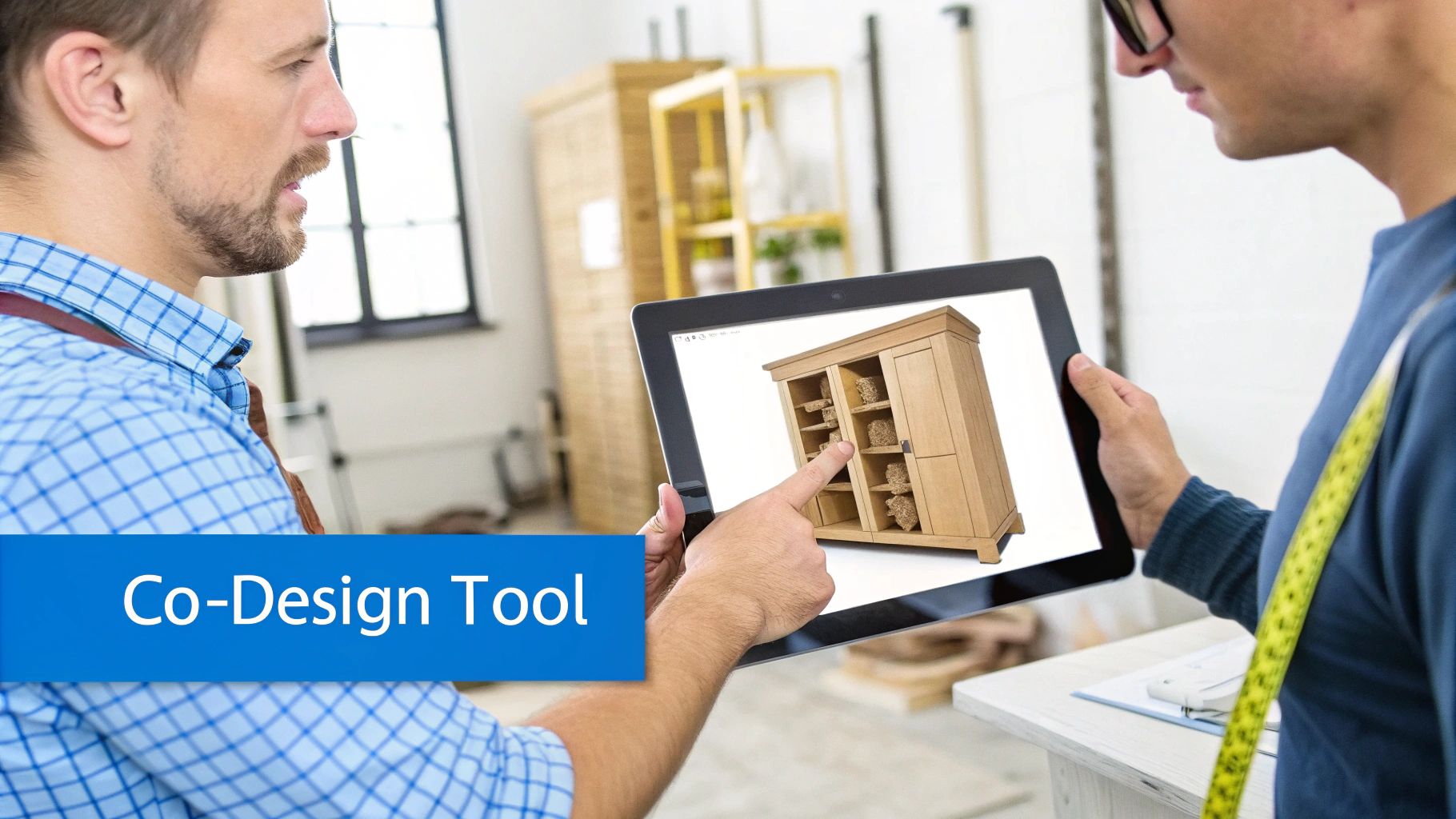
Bridging the Gap Between Sales and Production
A good product configurator becomes the single source of truth for every custom order. It ensures that every choice a customer makes is valid, buildable with your equipment, and priced correctly on the spot. No more endless back-and-forth emails and phone calls that kill momentum and introduce mistakes.
- For your customers: It’s a fun, visual experience. They get to see their choices come to life instantly, which builds their confidence and makes them feel in control.
- For your sales team: The quoting process is automated. They can generate a perfect, professional proposal in minutes, not days.
- For your shop floor: It spits out an exact bill of materials (BOM) and cut lists based directly on the customer’s final design. Production starts with flawless information, every time.
By digitizing your product rules, a configurator ensures that every custom order is both desirable for the customer and profitable for your business. It turns complexity into a competitive advantage.
To see the full picture, it helps to view configurators as a specialized form of ecommerce personalization software. All these tools share a common goal: create a unique and compelling customer experience that leads directly to a sale.
Manual Quoting vs Automated Configuration at a Glance
The difference between the old way and the new way is night and day. When you see it side-by-side, the value becomes crystal clear.
Process StepManual Method (Without Configurator)Automated Method (With a Configurator)Initial QuoteHours or days of calculations, sketches, and emails.Instant, accurate pricing as the product is designed.Design ChangesStart the quoting process over. More delays.Real-time updates to design and price. No waiting.Error PotentialHigh. Miscalculations and miscommunications are common.Extremely low. Pre-set rules prevent impossible combinations.Sales ProposalManually created, often inconsistent document.Professional, branded PDF generated automatically.Production HandoffHand-drawn sketches, messy notes, and spreadsheets.Clean BOMs, cut lists, and 3D models sent to production.
This table doesn't even account for the lost sales from leads who went elsewhere while waiting for a quote. The efficiency gains are massive.
The best part? This kind of technology is no longer just for massive corporations. It’s now accessible and affordable for custom woodworking and millwork shops of any size, completely leveling the playing field. By letting software handle the tedious administrative work, you and your team can get back to what you do best: crafting exceptional products.
For more ideas on making your shop more efficient, check out other articles on our blog.
How a Product Configurator Actually Works
So, how does this all come together? To really get what a product configurator is, you need to peek under the hood. It’s not some kind of black magic; it's a smart combination of logic, user experience, and data all working in concert.
Think of it as having three experts in one: a digital master craftsman who knows every rule of your shop, an interactive showroom that never closes, and an administrative assistant who never makes a data-entry mistake.
The Rules Engine: Your Digital Craftsman
At the very core of any configurator is the rules engine. This is where you essentially digitize all the hard-won knowledge sitting in your head and on your shop floor. It’s the logic that dictates what can and cannot be built, making sure every custom order is both structurally sound and profitable.
Let's go back to that customer designing their bookcase. As they make choices, the rules engine is working silently in the background, applying your specific constraints.
- Structural Integrity: If the customer stretches a shelf to 40 inches wide, the engine automatically adds a center support brace to prevent sagging. It knows the limits of your materials.
- Material Compatibility: They select "reclaimed oak," and the engine instantly limits the available finish options to only those that complement that specific wood.
- Production Logic: A "hand-rubbed oil finish" is chosen, so the engine automatically adds two days to the estimated lead time, accurately reflecting the extra labor.
This crucial component stops customers from designing something you can’t actually build, saving you from costly errors and awkward follow-up calls.
The User Interface: The Interactive Showroom
The User Interface (UI) is the part your customer actually sees and touches. It’s your digital showroom, and it needs to be intuitive, engaging, and visually rich. The goal here is to make customization feel less like filling out a boring form and more like a creative design session.
A great UI doesn’t just capture an order; it builds buyer confidence. By allowing customers to see their choices reflected in a real-time 2D or 3D model, you remove guesswork and create an emotional connection to the product.
This visual feedback is absolutely critical. As your customer adjusts the dimensions, swaps wood species from maple to walnut, or changes the hardware from brushed nickel to matte black, the on-screen model updates right before their eyes. This instant confirmation ensures what they see is exactly what they’ll get, dramatically cutting down on misunderstandings and returns. After all, research shows 91% of consumers prefer shopping with brands that provide relevant, personalized experiences—and a visual configurator is personalization at its best.
Data Integration: The Bridge to Your Shop Floor
Finally, the data integration layer is what connects your customer-facing showroom to your back-end operations. This is where the automation really shines. The moment a customer finalizes their design and clicks "Get Quote," this layer translates their visual creation into cold, hard production data.
This all happens in an instant, with zero manual input:
- Pricing Calculation: It tallies up the cost of materials, applies the right labor rates, and adds your markup to generate a perfect, profitable price every time.
- Bill of Materials (BOM) Generation: It spits out a complete list of every single component needed, from the exact square footage of plywood down to the last screw and hinge.
- Production Documents: It can even generate initial cut lists and assembly drawings, giving your team on the floor a clear, error-free blueprint to start from.
This seamless flow of information is what elevates a configurator from a simple online form to a true business system. Before going all-in, many shops choose to build an MVP of their configurator to test the core concept and get feedback. By tying these three pillars together, a configurator forges an unbroken chain of accurate data—from the customer's first click to your team's final cut.
Essential Features for Custom Woodworking Shops
When you're in the business of custom woodworking and millwork, not just any product configurator will do. A generic tool built for customizing T-shirts just can't grasp the complex rules of cabinet construction or the material nuances of a bespoke dining table. For a woodshop, a configurator is more than a flashy add-on; it's a critical operational tool that needs some serious horsepower under the hood.
Choosing the right platform means looking past the pretty interface and digging into the engine that runs it. The make-or-break features are the ones that directly solve your biggest headaches—from the inaccurate quotes that bleed profits to the production mistakes that turn expensive lumber into scrap. Let's break down the non-negotiable capabilities your shop absolutely needs.
Quoting by hand is like walking through a minefield. You forget the upcharge for a premium finish, miscalculate the board feet of walnut, or shortchange the labor for complex joinery. It’s a recipe for disaster. A top-tier product configurator for woodworking needs dynamic, rules-based pricing to put an end to these costly errors for good.
This feature is the brain of the operation, linking every customer choice directly to its real-world cost. As a customer tweaks their design, the price updates instantly and accurately based on the rules you set.
- Material Costs: When a client switches from oak to cherry, the price adjusts based on your current cost per board foot. No more guesswork.
- Labor Rates: Choosing a tricky "mortise and tenon" joint? The system can automatically add the correct labor hours to the final price.
- Finishing Upcharges: Selecting a multi-step, hand-rubbed finish instantly tacks on the associated material and labor costs.
This finally ensures every single quote you send out is not just fast, but genuinely profitable. It turns pricing from a high-stakes guessing game into a precise, automated science.
Visual Customization in 2D and 3D
"I thought it would be taller." "That's not the shade of stain I pictured." We've all heard it. These are the words that kick off frustrating revisions, eat into profits, and leave you with unhappy customers. The antidote is high-fidelity 2D and 3D visual customization, which closes the gap between what a customer imagines and what your workshop can build.
When buyers can see their choices come to life in a realistic rendering, their confidence soars. They can spin a 3D model of their custom vanity, swap out hardware on the doors, and confirm the proportions are just right before placing an order. This alignment is priceless. The market agrees—the 3D segment of product configurator software was valued at nearly $2 billion in 2025 and is on track to more than double by 2032. This explosion shows just how vital visualization is for anyone selling custom goods. You can dive deeper into the trends in the product configurator market to see why visuals are now front and center.
Automated Quote and BOM Generation
The paperwork shuffle between getting a "yes" from a client and actually starting production is a huge bottleneck. You manually create a professional quote, then turn around and re-enter all that same information to build a Bill of Materials (BOM) and cut list. It's redundant and a prime spot for human error to creep in.
A must-have feature is the power to automate the generation of sales and production documents. Once a customer finalizes their design, the system should instantly kick out:
- A Professional Quote: A branded, itemized PDF ready to be emailed for approval or an e-signature.
- A Complete Bill of Materials (BOM): A detailed shopping list of every single component, from wood panels and edge banding right down to the last hinge and screw.
- Initial Cut Lists: Data ready for your shop floor, slashing prep time and killing transcription errors.
This level of automation gives you back countless hours of admin time. It frees up your team to focus on what they do best—selling and building—instead of getting bogged down in paperwork. It creates one bulletproof source of truth for every single order.
Seamless E-commerce Integration
Finally, your product configurator can't be a silo. To really unlock its power, it needs seamless e-commerce integration. This means you can embed the tool directly into your website, letting you capture sales around the clock—not just when your shop is open.
This move transforms your website from a simple portfolio into a 24/7 sales machine. Customers can design, price, and buy their custom pieces whenever inspiration hits them, whether it's 2 PM or 2 AM. Opening up this direct-to-consumer channel creates brand new revenue streams and puts you in complete control of the customer journey. You can explore a full suite of these integrated tools for custom woodworking shops to see how all the pieces connect.
What a Product Configurator Actually Does for Your Business
It's one thing to talk about the bells and whistles of a product configurator, but it's another thing entirely to see what it does for your bottom line. Let's get past the technical jargon. This kind of tool delivers real, measurable results that solve some of the most frustrating problems in the custom woodworking and millwork world. We're not talking about small tweaks; we're talking about a fundamental shift in how you quote, build, and grow.
The impact is felt everywhere, from the first time a customer lands on your site to the moment their finished piece is shipped out the door. By automating the tedious, complex parts of the process, a configurator frees up your time, cuts down on waste, and builds a stronger, more profitable business.
Slash Your Sales Cycle from Days to Minutes
We’ve all been there. The traditional quoting process for a custom project is a huge bottleneck. It can take days of emails, phone calls, manual calculations, and napkin sketches, all while your potential customer’s initial excitement starts to fizzle out. A product configurator completely blows up that slow, frustrating routine.
By giving customers and your sales team instant, accurate pricing, you empower them to make decisions right then and there. When a client can design their dream cabinet and watch the price update in real-time with every change, the conversation flips from "I'll have to get back to you" to "Let's do this." That speed is a massive competitive edge. You'll be closing deals while your competitors are still trying to figure out the math.
A faster sales cycle isn't just about quick wins. It directly improves your cash flow, frees up your sales team to handle more leads, and grabs serious buyers before they start shopping around.
Eliminate Costly Production Errors
Every shop owner knows that sinking feeling when a production mistake happens. One wrong measurement or a miscalculated material order can turn a beautiful piece of hardwood into expensive scrap, wiping out your profit margin in a heartbeat. Almost every time, these mistakes come from a simple communication breakdown between the front office and the shop floor.
A product configurator serves as the single source of truth, creating a perfect, unbroken line of data from the customer's design to the CNC machine's cut.
- Perfect Handoffs: The design the customer finalizes automatically generates the exact Bill of Materials (BOM) and cut lists. There’s simply no room for human data entry errors.
- Built-in Guardrails: The rules you set up prevent a customer from ever ordering something that’s impossible to build or structurally unsound. It stops mistakes before they can even happen.
This kind of precision means you build it right the first time, every single time. That protects your margins and solidifies your reputation for quality.
Increase Average Order Value—Without Being Pushy
This is one of the most powerful benefits, and it’s often overlooked. A configurator is a natural upselling and cross-selling machine. When customers can actually see their options and play with them visually, they are far more likely to choose premium upgrades.
Think about a customer designing a kitchen island. Seeing a 3D model instantly change from standard oak to a rich, premium walnut makes the value of the upgrade crystal clear. Offering add-ons like soft-close drawers or a built-in spice rack becomes a helpful part of the design process, not an aggressive sales pitch. It's no surprise that 35% of Amazon's revenue comes from its recommendation engine; a visual configurator works on the exact same psychological principle, guiding customers toward higher-value choices they genuinely want.
Create an Unforgettable Customer Experience
In this market, the experience you provide is just as important as the product you sell. When you empower customers to co-create their own items, you build a deep sense of ownership and a real connection to your brand. They’re no longer just buying something; they’re participating in the creative process.
That interactive journey is far more memorable and satisfying than scrolling through a static catalog. A great experience builds loyalty and turns happy clients into your best marketers. They'll share their custom creations on social media and tell their friends about the amazing process, generating the kind of powerful word-of-mouth that money can't buy. To see how this powerful tool can fit into your business model, you can explore TimberCloud pricing and plans.
Measuring the ROI of a Product Configurator
Putting numbers to these benefits helps clarify the true business impact. This table shows common industry averages before implementing a configurator and the potential improvements you can realistically expect after.
Business MetricBefore Configurator (Industry Average)After Configurator (Potential Improvement)Quote Generation Time2–5 Business Days< 5 MinutesSales Conversion Rate10–15%25–40%Production Error Rate3–5% of Orders< 0.5% of OrdersAverage Order Value (AOV)Baseline+15–30% (from upsells & add-ons)Sales Team OverheadHigh (manual quoting & data entry)Low (automated & self-serve)
As you can see, the improvements aren't minor. They represent significant gains in efficiency, profitability, and customer satisfaction, proving that a configurator is far more than a "nice-to-have" tool—it's a core driver of growth.
Connecting Your Showroom to the Shop Floor
<iframe width="100%" style="aspect-ratio: 16 / 9;" src="https://www.youtube.com/embed/G0ZynrqM7sQ" frameborder="0" allow="autoplay; encrypted-media" allowfullscreen></iframe>
A product configurator is a fantastic sales tool on its own, no doubt. But its real power gets unlocked when it stops being just a sales tool and becomes the central nervous system for your entire operation. It's the integration with the other critical software you already rely on that creates a seamless, automated workflow.
This connection builds a direct, error-proof line from a customer’s click in your digital showroom all the way to a craftsman’s cut on the shop floor. We're not just talking about making sales easier; this is about manufacturing smarter from start to finish.
When your configurator can talk to your other systems, you eliminate those dangerous "islands" of information that cause so many delays, mistakes, and headaches. Suddenly, every part of your business is working from the same perfect set of instructions.
Creating a Single Source of Truth
At the heart of all this is what we call a 'design-to-production' workflow. Think of it like a digital domino effect. When a customer finalizes their custom cabinet design and places an order, the configurator doesn’t just send you an email notification. It kicks off a cascade of automated actions that get your entire shop ready for production.
And this all happens without a single piece of paper changing hands or a single number being manually typed into another system. It's the absolute key to scaling a custom manufacturing business without scaling the chaos that usually comes with it.
By connecting sales, inventory, and production systems, a product configurator ensures that every department is operating with identical, real-time information. This single source of truth is the foundation for eliminating waste and maximizing efficiency.
This connected approach is catching on everywhere. Product configurators are being adopted across countless industries that overlap with custom manufacturing, and the growth is undeniable. While manufacturing is the largest segment, the retail and e-commerce sector has become the fastest-growing, especially in industries like furniture where visual customization is crucial for closing sales and cutting down on returns. You can dig into more product configurator software market insights on verifiedmarketresearch.com.
Key Integration Points for Woodworkers
For a custom woodworking or millwork shop, a few specific software connections are game-changers. These are what turn a customer's simple configuration into an actionable, shop-ready plan.
- Customer Relationship Management (CRM): A potential customer saves a design, and that lead information, along with their specific choices, automatically populates in your CRM. Your sales team can now follow up with a complete understanding of exactly what that customer wants.
- Enterprise Resource Planning (ERP): The moment an order is confirmed, the configurator pings your ERP to check material availability. It can instantly reserve the necessary lumber, hardware, and finishes, making sure you never sell something you don't have the stock to build.
- Manufacturing Execution Systems (MES): The finalized design can generate a work order directly in your MES, scheduling the job on the shop floor and giving you a real-time view of production progress.
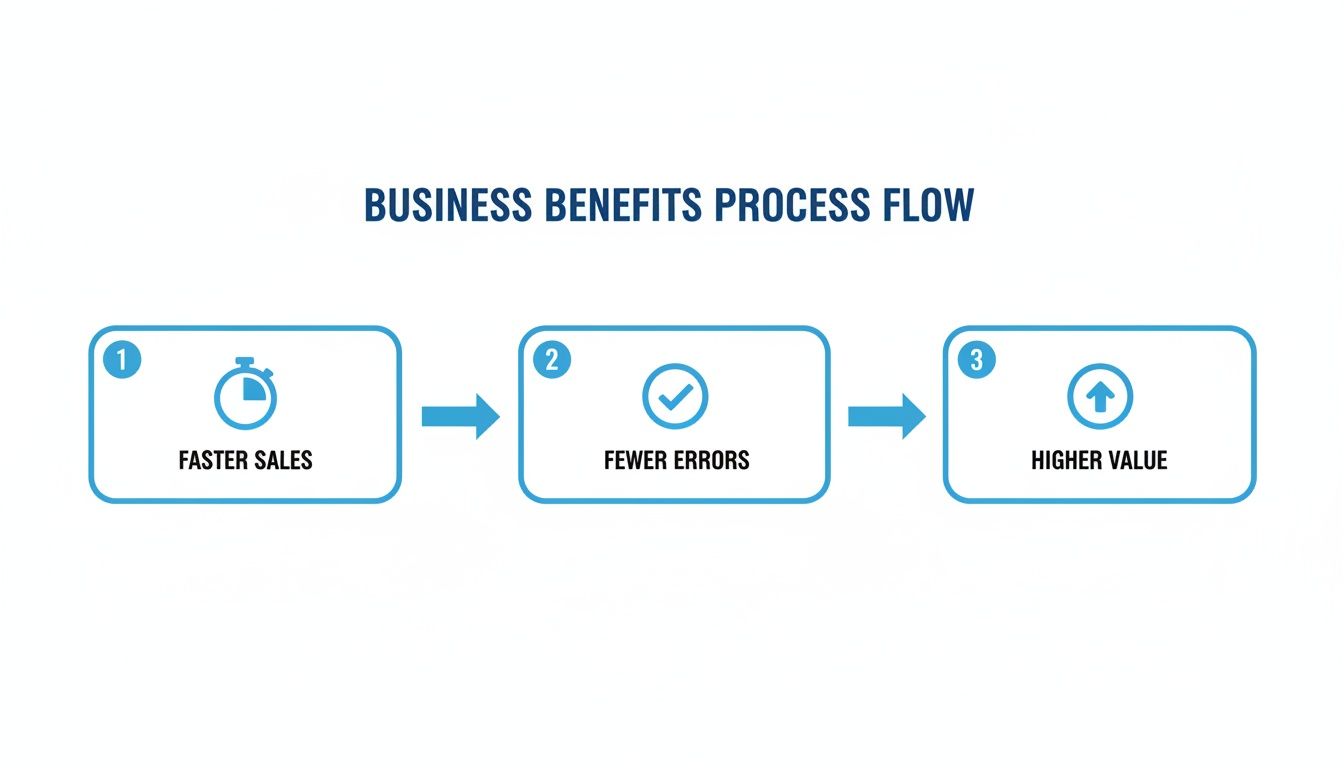
The chart below shows just how this connected process delivers faster sales, fewer errors, and ultimately, a much healthier bottom line for your business.
The Final Step: From Plan to Production
The most advanced configurator platforms are now closing that last, critical gap between digital design and physical production. Once an order is confirmed, the system doesn’t just spit out a simple PDF. It generates the detailed, technical outputs your machinery needs to get to work.
This is where the magic really happens:
- Optimized Cut Lists: The software calculates the most efficient way to cut every part from your sheet goods, slashing waste and saving a surprising amount of money on materials.
- CNC Machine Code: For shops with automated equipment, the configurator can generate machine-ready files (like G-code) that you can send directly to your CNC router. No manual programming needed.
- Assembly Instructions: It can even create step-by-step assembly guides, complete with 3D renderings, making the final build on the bench faster and far more accurate for your team.
Newer systems, like TimberCloud, are even incorporating AI to take this a step further. Their AI can analyze complex specifications or even old-school blueprints to automate the creation of these production-ready plans, ensuring every last detail is captured perfectly. This is the ultimate expression of what a product configurator is: a bridge that flawlessly connects a customer's unique vision to the reality of your shop floor.
So, Are You Ready to Build Smarter?
We’ve covered a lot of ground, from defining a product configurator to exploring its core features and seeing how it plugs directly into a modern manufacturing workflow. The big takeaway here is simple: this isn't just another piece of software. It’s a complete shift in how custom businesses need to think and operate if they want to stay in the game.
Think of it as the strategic core that connects everything. It speeds up your sales cycle, ensures your production is dead-on accurate, and, most importantly, puts your customers right in the driver's seat of the creative process. If you’re a custom woodworking or millwork shop still wrestling with spreadsheets and hand-drawn sketches, now is the time to take a hard look at your process. The edge this technology gives you is no longer a nice-to-have; it's quickly becoming a must-have.
The New Benchmark for Craft Manufacturing
In a world where customers demand both personalization and speed, manual processes are your biggest liability. A product configurator directly tackles the most common headaches in the custom world:
- Painfully Slow Quoting: Get instant, accurate, and profitable pricing.
- Costly Production Errors: Generate perfect BOMs and cut lists automatically, every single time.
- Frustrating Lost Sales: Capture a buyer's imagination with visuals and close the deal before they walk away.
The question really isn't if you should adopt this technology anymore. It's how fast can you get it at the heart of your business? The shops that will pull ahead are the ones that seamlessly connect their incredible craftsmanship to a modern, digital buying experience.
By bringing in a system that builds a bridge from your showroom straight to your shop floor, you're not just buying a tool. You're investing in a future that's more efficient, more profitable, and ready to scale. The technology is here, and it's built for the real-world challenges of craft manufacturing. It’s time to get your business ready to lead.
Got Questions? We've Got Answers.
Adopting any new technology comes with a healthy dose of skepticism and a lot of questions. That’s normal. When we talk with custom woodworkers and shop owners about product configurators, the same practical concerns always pop up. They want to know about the setup, the real capabilities, and how it all plugs into what they’re already doing.
So, let's tackle those head-on. My goal here is to give you straight answers, showing you how these tools are built for shops like yours, not for Silicon Valley tech giants.
"How Hard Is It to Set Up for My Custom Products?"
This is probably the biggest hang-up I hear. A lot of shop owners picture themselves needing a computer science degree just to get started. The good news? That's old-school thinking. Modern configurators are built for business owners, not coders.
Think of it less like programming and more like building with digital Legos. You use visual, drag-and-drop tools to define your product's logic. You'll list out the attributes—things like wood species, dimensions, or finish options—and then set simple rules for how they work together. For instance, you can easily create a rule that says, "If a cabinet door is over 48 inches tall, automatically add a center rail." It’s a no-code or low-code approach, meaning you or your team can manage it without writing a single line of code.
"Can It Handle My Crazy Pricing and All My Options?"
Not only can it handle them, but this is exactly what a good configurator is for. If your pricing fits neatly into a simple spreadsheet, you probably don’t need one. But for custom work, where every choice impacts the final cost, a configurator is a game-changer. It’s built to juggle all those variables that give you headaches.
A powerful, rules-based pricing engine does the heavy lifting in the background. It calculates the final price instantly and accurately based on whatever inputs you throw at it, including:
- Material Costs: It can automatically update prices based on the fluctuating cost per board foot for walnut versus oak.
- Labor Rates: It knows to add more labor cost for complex joinery or a hand-rubbed finish.
- Waste Factors: You can build in your standard waste percentage so you're not eating material costs on every job.
- Hardware and Finishes: It adds the right upcharge for those premium soft-close hinges or that extra coat of conversion varnish.
What you get is a quoting system that’s dead-on accurate every single time. It ensures every project is priced for a healthy profit while still being competitive. You can finally stop guessing and know your numbers are right.
"Will a Configurator Work with My Existing Website?"
Yes, absolutely. A modern configurator is designed to play nicely with what you already have. You’ve put work into your website, and the last thing you want is to scrap it and start over.
These tools are made to be embedded right into the most common website platforms, like Shopify, WordPress, BigCommerce, or Squarespace. Usually, it's as simple as copying and pasting a small piece of code onto the product page. This way, you keep your brand’s look and feel, but you add an incredibly powerful tool that lets customers design and buy right then and there. Your website goes from being a digital brochure to your best salesperson—one that works 24/7.
Ready to see how a product configurator can pull all of this together for your woodworking business? TimberCloud offers an all-in-one platform that connects your sales, engineering, and shop floor into one seamless workflow.
Topics
TimberCloud Team
Content Team
The TimberCloud team is dedicated to helping manufacturers streamline their operations with intelligent software solutions.