Unlock Faster Quotes with quoting software for manufacturing
Think of quoting software for manufacturing as your shop's secret weapon. It's the system that takes all the guesswork, spreadsheets, and frantic math out of your quoting process and replaces it with a fast, data-driven, and repeatable way to create accurate quotes.
For custom manufacturers, especially in woodworking, this is the essential leap from risky calculations to a strategic business tool.
Why Back-of-the-Napkin Quotes Are Costing Your Shop Money
Let’s be honest—the old way of quoting in a custom shop is a high-wire act. We’ve all been there: scribbling numbers, flipping through dusty price books for material costs, and trying to sound confident for an impatient customer, all while a little voice in our head asks, "Did I miss something?"
This old-school method isn’t just stressful; it’s a direct threat to your bottom line.
Every back-of-the-napkin quote is a gamble. Miscalculate a board foot, forget the setup time for a specific machine, or underestimate the finishing labor, and you’ve just erased your profit. This constant risk is why so many great shops work their tails off but struggle with wildly inconsistent profits.
The True Cost of Manual Quoting
The damage from manual quoting goes way beyond a single bad bid. It creates deeper, systemic problems that can hold your entire operation back, poisoning everything from your cash flow to what customers think of you.
When you don't have a solid system, you're constantly dealing with these headaches:
- Lost Revenue from Underbids: One simple math error is all it takes to turn what looked like a great job into one you're paying to complete.
- Slow Response Times: While you’re spending hours putting a quote together, your competitor who uses quoting software has already sent theirs over and is taking the deposit. Speed often wins the job.
- Inconsistent Margins: If every quote is built from scratch, your pricing becomes a matter of memory and mood. This makes it impossible to reliably forecast your profits or know which jobs are actually making you money.
To really see the damage, you have to get serious about knowing how to accurately calculate profit margins on every single job.
This shift away from manual processes isn't just a fleeting trend. It's a fundamental change in how manufacturing businesses have to operate to stay competitive. The need for absolute precision and efficiency is what's pushing shops to finally invest in these tools.
A Market Moving Towards Automation
The entire industry is moving in this direction, and it’s happening fast. The global quoting software market was valued at around USD 1.2 billion in 2023 and is expected to grow significantly over the next decade.
Why? Because manufacturers are realizing that accurate, automated quotes are critical for everything from planning material purchases to setting competitive prices. You can find more details on the growth of the quoting software market here. The numbers tell a clear story: for modern shops, embracing technology like this is no longer a luxury—it’s about survival and growth.
Understanding How Quoting Software Works for Manufacturers
Think of quoting software for your manufacturing shop as a digital master craftsman. This craftsman has a perfect memory—every material cost, every labor hour, and every machine setup you’ve ever done is instantly accessible. It's the central brain that connects what a customer wants directly to what your shop can realistically and profitably deliver.
On the surface, this software gives you a price. But its real magic is how it works behind the scenes as a deeply connected system. It's not just grabbing a number off a generic price list; it builds a quote from the ground up, piece by piece, just like you’d build the product itself.
So when a customer asks for a custom cabinet, the software isn't just spitting out a number. It's calculating the exact board feet of walnut needed (even factoring in waste), adding the cost of those specific Blum hinges and drawer slides from your live inventory, and then tacking on the precise labor hours for assembly and finishing.
From Simple Inputs to a Complete Production Plan
It all starts with you teaching the system the rules of your shop—your unique business logic. You'll input your material costs, labor rates, machine runtime costs, and the profit margins you need to hit. This isn't a "set it and forget it" task; the system lives and breathes with your business, updating as costs fluctuate so every single quote reflects today's financial reality.
When a new request comes in, the software walks the user through a guided process, either with a series of questions or a visual product builder. This structured approach puts an end to the guesswork and forgotten details that so often torpedo manual quotes.
The real job of quoting software is to take all that tribal knowledge—the costs, processes, and rules stored in your team's heads—and turn it into a repeatable, automated, and error-proof system. It finally systematizes your craft.
The explosive growth of these tools proves just how vital they are. The market for manufacturing quoting software was valued at a massive USD 525.1 billion in 2023 and is expected to more than double by 2031. This isn't just hype; it shows how essential automation has become for shops trying to escape the costly human errors that eat away at profits. You can dig deeper into the data on manufacturing quoting software's importance to see the full picture.
Connecting the Dots Across Your Operation
A truly effective quoting system doesn't operate in a vacuum. It plugs into the other vital organs of your business to get the full story before it ever calculates a final price. This integration is what separates a simple calculator from a genuine business management tool.
Here’s a glimpse of how it works:
- Inventory Check: It instantly pings your inventory system to see if you have the materials on hand. No more promising what you can't deliver.
- Production Capacity: It can glance at your shop's schedule to give the customer a realistic lead time, not just a wild guess.
- Margin Protection: It automatically applies your predefined margin rules, making sure every single job you quote is profitable from the start.
When these connections are broken, chaos ensues. You end up with underbids, painfully slow response times, and wildly inconsistent margins.
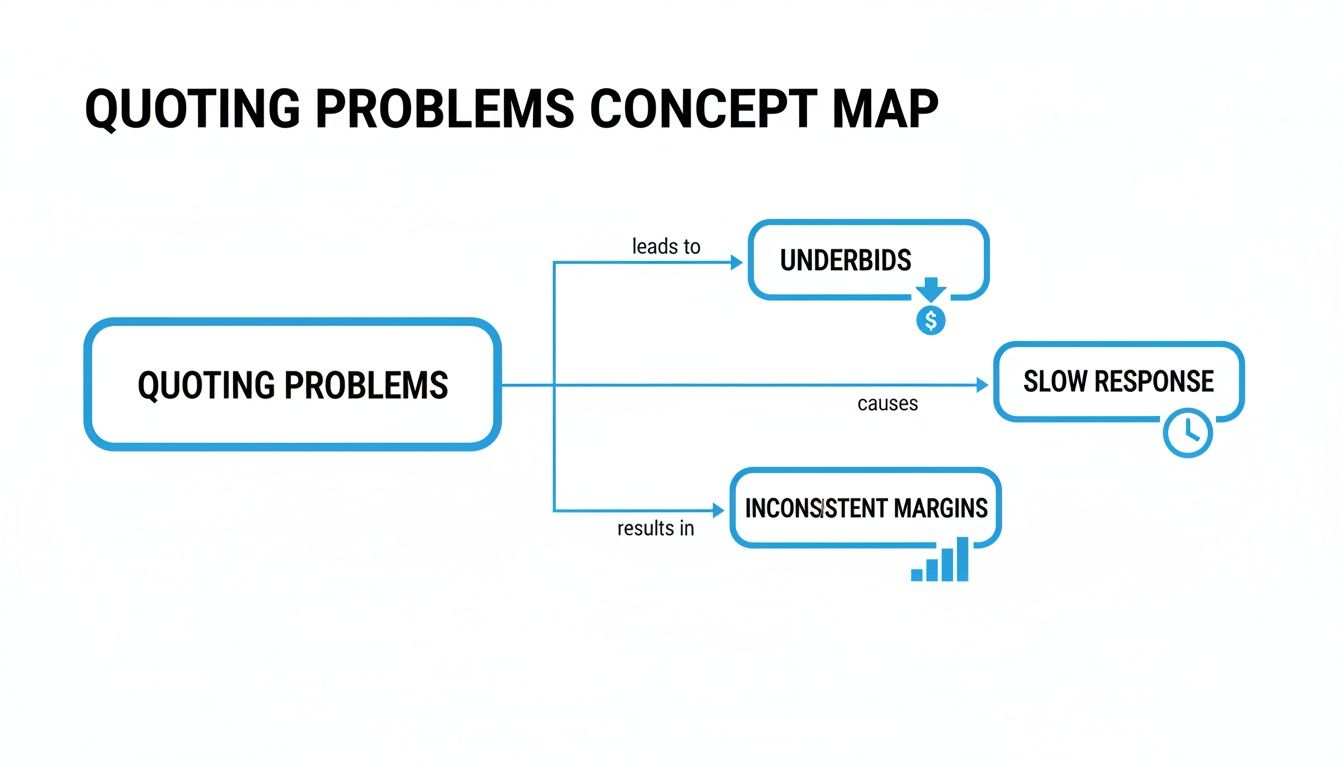
As you can see, these problems are all intertwined, creating a vicious cycle of inefficiency that hammers your bottom line and erodes customer trust.
Manual Quoting vs Automated Quoting Software
The difference between the old way and the new way is night and day. We're talking about moving from scattered spreadsheets and gut feelings to a unified, data-driven process. This table breaks down the fundamental shift.
| Process Step | Manual Method (The Old Way) | Automated Software (The New Way) |
|---|---|---|
| Information Gathering | Hunting for details in emails, notes, and old files. High risk of missing key specs. | Guided configurator ensures all necessary data is captured upfront, every time. |
| Cost Calculation | Manually looking up prices in outdated spreadsheets. Guesswork on labor and overhead. | Pulls real-time material costs from inventory, applies precise labor rates, and adds margins. |
| Quote Generation | Typing up proposals in Word or Excel. Prone to copy-paste errors and inconsistencies. | Instantly generates a professional, branded quote document with all details included. |
| Approval & Revisions | A slow back-and-forth email chain. Difficult to track changes and versions. | Centralized system for approvals. Revisions are updated instantly across the entire quote. |
| Data Accuracy | Relies entirely on human memory and diligence. "Fat-finger" errors are common. | Based on a single source of truth, eliminating human error and ensuring consistency. |
Ultimately, quoting software becomes your single source of truth. It ensures the price you give a customer isn't just fast, but also accurate, profitable, and actually deliverable.
The Five Core Features That Will Change How You Quote
Modern quoting software for manufacturing isn't just a fancy calculator—it's the command center connecting your sales desk directly to your shop floor. To really get it, you need to look past the buzzwords and see how these tools solve the real-world problems that drain time and kill profits in a custom woodshop.
These aren't just abstract ideas. They are practical, powerful features that work together to turn a chaotic, gut-feel process into a predictable, profitable system.
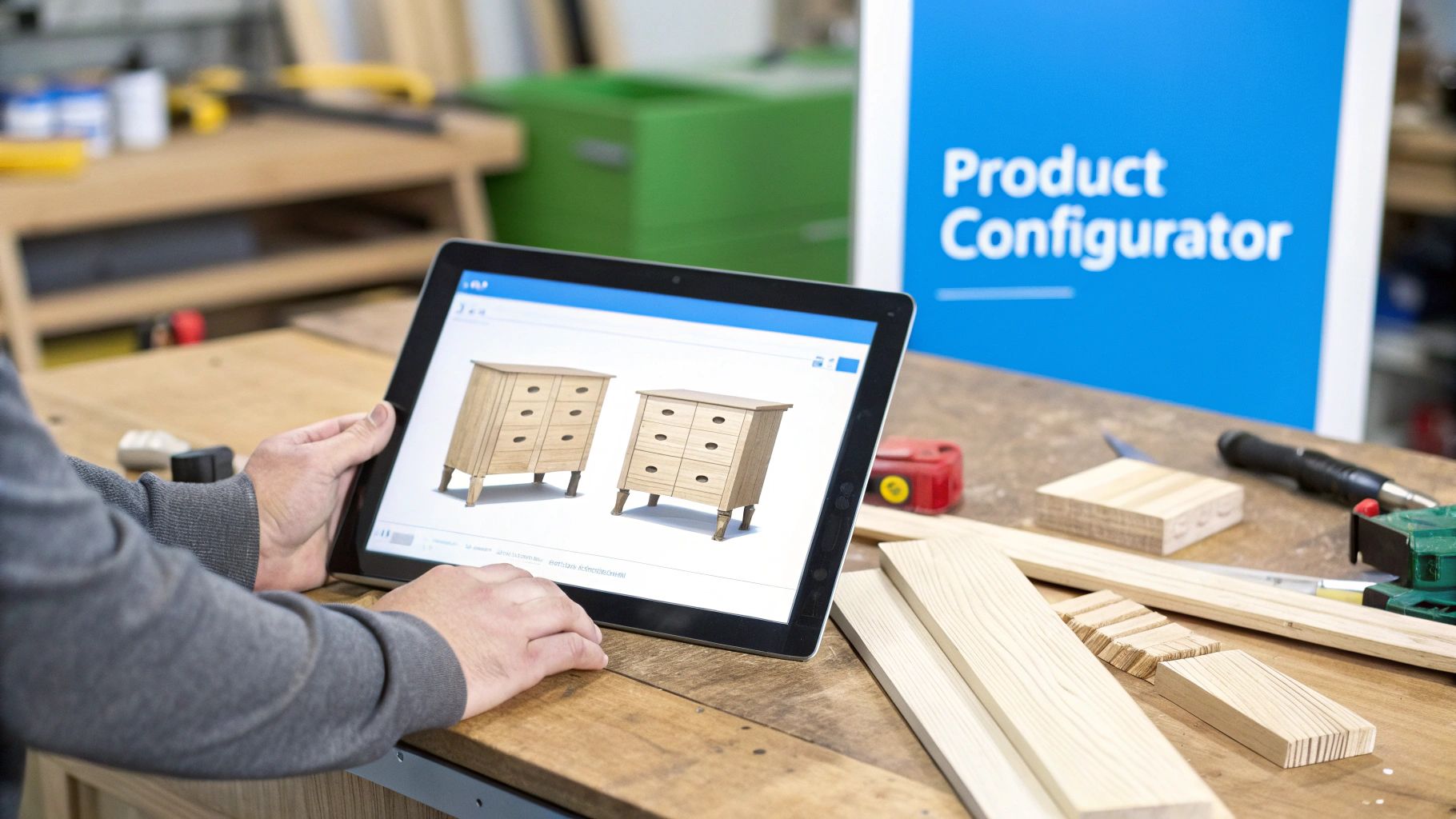
1. Interactive Product Configurators
Think of a product configurator as a digital showroom for your skills. Instead of handing a client a static price list and a pile of wood samples, you give them an interactive tool to build their dream piece in real-time.
Imagine a client wants a custom kitchen island. With a configurator, they can click through options for wood species (oak, maple, walnut), door styles (shaker, raised panel), and hardware finishes. Every single click instantly and accurately updates the price based on the rules you’ve already set.
This turns a confusing back-and-forth negotiation into a fun, guided design session. It empowers your customers with choices while ensuring every option they pick is both buildable and priced correctly from the start.
2. Live Bill of Materials and Inventory Integration
A great-looking quote is totally worthless if you can't build the job profitably. This is where a direct link to your Bill of Materials (BOM) and live inventory becomes an absolute game-changer. It grounds every quote in the reality of your current stock and costs.
Let's go back to that kitchen island. When you quote it with premium walnut, the software doesn't just pull a number from a spreadsheet. It checks your live inventory to see if you have enough board feet on hand. If you’re low, it can flag the material or even use the price from your most recent purchase order to protect your margins from a sudden price spike.
This feature alone prevents one of the most common and painful quoting mistakes: winning a job with materials you don't have or that just shot up in price. It's your digital safeguard against quoting yourself into a loss.
By tying directly into your inventory, the system stops you from flying blind. Every board, hinge, and drawer slide is accounted for before the quote ever reaches the customer.
3. CAD and Blueprint Parsing
For shops doing complex architectural millwork or highly custom pieces, turning a set of drawings into a quote is often the biggest bottleneck. Think of CAD and blueprint parsing as having a junior estimator on staff who can read technical drawings 24/7.
You upload a CAD file or a detailed blueprint, and the software gets to work. It intelligently analyzes the design, identifying components, measuring dimensions, and pulling out all the critical data needed for an accurate quote and a parts list. This can shrink hours of tedious manual work down to just a few minutes.
It means less time squinting at schematics and more time building relationships and winning jobs. It’s the bridge between the design office and the sales team, locking in technical accuracy from day one.
4. Automated Cut Sheet and Work Order Generation
The real magic of a great quoting system is what happens after the customer says yes. The best quoting software for manufacturing uses all the data from the approved quote to automatically kick off production.
The moment a quote is accepted, the system can instantly generate detailed cut sheets for your CNC operators and work orders for the shop floor. Every detail—dimensions, materials, hardware, and finishing notes—is passed along flawlessly.
This creates a perfect, error-free handoff from sales to production. It completely eliminates the risk of crucial details getting lost between a salesperson’s scribbled notes and the team on the floor, ensuring what you sold is exactly what gets built. You can see how these powerful quoting and production features create a seamless workflow from start to finish.
5. Multi-Tier and Rule-Based Pricing
Not all customers are created equal, and your pricing needs to reflect that. You might work with a high-volume contractor, a local designer, and a one-off retail client all in the same week. A flexible, rule-based pricing engine makes managing this easy.
You can build sophisticated pricing structures that run automatically.
- Volume Discounts: Set a rule to automatically discount an order when a contractor buys 10 or more cabinet sets.
- Customer Tiers: Create a "Trade Partner" tier for designers that gives them a standard 15% discount on everything they order.
- Margin Rules: Establish a floor for your profitability by setting a rule that no quote can be generated with less than a 35% gross margin.
This feature removes the emotion and guesswork from your pricing strategy. It makes sure every single quote aligns with your business goals, maintains consistency, and protects your bottom line without you having to review every line item.
The Real-World ROI Your Shop Can Expect
Let's be honest. Investing in new shop technology can feel like a leap of faith. But with modern quoting software, the return on your investment isn't some fuzzy, far-off concept—it’s immediate, it's measurable, and it touches every corner of your business. It's the difference between hoping for profit and building a system that actually protects it.
I see it all the time. A custom cabinet shop is stuck on a financial rollercoaster. One month, they hit their numbers; the next, they’re barely afloat because a couple of big jobs were underbid. The owner is up late, drowning in spreadsheets, while skilled builders are on the floor waiting for clear instructions. This isn't just a story; it's the draining reality for shops still wrestling with manual quotes.
Now, imagine that same shop a few months later. The chaos is gone. The owner cranks out complex, multi-room quotes in minutes, totally confident that every screw, every labor hour, and every bit of margin is accounted for. The moment a deal is signed, the shop floor gets an automated, error-free work order. This isn't a pipe dream; it's what happens when you swap guesswork for a data-driven process.
Winning More Jobs Through Unbeatable Speed
In a competitive world, being first often means getting the job. Simple as that. When a customer has to wait days for your quote, their initial excitement cools off, and they start shopping around. Quoting software completely collapses that turnaround time, shrinking it from days down to minutes.
This speed is your secret weapon. You can get a professional, detailed quote into a customer’s hands while their project is still top-of-mind—long before your competitors have even sharpened their pencils. This isn't just about looking good; it directly pumps up your quote-to-win ratio.
Protecting Your Margins with Rule-Based Precision
The most dangerous threat to any custom shop is the slow bleed from small errors. A miscalculated waste factor on a sheet of plywood, a forgotten set of drawer slides, or an optimistic guess on finishing time can completely wipe out your profit on a job. Quoting software is your financial watchdog, built to eliminate these costly oversights.
Once you set up your pricing rules, material costs, and labor rates, you create a system that simply can’t forget or miscalculate.
- Guaranteed Profitability: You can set minimum margin rules to ensure no quote ever goes out the door unless it’s profitable.
- Real-Time Costing: The system pulls in current material prices, shielding you from getting burned by a sudden price spike.
- Labor Accuracy: Labor is calculated based on defined, repeatable production steps, not just a gut feeling.
This systematic approach turns your pricing from a risky art form into a reliable science. It makes sure every single job you win actually builds your bottom line and creates predictable cash flow.
Elevating the Customer Experience
A fast, professional quote does more than just win the deal; it builds a foundation of trust from the very first conversation. When a customer gets an interactive quote where they can see their choices reflected in the price instantly, it completely changes their perception of your business. That's a level of professionalism that old-school manual quotes just can't compete with.
The proof is in the numbers. The benefits become crystal clear when you start achieving higher order success rates, which directly fuels your shop's profitability. You can explore a variety of quoting software pricing plans to find a solution that fits your shop's specific needs and budget.
The market for these tools is especially strong in North America, which is the largest global user of quoting software. With U.S. manufacturing output hitting USD 2.3 trillion in 2023, the demand for precision tools is massive. For shop owners like you, this means a wide availability of competitive solutions and solid support from vendors right here at home. It’s an ideal time to bring these powerful tools into your operation.
How to Choose the Right Quoting Software for Your Business
Picking the right quoting software isn’t like buying a new saw for the shop. It’s more like hiring a new operations manager—someone who will touch every single part of your business, from the front office to the shop floor. Making the right call demands a serious evaluation that goes way beyond a simple feature list.
This isn't about finding the software with the most bells and whistles. It’s about finding the one that speaks the language of your shop and actually solves your biggest headaches. A generic, off-the-shelf solution might look great in a demo but will fall flat the moment it runs into the real-world complexities of custom woodworking or manufacturing.
To make a smart decision, you need a game plan. You need to ask sharp, specific questions that cut through the sales pitch and reveal whether a platform is truly built for a business like yours.
The Critical Questions to Ask Vendors
When you start talking to software vendors, they’ll all promise the same things: speed, accuracy, and efficiency. Your job is to dig deeper and see if their system can handle the messy reality of custom work. Generic questions will only get you generic answers.
Here are the kinds of manufacturing-specific questions you should be asking:
- Material and Labor Costs: Does it handle the unique math of our industry, like calculating board feet, linear feet, and accounting for waste factors? Can I assign different labor rates for different jobs, like assembly versus finishing?
- Customization and Rules: How easy is the product configurator for our non-technical sales staff to actually use? Can we set up complex business rules, like preventing a certain wood finish from being paired with a specific type of hardware?
- Integration with Our Tools: How well does it play with our existing systems? We need it to connect seamlessly with our ERP, accounting software, and even our CNC programs. A quoting tool that creates data silos is just creating more work.
- Handoff to Production: How does an approved quote turn into something my team can actually build from? Does it automatically generate cut sheets, bills of materials (BOMs), and work orders without someone having to re-enter all the data?
Asking questions like these forces vendors to show you, not just tell you. It shifts the conversation from what the software is to what it can actually do for your specific operation.
The goal here isn't just to buy software; it's to find a true technology partner. The right platform should feel like an extension of your own expertise, automating your shop’s unique rules and processes—not forcing you into a cookie-cutter workflow.
Building Your Evaluation Checklist
Don't let a slick demo sway your decision. The best way to stay objective is to create a structured checklist. By breaking down your needs into key categories, you can compare different solutions on an even playing field. It turns a complex, gut-feeling decision into a clear, data-driven evaluation.
Think of it as creating a blueprint for your ideal solution. Once you’ve defined what you need, you can measure every potential software against that standard.
This table gives you a practical framework to start with. Add your own shop-specific criteria to make it even more powerful.
Software Evaluation Checklist for Custom Manufacturers
| Evaluation Category | Key Questions to Ask Vendors | Why It Matters for Your Shop |
|---|---|---|
| Core Quoting Engine | How does the system handle rapid pricing updates for raw materials? Can we set up multi-tier pricing for different customer types (e.g., retail vs. trade)? | This directly protects your margins from material price swings and lets you build a strategic pricing structure that rewards your best partners. |
| Shop Floor Integration | Can we track production status against the original quote? Does it support barcode scanning for materials and work orders to update job status automatically? | It creates a seamless link between sales and production. This visibility reduces errors, answers the "where's my order?" question, and keeps everyone in sync. |
| User Experience (UX) | How much training is really required for our sales team to get up to speed? Can we test the user interface with our own product data during a trial? | A clunky system will never get used, no matter how powerful it is. An intuitive interface is critical for getting your team on board and seeing a fast return. |
| Scalability & Support | What’s the process for adding new products or changing pricing rules down the road? What does your post-launch support actually look like? Are we talking to a real person? | Your business isn't static. The software must be flexible enough to grow with you, and you need to know you have reliable support when you hit a snag. |
Measuring the Potential Return on Investment
Ultimately, this decision has to make financial sense. Before you sign any contract, you need a clear picture of how this investment will pay for itself and then some. Start by identifying the key performance indicators (KPIs) you’ll use to measure success.
Track these numbers before and after you implement the software to prove its value:
- Average Quoting Time: Measure how long it takes to create and send a typical quote. Taking this from 2 hours down to 15 minutes is a massive and immediate productivity gain.
- Quote-to-Win Ratio: What percentage of your quotes actually turn into paying jobs? The speed, accuracy, and professionalism of a great quoting system should lift this number significantly.
- Quoting Error Rate: How often do quotes need to be revised because of a math mistake or a missed detail? This number should drop to near zero, protecting your bottom line from costly errors.
By focusing on these practical questions, using a structured checklist, and defining your ROI metrics upfront, you turn a daunting decision into a strategic business move. You'll end up with a quoting software for manufacturing that not only solves today's problems but also gives you a solid foundation to grow on for years to come.
Getting Your New Quoting System Up and Running
Picking the right quoting software is a massive step forward, but the real test starts when you bring it into your shop. A powerful tool is just a tool; it only starts making you money when your team actually uses it, and uses it well. A smart, deliberate rollout is what turns a software purchase into a genuine competitive advantage.
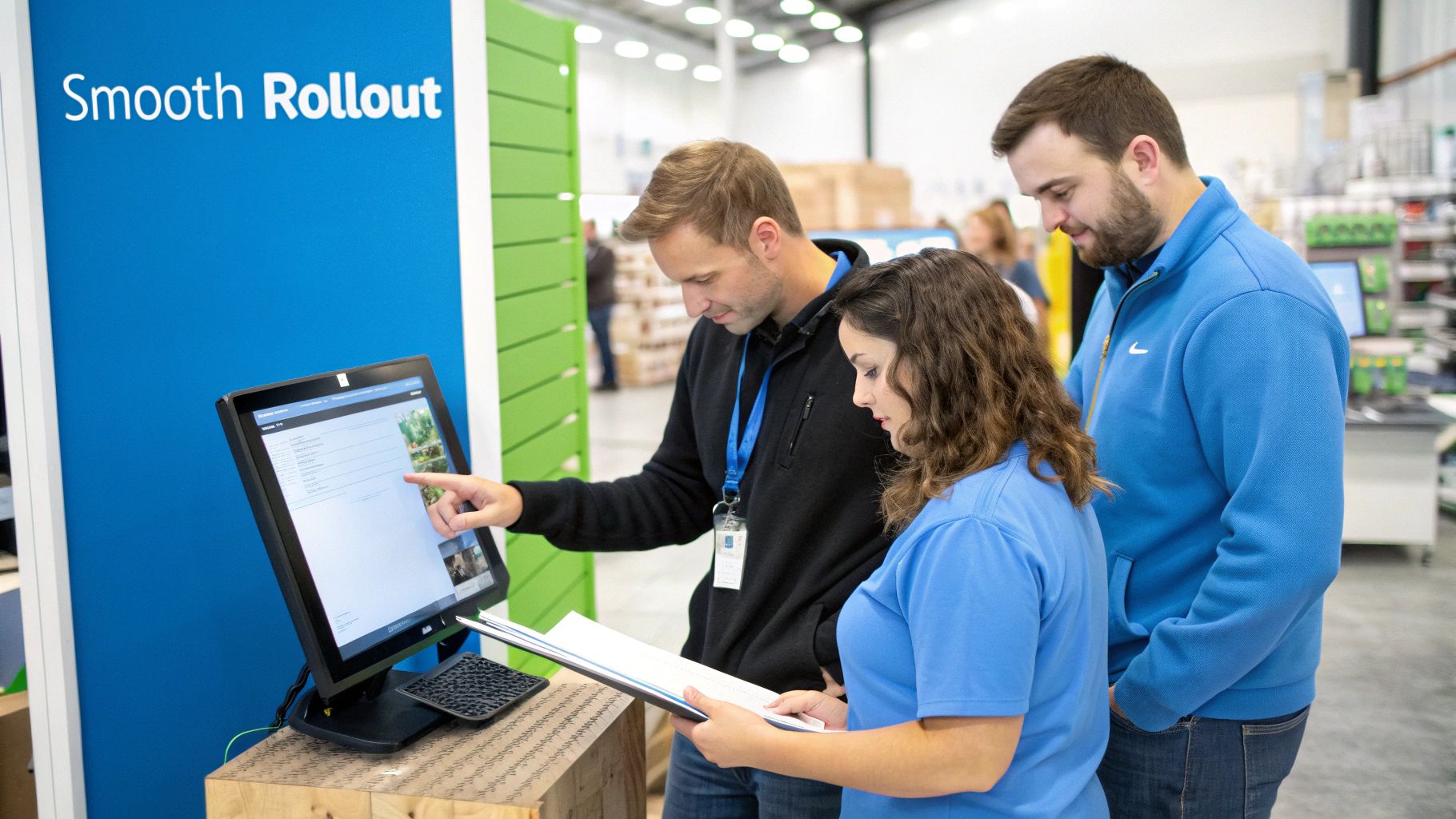
This is where the rubber meets the road. Success isn't about flipping a switch—it’s about having a solid plan that gets everyone, from the front office to the guys on the floor, on the same page. You want to build momentum, not overwhelm your crew.
Best Practices for a Smooth Rollout
A well-planned implementation avoids chaos and builds confidence from day one. Instead of a disruptive "big bang" launch, think of it as a gradual process that lets your team learn and adjust.
- Start with a Pilot Project: Don't try to cram your entire product catalog into the system on day one. That's a recipe for disaster. Instead, pick a single, popular product line to configure first. This gives you a controlled space to work out the kinks and score an early win.
- Appoint a Project Champion: You need one person who lives and breathes this new system. This champion becomes the internal expert and go-to resource, leading the charge, coordinating training, and acting as the main point of contact with the software provider. It keeps communication clear and focused.
- Invest in Real-World Training: Your team needs to see what's in it for them. Training shouldn’t just be about clicking buttons; it should walk them through the real-world quoting scenarios they handle every single day. Show them exactly how this new tool makes their jobs less frustrating and more productive.
The real goal here? To make the new software so essential that it becomes second nature. You'll know you've succeeded when your team can't imagine ever going back to the old, manual way of doing things.
Common Pitfalls You Must Avoid
Even the best software on the market can fall flat if the implementation is a mess. Knowing where others have stumbled is the best way to make sure you don't make the same costly mistakes.
The number one killer of these projects is incomplete or dirty data migration. The old saying "garbage in, garbage out" has never been more true. If you feed the new system outdated material costs, inaccurate labor rates, or messy customer info, you're just setting yourself up to generate bad quotes faster than ever before. Taking the time to clean up your data before you import it is absolutely non-negotiable.
Another huge mistake is failing to get buy-in from the shop floor. If the production team thinks this is just more administrative nonsense from the office, they’ll resist it. Bring them into the process early. Show them how automated work orders and crystal-clear cut sheets will make their lives easier by cutting down on mistakes and confusion.
A fully integrated quoting system is the final piece of the puzzle, connecting your initial plan to the final product. For more insights on building better manufacturing workflows, you can explore our in-depth articles on the TimberCloud blog at https://timbercloud.com/blog. This is about more than just quoting faster—it’s about building a smarter, more connected, and far more profitable business.
Still Have Questions? Let's Talk Shop.
Making any big change in your shop brings up questions, and that's a good thing. When you're looking at quoting software, you need straight answers that actually apply to the real world of custom manufacturing. Let's tackle a few of the most common concerns we hear from shops just like yours.
Isn't This Software Too Complicated for a Small Woodworking Shop?
Not a chance. In fact, it's the opposite. The whole point of modern quoting software is to wrangle the complexity you're already dealing with, not add more. Think of it less like a clunky engineering program and more like a smart assistant who already knows the rules of your shop.
Good systems are built with intuitive, visual interfaces and simple workflows. Once you get your materials, labor rates, and product rules dialed in during the initial setup, the day-to-day work of creating a quote becomes ridiculously fast and easy—far simpler than any spreadsheet or notepad you're using now.
How Does It Handle My Unique, One-of-a-Kind Custom Jobs?
This is where a purpose-built quoting software for manufacturing really proves its worth. You're not stuck with a rigid, predefined catalog. Instead, everything is built around flexible product configurators. You can start with a base product—say, a standard cabinet box—and then empower your team to add an endless list of custom options for those one-off projects.
And what about a job that's completely from scratch? No problem. You can build a quote by simply adding custom line items for non-standard materials, specific labor operations, or unique hardware. The entire time, the software is crunching the numbers in the background, applying your costs and margins automatically. It ensures that even the most creative, out-there jobs are quoted accurately and, most importantly, profitably.
The real magic of this technology is its ability to apply your systematic rules to non-standard, creative work. It brings structure and profitability to the custom projects that define your business, taking the guesswork out of pricing.
What's the Typical ROI? Is It Really Worth It?
While the exact numbers will depend on your shop, our customers consistently see huge returns in three key areas. The first and most immediate win is time savings. We're talking about quoting processes that used to take hours getting crunched down to just minutes.
Next is improved accuracy. This is huge. It completely eliminates the costly underbidding errors that silently eat away at your profit margins. Finally, a faster, more professional quoting experience directly leads to a higher quote-to-win ratio, which means more revenue. When you combine these factors, most shops find the software easily pays for itself within just a few months.
Ready to turn your quoting process from a painful bottleneck into your biggest competitive advantage? TimberCloud, Inc. offers an all-in-one platform designed to connect your sales, engineering, and production teams for seamless, profitable manufacturing. Explore how TimberCloud can work for your shop today!
Topics
TimberCloud Team
Content Team
The TimberCloud team is dedicated to helping manufacturers streamline their operations with intelligent software solutions.