8 Essential Methods of Valuing Inventory for Woodworking Shops in 2025
In a custom woodworking shop, your inventory isn't just a pile of lumber and hardware; it's a significant financial asset. The way you account for its value directly impacts your reported profits, tax liability, and ultimately, your ability to make smart business decisions. Choosing from the various methods of valuing inventory can feel overwhelming, but getting it right is the difference between guessing your margins and knowing them with precision. An incorrect choice can lead to overpaying taxes or misrepresenting your company's profitability to lenders and investors.
This guide breaks down the eight most critical inventory valuation methods, tailored specifically for the challenges of custom woodworking and millwork. We'll move beyond abstract accounting theory to provide actionable insights for each one, including:
- A clear definition and a worked example using a woodworking scenario.
- The direct accounting and tax implications.
- Specific pros and cons for a custom millwork or cabinet shop.
- Guidance on selecting the right method for your business model.
We’ll also cover practical implementation tips. For companies requiring a structured approach, an effective Odoo Inventory Management system can help streamline the application and tracking of these methods. By the end, you’ll be equipped to select and implement the approach that best aligns your financial reporting with your operational reality, turning your inventory management into a strategic advantage.
1. First-In, First-Out (FIFO)
The First-In, First-Out (FIFO) method is one of the most intuitive and widely used methods of valuing inventory. It operates on a simple, logical principle: the first inventory items purchased are the first ones to be sold or used in production. This approach closely mirrors the natural physical flow of materials in many businesses, especially in custom woodworking and millwork, where rotating stock to use the oldest materials first is common sense to prevent waste or degradation.
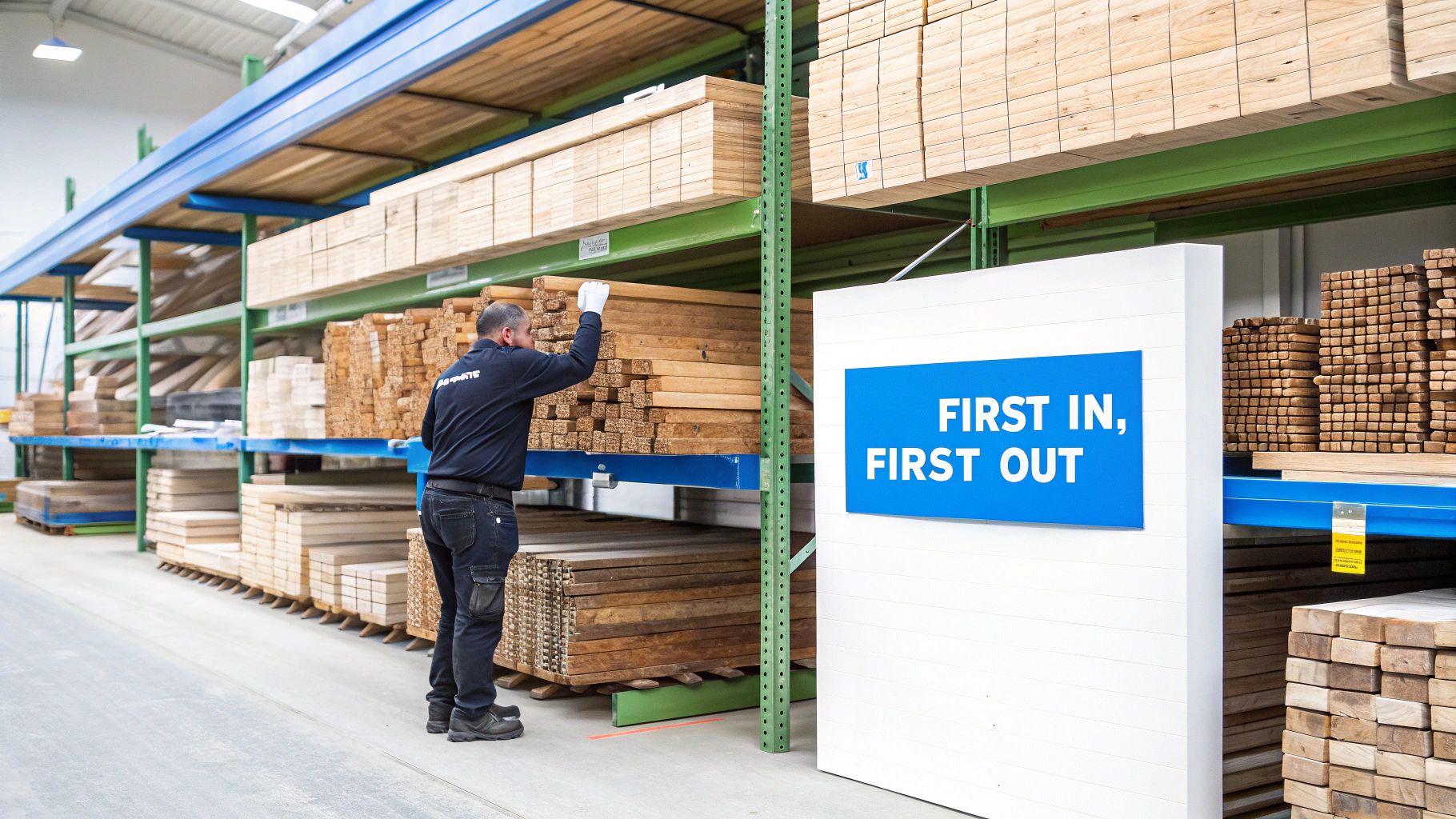
When you use FIFO, your ending inventory is valued at the most recent purchase prices, while the Cost of Goods Sold (COGS) reflects the cost of your oldest inventory. During periods of rising material costs, this results in a lower COGS, higher reported profits, and consequently, a higher tax liability. However, it also presents a more accurate balance sheet, as your inventory asset is valued at current market prices.
FIFO in Action: A Worked Example
Imagine a custom cabinetry shop purchases three batches of maple lumber:
- January: 500 board feet @ $8/bf = $4,000
- February: 500 board feet @ $8.50/bf = $4,250
- March: 500 board feet @ $9/bf = $4,500
In April, the shop uses 700 board feet for a large kitchen project. Under FIFO, the cost calculation is:
- First 500 board feet are from the January batch (500 bf x $8/bf = $4,000).
- The remaining 200 board feet are from the February batch (200 bf x $8.50/bf = $1,700).
The total COGS for this project is $5,700 ($4,000 + $1,700). The remaining inventory of 800 board feet is valued at the most recent costs: (300 bf x $8.50) + (500 bf x $9.00) = $7,050.
Practical Tips for Implementation
For FIFO to be effective, your physical inventory management must align with your accounting.
- Organize Your Stock: Arrange raw materials like lumber and hardware chronologically. Use clear labeling with purchase dates or batch numbers on each stack or bin.
- Leverage Technology: Implement barcode or RFID systems to automatically track the age of materials from receiving to production.
- Utilize ERP Systems: Platforms like TimberCloud are designed for this. You can use its raw material tracking to flag the oldest stock for upcoming production runs, ensuring your physical usage matches your accounting method. Explore how to set up and manage inventory lots by learning more about TimberCloud's powerful features.
- Conduct Regular Audits: Perform physical inventory counts quarterly or semi-annually to verify that your recorded inventory values match the actual stock on hand, correcting any discrepancies.
2. Last-In, First-Out (LIFO)
The Last-In, First-Out (LIFO) method operates on the principle opposite to FIFO: it assumes the most recently purchased inventory items are the first ones sold or used. This approach often diverges from the actual physical flow of materials in a custom woodworking shop, where using older stock first is more practical. However, LIFO is a powerful accounting tool, particularly for its potential tax benefits during periods of rising material costs.

When using LIFO, your Cost of Goods Sold (COGS) is based on the cost of your newest inventory, while your ending inventory is valued at older, often lower, costs. In an inflationary environment where lumber and hardware prices are climbing, this results in a higher COGS, which in turn leads to lower reported profits and a reduced tax liability. It's important to note that LIFO is permitted under U.S. GAAP but is prohibited under International Financial Reporting Standards (IFRS).
LIFO in Action: A Worked Example
Let's use the same custom cabinetry shop purchasing maple lumber, but this time applying the LIFO method:
- January: 500 board feet @ $8/bf = $4,000
- February: 500 board feet @ $8.50/bf = $4,250
- March: 500 board feet @ $9/bf = $4,500
In April, the shop uses 700 board feet for a project. Under LIFO, the cost is calculated using the most recent purchases first:
- First 500 board feet are from the March batch (500 bf x $9/bf = $4,500).
- The remaining 200 board feet are from the February batch (200 bf x $8.50/bf = $1,700).
The total COGS for this project is $6,200 ($4,500 + $1,700). The remaining inventory of 800 board feet is valued at the oldest costs: (500 bf x $8.00) + (300 bf x $8.50) = $6,550.
Practical Tips for Implementation
LIFO is primarily an accounting strategy, so meticulous record-keeping is crucial.
- Consult a CPA: Before adopting LIFO, discuss the full tax implications and compliance requirements with a tax professional. You must formally elect to use LIFO with the IRS.
- Use Capable Software: Your accounting or ERP system must be able to handle LIFO's "layering" methodology, tracking inventory in batches based on acquisition cost and date.
- Monitor Inflation: LIFO's main advantage is tied to rising prices. Keep a close watch on material cost trends to ensure the method remains beneficial for your business.
- Beware of LIFO Liquidation: If you sell more inventory than you purchase in a period, you may have to dip into older, lower-cost layers. This can trigger a significant, and often unexpected, increase in taxable income.
- Plan for Physical Stock: While your accounting is LIFO, your physical stock may still follow a FIFO flow. Ensure you have a system to reconcile the two for accurate financial reporting.
3. Weighted Average Cost (WAC)
The Weighted Average Cost (WAC) method smooths out price fluctuations by calculating a single average cost for all similar inventory items. It's determined by dividing the total cost of goods available for sale by the total number of units available for sale. This approach is particularly effective for woodworking shops that purchase homogenous materials like screws, hinges, or finishes from various suppliers at different prices throughout a period.
Unlike FIFO or LIFO, WAC doesn't require tracking individual purchase batches. Instead, it creates a blended cost that simplifies accounting. For millwork or cabinetry businesses with high-volume, interchangeable stock, this method provides a stable and consistent valuation, preventing large swings in COGS and profit margins caused by the latest price spike or discount.
WAC in Action: A Worked Example
Consider a furniture maker who frequently buys standard drawer slides:
- Beginning Inventory: 200 pairs @ $10/pair = $2,000
- Purchase 1: 300 pairs @ $11/pair = $3,300
- Purchase 2: 150 pairs @ $10.50/pair = $1,575
The total available inventory is 650 pairs (200 + 300 + 150) at a total cost of $6,875 ($2,000 + $3,300 + $1,575). The weighted average cost per pair is $6,875 / 650 pairs = $10.58 per pair.
If the shop uses 400 pairs for a production run, the COGS is $4,232 (400 pairs x $10.58). The remaining inventory of 250 pairs is valued at $2,645 (250 pairs x $10.58).
Practical Tips for Implementation
WAC is simpler to manage than other methods, but accuracy still requires systematic processes.
- Update After Purchases: Recalculate your weighted average cost after each new inventory purchase to maintain the most accurate valuation.
- Categorize Inventory: Apply the WAC method separately for distinct categories (e.g., hardware, finishes, lumber grades) to avoid skewing costs between vastly different materials.
- Automate Calculations: Use accounting software or spreadsheet templates to automate WAC calculations, reducing the risk of manual errors, especially with frequent purchases.
- Leverage ERP Systems: Use your ERP to track total costs and quantities automatically. Platforms like TimberCloud can integrate with your accounting system to provide real-time WAC reporting, simplifying financial statements and cost analysis. Learn how TimberCloud can help manage costs by exploring its core functionalities.
- Quarterly Reviews: Periodically review your average costs to identify significant price trends from suppliers and adjust your product pricing or sourcing strategies accordingly.
4. Specific Identification
The Specific Identification method is the most precise of all the methods of valuing inventory, as it tracks the actual cost of each individual item. It operates by assigning a unique cost to each product or material batch from purchase through to the final sale. This approach is perfectly suited for custom woodworking and millwork shops that handle unique, high-value, or easily distinguishable items, such as a rare slab of figured maple, a specific lot of reclaimed lumber, or custom-ordered architectural hardware.
With Specific Identification, the Cost of Goods Sold (COGS) is the exact cost of the specific items sold, and the ending inventory value is the sum of the costs of the specific items still on hand. This method provides the most accurate financial reporting possible because it perfectly matches costs to revenues. This precision is invaluable for calculating the true profitability of custom, high-margin projects where material costs can vary significantly.
Specific Identification in Action: A Worked Example
Consider a high-end furniture maker who purchases two unique walnut slabs for a custom conference table:
- Slab A (Figured Walnut): 1 slab @ $1,800
- Slab B (Standard Walnut): 1 slab @ $950
A client commissions a table and specifically requests the Figured Walnut (Slab A). When the project is complete and the table is sold, the COGS for that project’s primary material is exactly $1,800. The remaining inventory is valued at the cost of the specific item left, so the inventory asset for walnut slabs is $950 (Slab B). There is no cost-flow assumption, only a direct match.
Practical Tips for Implementation
Success with this method hinges on meticulous tracking and traceability.
- Tag Everything: Implement a robust tagging system using barcodes, QR codes, or RFID tags for every high-value item or distinct material batch upon receipt.
- Leverage Technology: A platform like TimberCloud is essential. Use its product builder and inventory management features to link specific material lots or serialized components directly to customer work orders.
- Document Meticulously: Create a detailed receiving process that captures not just cost but also source, batch number, and even photos for rare materials.
- Integrate with Production: Your work order system must document precisely which tagged materials were consumed for each job, ensuring the accounting reflects physical reality.
- Conduct Regular Audits: Perform frequent physical counts, verifying that the tagged items on your shelves match the records in your system to catch any discrepancies early.
5. Moving Average Cost (MAC)
The Moving Average Cost (MAC) method, also known as the weighted-average cost method, offers a balanced approach to inventory valuation. It continuously recalculates the average cost of all items in stock each time a new purchase is made. This creates a constantly updated, rolling average price that smooths out cost fluctuations over time, providing a more stable and representative inventory value.
This method is particularly effective for woodworking shops that receive frequent material deliveries at varying prices, such as weekly lumber shipments or regular hardware restocks. Instead of tracking individual cost layers like FIFO or LIFO, MAC simplifies the process by applying one consistent average cost to all units, making it one of the more practical methods of valuing inventory for businesses with high-volume, perpetual inventory systems.
MAC in Action: A Worked Example
Consider a millwork operation that regularly buys a specific type of veneer. Its purchase and usage are as follows:
- Opening Inventory: 100 sheets @ $40/sheet = $4,000
- Purchase 1 (May 10): 150 sheets @ $42/sheet = $6,300
- Sale (May 15): Sold 120 sheets
First, calculate the new moving average cost after the purchase:
- Total sheets: 100 + 150 = 250 sheets
- Total cost: $4,000 + $6,300 = $10,300
- New Average Cost: $10,300 / 250 sheets = $41.20 per sheet
The Cost of Goods Sold (COGS) for the May 15 sale is 120 sheets x $41.20/sheet = $4,944. The ending inventory is 130 sheets (250 - 120) valued at $41.20 each, totaling $5,356.
Practical Tips for Implementation
The MAC method's accuracy depends entirely on real-time data entry and system automation.
- Automate Calculations: Use accounting software or an ERP system that automatically recalculates the moving average cost whenever a purchase order is received. Manual calculations are prone to error.
- Sync Inventory in Real-Time: In platforms like TimberCloud, you can set up real-time inventory synchronization. This ensures that every new material receipt immediately triggers an update to the moving average cost, keeping your valuation current. Learn more about how to streamline this with TimberCloud’s powerful features.
- Monitor Price Variances: Regularly review your average costs against new purchase prices. This can help you identify significant supplier cost trends and inform your pricing strategy.
- Perform Regular Audits: Reconcile your perpetual inventory records with physical counts monthly to ensure the system's accuracy and catch discrepancies before they compound.
6. Standard Costing
The Standard Costing method moves beyond tracking actual costs by establishing predetermined or “standard” costs for materials, labor, and overhead. This approach is highly effective for custom woodworking and millwork operations as it provides a stable baseline for pricing, budgeting, and performance measurement. Instead of valuing inventory at its fluctuating actual cost, it’s valued at what it should have cost, making it an invaluable tool for operational control.
With Standard Costing, you compare your actual costs against these established standards. The differences, known as variances, highlight operational inefficiencies, unexpected material price hikes, or labor productivity issues. A favorable variance means you spent less than planned, while an unfavorable variance means you overspent. This makes Standard Costing less of a simple accounting method and more of a proactive management tool.
Standard Costing in Action: A Worked Example
Consider a millwork operation that produces a standard poplar door frame. It establishes the following standard costs per frame:
- Material: 15 board feet of poplar @ a standard cost of $4/bf = $60
- Labor: 1.5 hours @ a standard rate of $30/hour = $45
- Overhead: Applied at 50% of direct labor cost = $22.50
The total standard cost for one door frame is $127.50.
During production of 100 frames, the company incurs the following actual costs:
- Actual Material Used: 1,600 bf of poplar @ $4.10/bf = $6,560
- Actual Labor: 155 hours @ $31/hour = $4,805
By comparing actual to standard costs, you can identify variances. For instance, the unfavorable material price variance is $160 (1,600 bf x ($4.10 - $4.00)), indicating a higher purchase price than expected. This immediate feedback helps pinpoint cost overruns for quick corrective action.
Practical Tips for Implementation
Effectively using Standard Costing requires diligence in setting and reviewing your standards.
- Establish Realistic Standards: Base your standards on recent historical data, current market prices, and efficient (but achievable) production times.
- Review and Update Regularly: Material costs and labor rates change. Review and update your standards quarterly or semi-annually to keep them relevant and your variance analysis meaningful.
- Analyze Variances: Don't just record variances; investigate them. A significant material usage variance could signal waste on the shop floor, while a labor efficiency variance might point to a need for better training or equipment maintenance.
- Leverage Technology: Use TimberCloud’s product builder to establish and manage standard costs for each configurable product. The platform’s automated quotes and cut sheets can help validate your material and labor assumptions, ensuring your standards are grounded in reality. Check out how our system supports detailed cost management by exploring TimberCloud's transparent pricing.
- Train Your Team: Educate shop managers and key personnel on what variances mean. This fosters a culture of continuous improvement where everyone is focused on controlling costs and boosting efficiency.
7. Absorption Costing (Full Absorption)
Absorption costing, also known as full absorption costing, is a method of valuing inventory that assigns all direct and indirect manufacturing costs to the products produced. This includes direct materials, direct labor, and both variable and fixed manufacturing overhead. For a custom millwork or woodworking shop, this provides a comprehensive view of what it truly costs to create each product, ensuring that pricing covers not just the wood and the artisan's time, but also the rent for the workshop, the depreciation of the CNC machine, and the supervisor's salary.
Under Generally Accepted Accounting Principles (GAAP), absorption costing is required for external financial reporting. It ensures that inventory on the balance sheet and the cost of goods sold on the income statement reflect the full production cost. By allocating fixed overhead costs to each unit, you avoid expensing them all in the period they are incurred, which can smooth out profitability metrics, especially in businesses with fluctuating production volumes.
Absorption Costing in Action: A Worked Example
Consider a furniture maker that produces custom dining tables. In one month, they incur the following costs to produce 20 tables:
- Direct Materials: $10,000 ($500 per table)
- Direct Labor: $8,000 ($400 per table)
- Variable Overhead (e.g., electricity for machines): $1,000 ($50 per table)
- Fixed Overhead (e.g., rent, insurance, salaries): $5,000
The total manufacturing cost is $24,000 ($10,000 + $8,000 + $1,000 + $5,000). To find the cost per table under absorption costing:
- Total Cost / Number of Units = $24,000 / 20 tables = $1,200 per table.
If 15 tables are sold and 5 remain in inventory, the COGS is $18,000 (15 tables x $1,200), and the ending inventory value is $6,000 (5 tables x $1,200).
Practical Tips for Implementation
Successfully implementing absorption costing requires a systematic approach to tracking and allocating overhead.
- Establish Clear Allocation Bases: Determine how you will allocate fixed overhead. Common bases include direct labor hours, machine hours, or direct material costs. Choose the one that most closely correlates with your production activity.
- Review Allocation Annually: Your business changes over time. Re-evaluate your overhead allocation methods at least once a year to ensure they remain accurate and reflective of your current operations.
- Use for Reporting, Inform with Variable: While absorption costing is necessary for financial statements, use variable costing (which excludes fixed overhead) for internal decision-making to better understand break-even points and profit sensitivity.
- Leverage Technology: Utilize your ERP system to automate cost tracking. TimberCloud’s reporting features can help you monitor total manufacturing costs by product line, making it easier to calculate and apply overhead rates accurately.
8. Variable Costing (Direct Costing)
Variable Costing, also known as Direct Costing, offers a unique lens for internal decision-making by valuing inventory based only on its variable manufacturing costs. This method assigns direct materials, direct labor, and variable overhead to products, while treating all fixed manufacturing costs (like rent and administrative salaries) as period expenses expensed in the period they are incurred. This approach is invaluable for custom woodworking shops needing a clear view of which products truly contribute to covering fixed costs and generating profit.
Variable costing provides a powerful tool for short-term strategic decisions, such as pricing special orders or determining the profitability of a specific product line. By isolating variable costs, you can calculate the contribution margin for each item, which is the revenue left over to cover fixed expenses. This differs from other methods of valuing inventory that are required for external financial reporting, like absorption costing.
Variable Costing in Action: A Worked Example
Consider a millwork operation that produces custom doors. It receives a special, one-time order for 50 doors at a discounted price of $350 each.
- Direct Materials per Door: $150
- Direct Labor per Door: $80
- Variable Overhead per Door (e.g., electricity for machines, finishing supplies): $40
- Total Fixed Factory Overhead for the Month (rent, supervisor salary): $10,000
Under variable costing, the cost assigned to each door is only the sum of its variable costs: $150 + $80 + $40 = $270.
- Contribution Margin per Door: $350 (price) - $270 (variable cost) = $80.
- Total Contribution from Order: 50 doors x $80/door = $4,000.
This $4,000 contributes directly to covering the $10,000 in fixed overhead. While a traditional costing method might allocate a portion of fixed overhead and show the order as unprofitable, variable costing reveals it's a financially sound decision, provided the shop has the spare capacity.
Practical Tips for Implementation
Variable costing is primarily an internal management tool, not for external financial statements under GAAP or IFRS.
- Calculate Contribution Margins: Regularly calculate the contribution margin (selling price minus total variable costs) for each product or product line. Use this to identify your most and least profitable items.
- Set Production Targets: Use contribution margin data to perform break-even analysis. This helps you determine the sales volume needed to cover all fixed costs and start generating a profit.
- Inform Pricing Strategy: Leverage this method to evaluate special orders or sales promotions. If a proposed price exceeds the variable cost, accepting the order can contribute positively to covering fixed overhead.
- Use ERP for Clarity: A system like TimberCloud can be configured to track variable costs separately from fixed overhead. This allows you to generate internal reports for profitability analysis without disrupting your standard accounting for external reporting. You can find more insights on applying these principles on our company blog.
- Educate Your Team: Ensure stakeholders understand that variable costing profits will differ from figures on official financial statements. This clarity prevents confusion and promotes better, data-driven internal decisions.
Inventory Valuation: 8-Method Comparison
| Method | Implementation Complexity 🔄 | Resource Requirements ⚡ | Expected Outcomes 📊 | Ideal Use Cases 💡 | Key Advantages ⭐ |
|---|---|---|---|---|---|
| First-In, First-Out (FIFO) | Moderate — requires batch/date tracking but aligns with physical flow | Low–Moderate — barcode/RFID or basic tracking; supports JIT | Inventory valued at recent purchase costs; realistic flow; higher reported profits in inflation | High-turnover shops, seasonal purchases, multiple wood grades | Matches physical flow; simpler rotation; easier lot tracking |
| Last-In, First-Out (LIFO) | High — complex layer tracking and tax election (IRS Form 970) | High — advanced accounting, CPA involvement, detailed records | Lower taxable income during inflation; older-cost inventory valuation; potential mismatch with physical flow | Large stockpiles, US firms in inflationary markets, tax-optimization strategies | Significant tax savings in rising prices; protects margins |
| Weighted Average Cost (WAC) | Low — straightforward averaging calculations | Low — spreadsheets or basic accounting; group by category for accuracy | Smoothed unit costs and COGS; reduced profit volatility | Commoditized materials, varied suppliers, moderate inventory complexity | Simple to implement; accepted under GAAP/IFRS; stabilizes reported costs |
| Specific Identification | Very high — per-unit/batch cost tracking and traceability required | Very high — RFID/barcode, labor, sophisticated systems | Most accurate cost-to-project; precise margin and traceability | Premium/luxury furniture, made-to-order, high-value specialty materials | Maximum accuracy and traceability; supports premium pricing and QC |
| Moving Average Cost (MAC) | Moderate — perpetual system and real-time recalculation needed | Moderate — inventory software that auto-updates averages | Dynamic, current cost basis; balances timeliness and simplicity | Frequent purchases, perpetual-inventory users, continuous production | More responsive than WAC; reduces impact of single large purchases |
| Standard Costing | High — set and maintain standard rates; variance analysis required | Moderate–High — cost analysis tools, reporting, training | Predictable costing, variance insights, better quoting and cost control | Repetitive production, job-costing shops, margin optimization | Enables budgeting, early variance detection, process improvement |
| Absorption Costing (Full) | Moderate–High — requires overhead allocation methodology | Moderate — accounting systems and allocation bases | Full product cost on books; GAAP-compliant reporting; inventory may be inflated | External reporting, lenders/investors, long-term pricing strategies | Comprehensive cost recovery; GAAP-compliant; supports sustainable pricing |
| Variable Costing (Direct) | Moderate — must separate fixed vs. variable costs | Low–Moderate — internal reporting and managerial training | Clear contribution margins; profits tied to sales not production; not GAAP | Internal decision-making, special orders, break-even and product-mix analysis | Improves operational decisions; avoids overproduction incentives |
Choosing Your Method: The Blueprint for Financial Clarity
We've explored a comprehensive workshop of inventory valuation methods, moving from the straightforward logic of FIFO to the detailed precision of Specific Identification and the strategic nuances of LIFO and Absorption Costing. The journey through these eight distinct approaches reveals a powerful truth: your choice is far more than an accounting formality. It's a strategic decision that directly shapes your financial reporting, influences your tax obligations, and ultimately impacts your perceived profitability. Mastering the different methods of valuing inventory is not just about compliance; it's about gaining a competitive edge.
For the custom woodworking or millwork professional, inventory isn't just a number on a spreadsheet. It's the lifeblood of your craft, a tangible asset of wood species, hardware, and finishes that holds immense potential value. The method you choose to account for this value must align with the physical reality of your shop floor and your long-term business strategy.
Distilling Your Decision: Key Takeaways
Making the right choice requires reflecting on your unique operational model. Let’s distill the core insights from our exploration to guide your decision-making process:
- For Unmatched Precision: If your shop works with unique, high-value, or one-of-a-kind materials like rare burls, reclaimed timbers, or exotic veneers, the Specific Identification method is unparalleled. It offers a true one-to-one match between cost and revenue, providing the most accurate gross profit figures for bespoke projects.
- For Simplicity and Logical Flow: Most businesses, especially those with a consistent production flow, find First-In, First-Out (FIFO) to be the most intuitive and widely accepted method. It reflects the natural movement of materials and presents a clear, easy-to-defend picture of profitability, especially in stable or deflationary markets.
- For Tax Strategy in Rising Markets: In an inflationary environment where the cost of lumber and supplies is consistently increasing, Last-In, First-Out (LIFO) can be a powerful tool. By matching the most recent (and highest) costs against current revenues, it can lower your reported net income and, consequently, your tax liability. However, be mindful of its complexities and the fact it's prohibited under IFRS.
- For High-Volume, Homogeneous Inventory: When dealing with large quantities of similar items where tracking individual costs is impractical (like standard fasteners, hardware, or common lumber grades), the Weighted Average Cost (WAC) or Moving Average Cost (MAC) methods offer a practical solution. They smooth out cost fluctuations, providing a stable and representative inventory value that simplifies bookkeeping.
Strategic Insight: The best inventory valuation method is not static. As your business scales, introduces new product lines, or shifts its operational focus, you should periodically reassess your chosen method with your accountant to ensure it still serves your financial goals.
From Theory to Action: Your Next Steps
Choosing your ideal method is the first step; successful implementation is what brings financial clarity to life. This is where your operational processes and technology stack become critical. An integrated system is no longer a luxury but a necessity for accurate, real-time inventory valuation.
Your action plan should involve three key stages:
- Evaluate Your Flow: Map out how materials physically move through your shop. Do you use the oldest stock first (FIFO)? Do you pull from the most convenient location (potentially LIFO)? Do you reserve specific high-grade slabs for certain jobs (Specific Identification)? Your physical reality should heavily influence your accounting choice.
- Consult the Experts: Schedule a meeting with your accountant or a financial advisor. Discuss the pros and cons of the top two or three methods you've identified. They can provide invaluable insight into the specific tax implications for your jurisdiction and help you model the financial impact of each choice.
- Leverage Technology: The manual tracking required for methods like Specific Identification or Moving Average is prone to error and incredibly time-consuming. A robust ERP system transforms this challenge into an automated process. By integrating inventory management directly into your production workflow, you ensure that every board, every fastener, and every hour of labor is accounted for accurately from purchase to final sale.
Ultimately, selecting and implementing one of these methods of valuing inventory is about building a bridge between your workshop's physical assets and your company's financial health. It empowers you to make smarter purchasing decisions, price your custom work more profitably, and build a resilient business founded on a rock-solid financial blueprint.
Ready to replace guesswork with precision and transform your inventory data into your most powerful business asset? See how TimberCloud, Inc. integrates real-time material tracking directly into your production workflow, making complex methods like Specific Identification and Moving Average simple and automated. Book a demo with TimberCloud, Inc. today and build the foundation for true financial clarity.
Topics
TimberCloud Team
Content Team
The TimberCloud team is dedicated to helping manufacturers streamline their operations with intelligent software solutions.