Mastering Cost of Goods Manufactured for Woodworking Profits

Running a busy workshop can be a double-edged sword. Orders are flying in, the machines are humming, but when you look at the bank account at the end of the month, the numbers don't always add up. Sound familiar? This frustrating gap between being busy and being profitable often comes down to one critical blind spot: not knowing the true cost of what you build.
This is where the cost of goods manufactured (COGM) comes in. It’s not just another piece of accounting jargon; it’s the most important number you might not be tracking.
Why Cost of Goods Manufactured Is Your Most Important Metric
Think of COGM as the final "price tag" for everything you produce in a given period before it gets sold. It bundles up every direct cost—the lumber, the hardware, the hours your team spent sanding and assembling, and even a share of the factory's electricity bill—into one, all-in figure.
It’s the total cost of turning a pile of raw materials into a finished product ready for a customer. Without knowing this number, you're essentially flying blind, basing your pricing and business strategy on pure guesswork.
The Compass for Profitability
Too many shop owners see COGM as a chore for their accountant. That's a huge missed opportunity. This isn't just about paperwork; it's about giving yourself a strategic compass to guide your business. It tells you exactly how much value you’ve generated on the shop floor.
Once you start calculating your cost of goods manufactured, you can finally:
- Set Prices with Confidence: No more guessing games. You can price every job to ensure you’re hitting your target profit margin, every single time.
- Spot Hidden Inefficiencies: Is one particular product eating up more labor than you thought? Is material waste creeping up? COGM shines a spotlight on where your money is really going.
- Get a Handle on Inventory: You'll gain a much clearer picture of the value tied up in your half-finished projects, also known as Work-in-Process (WIP) inventory.
Mastering your COGM fundamentally changes how you view your business. It shifts your focus from just being busy to being strategically profitable. This metric is what separates the shops that just get by from the ones that truly thrive.
This guide will break down the cost of goods manufactured formula in a way that makes sense for a real-world shop. We'll ditch the dry theory and show you how to apply it, connecting your daily production work directly to your bottom line. You'll walk away with the confidence to make smarter decisions that actually grow your profits.
Breaking Down The COGM Formula For Your Shop
At first, the Cost of Goods Manufactured formula can look like some scary algebra problem from high school. But it’s not. It’s really just the story of your production process, told with numbers.
Think of it less like a rigid equation and more like a recipe. You’re simply adding up the costs of everything it took to turn a pile of raw materials into a finished product ready for a customer. To get it right, you just need to understand the three main ingredients.
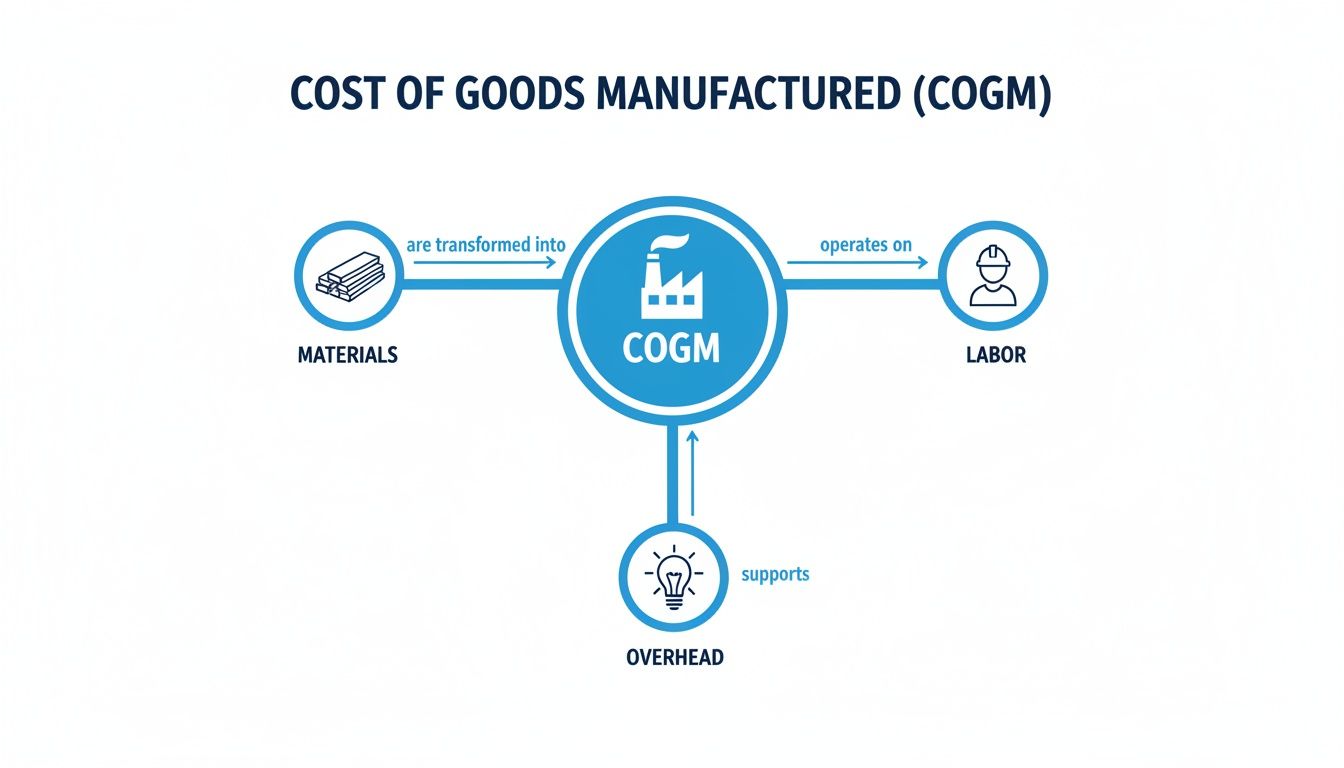
As you can see, your final COGM number is a blend of all the direct and indirect costs that happen on the shop floor. Let's dig into each one.
The Foundation: Direct Materials
Direct materials are the easiest part to grasp. These are the physical components that you can see and touch in the final product. For a woodworking shop, this goes way beyond just the lumber.
We’re talking about every board foot of walnut, every sheet of birch plywood, and every live-edge slab you pull from the rack. But it also includes the "small stuff" that adds up, like:
- Hardware: Hinges, drawer slides, fasteners, and cabinet pulls.
- Finishing Supplies: Stains, lacquers, sealants, and even the sandpaper used to prep the wood.
Getting a handle on the true cost of these materials as they move from inventory to the workshop floor is the first, most crucial step to an accurate COGM.
The Skill: Direct Labor
Next up is direct labor. This isn't your total payroll. It’s the specific wages and benefits paid to the people whose hands-on work actually transforms those raw materials.
These are your craftspeople—the team running the saws and CNC machines, the experts in the finishing booth, and the crew on the assembly line. Their time is a core production cost. The salary of your sales manager or bookkeeper, while a vital business expense, doesn't belong here. They aren't directly building the product.
The Engine: Manufacturing Overhead
This is where things can get a little tricky, but it’s just as important. Manufacturing overhead covers all the indirect costs needed to keep your shop running.
Think of it as everything that keeps the lights on and the machines humming, but which you can't easily pin to one specific cabinet or table.
Here’s a quick breakdown to help you visualize what goes into your overhead calculation.
| Component | Definition | Woodworking Shop Examples |
|---|---|---|
| Direct Materials | Raw materials that become part of the final product. | Lumber (maple, oak), plywood, hardware (hinges, pulls), finishes (stain, lacquer). |
| Direct Labor | Wages for employees who physically build the product. | Cabinet makers, CNC operators, finishers, assembly crew. |
| Manufacturing Overhead | Indirect costs that support production but aren't tied to a single item. | Factory rent, utilities, supervisor salaries, machine depreciation, sandpaper, glue. |
These components form the backbone of your COGM calculation, ensuring you capture the full cost of production.
Depreciation is a big one that a lot of shops miss. According to Federal Reserve data, industrial machinery prices have shot up 85% since 1994, with a massive 13.6% jump in 2022 alone. That trend makes accounting for your equipment's wear and tear absolutely critical for protecting your margins. You can explore more data on rising manufacturing costs to see just how much these trends can impact your bottom line.
Once you have these three components, the formula itself starts to make a lot more sense.
The Cost of Goods Manufactured (COGM) Formula:
Beginning Work-in-Process Inventory + Direct Materials Used + Direct Labor + Manufacturing Overhead - Ending Work-in-Process Inventory = Cost of Goods Manufactured
All this formula does is take your total manufacturing costs for a given period (a month, a quarter) and adjust for any unfinished jobs. What you're left with is the true, all-in cost of only the goods you actually completed.
A Real-World Example: Calculating COGM for a Cabinet Job
Alright, enough with the theory. Formulas are one thing, but seeing them in action on a real project is where the lightbulb really clicks on. Let's walk through the cost of goods manufactured for a job every woodworker knows well: a custom kitchen cabinet set. This example will take the COGM formula off the page and put it to work in a way you can immediately connect with.

Let's imagine our shop, "Artisan Cabinets," is crunching the numbers for the month of April to figure out the true cost of everything they finished.
Step 1: Rounding Up the Numbers
First things first, we need to gather all the key figures for April. This means pulling data on our materials, our labor, our overhead, and the value of any jobs that were half-done at the start and end of the month.
Here’s what Artisan Cabinets’ books look like for April:
- Direct Materials Used: The shop consumed $12,000 worth of maple, plywood, hinges, drawer slides, and finish.
- Direct Labor: The wages and benefits for the cabinet makers and finishers on the floor totaled $18,000.
- Manufacturing Overhead: All the indirect costs—shop rent, utilities, supervisor pay, and machine depreciation—added up to $9,000.
- Beginning Work-in-Process (WIP) Inventory: On April 1st, there was $7,000 worth of partially built cabinets on the shop floor.
- Ending Work-in-Process (WIP) Inventory: By the time April 30th rolled around, the value of unfinished jobs stood at $5,000.
With these numbers collected, we're ready to calculate what it actually cost to complete all the finished work this month.
Step 2: Calculating Your Total Manufacturing Costs
Before we get to the final COGM, we need to figure out the total amount of money we poured into production during April. This is your Total Manufacturing Cost, and it’s pretty straightforward.
You just add up your three main production costs:
Total Manufacturing Cost = Direct Materials Used + Direct Labor + Manufacturing Overhead
For Artisan Cabinets, that looks like:
$12,000 (Materials) + $18,000 (Labor) + $9,000 (Overhead) = $39,000
So, the shop sank $39,000 in new costs into production during April. But hold on—this isn't our final answer. We still have to account for the jobs that were already underway and those we didn't quite finish.
Step 3: Adjusting for Work-in-Process Inventory
This is the crucial step that separates COGM from a simple expense tally. We need to adjust for the change in our Work-in-Process inventory. Why? Because we only want to count the cost of goods that were actually finished in April.
Here's the full COGM formula in action:
Beginning WIP Inventory + Total Manufacturing Costs – Ending WIP Inventory = Cost of Goods Manufactured
Let's plug in the numbers for Artisan Cabinets:
- Start with what you had: We begin with the value of jobs already in progress on April 1st, which was $7,000.
- Add what you spent: Then, we add all the new costs from April, our $39,000 in Total Manufacturing Costs.
- Subtract what's left: Finally, we back out the value of jobs that are still on the floor on April 30th: $5,000.
Putting it all together:
$7,000 (Beginning WIP) + $39,000 (Total Manufacturing Costs) – $5,000 (Ending WIP) = $41,000
The Cost of Goods Manufactured (COGM) for Artisan Cabinets in April is $41,000.
This $41,000 figure is pure gold. It tells the owner the exact cost of all the finished cabinets that moved from the shop floor to the finished goods inventory during the month. It's the true cost of their output, ready to be measured against revenue to see how profitable they really were.
This single number becomes the bedrock for smarter business decisions. Was $41,000 a good number for the month's output? How does it stack up against March? By walking through a simple example like this, that abstract formula suddenly becomes a powerful, practical tool for keeping a finger on the financial pulse of your shop.
How Accurate COGM Drives Pricing and Profitability
Knowing the COGM formula is one thing, but the real magic happens when you start putting that number to work. A precise COGM figure is the absolute foundation of any solid pricing strategy. Without it, you’re basically just guessing what to charge for your projects.
That kind of guesswork is risky business. If you underprice a job because you didn't grasp your true production costs, you might win the work but end up losing money on the deal. On the other hand, if you overprice because your costs are a mystery, you'll watch potential clients walk away to a competitor who has their numbers dialed in.
Think of it like flying a plane through thick fog with no instruments. You feel like you're moving, but you have no clue if you’re climbing toward profit or spiraling into a loss. COGM is the critical instrument that gives you a clear view and puts you back in control.
Uncovering Your True Profit Centers
With an accurate COGM, you can finally figure out which products are your real moneymakers and which are just keeping you busy. Are those big custom tables actually profitable, or are the built-in bookcases quietly carrying the business? The answers might surprise you.
When you have job-specific COGM data, you can stop relying on gut feelings and start looking at a clear financial picture of your entire product line. This lets you:
- Spot Your High-Margin Winners: Pinpoint the jobs that bring in the most profit with the least amount of time and resources.
- Re-evaluate Low-Margin Items: See which products are barely breaking even or, even worse, actively costing you money. From there, you can decide whether to raise their prices, find ways to build them more efficiently, or maybe stop offering them altogether.
This kind of clarity isn't just a "nice-to-have"—it's a strategic necessity for any shop that wants to do more than just get by. It helps you focus your sales and marketing energy on the work that actually builds your bottom line.
Protecting Your Margins in a Volatile Market
The business landscape is always shifting, with material and labor costs constantly on the move. Labor costs, in particular, have shot up, increasing by a staggering 45% between 2020 and 2023. That far outpaces the 25% rise in material costs over the same time. For custom shops where skilled labor is a huge part of the cost, that trend puts a massive squeeze on profitability.
This is where knowing your COGM becomes your best line of defense. When you know the exact production cost for every single job, you can adjust your pricing on the fly to protect your profit margins from these outside forces.
A detailed cost of goods manufactured statement does more than just satisfy your accountant. It turns financial data into operational intelligence, shining a light on material waste, labor cost spikes, and overhead inefficiencies that would otherwise stay buried.
To really get the most out of your COGM data for pricing and maximizing returns, it's worth looking into specialized real-time profit tracking solutions. These tools connect directly to your COGM figures and give you an instant, clear view of how profitable each job truly is.
Making Smarter Strategic Decisions
At the end of the day, mastering your cost of goods manufactured is much more than an accounting chore; it’s a fundamental business skill. It influences almost every big decision you make, from quoting a new job to buying a new piece of equipment. When you have a firm grip on your numbers, you can run your business from a position of confidence and strength.
This data-driven approach helps you build a more resilient and profitable operation. You can plan for growth with real numbers, manage your cash flow more effectively, and make sure every hour spent on the shop floor is an hour that contributes to your financial health. Exploring software options, like those detailed in our TimberCloud pricing plans, can give you the tools to automate these calculations and find even deeper insights.
Common COGM Calculation Mistakes And How To Fix Them
Knowing the formula is one thing, but the real world of production is messy. It's shockingly easy for small errors to creep into your numbers, throwing off your entire cost of goods manufactured calculation. Get it wrong, and you're making flawed pricing and inventory decisions without even realizing it.
Think of this as your field guide to building a bulletproof COGM process. Even the sharpest shop owners can fall into these common traps. The trick is to spot them early and put simple fixes in place so you can trust your numbers.
Misclassifying Production Costs
One of the most frequent slip-ups is putting costs in the wrong buckets. For example, your office admin's salary is a vital business expense, but it’s not part of manufacturing overhead. Tossing it into the COGM mix inflates your production costs, making your products look more expensive to build than they actually are.
This simple mistake warps your view of production efficiency. It can lead you to overprice jobs, potentially losing bids to competitors who have a tighter grip on their numbers.
The Fix:
- Clearly Define Roles: Only count wages for people with hands on your products (machine operators, finishers) or those directly supporting them (shop supervisors, maintenance crew).
- Separate Your Expenses: In your bookkeeping, draw a hard line between manufacturing overhead (shop-related costs) and general & administrative expenses (office, sales, marketing).
Inconsistent Overhead Allocation
How do you spread overhead across different jobs? A lot of shops just guess or apply a flat percentage to everything that goes out the door. The problem? A small, simple cabinet doesn't eat up the same resources as a massive conference table that monopolizes your CNC for an entire day.
When you apply overhead inconsistently, some jobs look artificially profitable while others look like duds, even when the reality is the complete opposite. You lose sight of which products are actually making you money.
The point of overhead allocation isn't just to spread costs around—it's to assign them in a way that truly reflects how much of your shop's resources each job used. A consistent method is the only way to make fair, apples-to-apples comparisons.
A practical way to solve this is by using a predetermined overhead rate. This just means tying your overhead costs to a real-world production driver, like direct labor hours or machine hours.
How to Fix It with a Predetermined Rate:
- Estimate Total Overhead: Add up what you expect to spend on total manufacturing overhead for the year (e.g., $120,000).
- Estimate the Driver: Figure out your total estimated direct labor hours for that same year (e.g., 6,000 hours).
- Calculate Your Rate: Divide the overhead by the driver. In this case, $120,000 / 6,000 hours = $20 per direct labor hour.
Now, if a project takes 10 labor hours to complete, you apply a consistent $200 in overhead. This simple system brings fairness and accuracy to every job you price.
Poor Work-in-Process Tracking
Finally, getting your Work-in-Process (WIP) inventory values wrong can completely torpedo your COGM. If you're just eyeballing the value of unfinished work at the start and end of a period, you're flying blind.
A small guesstimate here can create a huge swing in your final COGM number, either hiding costly inefficiencies or masking true profitability. It's a number you have to nail down.
From Spreadsheets to Software: How to Automate COGM
If you’re still wrestling with a jungle of spreadsheets to track your Cost of Goods Manufactured, you know the pain. It’s slow, it’s tedious, and it’s a minefield of potential errors. One bad formula or a single outdated number can throw off your entire calculation, leading you to price jobs based on pure fiction. This isn’t just a headache; it’s a direct threat to your bottom line.
But there’s a much smarter way to work. Modern shop management software takes this high-stakes guessing game and turns it into a source of powerful, real-time insight. It finally closes the gap between the controlled chaos of the shop floor and the financial clarity you need in the office.
The Power of a Single Source of Truth
The fundamental flaw with spreadsheets is that your data is scattered everywhere. Material costs are in one file, labor is tracked on a clipboard, and your overhead figures are buried in your accounting software. Trying to stitch it all together is a manual nightmare just waiting for a mistake.
An integrated software platform completely changes the game by creating one central hub for everything. Every piece of production data—from lumber usage to labor hours—flows into a single system. What you get is a complete, up-to-the-minute picture of your true costs.
The goal of automation isn't just to save time—it's to eliminate the guesswork. When your data is integrated, your Cost of Goods Manufactured becomes a reflection of reality, not an estimate based on last month's numbers.
Getting this kind of clarity depends on solid automated data integration solutions that pull all this information together behind the scenes. It means what’s happening out on the floor is instantly reflected in your financial reports.
How Software Automates the COGM Calculation
Instead of you manually piecing together costs at the end of the month, a dedicated platform does all the heavy lifting in real time. It connects the dots between your materials, labor, and overhead automatically.
Here’s how it works:
- BOM-Driven Material Tracking: The software instantly deducts materials from inventory as they're assigned to a job, all based on your Bill of Materials (BOM). This gives you a precise calculation of direct material costs for every single project.
- Real-Time Labor Capture: Your team can clock in and out of specific jobs right from a tablet on the shop floor. This captures exact labor hours down to the minute, killing the guesstimates and delivering accurate direct labor costs.
- Intelligent Overhead Allocation: You can set up your overhead rates based on labor hours or machine time. The software then automatically applies the correct slice of overhead to each job as it moves through production.
By automating how you capture data at every step, the system ensures your COGM figures are always current and rock-solid.
By linking these three core components, the software can generate a precise Cost of Goods Manufactured for every item that rolls off your production line, instantly. You no longer have to wait until the end of the month to find out if a job was actually profitable.
With platforms like TimberCloud, you can explore a full suite of features at https://timbercloud.com/features that turn these complex calculations into effortless insights, empowering you to make smarter, more profitable decisions every single day.
Your Top COGM Questions, Answered
Even when you've got the formula down, putting the cost of goods manufactured into practice on the shop floor brings up real-world questions. Getting these details right is what turns COGM from a number on a spreadsheet into a tool that actually makes you more money.
Let's dig into a few of the most common questions I hear from shop owners.
What’s the Real Difference Between COGM and Cost of Goods Sold (COGS)?
Think of it like this: COGM is the total cost of everything your shop finished this month. It doesn't matter if you sold it or if it's sitting on a shelf waiting for a customer. COGM is all about your production cost for completed work.
Cost of Goods Sold (COGS), on the other hand, is the cost tied only to the products you actually sold and shipped out the door during that same period. COGS is what shows up on your income statement and directly impacts your gross profit.
The two are connected, of course. You start with the value of your finished goods, add this period's COGM, and then subtract the value of whatever is still on the shelf at the end. The result is your COGS.
How Do I Deal with Material Scrap and Waste in My COGM?
This is a huge one for woodworkers—waste is just part of the job. The trick is to know the difference between "normal" and "abnormal" scrap.
- Normal Scrap: This is the predictable stuff. Think sawdust, small offcuts from the table saw, and the end trims you can't avoid. Because this is an expected cost of doing business, you should roll its value into your manufacturing overhead rate.
- Abnormal Scrap: This is the painful stuff—an entire sheet of premium plywood ruined by a bad cut, or a finishing mistake that forces you to remake a cabinet door. This cost should not go into your COGM. Treat it as a separate loss on your books.
Why the distinction? Lumping abnormal waste into COGM artificially inflates your product costs and skews your profitability numbers. Worse, it buries the root cause, hiding an operational problem you need to fix.
How Often Should I Be Calculating COGM?
Your accountant will want you to calculate COGM monthly or quarterly for your financial statements. But if you're only looking at it that infrequently, you're missing the point.
The real magic happens when you calculate COGM on a per-job basis. This shifts it from a backward-glancing report into a powerful, real-time management tool. Modern shop software can give you this number the moment a job is complete.
This means you can spot a cost overrun immediately, not three weeks later when the books are closed. It allows you to adjust your pricing and quoting with confidence, knowing exactly what things cost you to build. To dive deeper into improving shop operations, you can find valuable insights on the TimberCloud manufacturing and woodworking blog.
Ready to stop guessing and start knowing your true production costs for every job? TimberCloud provides a single platform to automate material tracking, labor capture, and overhead allocation, giving you real-time COGM insights that drive profitability. See how TimberCloud can transform your shop's financial clarity today.
Topics
TimberCloud Team
Content Team
The TimberCloud team is dedicated to helping manufacturers streamline their operations with intelligent software solutions.