what is discrete manufacturing: a quick overview
When you hear the term “manufacturing,” what comes to mind? For most people, it’s an assembly line. Cars, computers, furniture—all being put together piece by piece. That, in a nutshell, is discrete manufacturing.
It’s a method centered on creating products by assembling individual, tangible parts into a finished item. Think of it like building with LEGOs, but on an industrial scale. Each brick is a distinct component, and you can, in theory, take the final creation apart again. This process results in products that are identifiable as separate units.
What Is the Discrete Manufacturing Process?
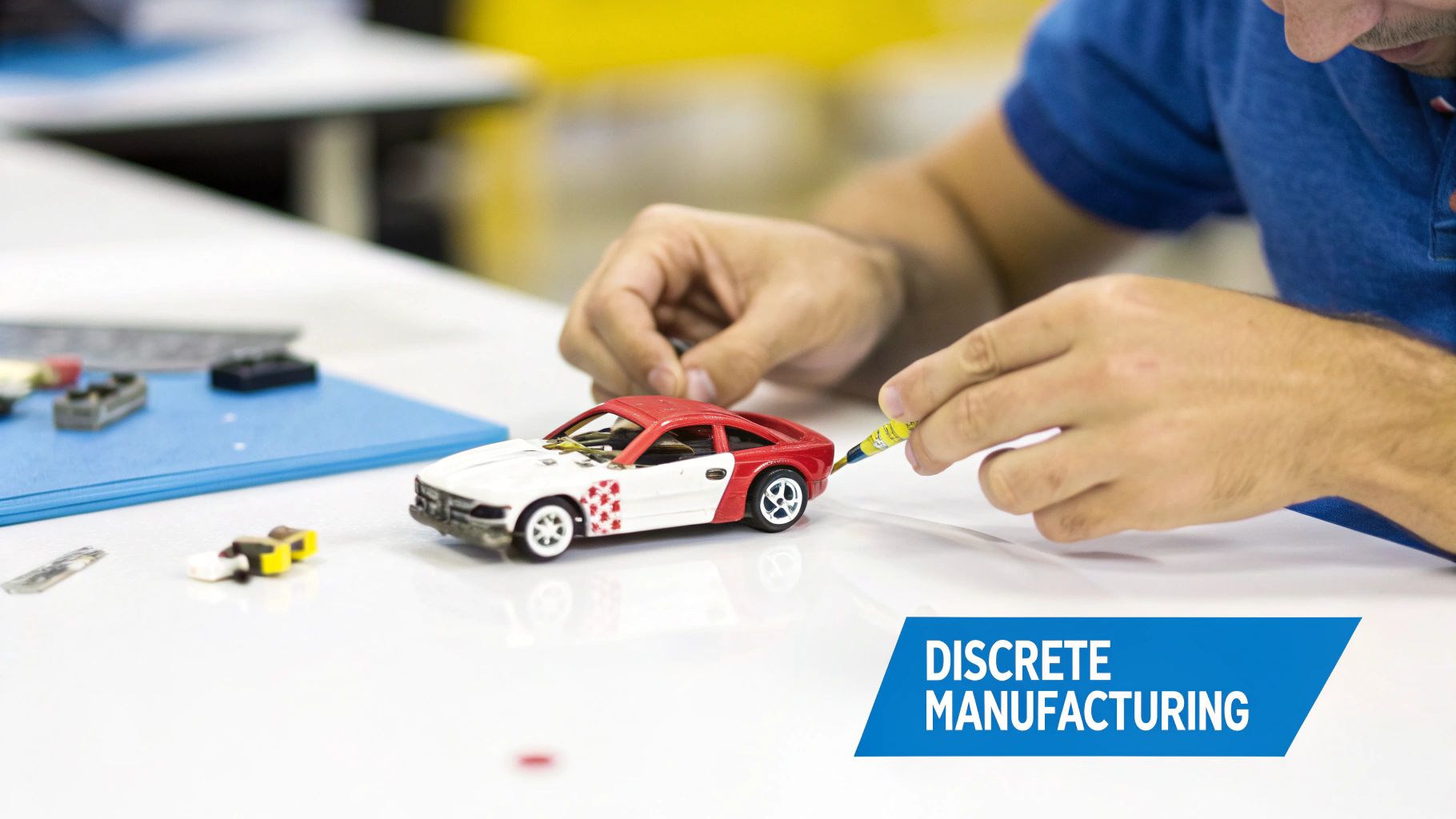
At its heart, discrete manufacturing is all about producing distinct items. These are things you can touch, count, and see as individual units—smartphones, kitchen cabinets, airplanes, you name it.
The whole operation hinges on a critical document: the Bill of Materials (BOM). Think of the BOM as a detailed recipe. It lists out every single part, component, and subassembly required to build one finished product.
Production then follows a carefully planned sequence of steps, often on an assembly line, where standardized parts are added one after another. This assembly-style approach creates products that are fundamentally similar yet can be highly customized. A car model might have different trim levels, or a smartphone could come in various colors, all thanks to the flexibility of this process. The key difference here is that the original components are never lost; they just become part of a larger whole.
Core Characteristics
This manufacturing style is really built on a few foundational ideas:
- Identifiable Units: The output is always individual items. You can count them, track them with serial numbers, and manage them one by one.
- Component-Based Assembly: Products are quite literally constructed from a collection of parts—screws, bolts, wood panels, circuits, and so on.
- Reversibility: Unlike mixing a cake batter, you can often take a discretely manufactured product apart. This is crucial for repairs, upgrades, and recycling.
The real takeaway here is that discrete manufacturing is about building things, not blending them. Every step in the process adds another distinct piece, moving the item closer to its final, assembled form.
You'll find this method everywhere, from the automotive and aerospace industries to electronics and furniture making. The production of countable units like cars or consumer gadgets is the signature of this sector. For woodworking shops and custom manufacturers, getting a grip on these fundamentals is key to optimizing production. To dive deeper into other manufacturing topics, you can explore our other articles on the TimberCloud blog.
The Building Blocks of Discrete Production
So, what really makes discrete manufacturing tick? It all comes down to a few core building blocks that take a product from a pile of parts to a finished item ready to ship. These are the non-negotiables that give the whole system its structure and control.
First up, and arguably most important, is the Bill of Materials (BOM). The simplest way to think of a BOM is as a product’s recipe. It’s a detailed, hierarchical list of every single thing you need to build one unit.
For a custom wooden cabinet, the BOM would list out everything from the specific type of lumber and its dimensions to the exact model of hinges and handles, right down to the last screw. It’s the single source of truth for what goes into your product.
From Blueprint to Action
If the BOM tells you what to build with, the next two pieces—routings and work orders—tell you how to build it. They are the roadmaps that guide a product’s journey across the shop floor.
-
Routings: This is your high-level game plan. It lays out the exact sequence of operations from start to finish. For that cabinet, the routing might look like this: cut lumber, then sand, then assemble, and finally, apply the finish.
-
Work Orders: This is the green light for production. A work order authorizes a specific quantity of a product to be made. It pulls together the BOM (the ingredients) and the routing (the instructions) into a single, actionable command for your team.
You can think of it like this: The BOM is the ingredient list, the routing is the step-by-step recipe, and the work order tells the kitchen how many dishes to make for the dinner service.
This entire framework is built around one simple idea: producing countable, individual units. This is the key differentiator. Every item that comes off the line can be touched, counted, and given a serial number.
This also opens the door for huge product variability. A car maker might have one base model, but by swapping out components from the BOM—different engines, paint colors, or interior packages—they can offer thousands of unique configurations. That’s the real power of discrete manufacturing: it lets you build variety and customization on a standardized, repeatable foundation.
Discrete vs Process Manufacturing
To really get a feel for discrete manufacturing, it’s helpful to put it side-by-side with its counterpart: process manufacturing. The difference is pretty simple but foundational. Think about building a bicycle versus brewing a batch of soda.
One is all about assembling distinct parts, while the other is about blending ingredients. You can take a bicycle apart and have all the original pieces right there in front of you—the wheels, the frame, the handlebars. You could even put it back together. But you can't exactly un-brew a can of soda to get your sugar, water, and flavorings back.
That simple test—can you take it apart?—is the clearest way to tell the two apart.
Key Operational Differences
The day-to-day operations for these two approaches are completely different, shaping everything from how you order materials to what comes off the production line. Discrete manufacturing runs on a Bill of Materials (BOM), which is basically a detailed shopping list of all the parts needed. Process manufacturing, on the other hand, uses a formula or a recipe, where the exact properties of the ingredients can change from batch to batch, like the moisture content in a bag of flour.
This infographic breaks down how a typical discrete workflow gets from a plan to a finished product.
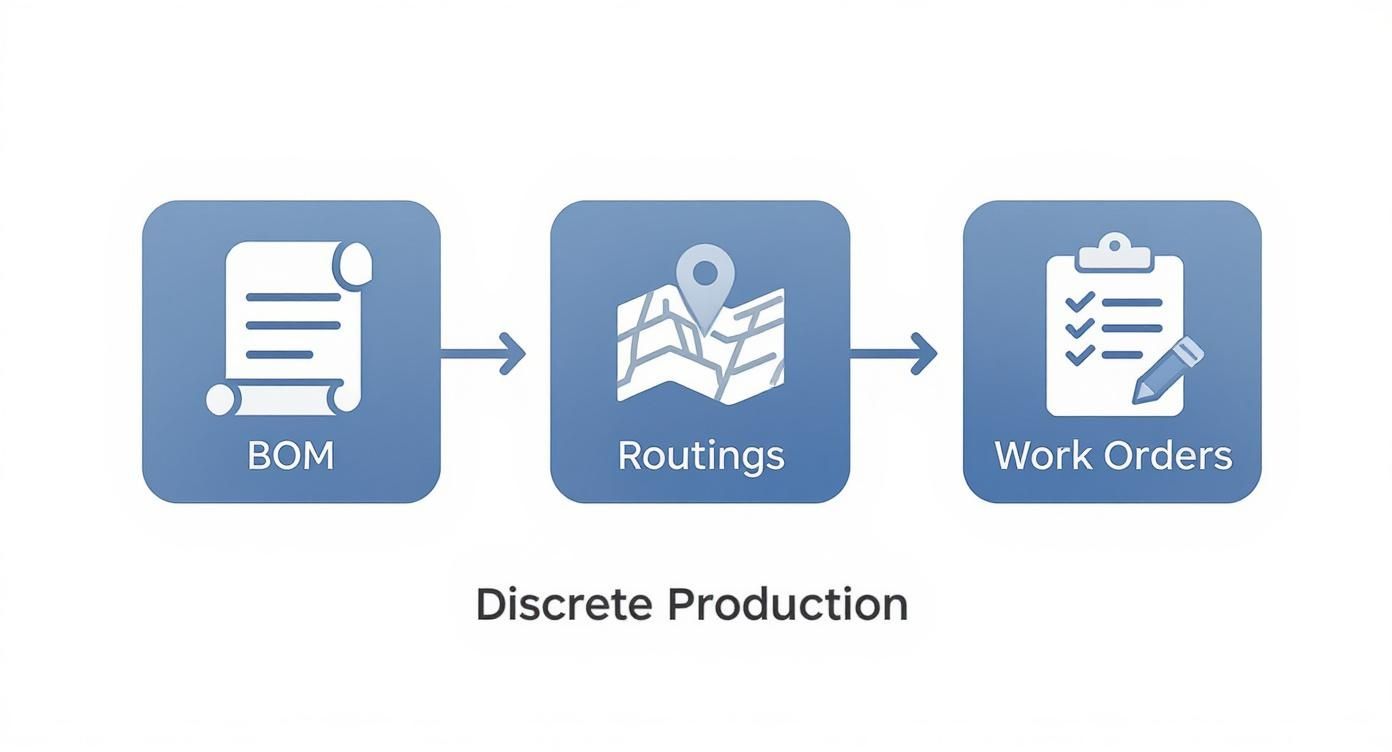
As you can see, the BOM, routings, and work orders all come together to create a predictable, repeatable system for assembling individual items.
Discrete vs Process Manufacturing Head-to-Head
To make the comparison crystal clear, let's look at their core attributes in a table.
| Attribute | Discrete Manufacturing | Process Manufacturing |
|---|---|---|
| Product Nature | Countable, distinct units (e.g., cars, chairs) | Bulk, homogenous product (e.g., paint, chemicals) |
| Material Inputs | Parts and components (BOM) | Raw ingredients (Formula/Recipe) |
| Reversibility | Can be disassembled back into original parts | Irreversible; ingredients cannot be separated |
| Unit of Measure | Individual units (each, piece) | Volume or weight (gallons, pounds) |
| Output Variation | High variability through different components | Low variability, focused on batch consistency |
At the end of the day, the core difference is this:
Discrete manufacturing is about assembly, while process manufacturing is about blending.
One method builds products you can count and track individually, while the other creates substances that are measured in bulk.
Understanding this contrast makes it obvious why a woodworking shop can't use the same software or workflow as a chemical plant. For anyone building custom cabinets, furniture, or architectural millwork, the principles of discrete manufacturing—with its focus on BOMs, assembly steps, and individual units—are the absolute foundation of the entire business.
How Technology Powers Modern Factories
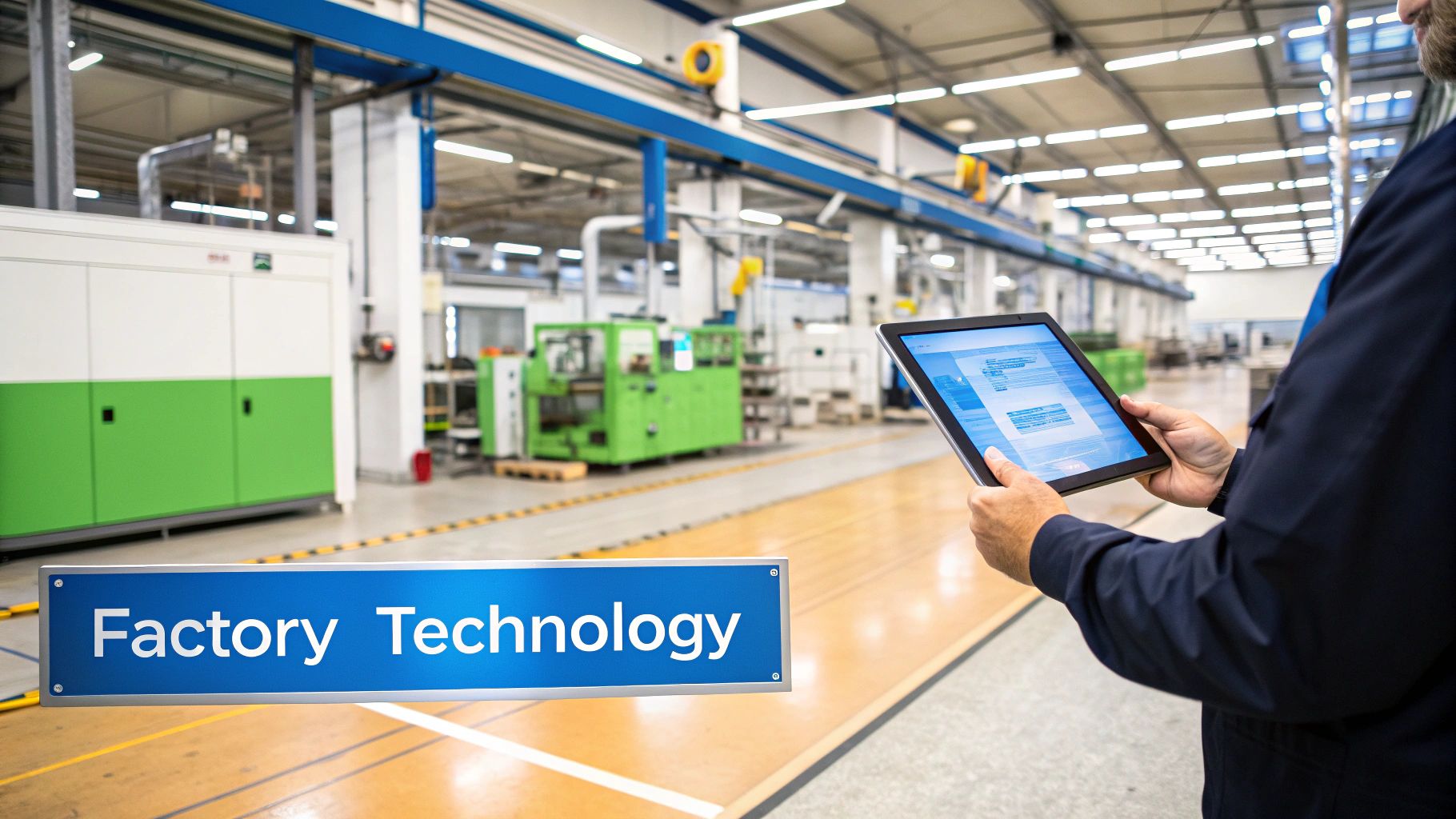
In a modern discrete manufacturing shop, technology is much more than just a helpful add-on—it’s the central nervous system connecting every part of the operation. The days of relying on stacks of paperwork, clipboards, and manual tracking are fading fast. Today, software platforms conduct the intricate dance of production from the initial quote to the final delivery.
These digital tools are what make sure the right parts show up at the right workstation at exactly the right time, slashing delays and preventing expensive mistakes. They create a single, reliable source of information that gets every department on the same page, from sales and inventory to the shop floor and shipping.
The Brains Behind the Operation
At the heart of this shift are two main types of software. While they handle different jobs, they are deeply connected and essential to the production journey.
-
Enterprise Resource Planning (ERP): Think of an ERP as the business brain of your factory. It ties together all the core functions—inventory levels, supply chain orders, financials, and customer jobs—into one cohesive system. For a woodworking shop, that means knowing exactly how many sheets of walnut plywood you have on hand and getting an alert to order more before you run out mid-job.
-
Product Lifecycle Management (PLM): If the ERP is the business brain, the PLM is the product brain. This software manages a product’s entire journey, from the first napkin sketch and CAD revisions all the way through manufacturing and even its eventual end-of-life.
The global PLM market in discrete manufacturing was valued at around $23.16 billion and is expected to keep climbing, which shows just how essential this tech has become. This trend underscores how much shops now rely on PLM to smooth out collaboration and catch design flaws long before a single piece of material is cut.
The real magic happens when ERP and PLM systems talk to each other. This integration creates a smooth, two-way flow of information. It ensures the design from the office is precisely what gets built on the floor, and that what gets built is something the business can actually produce profitably. For anyone curious about how these functions merge, exploring the features of an all-in-one solution shows what a truly connected operation looks like.
The Global State of Discrete Manufacturing
To really get a handle on discrete manufacturing, it helps to zoom out and look at its place on the world stage. This isn't an industry that exists in a bubble. It's deeply intertwined with global economic currents, shifting trade policies, and major technological waves. All these factors create a dynamic environment where some regions are hitting the accelerator while others are facing some serious headwinds.
The big picture is that the global sector is pegged for modest growth, with manufacturing giants like China and the U.S. leading the charge. Europe, on the other hand, is expected to see a bit of a downturn. This growth is unfolding against a backdrop of uncertainty from changing trade policies, but savvy producers are finding ways to adapt. You can get a deeper dive into how global trends are shaping production on ControlEng.com.
Strategic Shifts Building Resilience
So, how are manufacturers navigating this tricky landscape? They're making some bold strategic moves. Two of the biggest game-changers we're seeing right now are the adoption of artificial intelligence and a major push toward bringing supply chains closer to home.
-
AI Integration: Producers are increasingly leaning on AI to sharpen their production schedules, get ahead of machinery maintenance with predictive alerts, and tighten up quality control. It's all about boosting efficiency and cutting costs where it counts.
-
Supply Chain Nearshoring: To shield themselves from global disruptions, many companies are rethinking their logistics and moving supply chains closer to their final markets. This isn't just about shorter shipping times; it's about building a buffer against international instability.
These aren't just buzzwords; they are practical responses to real-world pressures. By investing in digital tools and smarter logistics, discrete manufacturers are doing more than just weathering economic uncertainty—they’re building a more robust and competitive foundation for the future.
This global perspective really underscores that discrete manufacturing is a field that never stands still. The ability to adapt through new technology and sharp strategic planning is what will separate the industry leaders from the rest of the pack in the years ahead. It’s how they’ll ensure they can keep delivering the cars, electronics, and custom goods the world relies on.
Common Questions About Discrete Manufacturing
Once you get the hang of what discrete manufacturing is, the real questions start popping up. It's one thing to understand the theory, but it's another to see how it plays out in the day-to-day operations of a business, especially one that doesn't fit into a neat little box.
Let's dig into a few of the most common questions we hear from shop owners trying to wrap their heads around this.
What Are the Biggest Challenges in This Field?
If you talk to anyone in discrete manufacturing, you'll hear two pain points over and over again: supply chain complexity and inventory control. Think about it—your entire production process depends on having every single part ready to go. A delay on one tiny component, like a specific drawer pull or a unique species of veneer, can stop an entire project in its tracks. That's a lot of power to put in the hands of your suppliers and shipping companies.
Then there's the inventory headache. You're constantly trying to strike the perfect balance. You need enough parts on hand to keep the shop floor moving, but you can't afford to have your cash tied up in components that are just gathering dust. It’s why having a sharp, data-driven system isn't just a nice-to-have; it's essential.
Can a Company Use Both Discrete and Process Methods?
Definitely. In fact, many businesses do. This is often called mixed-mode manufacturing, and it’s a practical solution for shops that handle different types of production under one roof.
Take a custom furniture maker, for example. They might use process manufacturing to create their own proprietary wood stains—blending various chemicals and pigments into a final product that can't be broken down again. But then, they'll switch right over to discrete manufacturing to cut, finish, and assemble those stained wood pieces into a final cabinet.
This hybrid approach gives a business the flexibility to use the best method for each stage of production. The trick is having an operational system that can seamlessly manage both without creating a logistical nightmare.
How Does the Bill of Materials Adapt for Custom Products?
This is a big one for custom shops. A standard, fixed Bill of Materials (BOM) is useless when no two orders are the same. The answer is a configurable Bill of Materials. The best way to think about it is as a dynamic recipe with a bunch of optional ingredients and instructions.
Instead of a fixed list, a configurable BOM is built on rules. A customer picks their preferred material, dimensions, and hardware, and the system instantly generates a new, unique BOM for that specific configuration. This is the magic that allows for mass customization without someone having to manually create a new parts list for every single order.
This dynamic BOM is the backbone of any modern woodworking or custom manufacturing business. Getting this capability usually means investing in specialized software, so understanding the costs is a critical first step. You can often see how different platforms bundle these features by checking out their transparent pricing.
At TimberCloud, we built an all-in-one platform that connects e-commerce, ERP, and AI to help woodworking and custom manufacturing shops master these challenges. From configurable product builders to real-time inventory tracking, our tools are designed to streamline your discrete manufacturing workflow. https://timbercloud.com
Topics
TimberCloud Team
Content Team
The TimberCloud team is dedicated to helping manufacturers streamline their operations with intelligent software solutions.