A Woodworking Shop's Guide to Lean Manufacturing 6S

If you've ever spent 15 minutes searching for a specific router bit or had a project stall because a cut sheet went missing, you know the hidden costs of a disorganized shop. Lean manufacturing 6S isn't just some abstract corporate theory; it's a battle-tested framework for turning that workshop chaos into a well-oiled machine.
This guide is all about applying the six core principles—Sort, Set in Order, Shine, Standardize, Sustain, and Safety—to the real-world grit and sawdust of a custom woodworking or millwork operation.
Why 6S Is a Game Changer for Custom Woodworking
In a custom shop, there's a fine line between creative energy and genuine inefficiency. Piles of offcuts, tools left on a workbench, and in-progress jobs scattered around can feel normal. But that "organized chaos" is quietly eating into your bottom line through wasted time, misused materials, and frustrating, preventable mistakes.
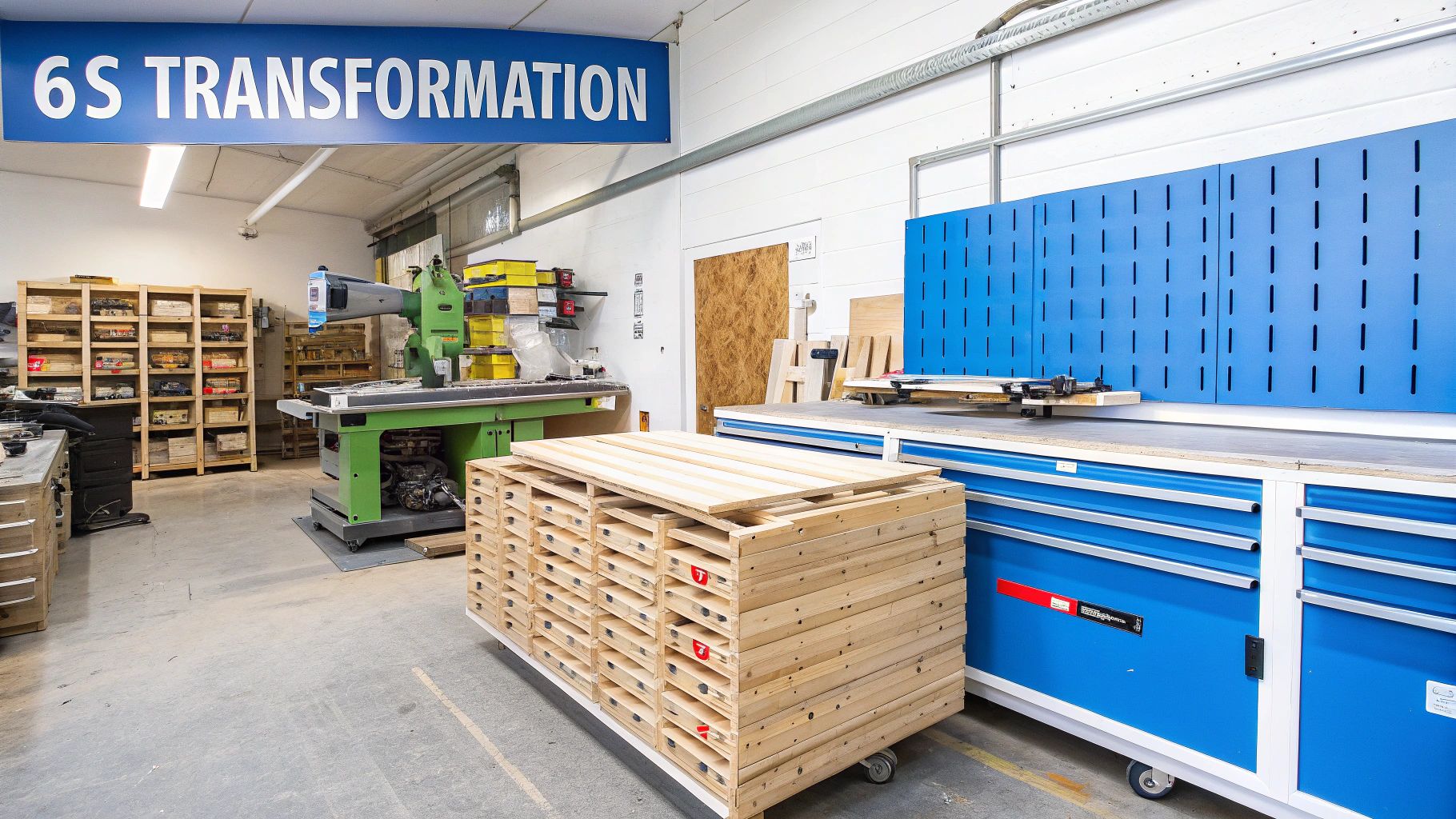
This is where the lean manufacturing 6S methodology comes in. It’s a systematic way to root out waste and bring predictability to your workflow. We're not just talking about a weekend cleanup. This is about building an intelligent, self-sustaining system where everything has a clear purpose and a designated home, freeing up your team to focus on their craft.
Moving Beyond a Simple Cleanup
It’s easy to mistake 6S for a one-and-done deep clean. The reality is, it’s a cultural shift. Think of it as upgrading your shop’s entire operating system. The "S" principles work in concert to create a smooth, efficient environment where quality and safety are built-in, not bolted on.
Let's break down what each "S" really means when the sawdust starts flying.
The 6S Principles Translated for Woodworking
| The 'S' | Core Principle | Woodworking Shop Application |
|---|---|---|
| Sort | Eliminate the unnecessary. | Getting rid of old jigs that haven't been used in years, scraps too small to be useful, and broken tools. |
| Set in Order | A place for everything, and everything in its place. | Creating shadow boards for hand tools, labeled bins for hardware, and designated zones for raw materials vs. work-in-progress. |
| Shine | Clean and inspect the workplace. | Wiping down machines daily to spot oil leaks or wear, and keeping dust collection systems clear to maintain air quality and performance. |
| Standardize | Make the best practices the new standard. | Creating a simple, visual checklist for CNC machine startup or a standard procedure for end-of-day tool storage. |
| Sustain | Embed the habits into the culture. | Conducting quick weekly audits, celebrating team successes, and making 6S a part of new employee onboarding. |
| Safety | Identify and eliminate hazards. | Ensuring machine guards are in place, marking clear walkways, and making PPE easily accessible and required. |
By building these disciplines into your daily routines, you directly attack the common frustrations that slow down custom millwork. The impact isn't just a cleaner shop; it's a more profitable and safer one.
Key Takeaway: Implementing 6S isn't about achieving a picture-perfect shop overnight. It's about making small, consistent improvements that add up to massive gains in productivity, safety, and profitability.
The financial proof is undeniable. Early manufacturing adopters saw incredible results. Motorola saved over $20 billion by integrating lean principles, while GE's rollout slashed defects and helped revenues climb to $130 billion by 2000. The market for lean consulting services is now projected to grow at a 14.70% CAGR through 2033 for a reason—it works.
While you're building your 6S system, it's also worth exploring other actionable strategies for increasing operational efficiency to get a wider view of what's possible.
At TimberCloud, we're obsessed with helping shops build smarter, more profitable systems. You can learn more about our philosophy at https://timbercloud.com/about. In the rest of this guide, we'll walk you through exactly how to make your own 6S journey a resounding success.
Building Your Foundation with Sort and Set in Order
Alright, this is where the real work begins. The first two stages of any good lean manufacturing 6S program—Sort and Set in Order—are the absolute foundation for everything else. It’s a hands-on, get-your-hands-dirty process, but the payoff is immediate. You're not just cleaning up; you're clearing out the physical and mental clutter that’s been holding your shop back.
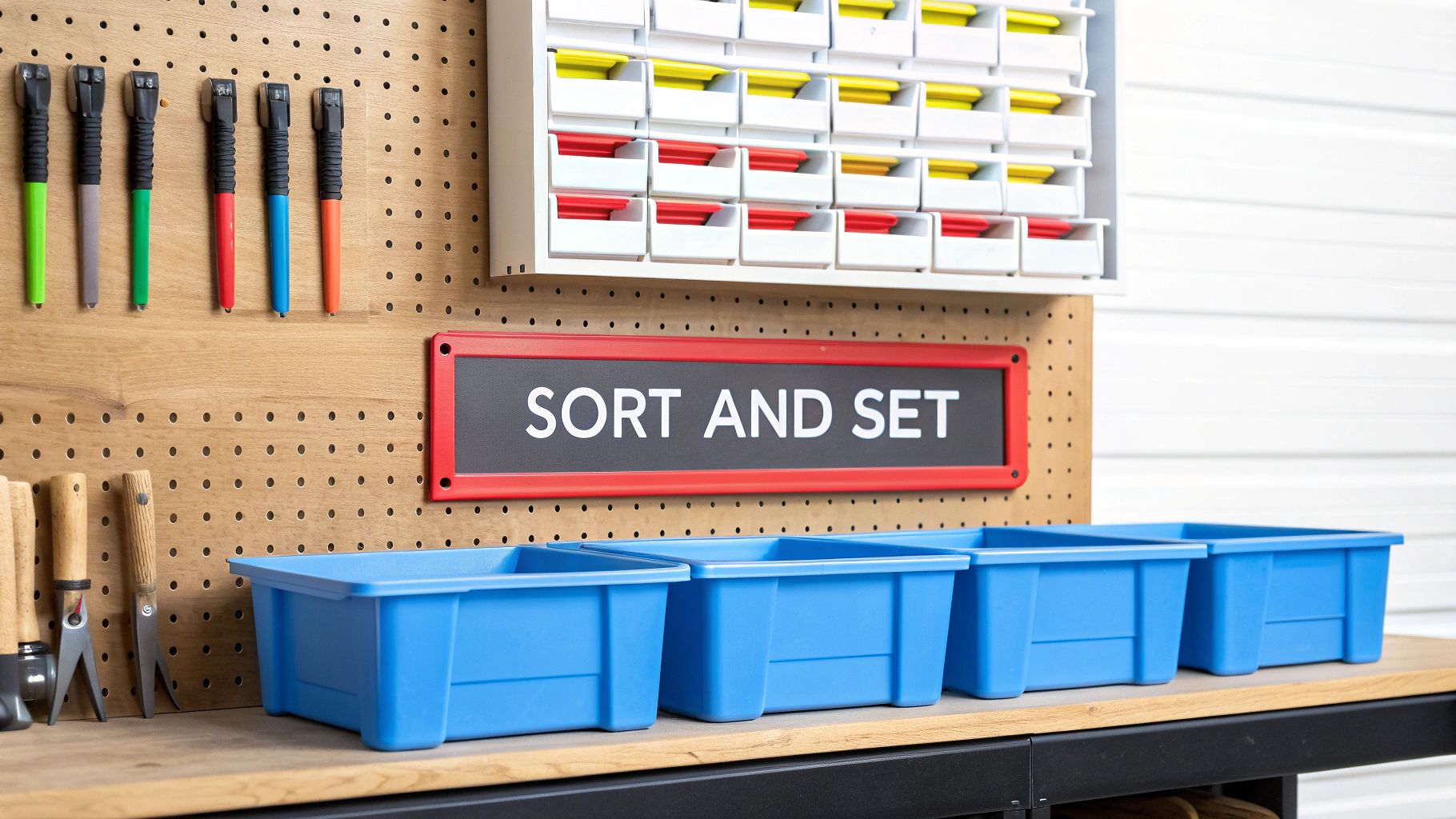
Think about it this way: you can't improve a process you can't even see. Those piles of offcuts, the three extra routers gathering dust, and that drawer full of mystery hardware are all hiding bottlenecks and wasted time. By first sorting through everything and then creating a permanent, logical home for what’s left, you’re engineering a smarter, more efficient workspace from the ground up.
Mastering the Art of the Sort
The goal of the Sort phase is brutally simple: get rid of anything that isn't absolutely essential for the work being done in that specific area. This is where the famous "red-tag method" becomes your new best friend. It’s a simple, visual, and decisive way to categorize every single item in your shop.
Get your team together and pick a spot to start—one workstation, one corner of the shop. For every single item you touch, from a half-used can of stain to that old jig in the back, ask these questions:
- Is this actually needed for current or upcoming jobs? Be brutally honest. "Maybe someday" is the enemy here.
- If we need it, do we need this many? Why are there four identical sanders at one station when only one is ever used? That’s waste.
- Is this even in the right place? That box of cabinet pulls has no business being next to the planer.
- Is it broken or obsolete? A cracked clamp or a jig for a cabinet line you stopped building five years ago has got to go.
Anything that fails the test gets a red tag. Move all red-tagged items to a designated holding area—a "quarantine zone." Give it a deadline, say 30 days. If nobody has a legitimate, immediate use for an item by then, it gets sold, recycled, or tossed.
We’ve all been there—holding onto tools or materials for sentimental reasons. You have to remind your team that every square foot of the shop is valuable real estate. An old, unused machine isn't an asset; it's an obstacle taking up space that could be making you money.
Bringing Logic with Set in Order
Once you’ve cleared out the junk, it's time for Set in Order. This is all about creating an intuitive, visual, and efficient home for every essential item left. The whole point is to eliminate wasted motion. No more searching. Every second a craftsman spends looking for a tool is a second they aren't building something.
This is where you can get practical and creative. For a millwork shop, this looks like:
- Shadow Boards: It's a classic for a reason. Trace your hand tools on a pegboard. At a glance, anyone can see if a router bit or a specific wrench is missing.
- Designated Carts: Build "project carts" with all the hardware, fasteners, and special tools needed for a specific job. No more walking back and forth across the shop for a handful of screws or a specific hinge.
- Color-Coded Racks: This one is incredibly simple but effective. Use colored tape or a splash of paint to label your lumber racks. Maybe blue for walnut, red for cherry, and yellow for oak. It’s a small visual cue that saves minutes every time someone pulls material.
Your Digital Ally in Organization
This foundational groundwork gets a massive boost when you pair it with the right technology. This is where a platform like TimberCloud’s inventory management changes the game. Instead of just guessing how much 4/4 walnut you have on the rack, you have a precise, real-time number at your fingertips.
Having that data makes a world of difference. It lets you sort materials with confidence, stopping you from over-buying and clogging up your racks with cash tied up in excess inventory. When you know exactly what you have and where it is, the entire system just runs smoother. This digital clarity is what takes a 6S program from a "cleanup project" to a true competitive advantage.
You've done the hard work of sorting and setting your shop in order. You've cleared the clutter and created a home for every tool and piece of material. Now comes the real test: turning those initial gains into lasting habits that define how your shop operates every single day.
This is where many 6S initiatives lose steam. The next three phases—Shine, Standardize, and Sustain—are all about building the discipline that makes excellence the new normal. It’s the shift from a one-time cleanup project to a continuous culture of improvement.
It All Starts with a Shine
In a woodshop, "Shine" is so much more than just pushing a broom. It's an active, daily ritual of cleaning that doubles as proactive maintenance. A clean workspace is a safer, more productive workspace, but the real magic happens when your team starts looking as they clean.
When your CNC operator wipes down their machine at the end of a shift, they aren't just getting rid of dust. They're in the perfect position to spot a loose belt, notice a slight oil leak, or hear a bearing that’s starting to complain. This is how you catch small problems before they become big, expensive, production-stopping disasters.
Here’s how to make it a practical habit:
- The 10-Minute Daily Shine: Every day, before clocking out, each team member spends 5-10 minutes cleaning their immediate workstation. This means wiping down surfaces, putting away their personal tools, and clearing the floor of offcuts and debris.
- The Weekly Deep Clean: Block off 30 minutes every Friday afternoon for a more thorough cleaning. This is the time to lubricate machine parts, check the dust collection system, or inspect the condition of saw blades and router bits.
This simple rhythm keeps chaos from creeping back in and, more importantly, fosters a sense of ownership at every workstation.
Lock It In with Standardization
If Shine is the action, Standardize is the system that makes it automatic. This phase is all about creating simple, unmistakable rules so that everyone performs critical tasks the same way, every time. It’s how you eliminate guesswork and make sure your hard-won organization actually sticks around.
Standardization doesn't mean writing a massive, dusty binder that no one ever reads. In a fast-paced shop, the best standards are visual and dead simple.
Creating a standard isn't about adding red tape. It's about defining the single best, safest, and most efficient way to do a job right now, and then making that the default for everyone.
For example, you could create a one-page, laminated checklist with photos for the end-of-day shutdown procedure at the edgebander. Or maybe you implement a color-coded tag system for materials: green for quality-inspected stock ready for production, yellow for material needing review, and red for scrap.
This is where the principles of Lean Six Sigma really hit their stride. The original 5S system, pioneered by Toyota’s Taiichi Ohno, was designed for this exact kind of process discipline. When you combine it with Six Sigma—a framework developed by Motorola in 1986 that helped them save over $16 billion—you get a powerhouse for quality control. The goal is to slash defects to a near-perfect 3.4 per million opportunities, and standardization is your path there. Shops that fully embrace these practices often see productivity jump by 20-30%. You can explore the rich history of Six Sigma on goleansixsigma.com to see its impact.
Make It Last with Sustain
Sustain is, without a doubt, the hardest part of 6S—and the most important. This is where you weave the 6S mindset into the very fabric of your shop's culture. Leadership is absolutely critical here. If the managers don't live and breathe the standards, the whole system will fall apart in a matter of weeks.
Keeping the momentum going boils down to a few key actions:
- Lead from the Front: When the shop owner takes a minute to organize a stack of offcuts or meticulously follows the new tool sign-out sheet, it sends a crystal-clear message: "This is how we do things here."
- Audit, Don't Criticize: Perform quick, regular 6S audits. This isn’t about pointing fingers; it’s about coaching and finding where the team needs more support. A simple checklist is all you need to score different areas of the shop.
- Recognize the Effort: Did a team nail their 6S audit for a month straight? Celebrate it! A team lunch, a small bonus, or even just some public praise can go a long way in reinforcing the right behaviors.
Sample 6S Audit Checklist for a Finishing Station
To make your audits practical and consistent, use a simple checklist with a scoring system. This isn't about punishment; it's about creating a baseline and tracking improvement over time.
Here's a sample you can steal and adapt for your own finishing station.
Sample 6S Audit Checklist for a Finishing Station
| Check Item | Standard (What to look for) | Score (1-5) | Notes / Action Items |
|---|---|---|---|
| Sort | Are there any non-essential tools, old rags, or empty cans in the area? | ||
| Set in Order | Are all spray guns, sandpaper, and supplies in their designated, labeled locations? | ||
| Shine | Is the spray booth clean? Are work surfaces free of dust and overspray? | ||
| Standardize | Are safety data sheets (SDS) and SOPs for mixing finishes clearly posted and followed? | ||
| Safety | Is PPE (respirators, gloves) stored correctly and readily available? Is ventilation working? |
A quick weekly review of this checklist gives you a concrete way to measure progress and have constructive conversations with your team.
This is also where a tool like TimberCloud can be a game-changer for your Sustain efforts. When you can pull up a dashboard and show your team how their 6S discipline connects directly to a 15% reduction in job setup times or a visible drop in material waste, it's incredibly powerful. That data transforms 6S from "just another thing management wants" into a shared mission that puts more money in everyone's pocket.
Making Safety the Heart of Your Operation
In a custom woodworking shop, safety isn't just another box to check—it’s the foundation of a healthy, profitable business. While some older lean systems tacked "Safety" on as an afterthought to 5S, a modern lean manufacturing 6S program puts it right at the center. After all, a shop floor littered with hazards isn’t just inefficient; it's a disaster waiting to happen.
The great thing is, the first five S's naturally create a safer environment. When you sort and set things in order, you eliminate trip hazards from offcuts and misplaced clamps. When you shine and standardize, you’re ensuring machines are inspected, maintained, and less likely to fail when you least expect it. A safer shop is simply the natural result of a well-run system.
Beyond Compliance to Culture
True safety goes way beyond meeting the bare minimum compliance rules. It’s about building a proactive culture where every single person on your team feels responsible for spotting and fixing risks. This starts by pulling safety out of the rulebook and making it a real, daily practice.
Ditch the once-a-year training session for something far more effective: a daily "toolbox talk." Gather everyone for five minutes at the start of the day. This isn't for big announcements, but for sharp, practical reminders.
- Pick one thing: One day, it’s proper lifting. The next, it’s double-checking the guards on the table saw.
- Get people talking: Ask questions. "Anyone see a near-miss yesterday?" or "Is the dust collector on the CNC pulling like it should?"
- Keep it short and sweet: This daily habit keeps safety front and center without feeling like a chore.
A safety policy collecting dust in a binder is worthless. A real safety culture is built when your team actively talks about and deals with hazards every single day. That's how you turn passive rules into active, protective habits.
Designing Safety into the Workspace
An organized shop is a safer shop, period. But you can take it a step further with intentional design choices that reduce physical strain and obvious hazards. We're not talking about expensive overhauls, just smart tweaks that protect your crew's long-term health.
Take a hard look at your high-traffic spots, like assembly benches and finishing booths. Are your people constantly hunched over in awkward positions? Simple fixes like adjustable-height tables or anti-fatigue mats can make a huge difference in preventing the chronic strain that leads to injuries.
And let’s talk about dust collection. This isn't just about keeping the place clean ("Shine"); it’s a critical health issue. Make sure your system is powerful enough for your equipment and that ducts are checked for clogs regularly. A shop with clean air protects your team's lungs and seriously cuts down the risk of a dust-related fire.
Visual Cues and Proactive Checks
Your "Standardize" phase is the perfect time to build visual safety cues right into the shop's DNA. Clear, simple signs can prevent a shocking number of accidents.
- Tape off clear walkways with high-visibility floor tape to keep people out of machine work zones.
- Outline where emergency gear is stored—fire extinguishers, first-aid kits—so there's no frantic searching when seconds count.
- Use shadow boards for more than just tools. Create them for personal protective equipment (PPE) stations to make it glaringly obvious when safety glasses or hearing protection aren't where they should be.
Speaking of PPE, making sure your team is properly equipped is non-negotiable. For hand protection, it's worth checking out a good guide to cut-resistant gloves. Making gear like this easy to find and its storage location obvious is a cornerstone of a solid 6S safety program.
Ultimately, when you integrate Safety as the sixth S, you change your entire mindset. It stops being a separate department or a nagging list of rules. It becomes the daily, active process of creating a workshop where your team can do their best work, confidently and without injury, all driven by the very principles of organization that help your business thrive.
Using Technology as Your 6S Partner
Let’s be honest. Trying to run a modern lean manufacturing 6S program with paper, clipboards, and a patchwork of spreadsheets is like trying to build a high-end kitchen with nothing but a hand saw. You might get there eventually, but it's going to be a painful, error-prone mess.
To make 6S actually stick, it needs to be woven into the very fabric of your daily operations. That's where technology stops being just another tool and becomes your most valuable partner. A solid software platform doesn’t just digitize your old, clunky processes; it actively reinforces the 6S mindset, turning abstract ideas like "efficiency" into cold, hard data you can actually use.
Nail Your Sort and Set in Order with Real Data
The first two S's are where you get your quickest wins, and software makes an immediate impact. During the Sort phase, guesswork is your worst enemy. Instead of squinting at a lumber rack and guessing what you have, a system like TimberCloud gives you live inventory numbers. You know for a fact you have 15 sheets of ¾” walnut ply, not "around a dozen." That kind of clarity eliminates over-ordering and frees up cash that's just sitting on a shelf collecting dust.
Once you’ve cleared the clutter, technology makes Set in Order dynamic and nearly impossible to mess up. Forget slapping on a few labels and just hoping everyone remembers where the jigs are. When digital work orders and cut lists are sent directly to a tablet on the floor, your team knows precisely what material they need for which job, right now. All that time previously spent wandering around looking for parts or trying to read a coffee-stained drawing? Gone.
Relying on manual systems for 6S is like trying to enforce a speed limit without a speedometer. Technology gives you the dashboard you need to see if you're on track, measure your progress, and prove the system is working.
Standardize and Sustain Through a Single Source of Truth
This is where a unified platform really proves its worth. It becomes your shop's single source of truth, which is the entire point of the Standardize step. When you develop a better edgebanding procedure, you update it once in the system, and everyone has the new standard instantly. No more outdated binders or conflicting verbal instructions causing chaos. That level of consistency is the heart of standardization, and it's a nightmare to maintain manually as you grow.
And for Sustain—the S where most shops fail—technology provides the proof. Production tracking dashboards show you the real-world impact with clear Key Performance Indicators (KPIs). You can walk over to your team and show them a graph that proves your 6S efforts led to a 10% reduction in material waste or that jobs are getting out the door 20% faster. This data turns 6S from a "chore" into a measurable business advantage, winning over even the most stubborn skeptics on your crew. You can see what's possible by exploring the features available in modern shop management platforms.
Visualizing a Truly Safe Workspace
The 6th S, Safety, isn't an afterthought; it's the result of doing the other five correctly. It's about building a workshop that protects your most valuable asset: your people. This map shows how all the pieces of a safe environment fit together.
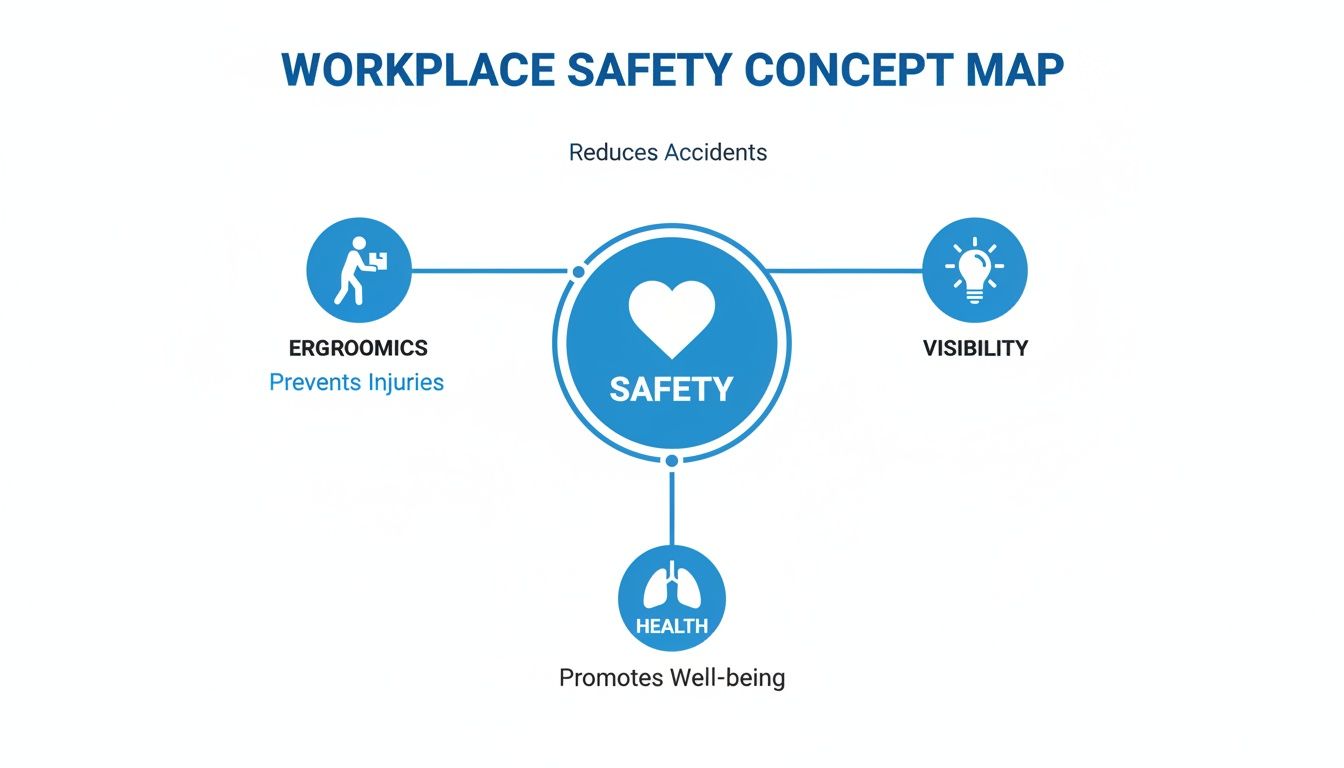
As you can see, real safety is a combination of good ergonomics, clear visibility, and proactive worker health—all direct benefits of a well-run 6S program.
When you bring the right technology into your shop, you’re not just managing tasks; you’re building an intelligent system. It’s a system where data drives your sorting, digital tools enforce your standards, and clear analytics prove the payoff, making sure your 6S program isn't just a one-time project, but a long-term competitive edge.
Navigating the Inevitable Bumps in the 6S Road
Let's be honest: kicking off a lean manufacturing 6S program is one thing, but making it stick is another. You can have the best intentions and the most detailed plans, but the reality of a busy shop floor always throws a few curveballs. The real trick to making 6S work isn't about enforcing rules; it's about understanding the human element and anticipating the pushback.
One of the first walls you'll hit is skepticism from your crew. You'll hear the grumbling: "Here we go again, another flavor-of-the-month program from management," or the classic, "We're too swamped to stop and clean all day." This isn't people being difficult for the sake of it. It’s a completely natural reaction rooted in the fear that 6S is just more work—and no more pay—piled onto an already demanding day.
Turning Skeptics into Believers
You can't win this battle with a memo. The only way to get your team on board is to make them the architects of the change. Forget handing down mandates from the office. Walk over to your cabinet assembly area, get the team together, and ask them point-blank: "What drives you crazy every day? What tool or piece of hardware are you always hunting for?"
When you give them the power to fix their own headaches, something powerful happens. They take ownership. The craftsperson who decides exactly where the hinge jigs should live and how the screws should be kitted out isn't following your system anymore; they’re championing theirs. This flips 6S from a top-down chore into a grassroots effort to make their own lives easier.
The game changes the moment your team sees 6S not as a cleaning checklist, but as a weapon against their daily frustrations. The goal is to make their job flow better, and they need to see that in action, not just hear about it in a meeting.
Another classic pitfall is the "one-week wonder." You do a big 6S event, the place looks amazing, and everyone is fired up. Then, a week or two later, you see old habits creeping back in. A pile of offcuts reappears, tools start migrating, and the labels start peeling. That’s not a failure of the team; it's a failure to Sustain. A 6S program without consistent, visible leadership will always wither on the vine.
Start Small, Win Big: The Pilot Program
Don't try to boil the ocean. A full-shop, all-at-once 6S rollout is a surefire way to create chaos and burnout. You’ll stretch yourself too thin and lose momentum before you even get started.
The smarter move? Pick one small, manageable area to be your pilot. A single CNC work cell or one assembly bench is the perfect testing ground.
This strategy is a game-changer for a few reasons:
- You get a quick, visible win. Nailing the process in one small area builds incredible momentum. It becomes a living, breathing example of what's possible.
- It’s your learning lab. You’ll hit snags you never saw coming, but you can solve them in a controlled space before you roll the system out to more complex departments.
- You create your own champions. The people in that pilot area become your most powerful evangelists. They’ll be the ones telling their skeptical coworkers, "No, seriously, this actually works. My job is way less frustrating now."
Once that first station is running like a well-oiled machine, its success does the selling for you. Soon, people from other areas will be asking when it's their turn. That kind of pull, instead of a constant push, is the hallmark of a 6S program that's actually built to last. For more on creating that kind of buy-in, we've got some great ideas over on the TimberCloud blog.
Ready to transform your shop's efficiency with a platform that supports your 6S goals? TimberCloud integrates inventory management, work orders, and production tracking to give you the data-driven control you need. Explore TimberCloud today.
Topics
TimberCloud Team
Content Team
The TimberCloud team is dedicated to helping manufacturers streamline their operations with intelligent software solutions.