how to improve manufacturing efficiency: 5 essential steps

Boosting manufacturing efficiency isn't about one magic bullet. I've found it's a blend of optimizing your processes, embracing the right technology, and, most importantly, empowering your people. The real formula for success is pretty straightforward: cut out waste using lean principles, adopt smart tech like automation and AI, and invest in your team with good training and open communication. When you do this, your shop floor stops being a series of disconnected steps and starts functioning like a single, high-output system.
Building the Foundation for Efficiency
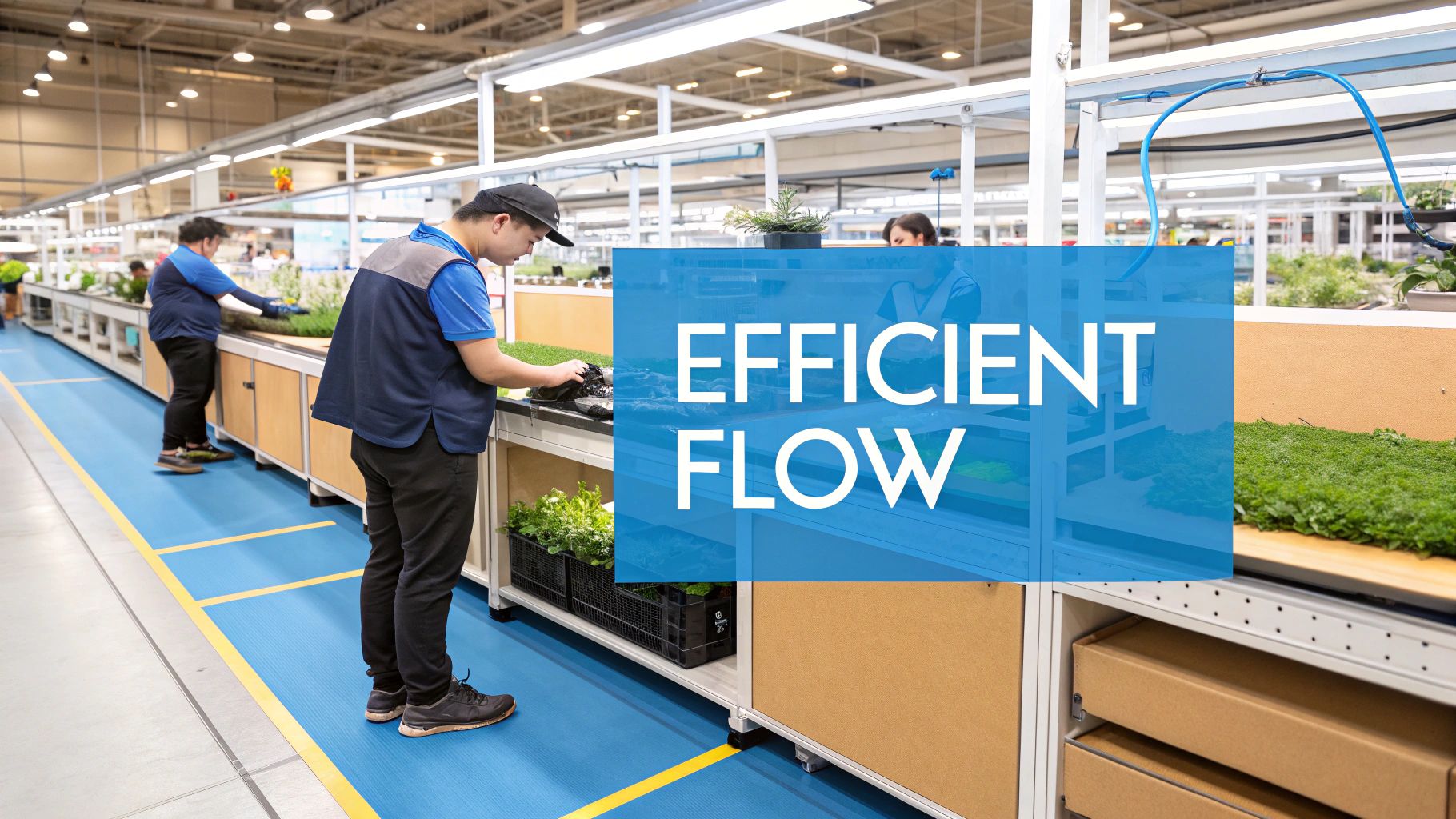
Before you even think about complex software or fancy robotics, the biggest wins often come from shoring up your operational basics. Efficiency isn't just about speed; it's about being smart with your movements and resources. That means taking a hard, honest look at the fundamentals—from how your plant is physically laid out to the core philosophies driving your team.
Think of it this way: a powerful engine is useless in a car with misaligned wheels. The same logic applies here. Dropping a state-of-the-art automation system into a chaotic workflow is a recipe for disappointment and a poor return on investment. If you first focus on getting the core pillars right, you create a stable, streamlined environment where every future investment can actually deliver.
Optimizing Your Physical Workspace
The layout of your shop floor is so much more than just where the machines sit—it directly dictates your productivity. A clunky layout creates needless movement, opens the door to safety hazards, and causes small, hidden delays that bleed you dry over time. Every extra step a team member takes to find a tool or haul a part is a tiny, but very real, loss.
I once worked with a cabinet shop that completely changed its game by rearranging its main workstations—the panel saw, edge bander, and CNC router—into a simple U-shape. This one move drastically cut the distance materials had to travel, which meant less handling time and less fatigue for the operators. It's often that simple. Even just making sure the right tools and parts are within arm's reach at each station eliminates all that time wasted searching.
Establishing Core Efficiency Principles
A solid foundation needs a clear set of guiding principles. These aren't just buzzwords to put on a poster; they are the philosophies that get your entire team pulling in the same direction. From what I’ve seen, manufacturers who achieve sustainable growth focus on three key areas:
- Lean Thinking: The big idea here is to ruthlessly identify and eliminate waste in all its forms—whether it's overproduction, bloated inventory, unnecessary motion, or defects. It's all about creating more value for your customers with fewer resources.
- Smart Technology: This is about strategically bringing in tools that automate the tedious stuff, give you real-time data, and connect processes that used to be siloed. It’s never about tech for tech's sake; it’s about solving specific production bottlenecks.
- An Empowered Team: The people on your floor have incredible insights. Giving them the training, tools, and a voice to flag problems and suggest improvements builds a culture where everyone owns the process. That's how you get continuous improvement to stick.
A common mistake I see is treating these pillars as separate projects. The reality is they're completely interconnected. An empowered workforce is the best engine for implementing lean principles, and the right technology gives them the data they need to make smart, lean decisions.
Before diving deeper into specific strategies, it's worth taking a moment to internalize these foundational concepts. They are the bedrock of any successful efficiency initiative.
| Pillar | Core Principle | Primary Goal |
|---|---|---|
| Lean Thinking | Eliminate anything that doesn't add value for the customer. | Reduce waste, shorten lead times, and lower costs. |
| Smart Technology | Use automation and data to solve specific problems. | Increase output, improve quality, and provide visibility. |
| An Empowered Team | Treat employees as experts in their own processes. | Foster a culture of continuous improvement and ownership. |
Getting this foundation right sets you up for everything that follows. With it in place, your processes are clearer, waste is easier to spot, and any new tool you bring in has a well-defined purpose. For businesses in woodworking and custom manufacturing, this might mean looking into platforms that tie sales, production, and ERP together. You can review TimberCloud pricing to see how an all-in-one system can support this foundational approach.
Getting Serious About Lean and Waging War on Waste
Lean manufacturing gets thrown around a lot, but it's not just another buzzword. At its core, it’s a straightforward mission: hunt down and eliminate anything in your process that doesn’t add real value for your customer. Improving shop floor efficiency isn't about pushing people to work harder; it’s about working smarter by relentlessly cutting out the fat.
This means you have to put every single step under the microscope—from the moment raw materials hit your dock to the second a finished product is loaded onto a truck. The goal is to make every action purposeful. When you achieve that, productivity naturally climbs and costs drop.
Learning to Spot the 8 Wastes
To win the war on waste, you first have to know your enemy. Lean thinking identifies eight distinct types of waste, easily remembered with the acronym DOWNTIME. One of the best things you can do is a "waste walk." Literally, grab a notepad, walk the floor, and start looking for them. You'll be surprised what you find.
- Defects: The most obvious waste. Anything that needs to be scrapped or reworked costs you time and money.
- Overproduction: Making more than you need right now. This just burns cash, eats up space, and creates inventory that might never even sell.
- Waiting: Idle time is a killer. It could be an operator waiting for a machine, a machine waiting for parts, or an entire line waiting on a previous step.
- Non-Utilized Talent: This one is huge. It's failing to tap into the knowledge and creativity of the people actually doing the work. They know where the problems are.
- Transportation: Moving materials and products around more than absolutely necessary. Every move is a risk and adds zero value.
- Inventory: Holding excess raw materials, work-in-progress (WIP), or finished goods. Too much inventory often hides other problems, like production imbalances.
- Motion: Wasted movement by your team. Think about an operator constantly walking back and forth to grab a tool or reaching awkwardly for parts.
- Extra-Processing: Doing more work on a part than the customer requires. Polishing a surface that will never be seen is a classic example.
Once you train your eyes to see these wastes, you'll start seeing them everywhere. They are the silent killers of your profit margin.
Practical Lean Tools That Actually Work
Spotting waste is one thing; getting rid of it requires a plan. You don't need to overcomplicate it. Three of the most powerful and practical lean tools for any shop floor are 5S, Value Stream Mapping, and Kaizen.
The 5S System: A Place for Everything
The 5S system is the foundation for a truly efficient workspace. It’s a simple methodology for creating and maintaining an organized, clean, and safe environment, but its impact is massive.
I once worked with a mid-sized furniture maker whose assembly area was a mess—tools were all over the place, and components were in unmarked bins. By implementing 5S, they created a designated, labeled home for every single item. The result? They slashed the time assemblers spent just looking for things by over 60%. Their daily output went up immediately, with no new equipment needed.
The real magic of 5S isn't the initial cleanup. It's about building a system where anything out of place—a missing tool, a component in the wrong bin—sticks out like a sore thumb to everyone on the floor.
Value Stream Mapping: Seeing the Whole Picture
Value Stream Mapping (VSM) is like drawing a detailed map of your entire production journey. You visually chart every single step, from raw material to finished product, and label each one as either "value-added" or "non-value-added." This is almost always an eye-opening exercise. It brutally exposes just how much time is lost to non-value-added activities like waiting, moving things around, and redundant inspections.
This map becomes your strategic guide, showing you exactly where to focus your improvement efforts for the biggest bang for your buck.
Kaizen: Making Small Wins a Daily Habit
Finally, Kaizen, or continuous improvement, is the cultural glue that makes lean stick for the long haul. It’s built on the idea that a thousand small, incremental improvements over time create a massive competitive advantage. This isn't about launching huge, disruptive projects. It’s about empowering every single employee to spot and solve small problems in their own work area, every single day.
When your team takes ownership of their processes, they become your most powerful asset in the drive for efficiency. A real Kaizen culture means you encourage suggestions, celebrate the small victories, and make problem-solving a collaborative, daily habit, not a top-down mandate.
Using Smart Technology for a Connected Factory
If you've already optimized your layout and started applying lean principles, you've built a solid foundation. But to really compete, you need to add smart technology into the mix. This is where you get a real jump in efficiency.
The idea of a "smart factory" isn't about robots taking over. It's about giving your people better tools and real-time data so they can make smarter decisions, faster. When the Internet of Things (IoT), artificial intelligence (AI), and automation work together, your entire shop floor becomes a connected, responsive system. You stop reacting to problems after they happen and start preventing them before they even start.
Building Your Data Foundation with IoT
The first move toward a smarter factory is gathering good data. The best way to do that is with the Internet of Things (IoT). It’s simpler than it sounds—you place small, affordable sensors on your most important machines and equipment.
Think of these sensors as your eyes and ears, working 24/7. They track everything from vibration and temperature to how much energy a machine is using. This constant flow of information is a game-changer. For example, a sensor might detect a tiny, unusual vibration in a CNC machine. It’s too subtle for a human to notice, but it’s often the first sign of a coming breakdown. You get an alert, schedule maintenance, and fix the issue before it causes a major shutdown. That's predictive maintenance in action, a strategy that can slash equipment downtime by as much as 50%.
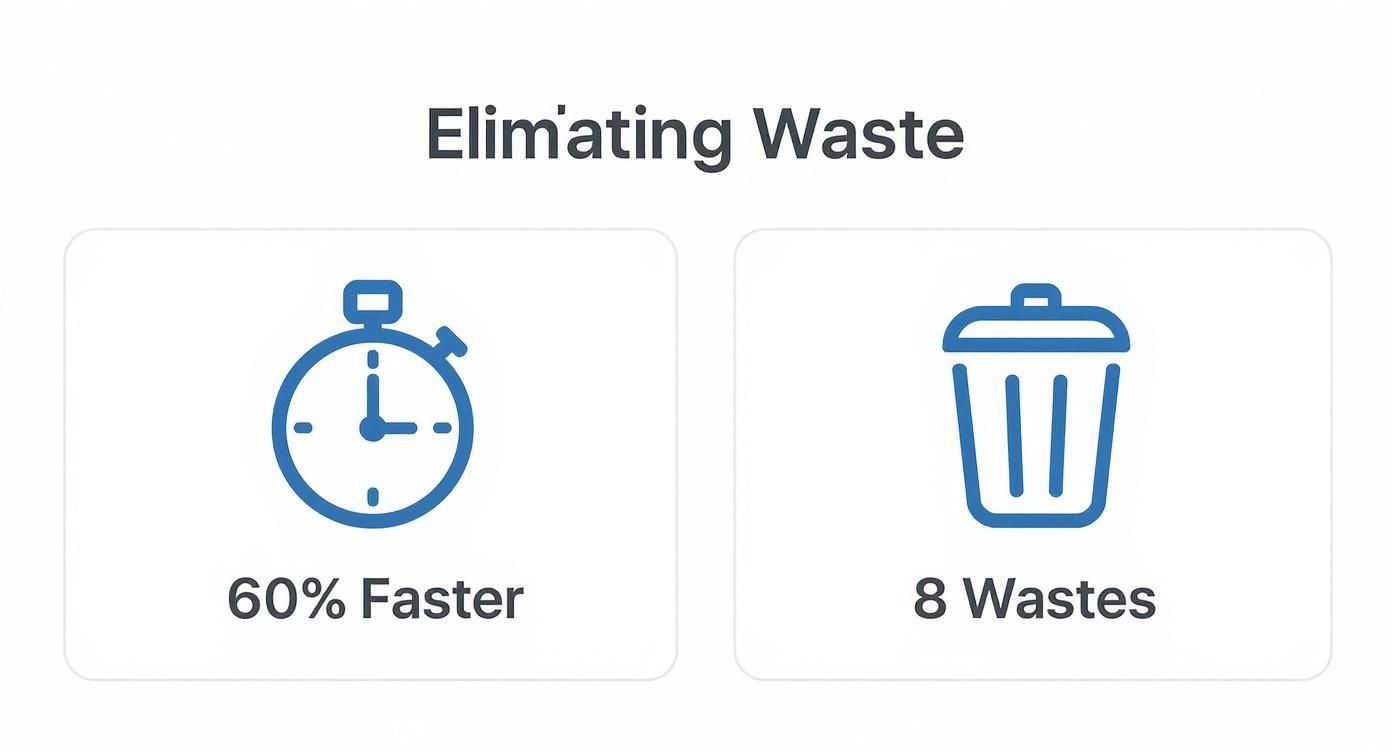
As you can see, the benefits are two-fold: you speed up production while also cutting out the inefficiencies that chip away at your profits.
Turning Data into Action with AI and Automation
Collecting data is just the start. The real magic happens when you use that data to make intelligent decisions—and that's where AI and automation step in. AI algorithms are brilliant at finding patterns in huge datasets that a person would never see.
Let's say an AI system analyzes sensor data from your production line and compares it to your quality control reports. It might find that a tiny dip in humidity at one station consistently leads to more defects two stages down the line. By flagging that connection, the system lets you adjust the environment before it becomes a problem, potentially cutting your defect rates by up to 30%.
The whole point of AI in manufacturing isn't to run a factory with no people. It's to give your team superpowers—the ability to see what's coming and stop problems in their tracks.
Automation then acts on these insights. This could mean using robotic arms for repetitive, physically strenuous jobs, which frees up your skilled team members to focus on more complex work. It also applies to software. Modern manufacturing platforms like TimberCloud use AI to automate the entire workflow from initial plan to final production. Take a look at the full list of TimberCloud's features to see how it connects every department.
A Practical Digital Strategy for Your Shop Floor
Buying new technology without a plan isn't a strategy—it's just shopping. A real digital transformation is about making every tool you own, from your ERP to the sensors on your machines, talk to each other to hit your business goals. It’s what powers a modern, efficient factory, but you can’t just throw shiny new gadgets at the problem.
The sharpest manufacturers I've seen are building a cohesive digital roadmap. They aren't just buying isolated pieces of software; they're weaving everything together into a smart, connected system. This way, every dollar they spend on tech directly helps them cut waste, speed up production, and run a tighter ship.
Stop Reacting and Start Anticipating
The biggest shift here is mental. It's about getting out of the old "firefighting" mode—reacting to a machine breakdown or a quality issue—and moving to a place where you can see problems coming. This only works if you have good, clean data flowing from every corner of your operation.
Think about it this way: instead of finding a bottleneck only when work starts piling up, a connected system can flag that a machine’s cycle times are starting to lag. That’s your cue to reroute jobs or tweak the schedule before a small delay snowballs into a huge problem. You're using data to see around the corner.
The real game-changer is creating a 'single source of truth' for the entire business. When sales, engineering, and the shop floor are all looking at the same live data, miscommunications and costly mistakes just melt away.
It's this commitment to data-driven decisions, from the top down, that fuels real, proactive improvement.
Where to Put Your Money for the Best Returns
You can't buy everything at once, so a smart strategy means putting your budget where it will have the biggest and fastest impact. The trends are clear: cloud computing, generative AI, and better connectivity are delivering the best bang for the buck.
Manufacturers are catching on and putting more skin in the game. In 2025, they allocated 30% of their operating budgets to technology, a big jump from 23% the year before. This isn't just random spending; it's targeted. They're pouring money into tools that fix supply chain headaches, give them clearer data, and make them more agile. For a deeper look, you can see how manufacturers are boosting digital maturity to stay competitive.
The takeaway is simple: if you're serious about improving efficiency, strategically investing in the right digital tools is no longer optional.
Tying the Digital Workflow Together
A truly cohesive strategy links every single step, from a customer's first click to the final product going out the door. This is where unified platforms built for custom manufacturing, like TimberCloud, really shine. They're designed specifically to tear down the walls that have always separated different departments.
Here’s what that looks like in the real world:
- Sales & Quoting: A customer designs a custom cabinet on your website using a product configurator. The system instantly generates a rock-solid quote based on live material costs and labor data. No more guesswork.
- Engineering & Production: As soon as the order is placed, AI tools analyze the design and automatically spit out production-ready cut sheets and work orders. This gets rid of the manual data entry that’s a classic source of errors.
- Shop Floor Execution: The team on the floor pulls up the work order on a tablet, tracks their progress, and logs every piece of material they use. Suddenly, your inventory levels are always accurate and synced across the whole company.
This seamless flow of information gets everyone on the same page, cutting out the friction that kills productivity and eats into your profits. It turns a clunky, disconnected process into a single, smooth, and intelligent workflow.
Empowering Your Workforce for Peak Performance

You can have the most advanced tech on the planet, but it's only half of the efficiency equation. The other, more critical half? Your people. All the automation and smart software in the world are just expensive tools without an engaged, skilled, and empowered team driving them.
Investing in your team isn't a "soft skill"—it’s a hard-nosed business strategy. When your crew understands the 'why' behind a new process and feels equipped to handle it, they stop being passive operators and become active problem-solvers. That's when you start seeing small, daily improvements compound into massive gains.
Bridge the Skills Gap Before It Becomes a Chasm
The manufacturing skills gap is a real and persistent challenge, and it only gets wider as technology leaps forward. You can't just drop a new system on the floor and expect your team to figure it out. You need a proactive training plan that bridges the gap between where your workforce is today and where your business needs to be tomorrow.
Good training goes beyond just showing someone which buttons to press. It's about helping your team work alongside new technology, understanding how their role fits into the bigger picture.
- Practical Upskilling: Get hands-on. Train your team not just on how to run new machinery or software, but also on basic troubleshooting. This empowers them to fix minor issues on the spot instead of waiting for a technician.
- Lean Thinking: Teach everyone on the floor the principles of lean manufacturing, especially how to spot the 8 Wastes (DOWNTIME). When your team knows what defects, overproduction, or waiting looks like in their specific work area, they become your first line of defense against inefficiency.
- Data Fluency: As you collect more shop floor data, you need to make it mean something to the people doing the work. A simple dashboard showing real-time OEE (Overall Equipment Effectiveness) can give an operator the insight they need to make a small adjustment that boosts output for the rest of their shift.
Training isn't a one-and-done event. It's a continuous loop. As your technology and processes evolve, your team's skills have to evolve right along with them.
Cultivate a Culture of Ownership
An empowered team is a team that feels a sense of ownership. When every employee is encouraged to speak up and contribute ideas, you tap into a goldmine of process improvements. But this doesn't happen by accident—it has to be built into your culture.
Simple habits can make a huge difference here. Start a quick daily huddle to discuss yesterday's roadblocks. Create a straightforward system for submitting improvement suggestions, and—this is key—publicly recognize and reward the good ones. It sends a clear message: we trust your expertise and value your input.
The Bigger Picture: Your Workforce in a Global Context
These workforce dynamics are playing out on a global scale. Even as demand soars, the manufacturing sector is still grappling with a skills shortage projected through 2025.
Look at India, where the manufacturing PMI hit a 17.5-year high in mid-2025, driven by a hiring surge to meet global and domestic demand. This highlights just how critical effective labor management is. Different regions play to different strengths, from the high-tech precision of Japan to the large, cost-effective labor pools in Mexico. Integrating AI and automation is a direct response to this skills gap, freeing up human workers to focus on higher-value, more complex tasks. You can read more about these global workforce trends to see how it all connects.
In the end, your people will make or break any efficiency initiative you launch. Give them the right skills, clear communication, and a real sense of purpose, and you'll build a resilient team that’s ready for anything. That investment is the surest way to build a truly competitive operation for the long haul.
Answering Your Top Efficiency Questions
Even the best-laid plans hit a few bumps on the road. When you start making changes on the shop floor, questions are going to pop up. Let's tackle some of the most common hurdles managers and engineers face when they start trying to boost manufacturing efficiency. The goal here is to give you practical answers for those real-world challenges.
Where Should I Start Improving on a Tight Budget?
You don't need to find a ton of cash to make a real difference. If your budget is tight, the best place to start is with low-cost, high-impact lean principles. Honestly, your most powerful tool is observation, and that’s completely free.
Get out on the floor and do a "waste walk." This isn't just a casual stroll; you're actively hunting for the eight wastes—things like unnecessary movement, waiting times, excess inventory, and defects. This costs you nothing but time, and it will shine a spotlight on your biggest opportunities for a quick win.
Another fantastic, budget-friendly strategy is the 5S methodology. It's a simple system for creating a clean, organized, and efficient workspace.
- Sort: Go through a workstation and get rid of anything that isn't absolutely essential for the job at hand.
- Set in Order: Give every remaining tool and part a specific, logical home.
- Shine: Clean the area and equipment. You'd be surprised how often this uncovers hidden maintenance issues.
- Standardize: Create simple, visual rules so everyone knows how to keep the area organized.
- Sustain: Make it a habit. This is about building the discipline to keep the system going.
This approach gives you immediate workflow improvements by cutting down on the time people waste looking for tools or materials, all without needing a major capital investment.
How Do I Measure the ROI of Smart Technology?
You absolutely have to know where you're starting from. If you want to accurately measure the return on investment (ROI) for any new technology, you need a crystal-clear "before" picture. You can't prove you've improved if you don't have a baseline.
Before you roll out anything new, establish clear metrics for your most important Key Performance Indicators (KPIs). Focus on the numbers that directly impact your bottom line.
The most effective KPIs for this are usually Overall Equipment Effectiveness (OEE), which rolls availability, performance, and quality into one number, along with defect rates and machine downtime. These give you a hard-data snapshot of your starting point.
Once the new tech has been running for a while, compare the new KPIs to your original baseline. But remember, the ROI isn't just about saving money on downtime or defects. You also have to factor in the revenue gains from pushing more products out the door and being able to take on more work. That’s how you get a complete picture of the technology's true financial impact.
How Can I Get My Team Onboard with New Processes?
Look, people are naturally resistant to change. That means managing that change effectively isn't optional—it's essential. If you want your team to actually embrace a new process, you have to bring them into the fold right from the very beginning.
Start by clearly explaining the "why." You need to show them how this new system or process will make their specific jobs easier, safer, or more valuable. Is it going to eliminate that one frustrating task they all hate? Will it reduce the physical strain of their work? Frame it in terms of what's in it for them, not just what's in it for the company.
The single most powerful thing you can do is involve them in the planning and rollout. Ask for their feedback on a new workstation layout. Let them be the first to test a new piece of software. This simple step turns them from people being told what to do into active participants who have a stake in its success. For more tips on getting your team engaged and other efficiency strategies, you can find a lot of great resources on the TimberCloud blog.
Finally, provide great training and be patient. It takes time. Celebrate the small wins as you go to build momentum and show everyone that the new way is actually working. When your team sees their own coworkers succeeding with a new process, they’ll get on board much faster.
At TimberCloud, we build tools that connect your entire operation, turning complex challenges into simple, efficient workflows. Ready to see how a unified platform can transform your manufacturing business? Explore TimberCloud today.
Topics
TimberCloud Team
Content Team
The TimberCloud team is dedicated to helping manufacturers streamline their operations with intelligent software solutions.