How Do You Calculate Takt Time A Practical Guide

To figure out your takt time, the formula is refreshingly simple: you just divide your Net Available Production Time by your Customer Demand over that same period. The result is your production heartbeat—the maximum time you can spend on each unit to perfectly match what your customers are asking for.
Looking Beyond the Takt Time Formula
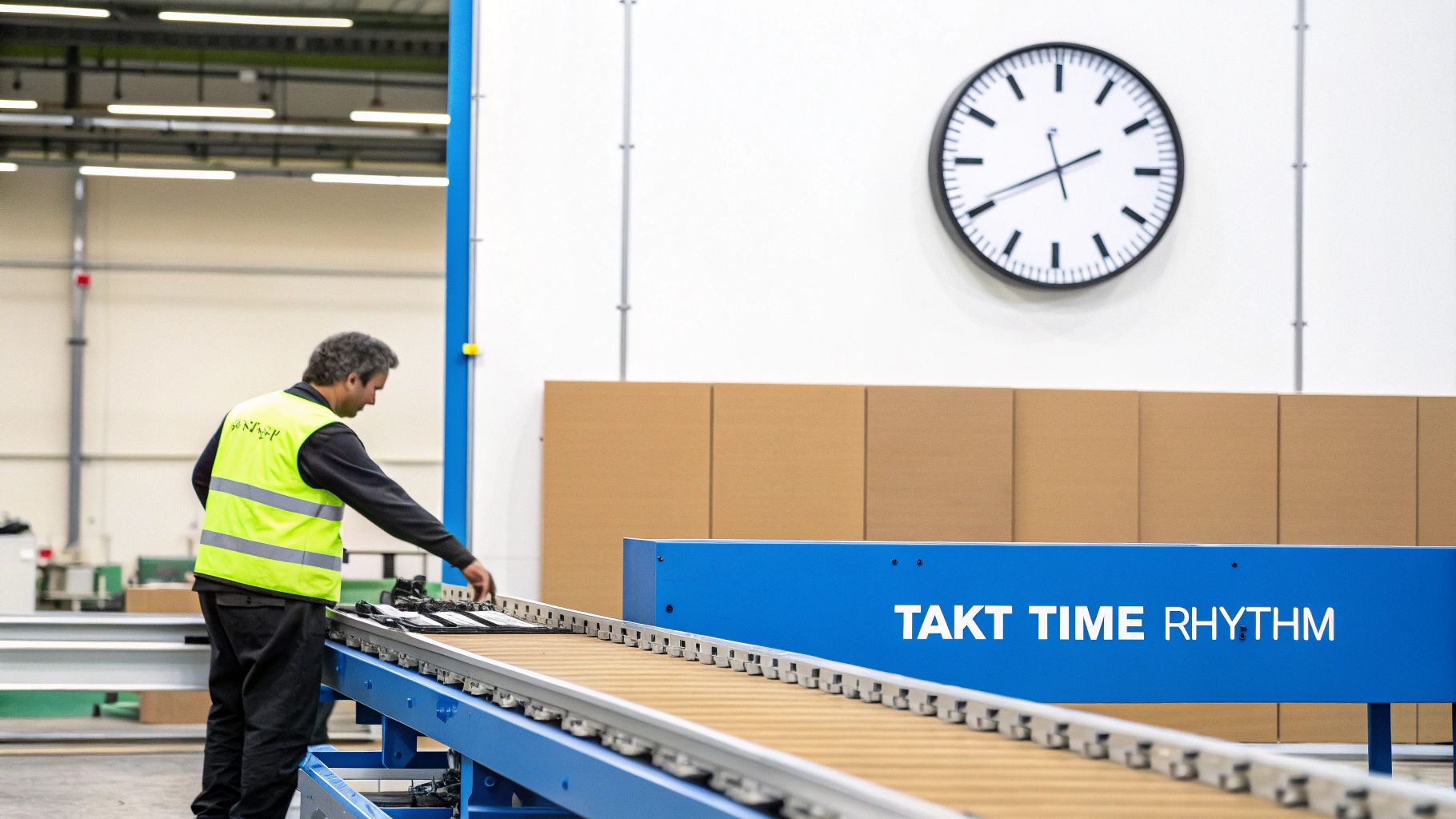
Before you grab a calculator, it’s crucial to really get what takt time is all about. This isn't just another production metric to track on a spreadsheet; it's the rhythm of your customer demand translated directly to your shop floor. Think of it as a metronome, setting a steady, required pace to build exactly what's needed, right when it's needed. This helps you dodge the costly headaches of both overproduction and stockouts.
The idea actually got its start with German aircraft manufacturers back in the 1930s and was later perfected by Toyota as a cornerstone of their production system. Its adoption has been massive. By the early 2000s, studies found that over 60% of manufacturing firms in North America and Europe were using it in some form. A 2005 survey, for example, revealed that 68% of automotive manufacturers used takt time to sync their assembly lines, leading to an average 22% reduction in overproduction.
To really see how it fits into the bigger picture of efficiency, it’s helpful to understand its role in methodologies like Lean Six Sigma principles in manufacturing. Getting this concept right is the first and most important step.
Takt Time vs. Cycle Time vs. Lead Time
On the shop floor, a few terms get thrown around that sound similar but mean very different things. Confusing them can lead to some real operational missteps. Let's clear up the big three.
| Metric | What It Measures | Primary Goal |
|---|---|---|
| Takt Time | The pace required to meet customer demand. | Match the rate of production to the rate of sales. |
| Cycle Time | The actual time it takes to complete one unit. | Measure and improve the efficiency of a specific process. |
| Lead Time | The total time from customer order to delivery. | Measure the overall customer experience and supply chain speed. |
Getting these definitions straight is non-negotiable for anyone serious about operational excellence. Each metric provides a unique lens through which to view your performance.
Takt time is essentially the voice of the customer translated into a production schedule. While cycle time shows your current capability, takt time shows your obligation. The real magic happens when you align the two.
Calculating Your Net Available Production Time

The first piece of the puzzle is figuring out your Net Available Production Time. This isn't just the length of a shift; it's the actual, hands-on time your team has to get work done. I've seen it time and again—getting this number wrong is the fastest way to make your entire takt time calculation useless.
To get it right, you start with the total shift time and then subtract every planned, non-productive activity. We're not just talking about the lunch break. You have to account for all the little things that eat into the workday but don't directly produce parts for a customer.
Ignoring these pauses paints a rosy but completely false picture of your shop's capacity.
Pinpointing Your Non-Productive Time
To get a number you can actually trust, you need to be honest about all the planned stops in a typical day. A great first step is to simply walk the floor and list everything that regularly pulls people away from production.
Think about all the time you need to deduct. This usually includes:
- Scheduled Breaks: Both the unpaid lunch hour and any paid 15-minute breaks.
- Team Meetings: Don't forget those daily huddles, safety briefings, or shift hand-offs.
- Routine Maintenance: Things like blade changes, equipment tune-ups, or scheduled cleaning cycles.
- Setup and Cleanup: The time spent at the start of the day getting ready and at the end of the day tidying up.
Let’s look at a real-world example. Imagine a woodworking shop that runs a single eight-hour (480-minute) shift. That's the gross time, but it's not what's actually available.
In reality, the team has:
- One 30-minute unpaid lunch.
- Two 15-minute paid coffee breaks.
- A 10-minute huddle every morning.
- A 10-minute cleanup period at the end of the shift.
When you add up all those planned stops (30 + 15 + 15 + 10 + 10), you get a total of 80 minutes of non-productive time. Subtracting that from the full shift gives you the real number you can use for your takt time calculation.
This simple bit of math takes a vague 480-minute shift and turns it into a much more realistic 400 minutes of net available production time. This number is the bedrock of an accurate and genuinely helpful takt time.
Alright, you've got your available production time figured out. Now for the other side of the coin: customer demand.
This is where you need to be brutally honest with yourself. We're not talking about sales forecasts or wishful thinking. For a truly useful takt time, you need a solid, data-backed number that reflects what your customers are actually buying from you. This number is the total quantity your team needs to produce within that specific timeframe.
Get this number wrong, and you're either scrambling to fill backorders or tripping over excess inventory. Both are expensive mistakes.
In a woodworking shop, this might be the 100 custom cabinet doors you have confirmed orders for this week. If you're running a software team, it could be the 12 user stories you've committed to delivering in your two-week sprint. The concept is the same no matter the industry: what's the specific output required?
Match Your Time Frames
Here’s a crucial point that trips people up: the time frame for your customer demand must mirror the one you used for your available production time. If you calculated your available time for an 8-hour shift, your demand figure must also be for that same 8-hour shift. No exceptions.
Common time frames people use are:
- Per Shift: Great for high-volume shops where hitting daily targets is everything.
- Per Day: A common standard for most manufacturers, helping to balance production across one or more shifts.
- Per Week: Often works best for shops with more product variation or longer, more complex builds.
Let's go back to our woodworking shop example. We know they have 400 minutes of real production time each day. If they have firm orders for 25 chairs that need to ship out daily, then their customer demand is 25. It's that simple.
A quick tip from experience: always lean on historical order data rather than speculative sales goals. Base your calculation on what you've actually sold, not what you hope to sell. This keeps your takt time grounded in reality and makes it a far more reliable planning tool.
Putting It All Together with Real-World Scenarios
The theory behind takt time is great, but the real "aha!" moment comes when you plug in your own numbers and see it in action. Let's walk through a couple of practical examples to show you just how this works on the ground, both in a traditional manufacturing setting and a service environment.
Scenario 1: A Custom Furniture Workshop
Picture a custom woodworking shop that builds high-end chairs. After accounting for breaks and meetings, they've figured out their Net Available Production Time is 400 minutes per day. Looking at their order book, they see they need to ship 25 chairs each day to stay on schedule.
The calculation here is pretty direct:
- Takt Time Formula: Net Available Production Time ÷ Customer Demand
- Calculation: 400 minutes / 25 chairs = 16 minutes per chair
What does this tell them? It means to meet their commitments without falling behind, a finished chair needs to come off the line every 16 minutes. This single number becomes the heartbeat of the shop floor. Every process, from cutting to finishing, now has a clear rhythm to follow.
Scenario 2: A Busy Coffee Shop
Takt time isn't just for making things—it's incredibly useful for service businesses, too. Let's take a busy coffee shop during its morning rush, from 7 AM to 9 AM. That's a 120-minute window where they get slammed.
During that peak period, they average 160 customer orders. We also have to account for a quick 10-minute restocking break for the baristas.
First, let's nail down the actual working time:
- Net Available Time: 120 minutes - 10-minute break = 110 minutes
Now, we can find the takt time for the morning rush:
- Takt Time Calculation: 110 minutes ÷ 160 orders = 0.6875 minutes per order
- Converting to Seconds: 0.6875 x 60 = 41.25 seconds per order
To keep the line moving and customers happy, the team needs to complete an entire order—from taking payment to handing over the drink—every 41.25 seconds. This is a powerful insight. It might lead the manager to redesign the counter layout, add another staff member during peak hours, or pre-grind beans to shave off precious seconds and hit that target.
You can see how this simple calculation helps turn a fuzzy goal like "be faster" into a concrete, measurable target. It's a concept that scales up dramatically, too. Automotive plants run their entire operations on this principle, calculating takt time down to the second to coordinate thousands of moving parts.
This visual breaks down how customer orders within a specific timeframe directly translate into your quantifiable demand number.
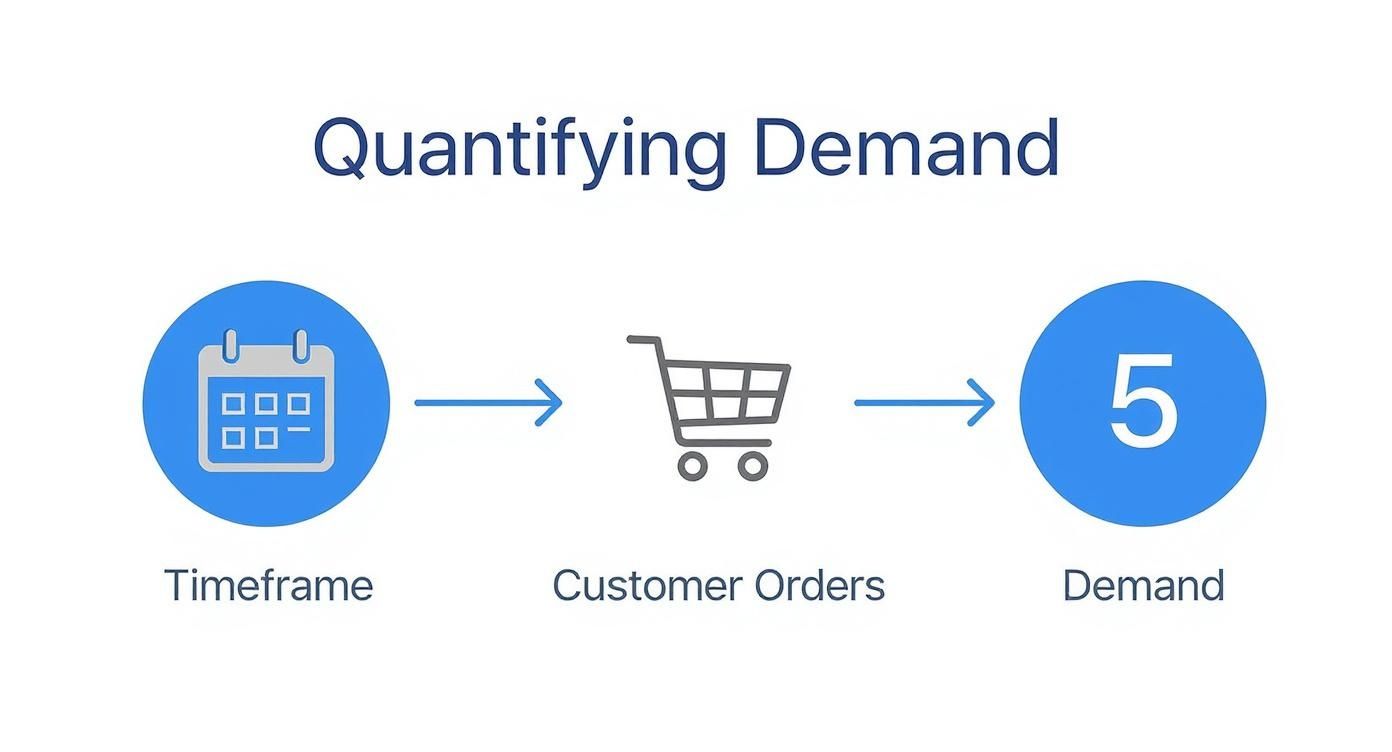
Ultimately, calculating takt time grounds your production targets in the reality of what your customers are actually asking for. If you're looking for more ways to improve your shop's efficiency, you can find more operational tips on the TimberCloud blog.
Where Takt Time Calculations Go Wrong
Getting your takt time calculation right is crucial. A good number can synchronize your entire shop floor, but a bad one can throw everything into chaos. I’ve seen it happen time and again: teams miss the mark because they stumble over a few common, easily avoidable mistakes. Let's walk through them so you don't make the same errors.
One of the biggest mix-ups is confusing takt time with cycle time. They’re often used interchangeably, but they measure completely different things. Think of it this way: takt time is the pace you must hit to satisfy your customer. It’s the goal. Cycle time is your current reality—how long it actually takes you to make one part. If your cycle time is higher than your takt time, you’ve just found a bottleneck.
Forgetting the "Hidden" Downtime
Another classic mistake is being overly optimistic about your available production time. Everyone remembers to subtract the hour-long lunch break, but what about all the other little moments that chip away at the clock?
- Short Breaks: Those two 15-minute coffee breaks? That's 30 minutes of production you don't have.
- Daily Meetings: The 10-minute morning huddle to discuss safety or the day's plan needs to come out of the total.
- Cleanup and Setup: Time spent prepping machines at the start of a shift or cleaning up at the end isn't time spent making parts.
If you ignore these small but consistent interruptions, you’ll end up with a takt time that’s impossibly fast. It sets your team up to fail, leaving them scrambling to hit a target that was never realistic to begin with.
Be brutally honest when you calculate your Net Available Production Time. A number grounded in reality is infinitely more valuable than an optimistic one that's impossible to achieve.
Using Forecasts Instead of Firm Orders
The last pitfall is basing your customer demand on sales forecasts instead of actual, confirmed orders. Forecasts have their place in long-term strategic planning, but for setting the daily pulse of your shop floor, you need to work with what's real right now.
Let's say your sales team has a goal to sell 50 units, but you only have firm purchase orders for 35. If you produce 50, you’re just building expensive inventory that sits on a shelf. Tying up cash in unsold goods is a recipe for trouble.
Stick to the hard numbers from your order book. This keeps your production rhythm perfectly in step with what customers are actually buying today, not what you hope they'll want next month. Sidestepping these mistakes is the key to setting an operational pace that truly works.
Putting Takt Time to Work on Your Production Floor

Running the numbers is one thing, but making takt time a real part of your daily operations is where the magic happens. You want this number to be the pulse of your production line, something everyone on the team can see and feel.
A simple and powerful way to do this is by getting the takt time out in the open. Use large digital screens or even basic pace clocks at each workstation. When everyone knows the target pace, they’re all pulling in the same direction.
With the pace clearly visible, takt time becomes your best diagnostic tool. It shines a spotlight on bottlenecks—any process that consistently takes longer than your takt time. This is your cue to dig in. Do you need to rebalance the workload? Should you assign an extra person to a struggling station? To keep things on track, you'll need effective process control systems to help monitor and fine-tune your operations.
Let Technology Keep the Beat
Manually tracking everything is a chore. Modern production management tools can automate this entire process, giving you a live look at what’s happening on the floor.
Platforms like TimberCloud can monitor your progress in real-time and even send alerts the moment a station falls behind schedule. This means you can step in and fix a small problem before it becomes a major delay. Integrating systems with advanced production management features helps your team stay locked in with customer demand, no matter how much it changes.
Did You Know? Takt time isn’t just for manufacturing. A 2012 study showed that hospitals using takt time to manage patient flow cut wait times by 35% and boosted staff efficiency by 22%.
Ultimately, this is about transforming takt time from a static number on a spreadsheet into a dynamic guide for your entire operation. It directly connects every team member's effort to what the customer actually needs, creating a far more responsive and efficient shop floor.
Tackling Common Takt Time Questions
Once you get the hang of the basic formula, the real-world questions start popping up. It's one thing to calculate a number, but it's another to know what to do with it on a busy shop floor.
So, what happens when your process—your actual cycle time—is slower than your takt time? This is actually a great discovery. That gap is a massive flashing sign pointing directly at your biggest bottleneck. It tells you exactly which process needs attention, whether that means rebalancing the workload, improving the workflow, or dedicating more resources to it.
Another question I hear all the time is, "How often should we be doing this?" Takt time isn't a "set it and forget it" number. For it to be a useful guide, it has to reflect what's actually happening right now.
As a rule of thumb, recalculate your takt time whenever there's a real shift in customer demand or your available production time. For some shops, that might mean a weekly adjustment. For others dealing with high-mix, low-volume work, it might even be a daily huddle topic.
Is This Just for Manufacturing?
Not at all. While takt time was born on the Toyota production line, the core idea of matching your work pace to customer demand is incredibly flexible. Think about it: a healthcare clinic needs to manage patient appointments to avoid long waits, and a software team has to pace its work to fix bugs and release features on schedule.
The principle is the same no matter the industry: align your operational rhythm with what your customers are asking for.
If you're trying to figure out how to apply this to your own unique setup, don't hesitate to get in touch with our team for some practical advice. Our experts have seen it all and can help you make these concepts work for your shop.
At TimberCloud, we build tools that take the complexity out of production management. See how our platform can help you automate these calculations and keep your team perfectly in sync with customer demand at https://timbercloud.com.
Topics
TimberCloud Team
Content Team
The TimberCloud team is dedicated to helping manufacturers streamline their operations with intelligent software solutions.